
Saturday 11th July 2026
Blog Page 333

Northern Ireland’s three-way split

0

For the first time since the foundation of Northern Ireland, a nationalist/republican party with the expressed aim of a united Ireland is the largest party in Stormont, the Northern Irish parliament. Sinn Fein received the most first preference votes, the largest vote share, and the most seats in the 5th May election, returning 27 Members of the Legislative Assembly (MLAs) out of the 90 positions up for grabs. As part of the 1998 Good Friday Agreement, power-sharing between representative parties of the two ethno-nationalist communities in Northern Ireland is a prerequisite for a devolved administration. So, if the two largest parties following the election – nationalist/republican Sinn Fein and the unionist/loyalist Democratic Unionist Party (DUP) -manage to strike a deal and form a power-sharing executive, Sinn Fein’s Michelle O’Neil will become First Minister. This would be a monumental milestone in the history of Northern Ireland, which has had a unionist Premier since the country’s establishment in 1921. 

The cross-community Alliance Party was the other big winner of the election. Despite a marginal decrease in vote-share, Alliance increased its returned MLA count by nine – the largest increase of any party in the election. The Social Democratic Unionist Party (SDLP) and the Ulster Unionist Party (UUP) both lost seats (four and one, respectively) and vote share. The Green Party has been completely wiped out, losing their only two MLAs in the Assembly. But it is the DUP who has been the most impacted. The DUP remains the largest unionist party in Stormont with 25 seats, but it lost 6.5% of the vote share and three seats The resulting electoral landscape in Northern Ireland is complex, with patterns going beyond the traditional divide of ‘orange’ and ‘green’ – shorthand for the politics of unionism and nationalism respectively. Broadly, three distinct patterns can be seen: the holding of the Sinn Fein vote, intra-unionist competition, and what looks to be the establishment of a non-aligned third force in Northern Irish politics. 

On the latter, the rise of Alliance, largely at the expense of the SDLP and the UUP, conforms to trends existing since 2006 in Northern Ireland, with an increasing number of people identifying with neither party. Last year, the politics Professor Emeritus Professor John Coakley (University College Dublin and QUB), noted that “a new middle ground is indeed slowly emerging in Northern Ireland”, where changing domestic priorities and increased immigration will produce dynamics in which lower-preference votes are given to parties of the centre (Coakley, 2020: 47). The 5th May election results appear to reflect this. Polling revealed consistent big issues for voters were healthcare and the rising cost of living, not border polls or the Northern Ireland Protocol (which governs customs and immigration issues at the Irish / Northern Irish border post-Brexit). 

As Alliance rises, the UUP and the SDLP, formerly the two largest parties and governmental partners between the establishment of devolution in 1998 and 2002, have continued their downward trajectory. The future looks bleak for these two. Despite the UUP’s attempt to burnish its progressive liberal image under a new leader Doug Beattie, the hoped ‘Beattie Bounce’ fell noticeably short, and the SDLP also faces a painful post-electoral reckoning. It seems unclear where these parties can position themselves. On national issues both parties have been long outbid by the DUP and Sinn Fein respectively, and on middle-ground issues such as health and social care, the economy, and integrated education, the parties look to have been overtaken by Alliance. If the UUP and the SDLP want to stay relevant in Northern Ireland, they must find a way of navigating these two forces.

Sinn Fein has done a much better job at retaining vote-share and seats than its longstanding partner in government. The lack of significant intra-nationalist electoral competition along the lines of the intra-unionist fallout that the DUP has faced in regards to the Northern Ireland Protocol helps explain why the DUP has been knocked into second place. Sinn Fein have become the largest party despite only a modest increase in its vote share (1.1%), and no gained seats. They have also played a tactical game by focusing primarily on social issues this election, such as the cost of living and healthcare investment, and largely avoiding overt messaging that a vote for the party was a vote for Irish unity. They didn’t have to, since the campaign for Irish unity  is obviously the foundational tenet of an organisation that was set up as the political wing of the Provisional IRA (PIRA),and with no intra-nationalist challenger, this left campaigning space and energy for messaging on social issues. Additionally, Sinn Fein has done a good job of keeping its traditional working class voting bases with the party while developing beyond this. Throughout and after the Northern Irish Conflict known as ‘the Troubles’, Sinn Fein developed community structures within republican areas. Many of these community centres are still functioning, and Sinn Fein maintains a strong presence within its traditional heartlands in working class nationalist communities while additionally increasing appeals to a generation born after 1998 and middle class voters. April 2022 polling data showed that Sinn Fein had a dominance of planned first-preference votes in the 18-24 demographic (38% compared to the SDLPs meger 2% in the same cohort), and among middle class, working class, and “other” voting blocks (27%, 29% and 23% respectively). This is not to say that there are no issues within creating this type of ‘big tent’ voting coalition. In certain areas of traditional support, notably areas of Derry, the party has suffered from allegations of ‘jobs for the boys’ and perceptions of the monopolisation of the community sector and peace-funding allocation. Independent councillors took five seats off Sinn Fein on Derry and Strabane District Council in 2019, including the former dissident-republican prisoner Garry Donnelly (who still retains his seat) in the Creggan area of the city, a republican stronghold. Sinn Fein is clearly aware of its vulnerability here, and removed the leadership of the local Sinn Fein Cumann (Irish for ‘branch’), including both its MLAs in 2021. Despite this, the collapse of the SDLP and Sinn Fein’s holding of the vote in Northern Ireland, and its spectacular growth in the Republic of Ireland where the party stands at 36% support – putting it on course to win the next election if this is accurate and voter support holds – puts the party in a very healthy position going forward. 

In comparison, the DUP placed the national question at the centre of its electoral messaginghighlighting the thorny issue of the Northern Ireland Protocol and the party’s position as the only blockade against a Sinn Fein victory. The largest challenge for the DUP now clearly lies to its right. Though the Traditional Unionist Voice (TUV) won’t be sending another MLA to join its leader, Jim Allister, in Stormont, the party can claim success in its increase in votes by five percentage points, having challenged the DUP in key battlegrounds like North Antrim and Strangford. It remains to be seen if the TUV will be able to capitalise on its gains from this election, but it has clearly had a huge spoiler effect (a product of vote-splitting) on the DUP, waging a consistent campaign on the Northern Ireland Protocol and eventually contributing to the DUP’s collapse of Stormont. It is unclear what the DUP can do to win back support lost chiefly to the TUV. Ideally, the party should focus on the needs of the communities it represents, for example by alleviating the cost of living crisis and increasing opportunities. This can only be achieved by re-entering Stormont as a constructive partner of government. However, it seems likely that in practice we will see a hardening of positions, not pragmatic politics.

On this point, it is unclear when the DUP will decide to re-enter Stormont, if at all. Failing to re-enter would in effect leave Northern Ireland ruled from Westminster. As the largest unionist party, the DUP is required to nominate a Deputy First Minister and agree a power-sharing executive with Sinn Fein. It is unclear how the party can do this, considering recent statements made by its leader Jeffery Donaldson over refusing to re-enter Stormont until the Northern Ireland Protocol is essentially removed, and the perverse but tempting electoral benefits which could emerge by hardening their position in the face of TUV pressure. Critics of Northern Ireland’s ethnic-tribune system note that the political structure produces what is known as ‘centrifugalism’, whereby parties are rewarded for hard-line appeals to one community to outbid others from within the same ethno-nationalist block. As the TUV’s vote share increase maps largely onto DUP loses, a continuing period of intra-unionist jockeying seems likely. 

Northern Ireland has had periods of power-sharing collapse and reversion to direct rule by Westminster twice since 1998. The longest collapse, from 2002-2007, occurred after the police service of Northern Ireland believed that they had discovered a PIRA spy ring in Stormont, which resulted in the arrest of three Sinn Fein members, though these charges were eventually dropped. The most recent collapse lasted from 2017 to 2020 and was caused by the ‘cash for ash’ green energy scandal tied to then DUP leader and First Minister Arlene Foster and the DUP’s refusal to agree to an Irish Language Act as a precondition for resuming Stormont. Northern Ireland will face serious problems if Stormont collapses again, most notably the lack of leadership and the inability to pass budgets. This comes at a time when the region – which includes some of the most deprived areas in the United Kingdom – faces a growing cost of living crisis. 

A collapse of Stormont would also likely be seized upon by republicans opposed to the GFA – so-called “dissidents” – for whom it would offer a clear way of discrediting the existing system of politics in Northern Ireland. It must be stressed that ‘physical force republicanism’ is small, fragmented, largely constrained to specific areas in Northern Ireland, and lacks the capability of the Provisional IRA. But Northern Ireland risks a perfect storm of growing deprivation combined with feelings of disenfranchisement among the nationalist/republican community. Groups which recruit in areas of low income and poor opportunity provision, and who utilise historical parallels to highlight continued repression and the supposed failure of the post-GFA state and the peace process, would likely benefit from another Stormont collapse. Loyalist paramilitarism would also likely be strengthened by this political vacuum for the same reasons. 

So where next for Northern Ireland? Despite Sinn Fein’s success, a referendum on Irish unification is unlikely to occur anytime soon, despite the party’s president Mary Lou McDonald now talking about holding a border poll within the next five years. Unionist parties across Stormont still hold a slim majority, and there remain plenty of obstacles in the way of Irish unity. However, this election demonstrates that the likelihood is certainly not decreasing, and Sinn Fein has demonstrated its hegemony in nationalist politics. The growth of Alliance, meanwhile, raises an interesting dilemma for how to accommodate non-aligned parties (and voters) into a political system developed to bridge intractable conflict between unionists and nationalists. 

Once again Northern Ireland is entering into a period of governmental uncertainty. There are challenges across the country which can only be solved by strong, cross-community,good-faith leadership. When Stormont resumed in 2020, roughly three years after the last collapse, it was spurred on in a large part by the death of the journalist Lyra Mckee, who was shot by a gunman of the New IRA in Derry following street disturbances. Parties should remember what can occur when a political vacuum is allowed to manifest and their obligations to govern in the coming days and weeks.

Image credit: Dom0803 / CC BY-SA 3.0 via Wikimedia Commons
The changing role of Christianity in British society

0

In 2018 a survey found that 70% of young Brits aged 16–29 had no religious affiliation. Yet the country as a whole remains firmly religious with the large majority (59% as of 2011) identifying Christian. It seems that we are at the pinnacle of a great social upheaval; Christianity remains firmly imprinted in the national psyche, even as it fades from its once prominent position. Understanding in which directions society will go as it breaks free from religion is of utmost importance to social planners, politicians, and all of us. Britain is entering the beginnings of a social experiment like no other. Atheism looks set to become the biggest group belief. And so, we need to find another way of living. Another way to ‘love thy neighbour’. Another way to find a purpose in life. This development is perhaps particularly surprising given the way that Christianity is so tightly integrated into many British institutions and much of British culture. 

My childhood is emblematic of the Christian-oriented upbringing that many in this country experience. I went to a Church of England primary school and was brought up with Christian values, forced to recite the Lord’s Prayer and sing hymns, regardless of what my true beliefs actually were, and regardless of the fact that my peer group encompassed a variety of faiths.  Quite how this is allowed in our supposedly secular state is baffling. The double standards with attitudes to Islamic schools is obvious, with much controversy and debate surrounding their presence, while many Christian schools continue with none of the sort. Christianity is presented as persisting in the performance of the national psyche, whether that be church bells ringing or Christmas festivities.

The celebration of Christian festivals, particularly Easter and Christmas, has become normalised in our multicultural society. A comparison with how the holidays of other religions are treated illustrates the point; for example, many people see Jews celebrating Hanukkah or Passover as a primarily religious activity, regardless of whether the Jews in question identify as religious or not.  By contrast, celebrating Christmas or Easter can be seen as totally secular just because of how much Christian traditions are normalised as part of British culture, and plenty of non-Christian or non-religious households feel comfortable decorating a Christmas tree, when it (probably rightly) would feel strange for them to light a chanukiah. For me, growing up, every Christmas, there would be the annual school nativity play, in which the nativity story was presented as fact. And then Father Christmas would deliver your presents. When Santa Claus was shown to be a marketing ploy and nothing else, your faith which had developed as a child went under the most stringent of tests. Is it a coincidence that most people lose their faith in their teenage years? The ONS 2011 census showed a dramatic difference between a larger percentage of people who identify with a faith from 0-15 years old and then a drop of over 50% in the 16-24 category.

I recently went to a church service out of curiosity as to how Christianity is being practised today. As I sat in there, I was told that “To be a Christian today means to be an exile, much like Peter was”. It shocked me that this was being openly preached. Did he forget that our head of state is Christian? Or that our school terms revolve around Christian holidays? Or that the flag of our country is derived from the symbol of a Christian saint? It was as if everything I had studied and read about the hardlining of Christian identity was appearing in reality. As I sat there my suspicions felt confirmed. Regardless of the joy of the worship songs, or the promised feeling of belonging, I couldn’t escape feeling that it was for me an uncomfortable precedent.    

As a gay person I don’t always feel comfortable with religion. I know how much it’s been used to persecute fellow members of my community, and how it continues to torture them through conversion therapy. Yet I can still see the attraction of it; religion can be a means to do good, or at least to provide a moral framework.  Without this guideline where do our ethics come from? Kindness? Compassion? It’s a dilemma that we have yet to fully embrace. One group that seeks to undertake this challenge is the Humanists: a broad global movement with a common goal of building a community with shared values but without a religious aspect. Humanists UK defines a humanist as someone who “trusts to the scientific method when it comes to understanding how the universe works, rejects the idea of the supernatural, makes ethical decisions based on reason and empathy, and  believes that human beings can act to give their own lives meaning by seeking happiness in this life and helping others to do the same.” It sounds rather good, and they claim to have millions of followers in the UK. Surely caring for the planet and others is a noble endeavour?

Yet it is precisely in the empowerment of individuals that issues arise. Who defines what is relatively ethical, and how can we know that they are right? On the other hand, while religion can help to define a group’s ethics and so act as a source of peace and cohesion, it also can divide and has served as the justification of many horrors. Take apartheid in South Africa; it was justified by the Afrikaners through religion. At the same time, the Truth and Reconciliation Commission which helped the country come to terms with the past and move on based its messages on the Christian principle of forgiveness. But did they really need Christianity to forgive? Did they even have a moral obligation to forgive? Humanists would question this. 

The role of the church in British communities has been entrenched as a seemingly immovable presence for centuries. Even in Oxford, while the built environment and land use has changed drastically, a quick look at old maps will show that the churches that pervade the city today have been present for nearly a thousand years. The decline of churches and the conversion of many into new spaces – take Freud bar in Oxford for example – have had profound consequences for the societies they inhabit. For instance, the death of social network programming in south-eastern US with the decline in churches has worsened the situation of some of the most vulnerable in society. During the evacuation of Afghanistan in August 2021, churches in the UK played an important role in taking in Muslim refugees and providing basic essentials for them. Of course, community centres also played an important role in this, suggesting that better funding of community centres and schemes – a vital necessity in the face of declining church numbers (only 1% of the population now regularly attend a Church of England Sunday service) – could fill the void left by the decline of religious institutions.

I respect the view that there is much wisdom to be learned from the Bible: many valuable lessons about how to live a fulfilled, and contented life. But is the meaning still true when separated from the faith they originate from? In many cases, I think yes. Being respectful, kind, caring, and helping the less fortunate are all noble endeavours. But it is simultaneously true that the Bible has been used to impose stringent controls over people’s behaviour and identity. Here it is clear to see that the way faith is upheld shifts with the time. For younger generations some ‘theological’ debates are no longer relevant: do I care that some religious texts allegedly say that homosexuality is wrong? Absolutely not. My identity is neither validated nor invalidated by scripture. In the words of the US Secretary of Transport Pete Buttigieg, “If me being gay was a choice, it was a choice that was made far, far above my pay grade […] if  you’ve got a problem with who I am, your problem is not with me. Your quarrel, sir, is with my creator”. Yet there are many religious gay people out there; they combine their faith with their true identity in a way that I think is pioneering.

Regardless of the growth of atheism in Britain, the relevance of Christianity in the world at large today is doubtless. Since the beginning of the Ukrainian invasion, the Russian Orthodox church has played a significant role in sustaining public support for the military effort. Indeed, since Russia’s post-Soviet reformation, religion has become a powerful form of social control. Conservative Christians have seemingly hijacked national sentiment in the US. It turned sharply to Christianity during the Cold War, to combat the ‘godless USSR’; this  resulted in President Eisenhower changing the national motto from ‘E Pluribus Unum’ (From Many, One) to ‘In God We Trust’. The sentiment clearly persists in the ‘radical left’ narrative pervading conservative airwaves today; being aetheist can be political suicide in the US.

Christianity will still persist and like anything under a perceived threat, it is ripe for the pressures of extremism to pervade it. The rise of white Christian nationalists in the Western world will continue to pose an issue for national security; we can already see how conservative Christians have seemingly hijacked national sentiment in the USA. Is using religion to justify attacks on civil liberty or bodily autonomy really religious in origin? I think most would agree that Christianity has been distorted and moulded to suit the political motives of these groups. One thing is for certain: we are firmly entering the post-Christian era in the UK. Will we have an atheist Prime Minister in a few years? The leader of the opposition and labour party, Sir Keir Starmer, is an atheist, so it is a real possibility. What the country decides to do with the religious relics that scatter the physical and imagined fabric of the country will determine to what extent Christianity fades from our collective psyche.

Christianity has played a unique role in my life. I was brought up a Christian, I was christened, attended Church services, and was instilled with Christian values for the entirety of my primary school days. It was the realisation of my sexuality that ran parallel with my realisation that religious folks who espouse homophobia have no basis to their argument. Their belief is just a belief, because for me my existence is reality. Ultimately this undermined my faith in its entirety. And I began to see the often patriarchal nature of Christianity (with God as the ‘King of Kings’) as evidence for it being a social tool and not something I wanted to be part of. Christianity is still the world’s largest religion and its influence is huge. Yet in the changing trends of religious belief in this country, it is shifting out of its position of dominance. Perhaps this reflects the freedom of thought we enjoy nowadays and our largely improved situations compared to our historical counterparts. Is it not in the face of suffering or sorrow that religion becomes most attractive? 

Image credit: Dillif / CC BY-SA 3.0 via Wikimedia Commons
Union president Michael-Akolade Ayodeji facing resignation calls after bullying complaints

0

Members of the Oxford Union, including librarian Charlie Mackintosh, made official complaints accusing Trinity Term President Michael-Akolade Ayodeji of bullying and sexism, following a week of controversies over a debate and a fashion show. Ayodeji is currently also president-elect of the Oxford Student Union.

Issues were raised in the chamber following the President’s rescindment of a speech on the debate “This House Believes The Raj Lives On”. Disha Hegde, a member of the Standing Committee, made a Facebook post on Thursday morning saying that Ayodeji had visited her the night before to tell her that she would not be speaking in the debate, with no reason given.

Hegde wrote: “This debate meant a lot to me, as an opportunity to talk about my country and my culture in such a historic debate. Before she passed away, my grandma and I used to watch videos of the Oxford Union debates together. I’m not really sure how I’m supposed to tell my mum who was coming down to Oxford with my Grandma’s sari for me to wear.”

Hegde continued: “While I do think the way I’ve been treated is symptomatic of a larger problem of the culture at the Union, I won’t get on to that right now.” 

Two members, Librarian Charlie Mackintosh and Secretary’s Committee member Joe Murray announced their intention to raise questions over Ayodeji’s conduct at the Public Business Meeting (PBM), scheduled to take place before the debate. 

This follows a schism within the Union over a planned fashion show; several members of the committee, including the Chief of Staff, Chloe Glynn, and the Chair of the Consultative Committee, Alex Fish, registered complaints over the event. They cited some committee members’ discomfort at being expected to work at the show, as they believed the Union was “not a safe space for women”. Though these concerns were expressed to Ayodeji and Secretary Anvee Bhutani, the event will still go on this Saturday.

There was commotion after Ayodeji made the decision to postpone the PBM to after the debate – a move which is conventionally followed by a public vote. Murray stood to ask “on what ground?” after which the president continued without acknowledging the opposition. 

After this, Hegde stood, saying “‘You are suppressing a member’s right to speak”. Ayodeji appeared unfazed, after which Dhruv Sengupta, another member present, stood to say “‘you can laugh all you want, you can either take it to a vote or ignore the rules of democracy.”

Following this fracas, about 40 members in the chamber stood and left. A member of the Union’s committee described it as a “shitshow”. Another member in attendance told Cherwell that “I’m sickened to have voted for a president of a debating society who doesn’t want to facilitate good debate. He’s a twat.”

Once the debate ended and the PBM started, the atmosphere in the chamber quickly became hostile. Mackintosh, the librarian – the second most senior post in the organisation – rose to stand opposite Ayodeji at the dispatch box. He began his questioning by asking the president to explain the postponement of the PBM. Ayodeji initially refused to answer, but when pressed – with Mackintosh citing how two other notices had been read out – he explained it as a matter of courtesy to the invited guests.

Ayodeji denied Mackintosh’s claim that three separate individuals had had opportunities to speak rescinded. Mackintosh then asked whether the rescindment of Hegde’s invitation was fair, given that it took place fewer than 24 hours before the debate, to which members of her family intended to travel. Ayodeji responded that he had offered her an opportunity to take part in a floor speech,a privilege open to all members.

Mackintosh asked whether it was true that he had “reduced female members of committee to tears on several occasions”. Ayodeji responded: “As we both know, I work very hard to make the Union and the University an inclusive space.” Mackintosh didn’t accept this, asking: “Then why did I have to sit at 1AM today comforting a crying member of committee due to the manner in which you spoke to them?”. Ayodeji simply replied “I don’t know.”

Mackintosh ended his questioning by addressing the audience, saying “I think the questions and the answers this evening speak for themselves.”

Joe Murray, a member of the Secretary’s Committee, continued Mackintosh’s line of questioning, asking whether it was true that multiple people have threatened to resign over Ayodeji’s treatment of them. Ayodeji refused to comment on the “various reasons as to why people want to step away from the Union.”

Murray asked “In light of the events that have unfolded, which are a great embarrassment, do you think that you should resign?” Ayodeji retorted, “I do not.”

Joe Murray told Cherwell that he brought his questions to the chamber “as a public business meeting, because too many in the Union do not feel heard. I am doing this on behalf of them. Accountability is crucial in any student society, and I seek to uphold that in the Union.”

As events came to a close, with members in the chamber well after midnight following over two hours of infighting and hostility, the Deputy Returning Officer addressed Mackintosh, asking a question sure to cut to the core of the Union’s internal politics: “are there more members here to watch the Public Business Meeting than the debate which just happened?”

Michael-Akolade Ayodeji, Anvee Bhutani, Disha Hegde, and Charlie Mackintosh have been approached for comment. This article will be updated to reflect their responses. 

Image Credit: Nato via flickr.com

This article amended an issue pertaining to the fashion show at 13:46 03/06/22

‘Rescheduled’ speaker launches Union lawsuit

0

A controversial Indian filmmaker, whose talk at the Oxford Union was rescheduled following a planned protest by the India and South Asian Societies, has said he has filed a lawsuit against the Union, taking to Twitter to bemoan his “cancellation”.

The invitation of Vivek Agnihotri brought criticism from the two societies, who called him “a known Islamophobe, casteist, and misogynist”. Agnihotri’s most recent film “The Kashmir Files”, released earlier this year, depicted the mass migration of Kashmiri Pandits, a Hindu ethnic group, from the area in the late 90s. It has been criticised for its portrayal of the exodus as a genocide, which has been called a conspiracy theory. A reviewer for The Wire referred to it as “mythmaking” and a “terrifying peek into the Hindutva mindset with respect to Kashmir”, referring to the right-wing programme of Hindu nationalism.

The talk was originally scheduled for last night but has been moved to July 1st. The Union describing Agnihotri as “a highly-acclaimed Bollywood film director, screenwriter and author.”, with no reference to any controversy over his films. In 2018, he was accused of sexual assault by actress Tanushree Dutta.

Yesterday, after news of the last-minute cancellation – which the Union said was because of a double booking – broke, Agnihotri issued a video message claiming the Union was “Hinduphobic”. Alongside the video, he wrote: “They have cancelled me. In reality, they cancelled Hindu Genocide & Hindu students who are a minority at Oxford Univ [sic]. The president elect is a Paksitani [sic]”, referring to president-elect Ahmad Nawaz’s Pakistani origins.

In the video, he referenced a similar protest at Cambridge, describing “a few Pakistani and Kashmiri Muslims protesting against [his talk]” and calling them “genocide deniers and fascists” claiming this was “because I support a democratically elected Prime Minister, Mr Narendra Modi”, referencing the far-right nationalist who has been leader of India since 2014. His BJP party has been accused of stoking rising Islamophobia through discriminatory laws and hateful rhetoric. 

Rashmi Samant, the Student Union president-elect who stepped down from her role last year following Cherwell’s revelation of past transphobic, antisemitic, and anti-Asian social media posts, published this tweet.

The President of the Oxford Hindu Society told Cherwell: “The aforementioned protest against the event by the executive committees of the concerned societies was not targeting a person, but it was a colourable action targeting the cause of the persecuted Kashmiri Hindu community. This protest is tantamount to an attempt to distract the attention from the genocide of the minority Kashmiri Hindu community, and indulgence in historical revisionism by denying and trivializing the sufferings of genocide victims and curbing the expression of the minority Kashmiri Hindus.”

The full statement can be found here:

Vivek Agnihotri, The Oxford Union, India Society, South Asian Society, Pakistan Society, Islamic Society, and the Oxford Union’s president-elect have been approached for comment

Image Credit: Priyankaabhishek / CC BY-SA 4.0 via Wikimedia Commons

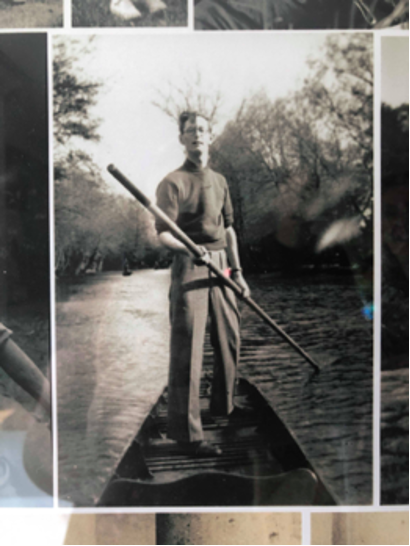
Tales from the Archives: the Secret History of Oxford Punting

With the Final Seed of Punting Cuppers just around the corner, we share three of the more intriguing anecdotes from the records of the competition, dwelling upon the more subversive and revolutionist undercurrents that swept along some of our Oxford punts. Though Punting Cuppers is often considered a “stuffy bastion of flat Englishness,” one can easily determine, from nought but a perusal of the ensuing yarns, that the history of this quintessentially Oxonian sport is only too chequered.   

For those interested, this year’s Grand Final Seed can be both attended and spectated on 18 June, 12 sharp, at the Victoria Arms. Facebook: Oxford_Punting_Cuppers_2019. 

A Phantom Puntsman: 

The first legible entry in the annals of Oxford punting is – perhaps predictably – a good old-fashioned ghost story. Veteran punters will no doubt be aware of Percie Punting, the patron saint of competition punting, who, as legend has it, spent thirty years punting the length and breadth of England to escape the reproaches of his “Shrewishe and Nagginge Wyfe”. In the years after his death (c. 1840), the so-called Phantom Puntsman morphed into a popular mascot for students boating on Cherwell, becoming the subject of ballads and drinking-songs. 

One still May night in 1913, the officials of the newly founded Punting Cup were making their way up to Parson’s Pleasure to clear the course for the next morning’s race, when they spied a peculiar light in the distance:

P.P. – coming down the Piste as we were putting away the fallen branches – what a joy! He waved at us and bade us sing of him on the morrow. P.P., P.P. – what a sheer joy!

Was it in fact an epiphany of the Ghostly Boatsman that the proctors (among whom was none other than Aldous Huxley) spied? Or just a phantasm borne of too much late-night port? Unfortunately, the true facts are lost to time.

The Suffragettes Storm the Cherwell:

Protesting social issues by jumping in front of races has a long and illustrious history in this country. From Emily Wilding Davison to Trenton Oldfield, countless activists have seized the limelight of high-stakes sport to draw the eyes of the nation to vital and important issues. 

The 1921 final seed of the Oxford Punting Cup was to be a grand affair: in the twenty or so years since the competition’s inception, the number of competing boats had swelled to the point where most colleges fielded a main and a reserve team (at least). And that year, there were some big names: the future novelist Graham Greene was to captain Balliol’s 1st, and no less an international celebrity than Prince Paul of Yugoslavia stood at the helm of Christchurch’s 1st

By all accounts, it was a race hard-fought and hotly contested; but by the second-to-last bridge, the royal punt had opened a decisive lead. That was when Mary Ellen Elin, a student of Lady Margaret Hall and a committed suffragist, leapt in front of the Christchurch boat, wrapped in a banner reading “DEEDS NOT WORDS”. The race, now disrupted, was put off to another time; but for that day, it was the subversive message of votes for women that took the biscuit, if not the Golden Punt.  

Punts for World Peace:

Fast forward a few decades to the “groovy” era of the 1960s, and punt activism had become rife amongst the hipper undergraduates of the university. According to Dr Ffrench, renowned punter and ornithologist, one particularly “saucy” outcome of this development occurred in a Trinity term near the close of the decade. Writing in the ’68-70 Punting Cuppers Annal, French relates that students of Wadham College, overcome with the zeal of May ’68, decorated a punt with flowers and “sailed” down Broad Street, singing anti-war protest songs and, in general, carousing in the manner typical to that set at that time. Finally, after some invigoration at the KA, and no doubt part-ameliorated by marijuana, they attempted to secure entry at the very doors of their college. 

Though the infamous ’68 “peace punt” was equipped with wheels that had been screwed on for the purpose of land manoeuvring, it was unfortunately unequipped with brakes, and the ensuing collision between porters, students, and 17th-century oaken door, resulted in more than a half-dozen bone fractures. The incident began to sour when the Warden, Maurice Bowra – renowned, at that time, for his acerbic wit – attacked the “peace punters” with the following couplet:

The blossom of ’68, sailing for peace in their punts,

Crashed on the sturdy gate, the moronic, ambisinistrous c –. 

So potent was the reputed force of his lashing tongue that some undergraduates collapsed at the spot. 

Dr Ffrench: Ornithologist and Puntsman

Postlude: 

In these months of predictably large and unexpected change, who knows with which verge or gurge the barge of Punting Cuppers shall merge in the coming weeks? Already, the competition of this academic year has seen, if we are to believe Kee’s Exeter First boat, the re-emergence of Percie Punting himself onto the esteemed waters. Though the times be difficult, and the threat of Monkeypox squares itself ever more heavily upon our bosom, the punters of this year remain, as ever, “hot-blooded by temperament, risk-takers by disposition.” We wish best of luck to the colleges and boats in the “Final Eight” Seed, and competing in private engagements this week: Wolfson (1), Exeter (1), St. Hugh’s (2), Oriel (4), Christ Church (3), Oriel (5), St. Hilda’s (1), and St. Hugh’s (3). 

The Oxford Punting Cuppers 2022 Team 

For queries, or for more on the history of the sport, please find: [email protected].

Love and patriotism: A critical reflection on the Jubilee

0

As Jubilee weekend approaches I am conflicted. Many on Sunday will be celebrating their affection for our nation, and I should make it clear that this is something I am not at all opposed to. I think our country has many excellent qualities that deserve to be celebrated, and, by and large, I think Elizabeth has done a reasonably good job as a modern monarch: remaining (largely, but not totally) impartial in matters of politics and providing a great deal of constitutional stability to the state throughout her long reign. This much should be recognised, particularly through the past decade or so of national and international turmoil.

My problem with the narrative around events like the Jubilee – and with displays of patriotism more generally – is their lack of critical reflection on what it genuinely means to love one’s nation (to say nothing of the brutish jingoism they sometimes also induce). There will be all the normal trappings of street parties, flag waving, and singing of the national anthem. I begrudge none of this if it appeals to you. But please note that none of these behaviours are behaviours of love: they are simply demonstrations of affection.

At the same time as these parties occur, countless citizens will be living in a state of anxiety. They will be worried about whether they have enough money to make it to the end of yet another week of increasing food and energy prices. Others will be worried about the yet unfinished turmoil of Brexit and the pandemic – not to mention the wars in Europe and our ongoing climate crisis. Patriotic celebrations may provide a brief escape to some from these concerns, if only for a day, but nothing of any tangible significance will come of it. “Give them bread and circuses and they will never revolt”, Juvenal wrote; what is so egregious about this upcoming circus is that, at the same time, the government can’t even give us bread.

What could be more patriotic then – if patriotism really means love of one’s nation, of one’s fellow countrymen – than to address the suffering felt in so many communities at this time? Our treasury of patriotic imagination is full of examples of service which we rightly celebrate, from those who gave their lives in past wars against fascist atrocities to the tireless work of those in the NHS, yet when we come to a period of national celebration we so quickly forget that love in its most sincere form means service, sacrifice and compassion. If you want to celebrate the Jubilee, please do by all means, but do not let this jubilation allow you to slip uncritically into the fantasy that all is well in our country. Pick up the flag, but do not put down the duty of charity, or the banner of protest against a society that continually privileges the few at the expense of the suffering of so many.

Special Report: Merton tops 2021 Norrington Table but rankings show link between college wealth and academic performance

0

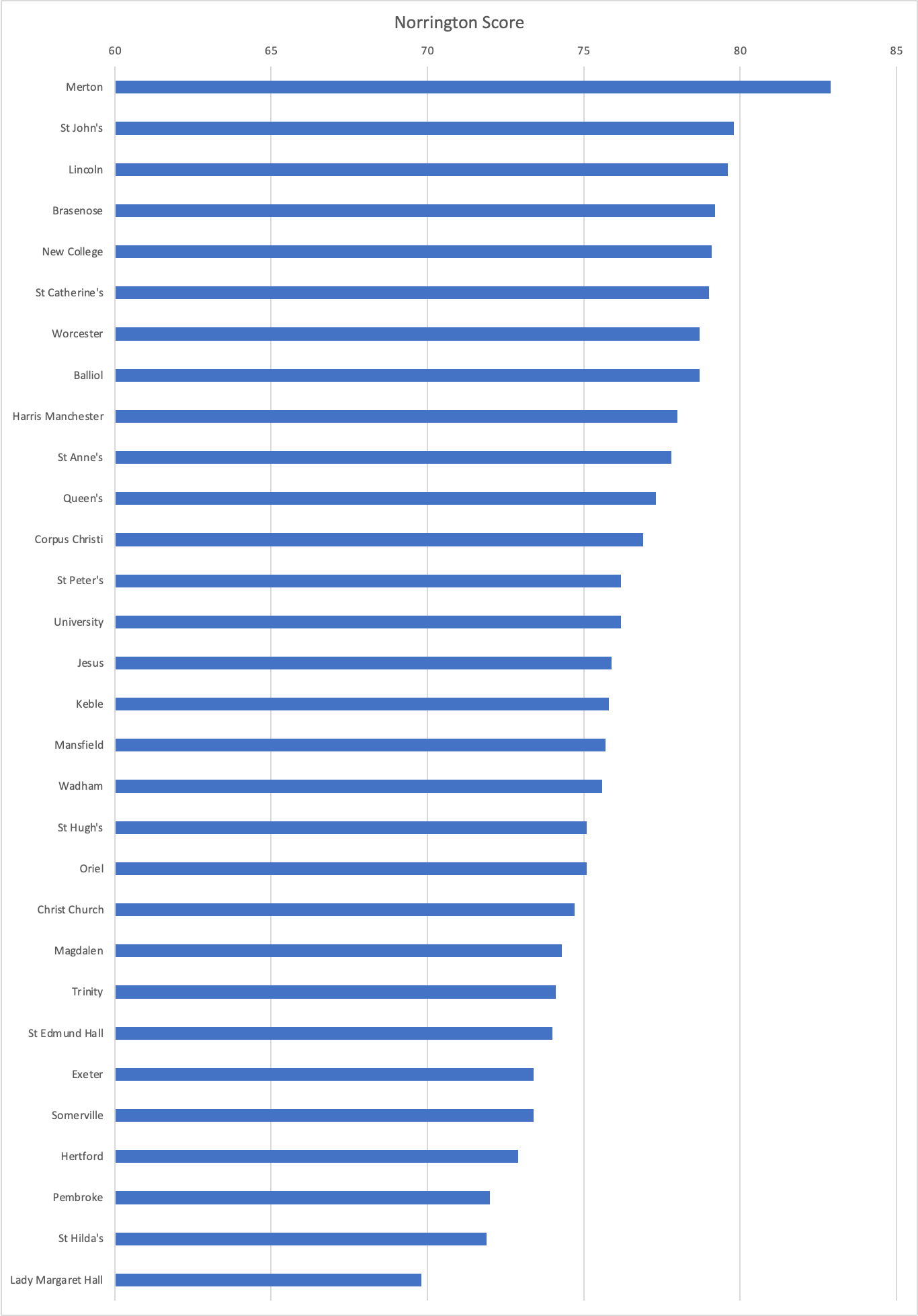
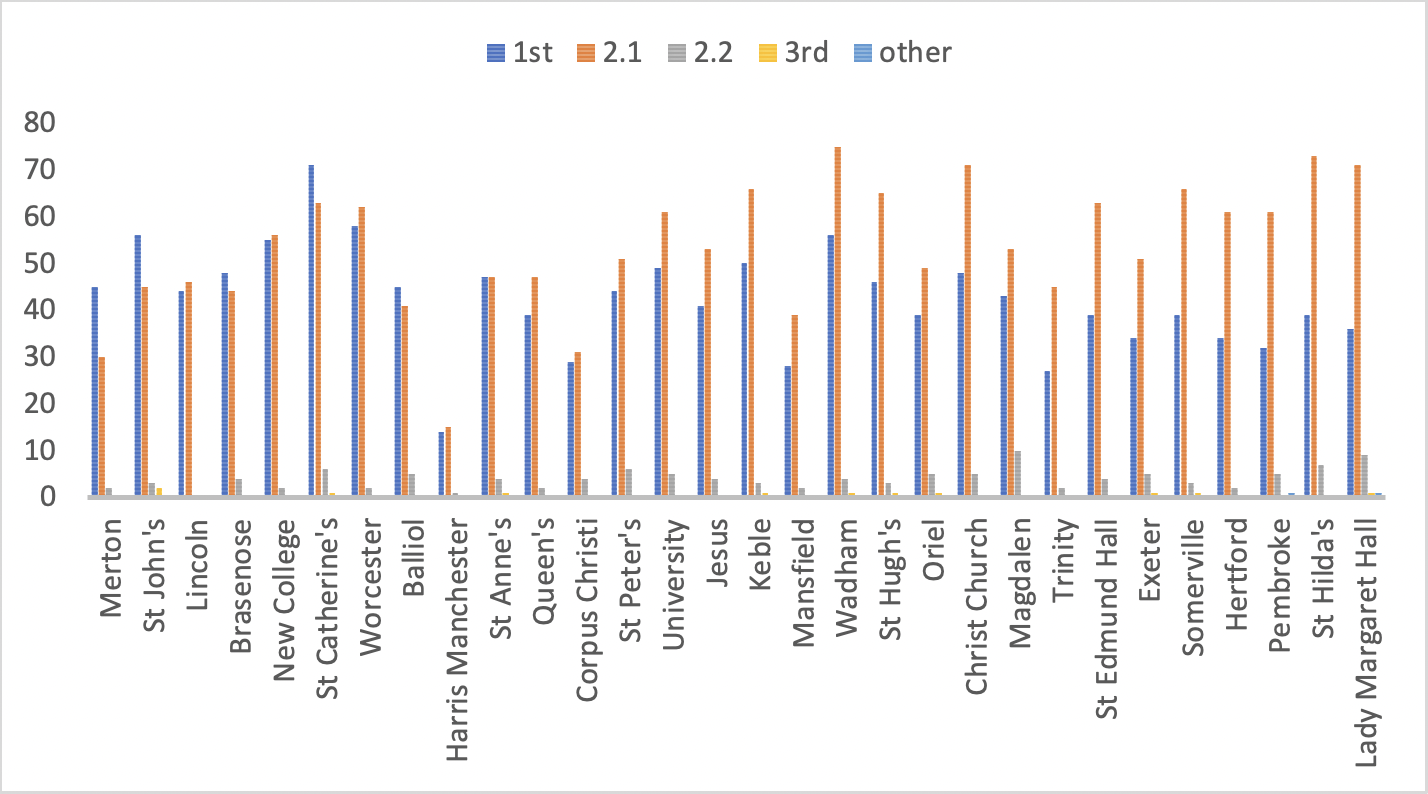
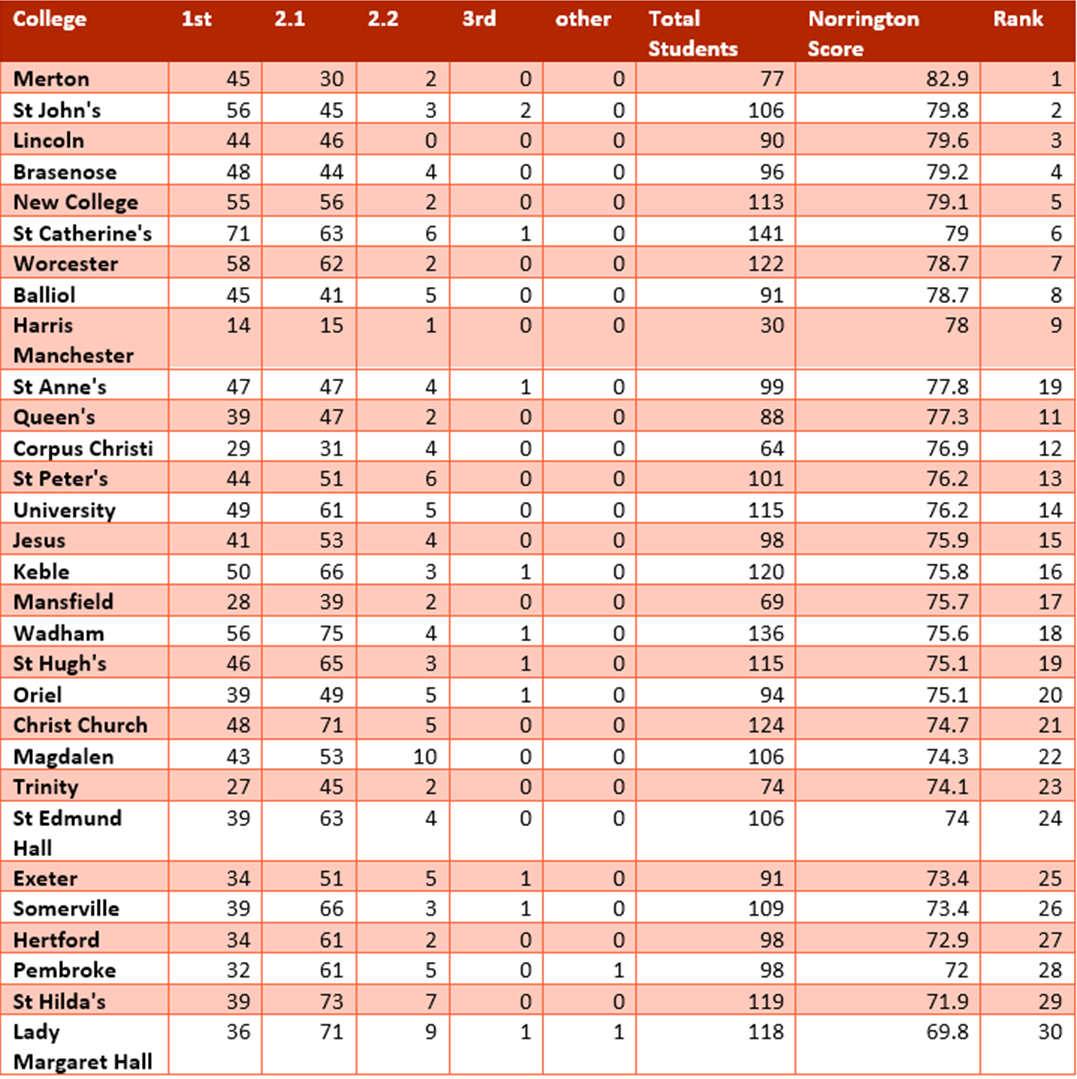
Merton College, described by students as “where fun goes to die”, has lived up to its reputation for high academic attainment by topping this year’s Norrington Table, with 45 of 77 students scoring a first in their finals. LMH is the college with the lowest score, with only 36 of 118 students achieving a first-class degree.

Regent’s Park had the lowest score of any PPH or college with more than one exam-sitting student, with a Norrington score of 69.7%. LMH narrowly missed out on the bottom spot with a score of 69.8%.

The overall lowest score on the table was earnt by Ripon Cuddesdon. This widely unheard-of college is situated 7 miles out of the centre of Oxford, nestled in the Cotswold countryside. A Church of England theological college, Ripon Cuddesdon trains men and women for ministry, with alumni including David Hand, Archbishop of Papau New Guinea 1977-83, and Cosmo Gordon Lang, Archbishop of Canterbury 1928-42. It had just one student who sat an exam in 2020-1, and because that student earnt a 2:1, the college scored just 60% on the Norrington table.

With the exception of St Stephen’s House, whose single exam entrant scored a first and earnt the House a score of 80%, most PPH’s scored lower than colleges. Indeed, the mean Norrington score for PPHs was just 70.4% compared to a mean score of 76.1% for colleges.

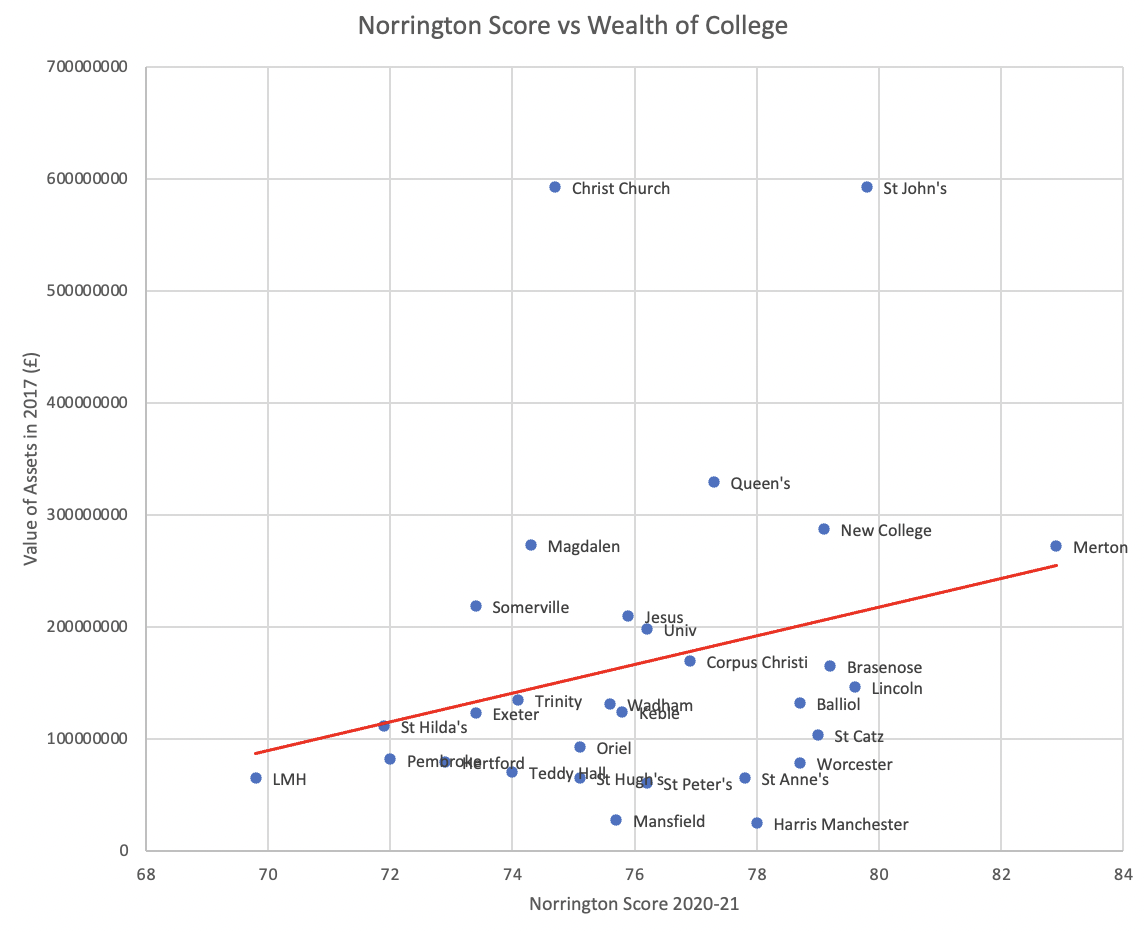
A Cherwell investigation in 2018 revealed that the wealth of colleges could have a substantial bearing on their performance in the Norrington Table. Looking at the data for this year, this finding seems to have held true.

The five colleges to top the Norrington Table are all among the oldest and wealthiest Oxford colleges. Merton, St John’s, Lincoln, Brasenose, and New College were all founded before 1510. Financial reports published in 2017 show that all of these colleges were in the top half of Oxford colleges and PPHs as ranked by wealth. Lincoln, the college with the lowest net assets of the five, still ranked 15th out of 36 according to wealth.

In contrast, the colleges at the bottom of the table are generally considered to be some of the poorer colleges at Oxford. Hertford, Pembroke, St Hilda’s and LMH are all in the bottom half of colleges as ranked by wealth, placing 24th, 23rd, 20th, and 31st respectively.

However, there does not seem to be a consistent correlation between the wealth of colleges and their performance on the Norrington Table. Christ Church, the second wealthiest college, was ranked 21st out of all colleges on the Table, whilst Harris Manchester, the poorest college, ranked 10th.

The relationship between the wealth of colleges and their academic attainment is not a new phenomenon. In 2002, the Oxford Student Union released a report stating that disparities in college wealth meant that students “are far from guaranteed a common educational experience, with detriment not only to their academic performance but also to their general welfare and financial condition”. The report found that poorer colleges had smaller libraries – with 160,000 volumes at Christ Church compared to 40,000 at Wadham – and generally paid their fellows less, making it harder to attract the best tutors.

Nonetheless, the significance of the Norrington Table as a metric of college’s academic performance has been widely criticised, since the differences between college’s scores are generally small, and a single student being awarded a 1st instead of a 2:1 could improve a college’s rank by four or five positions.

The Norrington score was developed by Sir Arthur Norrington, former President of Trinity college, in the 1960s, as a way of measuring the performance of students in finals. The score is based on the classifications of undergraduate degrees awarded and expressed as a percentage.

The Norrington calculations attach a score of 5 to a 1st class degree, 3 to a 2:1 degree, 2 to a 2:2 degree, 1 to a 3rd and 0 to a pass and Honours Pass. The percentage is then calculated by dividing the total college score by the total possible score the college could attain (ie the number of degrees awarded per college multiplied by a score of 5).

The Norrington Table for 2020-21 can be found here.

Image Credits: Meg Lintern

Hertford College launches John Porter Diplomacy Centre

0

This year, Hertford College inaugurated its John Porter Diplomacy Centre, a key part of the Hertford 2030 aspiration to prepare students for “life, work, and citizenship, and to be on the frontline for a better society.”

The Centre emerged out of conversations between Hertford College Principal Tom Fletcher, a former British Ambassador to Lebanon and foreign policy advisor at No. 10, and John Porter, an alumnus of Hertford who matriculated in 1971 and was the namesake of the John Porter Charitable Foundation. Porter passed away in 2021.

The John Porter Diplomacy Centre, a unique effort among Oxford’s colleges, will train students in diplomatic skills, connect different parts of the Oxford ecosystem working in diplomacy, encourage people-to-people partnership-building, and support the creation of scholarships for refugee leaders to come to the University of Oxford.

Two particular notes from the conversations between Fletcher and Porter animate the current vision for the John Porter Diplomacy Centre: approaches to the peace processes of the future and supporting the development of young peoples’ diplomatic skills.

“When it comes to the peace processes of the future, we want to know where we need to invest time and energy now to prepare for moments of tension and friction in the world,” Fletcher told Cherwell.

John Porter’s desire to support a Diplomatic Centre stemmed, in part, from his experience watching a 1988 BBC clip of Nicholas Winston reuniting with dozens of children he had helped rescue from Nazi Germany. In total, Winston assisted in the rescue of 669 children, most of them Jewish, from Czechoslovakia on the eve of World War II.

“He was just struck by seeing an example of such an extraordinary effort to transform peoples’ lives and wanted to support something that would continue that legacy,” Fletcher said of Porter.

They are partnering with the Oxford Refugee Centre, headed by Professor Alexander Betts, to support refugee scholarships. They are also studying different points of “intervention” on a refugee’s life journey that can ultimately help them come to Oxford and succeed.

Fletcher also strives to use the Centre as a platform to discuss what “peace” means in a world where that term has become highly contested.

“We are looking at peace with our planet, with climate change. We are looking at peace between the government and Big Tech, and peace with tech itself. We are looking at peace between migrants and host communities. We also look at peace between generations, to heal the wounds of history and ensure that we do not pass on inherited conflict and inequality,” Fletcher told Cherwell.

“We are a Big Tent, but not a big building. We are not trying to duplicate or replace what is already going on at Oxford, but instead we want to connect the dots between different parts of the Oxford ecosystem,” added Fletcher.

With such a wide-range of topics and interests within the Centre’s wheelhouse, Fletcher naturally envisions that they will take an expansive view of what constitutes success.

“I look at 2030, and I think that if we can get together a sort of reunion of everyone involved in this project up to that point, from senior ambassadors to ministers to military people to humanitarians to students, and that we can say that we directly contributed practical ideas and time and energy to some really important peace processes, I would consider that a success,” said Fletcher.

“We cannot write the script of where people will go, but we can give them the tools to apply themselves to amazing things,” he added.  

Image Credit: Hertford College

Once Long Ago

In Once Long Ago, Jenny Robinson invites us to listen to the “dead tales of old gods long gone” struggling to find their place in a new world, where they are “only folklore”. The resultant effect of her aural images and enjambed lines is one of limping — each line unfolds hesitantly, like the shifting of tired feet.

The dead tales of old gods long gone 

Far off from slumber,

In dreams they shall wake

As their backs break,

Cracking to conform to a new world, 

Their stories, only folklore,

All that’s left of them lives on.

To breathe and to die, to slowly be consumed

Back into the worlds from whence they came,

An always cycle, eternal wail, never finished,

Like a snake eating its own tail,

Wrapped around the world

Patiently waiting to be one

Again.

“I am a proud convert”: My conversion to Judaism

   I am a proud convert. My interest in Judaism began with my family background, and I cannot explain my conversion without first explaining that.

   My mother’s side of the family, while interesting in its own way, is Friulan (Friuli is a northeastern Italian province) going back to the 16th century. I have no Jewish ancestry through her. Instead, my Jewish ancestry comes from my father’s side, from my paternal great-grandfather, Benjamin Itzhakin.

   Benjamin was born to a Jewish family in Babruysk, modern-day Belarus, on 15th April 1888. As he reached his teen years, antisemitism grew increasingly violent in revolutionary Russia. So, Benjamin left on a ship to Chicago, Illinois, America. Immigration officers changed his last name from Izhakin (meaning son of Isaac) to Jacobson. He married and had several children, one of them being my grandfather Howard.

    In his letters to me, Howard gave me the impression of being a “self-hating Jew,” a loaded phrase, which I’m using here to mean a Jew who internalises their marginalisation, resents their Jewish identity, and wishes to distance themselves from “all things Jewish”. In other words, Howard did not want to be Jewish. So much so that he decided to convert to Christianity and create his own Christian denomination.

   Years later, Howard had a son, who would later become my father. Whenever my dad would ask Howard about his family background, Howard would respond that they were American, without further detail. As a result, my father grew up not knowing about his Jewish heritage and was not raised, according to any definition, Jewishly. It wasn’t until his adulthood that my father learned about his Jewish ancestry.

    I grew up with knowledge of this ancestry, and Judaism always fascinated me. I was born and raised in Columbus, Georgia, a place that actually has a sizeable Jewish population compared to most places in Georgia. Columbus has two synagogues, one Conservative and one Reform. But the Jewish population and two synagogues are outweighed by the existence of over 200 churches in the area. Public education in the Bible Belt taught me very little about Judaism, and what it did teach was mostly incorrect and simplified to the point of being borderline offensive. I was drawn to Judaism because it felt like a lost puzzle piece to my own identity.

“It wasn’t until his adulthood that my father learned about his Jewish ancestry.”

   I began a more serious interest in Judaism when I was in high school. My high school was located in a historically Jewish area of Columbus, and so there were several Jewish students and one Jewish teacher (who just so happened to be my homeroom teacher). I can’t explain why, but I felt very compelled to learn about Judaism. I didn’t have many Jewish resources, though, so I started by reading a used, pink pocket edition of the Jewish Publication Society translation of the Torah from cover to cover. I didn’t know what to do after that, and so my interest in Judaism lay mostly dormant for the next couple of years, until the pandemic.

   Like many other Americans, I found my work hours cut. Actually, I was making more money off of Georgia’s unemployment pay-outs than at my less-than-mediocre retail job. School moved to Zoom, and I found myself at home for most hours of the day, and so I had a lot of time for thinking. I began thinking about Judaism again, and I took an online edX course called “Judaism and its Scriptures.” I read a lot of articles, and I found that my existing values tended to align with Jewish values.

   Near Rosh Hashanah of 2020, I got into contact with the Reform temple, thanks to my old homeroom teacher and his very kind wife. I learned about the possibility of converting and then began a conversion process with the rabbi there, who was planning to retire the following summer. Although the temple was conveniently located within walking distance, it was currently closed to the public due to the pandemic, so the rabbi and I held our classes once a month on the phone. We later moved to Zoom.

   It was a very unconventional conversion, but my rabbi would basically assign me different books to read or different tasks to do at home, such as observing Shabbat, baking challah, and practising prayers. I would attend services on Zoom, and I was always the youngest person to attend. Out of all of the services, I loved Torah study the most—I found analysing and discussing the parshahs (weekly Torah portions) to be the most invigorating. I found it a little difficult to find parts of my identity in the holidays at first, but the first holiday I found myself in was Purim. No, it wasn’t because it’s a mitzvah to get absolutely pissed drunk, but because it was very similar to the Italian holiday of Carnevale and because I loved the Book of Esther. At some points during the year, my conversion became quite difficult because I was a full-time university student who was juggling two, sometimes three, part-time jobs.

“I was drawn to Judaism because it felt like a lost puzzle piece to my own identity.”

   As summertime approached, my rabbi told me to start considering a Jewish name. She wanted to be the one to see out the end of my conversion—maybe for her it was a last hurrah before retirement—and she felt that I would be ready to convert by June. I felt slightly unprepared to dive into the mikveh (a ritual bath involved in the conversion process) and officially become a Jew. Most conversions to Judaism take a full year or two, or sometimes even longer. My mikveh ceremony was to take place just nine months after I began my conversion back in Rosh Hashanah.

   I struggled to choose a name; it actually wasn’t until the week before my conversion that I settled on “Naftala,” a name I found in a book my rabbi let me borrow. According to that book, “Naftala” means to “wrestle with God,” but it more commonly means “my struggle.” I felt this name was apt because I had always struggled with religiosity, and my conversion was made more difficult by the situations the Wheel of Fate threw at me.

” Because of the nature of my conversion—or simply because I converted, some people don’t consider me a Jew. “

   My conversion took place in a swimming pool at a temple member’s house. I said a prayer, then immersed myself in the water, and repeated that process two more times. The cynical side of me wondered how my dipping in the pool really changed me from being a non-Jew to a Jew. My rabbi gave me the theological explanation behind the mikveh, but I found the answer in something else.

   As I began to live my life as a fully-fledged Jew, I looked back to my mikveh ceremony and felt that it held more meaning. And perhaps this is a sacrilegious thought, but I felt that the conversion was simply a formality, a ceremony to mark my once-lost Jewish soul finally returning to its proper home. I thought about it as if the Jewish soul which was supposed to travel through my lineage—and stopped at my grandfather Howard—had finally returned to me from its long hibernation. When I bake challah, when I light the Shabbat candles, when I read the Torah, when I eat the “Shabbat dinner” I cooked among my non-Jewish friends, when I observe Tu B’Shevat by drinking prosecco and eating strawberries in Port Meadow with my self-proclaimed Aristotelian philosopher friend, when I make weird “calzone” hamantaschen with my partner—that is when I feel that returned Jewish soul kindling within me.   Because of the nature of my conversion—or simply because I converted, some people don’t consider me a Jew. Some people have even told me I am “un-Jewish” because of my views on Israel and Palestine (as if that is the issue that determines my Jewishness). Some people have thought of me as less-than because I can’t and don’t observe holidays and ceremonies properly. Those words hurt, especially when they come from other Jews. But my Jewishness—although admittedly a result of an odd conversion—is my Jewishness nonetheless, and no one can ever take that away from me. I am a proud convert, and I am proud to be a Jew.