

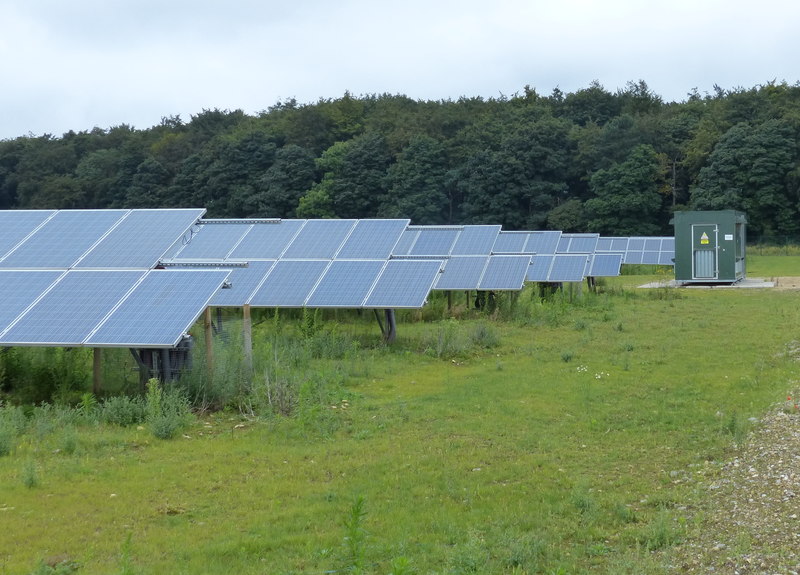
The UK government has blocked plans to build Europe’s largest solar farm in the outskirts of Oxford. As a Nationally Significant Infrastructure Project (NSIP) requiring approval by the government, the £800 million proposal in Botley West was rejected by Baroness Margaret Curran, on behalf of the Secretary of State for Energy Security and Net Zero.
Spanning across more than 2,000 acres of land, Botley West Solar Farm would have generated 840MW of clean energy for 330,000 homes, equivalent to roughly 1.5% of the government’s solar generation capacity target by 2030. Photovolt Development Partners (PVDP) has previously claimed Botley West’s capacity would be sufficient to power all homes in Oxfordshire and upgrade what is “currently one of the most carbon-intensive [grids] in the country”.
The Decision cites concerns of “substantial harm to the Green Belt”, adverse effects to designated assets of cultural heritage, visual pollution, and impacts on nearby London Oxford Airport that would pose an “unacceptable risk to public safety”. Baroness Curran’s Decision highlights the proposed site’s proximity to Blenheim Palace, a World Heritage Site, the Cotswold National Landscape, and other Listed Buildings, noting that the applicant, PVDP, did not conduct their assessments in sufficient detail “proportionate to the importance of the heritage assets”.
Reacting to the government’s Decision, John Orme from local campaign group, Stop Botley West, told Cherwell: “The Botley West proposal was wrong in scale, location, governance and process. Solar panels belong on roofs, and not on productive arable land.” A survey of 1,442 local residents commissioned by the campaign found that 90.8% were opposed to the construction plans.
Orme added “We believe there is a clear need for national guidelines on the style and location of renewable projects, so that speculative, misguided and poorly-judged applications such as Botley West are rooted out at the start of the planning process.” Stop Botley West has urged the government to instead use “industrial and brown field sites to house large-scale solar arrays.”
Local farmers have also highlighted potential negative impacts on food production. These claims have previously been dismissed by Professor of Energy and Climate Policy at the University of Oxford’s Environmental Change Institute, Nick Eyre, as “hugely exaggerated”, who has also added that there are an insufficient number of homes in Oxfordshire to construct the necessary amount of roof solar panels.
Mark Owen-Lloyd, Director of PVDP, told Cherwell: “We are extremely disappointed by the decision to refuse development consent for Botley West Solar Farm. We continue to believe that there is a compelling case for Botley West, based on the project’s merits and its potential to deliver significant benefits for Oxfordshire, while contributing to the UK’s energy security and clean energy ambitions.”
Stop Botley West, the community volunteer group who spearheaded public and legal opposition to PVDP’s Botley West project, continues to advocate for changes to the UK’s planning system. When asked about the implications of the government’s Decision in relation to wider plans for an “Oxford-Cambridge growth corridor”, Orme told Cherwell: “One of the major limitations of the NSIP planning process is that each application is considered in isolation, rather than consider the cumulative impact of development applications. We would like to see that the important role of local authorities and their communities is emphasised.”
Plans for a £900 million data centre funded by Exeter College, located near Oxford Parkway station in Kidlington, have also sparked controversy. Exeter was in “advanced negotiations” with PVDP to power its data centre, titled EXOq, using a maximum of 5% of Botley West Solar Farm’s energy output. A decision by Cherwell District Council on whether to grant permission for the EXOq data centre remains pending.
PVDP has six weeks to challenge the Secretary of State’s Decision at the High Court and request a judicial review. A spokesperson for PVDP told Cherwell: “We will now carefully consider the reasons for the decision and assess all available options before determining our next steps.”
Baroness Curran was approached for comment.


 requiring approval by the government, the £800 million proposal in Botley West was rejected by Baroness Margaret Curran, on behalf of the Secretary of State for Energy Security and Net Zero.)