

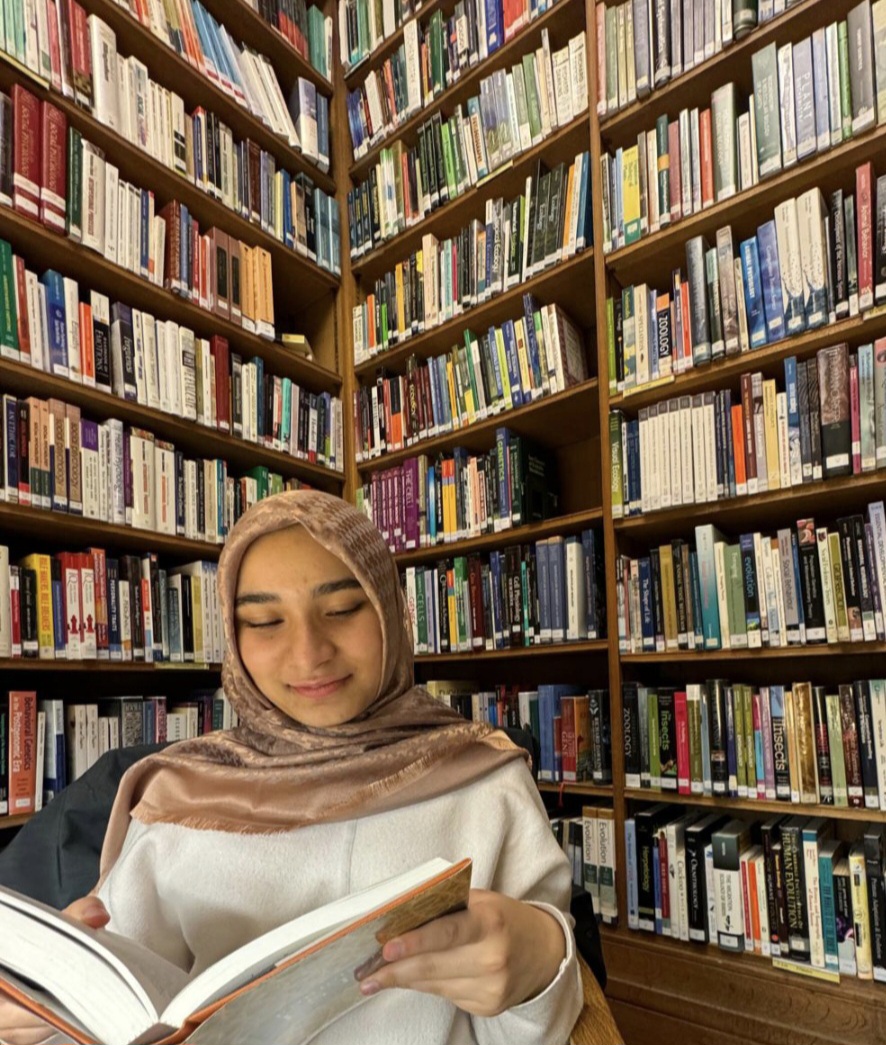
“If they tell me to take it off, I won’t do that, and I will leave the school because the hijab is more important to me than the school. It’s the most important thing in my life”
-Hijab-wearing schoolgirl Florinda Zeka, 2010 BBC interview about Kosovo’s hijab ban in schools.
For me, one of the most challenging aspects of wearing a veil is being at the receiving end of attempts to unveil you. I personally first encountered this at age ten, when Ofsted decided to target visibly Muslim primary school girls across the country and ask them why they wore the hijab and whether they are forced, in front of their peers. Many other visibly Muslim girls and I grew up being the target of interrogations while facing demands to condemn the two countries which imposed veiling on women. Meanwhile, we endured watching more European countries like France, Austria, Norway, Netherlands, Germany, Belgium, Kosovo, Russia (in areas like Stavropol Krai and Mordovia), Spain, Italy, and Switzerland banning the hijab and/or niqab in educational institutions.
While our peers in these countries were fighting for their religious freedoms and right to an education, we grew up very aware of the stereotypes attached to the hijab, including being thought of as uneducated or less ambitious. We grew up being told that the hijab is a backward, alien, or unnatural practice despite the fact that women veiling is as old as civilisation itself. I cannot think of a practice that unites more women globally than veiling. From England to Assyria to Greece to India and even further afield, women have traditionally veiled for either cultural or religious reasons.
The stereotype of veiled Muslim women lacking basic skills, basic education, or being confined to their homes is the one that has had the most impact on my self-image as I began to veil. I have had to remember to stop viewing myself through a lens of ‘double-consciousness’, a sociological term meaning to constantly measure and view oneself through the prejudiced eyes, stereotypes, and contempt of the dominant culture.
When I decided to wear the hijab in primary school, I was ridiculed and excluded by close friends. On World Book Day, for instance, I was told that I could not be Matilda, like all the other girls in my class, because “she never wears a scarf”. Gradually, I stopped many activities like drama, and felt discouraged ice skating, since I was influenced into thinking that certain activities look silly in a hijab. Giving up on hobbies however, is not much in comparison to girls who are denied an education, or offered a conditional education that compromises their religious freedoms and choice.
During my first year, when someone at the Oxford Union was speaking in an emergency debate about feminism and women’s education, I reminded him that such education does not extend to women like me in many European countries. In reply, he said: “I think it is a great privilege you have to be speaking in a place like this.”
While the international community and women’s rights activists look the other way, veiled Muslim girls are fighting one of the hardest battles to attend school. The psychological trauma and violence of forced unveiling is a lived reality for so many veiled Muslim girls, both throughout history and across the world today. There are more countries in the world that force Muslim women to remove our veils than those that impose them, yet we grew up very aware that most people assume that we are unable to make our own choices about our own bodies and are forced.
At a society event I attended in Oxford during my first year, someone asked me why I still wear a scarf and whether I was forced to. I told her, mindful to do so gracefully, that this is never forced. She replied: “No, you are, because if you don’t you go to hell.” I told her that Muslims do not weaponise or invoke hell upon each other and that God is the ultimate judge. She carried on following me across the room, insulting me and questioning me about Iranian law, despite me telling her that I am not only not Iranian but that there are many women in Iran who no longer veil. As expected, nobody else in the room told her to stop harassing me.
I think about this moment most, because while today the hijab and/or niqab is banned in educational spaces across Europe, the overwhelming majority of people not only do not condemn this, but do not question it either. Only 50% of Western Europeans favour allowing Muslim women to wear religious clothing in any setting (with this still excluding face coverings), while 23% favour a ban on all religious clothing.
In UK schools, there have been many cases of both teachers and other pupils forcefully pulling Muslim girls’ hijabs. Some UK schools have also banned the hijab. Forced unveiling of any kind not only removes our identities from educational spaces and public life, but as a result of our absence, also reinforces the stereotypes of us as intellectually deficient or absent in public life and service. The most recent country to enforce forced unveilings in educational spaces is Azerbaijan, shortly after Austria and Kosovo.
However, discrimination, mockery, attempts to remove us from academic spaces, and aggressive attempts to unveil us are not recent. My Iranian great-grandmother lived under Kashf-e-Hijab (the Shah of Iran’s ban on all veils in public spaces to promote Western-style attire for both men and women). My grandmother once told me that her mother and grandmother like many women at the time would avoid going out altogether and if they had to they would go early mornings or late at night where there was likely to be authorities on the street. If they were stopped by authorities they would say that they were tourists visiting from neighbouring Afghanistan, she said.
This forced unveiling mimicked soft power tactics to unveil Muslim women in Türkiye under the presidency of Mustafa Kemal Atatürk, who viewed veiling or any traditionally Islamic clothing as backward. In his public speeches, he argued that traditional head coverings humiliated Turkish women and hindered national progress. Such beliefs and comments are not too different from verbal insults directed at veiled and visibly Muslim women today. During Kyrgyzstan’s campaign to pressure Muslim women to unveil, the government displayed billboards of women in niqabs, with the question, “My poor people, where are we going?”. In 2016, then-President Almasbek Atambayev repeatedly targeted veiled women in a press conference, also saying: “Women in mini skirts do not become suicide bombers”.
Tunisia, for instance, like India, Belgium and other countries, no longer implements its hijab ban in academic spaces, but discrimination and ridicule directed at veiled women continues. On one occasion, Tunisian actor Mohamed Kouka publicly remarked that “the hijab makes women inferior and less worthy” and that “when I come across a veiled woman, I wish to tear the headscarf up”. Hand in hand with their fantasies to unveil us, Mohamed Kouka has also made hand gestures showing himself ripping off an imaginary hijab on air and saying that the hijab “takes the value of women to the lowest”. When later asked why he said he would rip the hijab off, Kouka said it was “a joke” and refused to apologise.
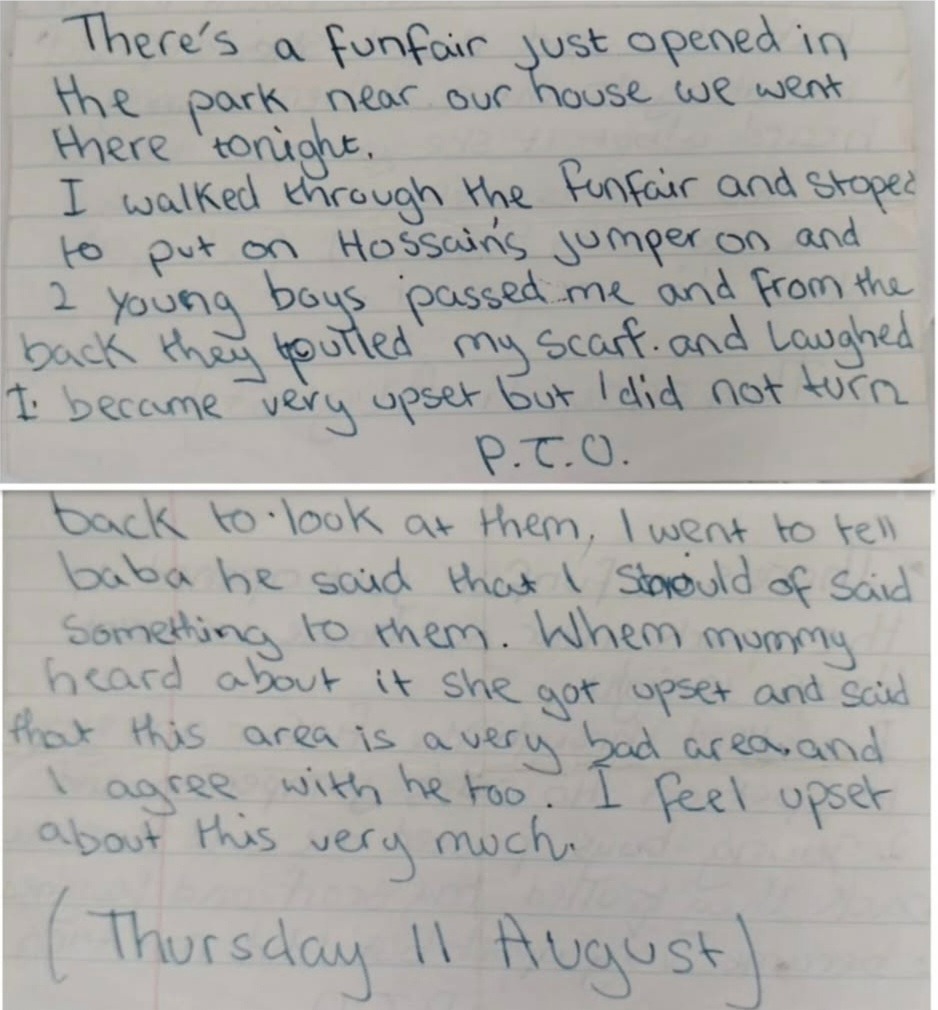
Mimicking the harassment of women is not a “joke”, especially not to those who have experienced such physical assault. I was first threatened with this when I was in Year 8, just a little over a year after ‘Punish a Muslim Day’; a shirtless man waved his shirt at me, his upper body out of his car window, as he shouted: “I’m going to pull your hijab off.” Assault follows such threats. At age ten, my mother wrote in her diary (pictured): “Two young boys passed me, and from the back they pulled my scarf and laughed. I became very upset, but I did not turn back to look at them.” Thirty years later, when I found this page in a storage box in the garage, I asked my mother if she remembered, and she responded yes, before revealing that, even as an adult, she does not like going to funfairs because they remind her of moments like this in her childhood.
On another occasion, when I asked her whether she felt discriminated against at university for being a young mother, as I had to sometimes accompany her to university, she told me that she did not feel discriminated against or judged for that at all in front of her professors, but instead for wearing the hijab. “I always felt they look down on us, as if we are uneducated and ignorant, as if we are inferior and do not know anything.”
We are still thought of as lacking basic skills and education. At Oxford, after I had told someone where my grandmother had studied for her master’s, they said: “Wait, what? So she’s actually smart?” In her blog, British school teacher, by the name of Miss Moga wrote of one of her experiences of working in UK schools that: “When I attended the interview I was to first have a short meeting with the headteacher to be welcomed to the school and have a little tour, the initial moment she laid her eyes on me, she looked surprised and grasped her necklace and turned to her assistant and whispered (quite loudly!), “I thought she was the most educated candidate?!”,”.
Strangers on the street have asked me, “can you speak English?” before they stop me to ask something. ‘Perhaps you could argue that they have asked in good faith’, but what about the strangers that have stopped me on the street to say “you are not welcome here”, “aren’t you hot?” and even during my year abroad, “this is Armenia, you do not need to wear your… your bandana” and “you are in Armenia, you should respect our laws”. What about strangers who threw newspapers at my cousin’s face on the tube, and received thanks from onlookers as a result? Living through this daily puts pressure on young girls growing up to unveil. As Journalist Mohamed Hassan wrote in his award-winning poem ‘The Muslim women who raised us’: “when us men hide in shirts and jeans, shaved jaws, and blue eyes, nobody asks us where we are going, why we are here, what we are trying to prove with our insistence to go to school, to get degrees…”
Forced unveiling in women’s sports is also commonplace. At a press conference, Tunisian runner Habiba Ghribi told a young hijab wearing runner to “choose between the hijab and running”, to which she later burst into tears. This also echoes France’s attitudes to hijab-wearing athletes, who are not permitted to partake in competitions unless they unveil. For myself, it was only after I came across ice skater Zahra Lari, who wears a hijab, that I started ice skating again. It reflects the profound impact that representation has, and the need for young Muslim girls to be exposed to veiled women in different roles. Forced unveiling, apart from causing great psychological distress, places a glass ceiling upon the potential and dreams of young veiled Muslim girls.
I spoke to Elif Feyza Dinc, an MPhil student reading Development Studies. She came to Oxford after graduating from Boğaziçi University, one of Türkiye’s most prestigious institutions. Though only a generation earlier, her mother “lived through every hardship that the 28 February decisions produced”. She is referring to Türkiye in 1997, when the so-called postmodern coup carried out by the secular military establishment set in motion a sweeping hijab ban across universities and public institutions. She tells me that twenty-nine years later, its effects still resonate among Muslim women in Türkiye, and in their social attitudes and sense of belonging in public space.
“The ban was enforced brutally”, and her mother was forced to leave the school where she had spent four years. She instead had to complete her education through an open high school. “The second blow,” she says, came at university gates after women wearing the hijab were barred from entering campuses and “told to remove it if they wished to receive the education they had already earned, having passed a national exam from an unequal starting point”.
Some universities set up what came to be known as Ikna odaları, or ‘persuasion rooms’, which were spaces of psychological pressure and isolation where veiled students were coerced to uncover their heads. Her mother was among those caught in the system: “She came from a small town, where people had fewer resources and fewer alternatives once these restrictions took hold. In the end, she was unable to enrol in her faculty.”
Eighteen years later, however, after the ban was lifted and after becoming a mother of three at the age of 36, Elif’s mother prepared once again for the national university entrance exam. She was admitted to the Department of History at Marmara University in Istanbul and graduated second in her cohort, yet she “still speaks of those years as the time her rights were taken from her, and of her degree as a way of fulfilling the dreams she held at 18”.
The legacy of 28 February lies not only in the coup’s decisions, but also in the everyday language now engraved in women’s social memory. Throughout our conversation, Elif had deliberately avoided the word ‘victimhood’. She told me that this is because “the language for describing the suffering imposed by a top-down secular authority has itself been shaped, and weaponised, by parts of secular society”. In Türkiye, for instance, the phrase ‘bitmedi mi mağduriyetiniz?’ (‘will your victimhood never end?’) is routinely used to silence anyone who speaks about the injustices of 28 February in public conversation.
“To this day, Muslim women in Türkiye face ridicule in everyday life whenever they speak about the hardships they have endured because of their socio-religious identity. The ban may have been lifted, but the right to name what happened is still contested,” Elif says.
As we study in Oxford, and as you read, young Muslim Azerbaijani schoolgirls are having school gates closed on them and are sitting on the school steps studying in isolation. The international community of women’s rights activists have failed to protect them and stand up for their right to an education. Malala Yousafzai is among Oxford’s most well-known alumni and has built her entire brand of activism around young girls’ access to an education, but her silence in recent weeks proves that advocacy for women’s rights, including the right to an education and a right over our bodies, does not extend to veiled Muslim girls across the world, and most recently, distressed Azerbaijani schoolgirls.
When I reported on Oxford’s scholarship for Afghan women, who have been denied an education since the Taliban returned to power, it was painful to know that Oxford has not set up a similar programme for Azerbaijani girls. One could be quick to tell me that perhaps they are considering it and that these things take time and planning. But on the contrary, out of 193 UN recognised countries, Iran is the only one that has not hesitated to offer Azerbaijani girls a sanctuary and access to the education that they are being denied in their own country.
I ask all readers to reflect on what it means to deny a veiled girl an education, how little care one must have for that girl’s progress, place in society and livelihood. How these laws serve to further perpetuate the stereotypes of being uneducated, not thinking for ourselves when we veil, or being silent and absent.
As school gates slam in the face of young veiled girls and veiled teachers are being dismissed from their jobs when these bans are implemented, I ask all to reflect on the danger that not having a veiled teacher can have on pupils; when they are not taught or learning from a veiled woman. When the educated person standing in front of them in the classroom is never a veiled woman.
Even in countries where the hijab is not formally banned, women are discriminated against into unveiling. US school teacher Hind Haddad wrote of her experience of her first day at work: “When I arrived, the principal saw me and immediately frowned once she saw my appearance and the hijab on my head. She then informed me that it would be my first and last day at the school before I left to go to my classroom”. British schoolteacher, Miss Moga also says students looked at her “like I was some kind of alien or make-believe creature and I was instantly bombarded with questions such as: “Why do you dress like that?” and “Are you hot under there?”,” On another occasion, when a senior member of staff witnessed the Islamaphobic comments she was receiving from students, she told her, ”I can understand why they do not respect you” and, “the way you are dressed is hindering their learning.”
I reflect on my own experience as a veiled student in Oxford. As a fresher, I was hyper-conscious to not make mistakes in front of my peers or ask obvious questions during lectures because I knew that any scrutiny, especially with regard to intelligence or competence, would not just be directed at me as an individual, but would extend to people’s image of visibly Muslim women. When I expressed my exhaustion and frustration at this to someone during first year, they justified the prejudice. They said that I cannot expect anyone to consider me intelligent regardless of whether I have made it to the same competitive university as them or sitting in the same lecture hall as them, “because so long as you continue to wear the hijab, people will think that you lack critical thinking”.
Despite such force, pressure, and effort to unveil us, especially in academic spaces, our hijab will always be a reminder that Muslim women not only belong but thrive in these spaces. We have much more stamina and strength than to remove our veils in the face of soft power tactics, pervasive stereotypes, or even such bans and hard power tactics to eradicate our hijab. We are fully aware that our presence and veil irritate many who cannot stand to see us progress, but they will never make us compromise on our values, chip away at our identity, nor separate this hijab from our education. The two go hand in hand. Indeed, the world’s oldest university, two centuries older than Oxford, was founded by none other than a Muslim woman: Fatima al-Fihriya.
I wear my hijab in Oxford because girls younger than me across the world are denied an education because of this; my hijab is my way of resisting, of asserting our identity in an environment where our presence is unjustly limited. And because, as one social media user put it: “Those who fear a little girl’s headscarf also fear her pen.”