

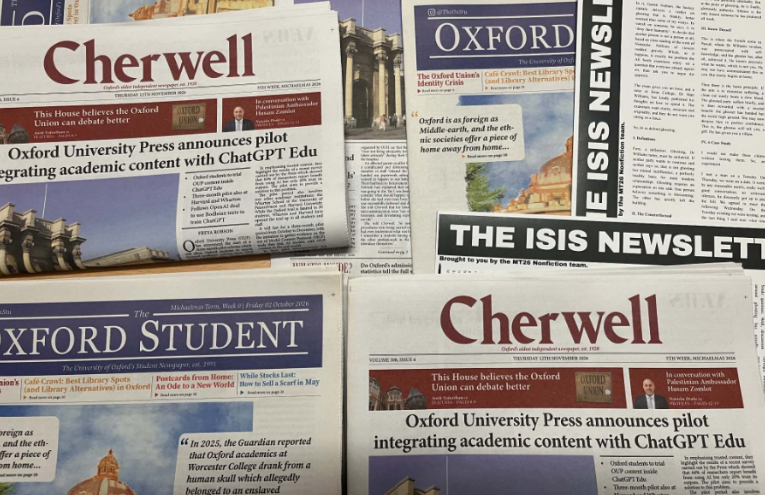
When Alexander Görlach, former publisher and Editor-in-Chief of The European Magazine, asked the crowd of Media Society attendees when they last picked up a printed newspaper, it was clear he expected an answer like his own: not for years. This would hammer home the trepidation that dominated his discussion about the future of modern, online journalism. But the contrasting response, a mix of chuckles and shrugs followed by “well, the last Cherwell, obviously”, seemed to jar after the laughter had died out. It’s clear that the journalism we have here in Oxford, a thriving, near-saturated print culture, and the journalism Görlach diplomatically discouraged us all from pursuing aren’t just slightly different, but incomparable – the word can’t possibly cover both.
Even after only a few weeks in Oxford, I’ve felt the palpable hold of student publications over this University, whether at bustling launch events at pubs across the city or unwavering recruitment drives at the Freshers’ Fair, more determined than any other society. Writing and reading about relevant issues both globally and locally is a key part of building this academic community, so it’s easy to adopt a rose-tinted view of what it means to be a journalist outside of the Oxford bubble. There is everything admirable but nothing realistic about our steadfast intention to educate each other about what goes on outside college walls.
So, if we want to pinpoint this dissimilarity, that word ‘intention’ is where I would start, as it’s precisely what is contorted in the digitised world of media that Görlach knows all too well. The multiplicity of sites, papers, and journals now readily available means it’s no longer possible (if it ever has been) to attempt to read a neutral perspective; you must, as Görlach implied, become almost mercenary with your intentions when seeking out material. He noted that the political orientation of a source comes second to the standards he wants to hold himself to in terms of quality of writing, citing his loyalty to The Economist as an example, but added that when he needed “cheering up”, he would turn to The Guardian. Such a level of selectiveness even in the day-to-day act of getting the morning headlines would have been unimaginable in a pre-digital age and is still an alien concept to our more inclusive culture of student journalism. The question of intention can equally lead to the opposite extreme – the majority of people do not ponder what they consume to the extent of Görlach, and rely on what the Reuters Institute labels “incidental exposure”, being entirely at the mercy of external companies, predominantly social media outlets, to deliver pieces of journalism at well-timed intervals on their feeds. The role of the journalist is, at both ends of the spectrum, at the mercy of whim, whether this is of the algorithm or the academic. Simultaneously, even the most established papers cease to be viewed as organisms by everyone but their most committed followers, turning into a variety of Instagram thumbnails and the regular voices of one or two particularly enigmatic commentators.
But it would be naive to claim that the decline of coherent media is purely the fault of technologicalisation – the call is also coming from inside the house. It’s no secret that journalistic principles have never truly applied to the senior money-wielders behind the tabloids, yet there have been recent instances where the relationship between the article and its financier has become paradoxical. For example, while we might not expect, or want, objectivity from a journalist, every release from a publication under the Polish media group Polska Press is automatically inextricable from its recent owner, state-run oil firm Orlen – the company echoes the ruling party’s intention to “repolonise the media”, leading to concerns for Poland’s media pluralism, a key characteristic of modern journalism. The gradual subsumption of countless local papers into a nationwide political drive is hardly something that can be shrugged off when doing the crossword, let alone reading the opinion pages.
With this in mind, if the only current sign of cohesion in newspapers or other bodies of journalism is their commercial and strategic utility, will we ever reclaim a media that prioritises informing? Yet we have been forced to ask this question on a far greater scale, since the role of the journalist as gatherer, fact-checker, and reporter has expanded in conflict zones (most recently in Ukraine and Gaza) to include sacrifice. Watching journalists lose their lives for their stories makes us wonder whether there is indeed a difference between a journalist and an activist – a comparison that feels almost shameful versus the low-stakes reporting done from our Cherwell-shaped ivory towers. Görlach pushes for these titles to be kept very separate, however, not because journalism should be apolitical, but because it should be undiluted in its purpose of providing information.
Nevertheless, this conclusion doesn’t take into account the fact that knowledge, especially in crisis zones, is a coveted luxury; losing it is an experience few of us will ever understand. Maybe we call a journalist one who recognises the sheer value of knowing things, of understanding them, purely because they have experienced unwanted ignorance.
It feels a little ironic that my first contribution to Cherwell might seem to threaten the justification of its existence, but in some ways I start as I mean to go on. The parameters of our humility here in Oxford shouldn’t be limited to the financial or academic, but expand into the social and journalistic. While the freedom and fluidity of our paper culture are welcomed with open arms, it wouldn’t hurt to look up from your pitch or commission every now and then to question where our journalism is taking us.