

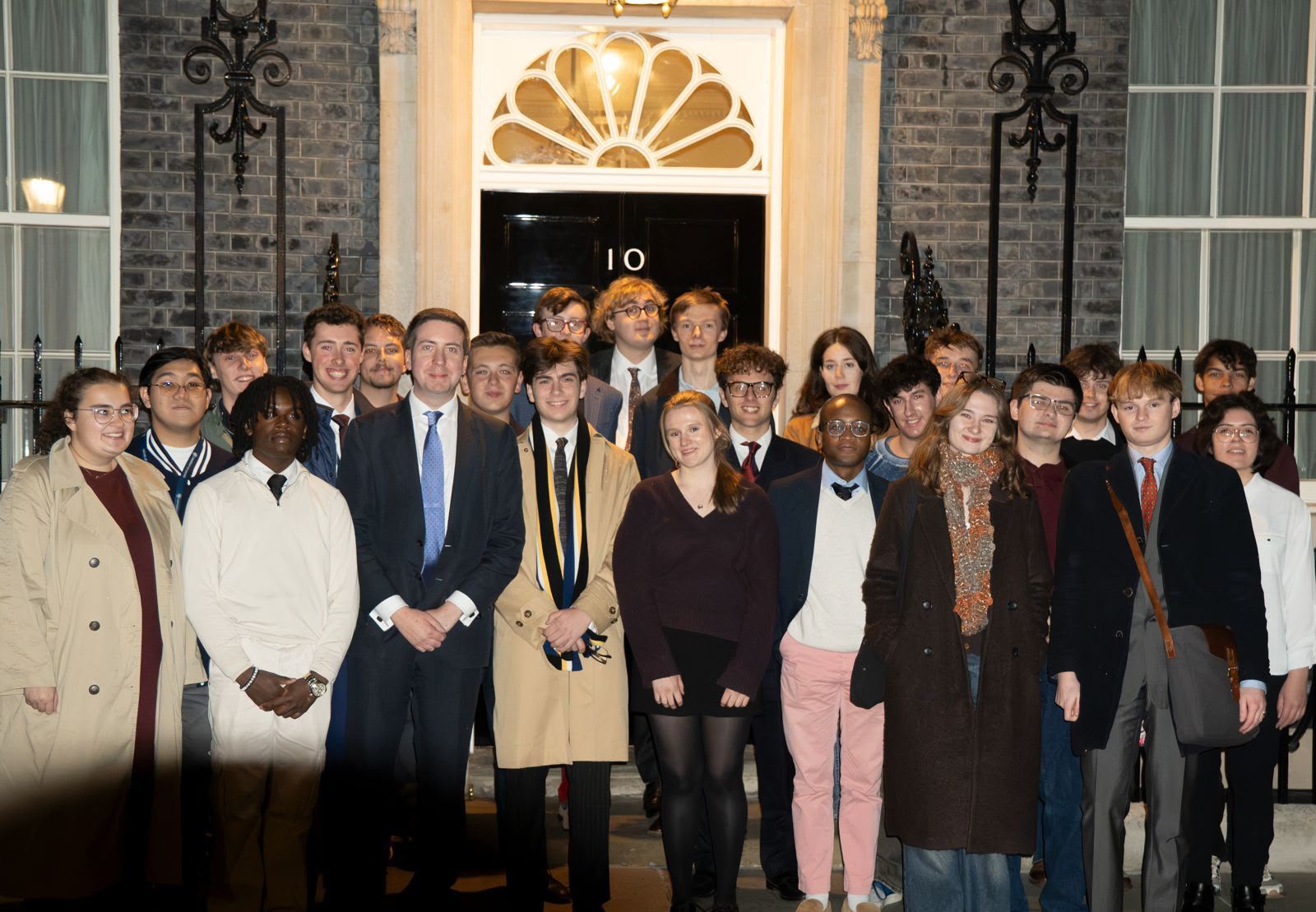
This academic year, two new societies have entered Oxford University’s political scene: Oxford Student Greens and Oxon Universities’ Reform Society. Despite their diametrically opposed politics, both represent a growing appetite among students for alternatives to the established political parties.
I have spoken to a number of students involved in societies across Oxford’s political spectrum. What has emerged from my conversations is a generation widely dissatisfied with the political status quo. But that dissatisfaction is producing radically different, sometimes diametrically opposed, visions of what Britain should become.
The national picture reflects this fragmentation. At the 2024 General Election, Labour won 40% of the vote amongst young voters, defined as 18-24-year-olds, but the Green Party secured 18% – a 14% increase on the previous election. On the right, Reform got 9% of the youth vote, narrowly ahead of the Conservatives on 8%.
One thing is undeniable: student politics is a world away from national politics. Recent YouGov polling shows the Greens are supported by 36% of 18-24-year-old voters, four times their support among the electorate as a whole. Reform, meanwhile, attracts just 8% of young voters, against 21% across all age groups.
Oxford’s student politics offer a glimpse of this changing landscape.
The Oxford Student Greens are one of the newest additions to the University’s political scene. Nathan Cohen, their political education officer, tells me that when the committee assembled over the summer to discuss establishing the society, two competing visions emerged. One was centred on bringing more students into the local Green Party, the other on creating a forum for political discussion and debate. The committee ultimately opted for the latter.
For many of the students now gravitating towards the Greens, their political journey began elsewhere. Some students who once aligned with Labour became disillusioned with the party under the former Prime Minister Sir Keir Starmer. “When Starmer shifted more rightward and abandoned a lot of the left-wing policy turn that Corbyn brought, I felt quite alienated,” Cohen explains. “Labour as a party, historically, has had times when it is a part of the establishment, and times when it is willing to take it on and actually adopt radical change. And I think that what we saw from [former Labour leader Jeremy] Corbyn to Starmer was a transition from one of those to the other.” Alfie Davis, an Oxford graduate who is now a Green councillor for the Holywell ward, tells a similar story of disillusionment. “I was a Labour Party member in my teenage years under Corbyn. I left sometime during the Starmer years,” he says. Davis says he did so after Labour took “this hard turn towards neoliberalism” and did not take a clear enough stance on “trans rights and Palestine”. Starmer, he felt, was “so focused on purging the Corbynite left”. Davis then joined the Green Party in order to vote for Zack Polanski in the leadership election.
Many young people joined the Green Party after Polanski’s election as leader in September 2025. The party’s membership rose by 50% in the month following his election, surpassing 100,000 members for the first time. Nidal Shah, president of the Oxford Student Greens, tells me that “a lot of people just want a home on the left” and found it in the Greens, both nationally and at Oxford.
Under Polanski, the Green Party’s willingness to challenge “the establishment” proved a potent source of appeal to students. “Under Carla Denyer and Adrian Ramsey, certainly we were considered a more likeable party by sort of the average voter”, Cohen acknowledges. Now Polanski has brought a change in style and substance. “Polanski has definitely brought a wave of energy to the party”, Cohen tells me, adding that he has made the Greens “a lot more willing to take on the Establishment in a bold way”.
The party’s readiness to advocate radical change to the status quo is a key element of its appeal to Oxford students who vote Green. “You have to target the root of these problems rather than sort of like doing small tinkering around the edges,” Davis tells me, adding: “There’s the same sort of level of anger by our generation that we’re going to inherit very little, right? We’re going to inherit nothing but problems made by decades of status quo politics.” To Davis, members of the Green Party are united by the conviction that “the fundamental system that we’ve got isn’t working” and that “we need foundational economic, environmental, social change”.
The issues attracting these students to the Greens are not always those traditionally associated with the environmental movement. Palestine, in particular, has become an important point of identification. Cohen tells me that the party’s “firmer stance against Israel” was a significant drawing point. He also points to its position on trans rights, arguing that “a lot of students feel that Labour has taken quite a cowardly stance”. The climate crisis has, however, “become a bit more secondary in the minds of people”. Cohen considers that it is the role of the Greens to “amplify that and bring it back into the national conversation”.
Yet the Greens’ increasingly assertive political identity is not without its complications. At the party’s recent conference, members voted to adopt a motion declaring that “Zionism is Racism”, a decision that exposed differences of opinion within the party. What do Green supporters at Oxford think of this policy? Views are mixed. Shah thinks “this is a popular policy”. He thinks that Palestine has receded from public debate, and that the motion therefore “refocuses us on a really important point that we may have been losing focus on”. Davis, who voted for the motion at the Green Party conference, says it was “shifting the Overton window and what’s acceptable when it comes to talking about Zionism, talking about Palestine”. Cohen, however, said he opposed the motion. “I am anti-Zionist, but I don’t think that that’s the same thing as saying that Zionism is racist,” he tells me. He says he is glad that the Green Party has distinguished itself by “standing up for Palestine”, but does not believe the motion was the right way of going about it
After ceding ground to the Greens in the first months of 2026, Labour seems to be gaining momentum amongst students again, recovering some of the political energy it lost under Starmer’s premiership. The Greens’ ‘Zionism is Racism’ motion has played a part in this. “A lot of people have come up to me really concerned with what the Greens are introducing, particularly the Zionism is Racism motion”, Awab Kennedy, Co-Chair Elect of the Oxford Labour Club (OLC), says. “People that I spoke to were horrified by it. These are Greens that have left and are finding themselves politically homeless.” He explains that people were most concerned that Amendment Three, which provided the motion would not be used to ‘pressure, proscribe or discipline members based on affiliation with Jewish community institutions’, was voted down.
Andy Burnham’s arrival at Number 10 has also helped Labour reclaim the support of young people who turned away from it. OLC Co-Chairs Catherine Harrison and Tom Haydon tell me that “the change in leadership has brought real energy to [the OLC]. A lot of students find Burnham’s focus on fairness and opportunity for young people easy to connect with.” Kennedy agrees, saying that Burnham has “hit the ground running”. One difference he sees between Starmer and Burnham is that the latter’s “messaging is more optimistic”. Whereas Starmer frontloaded his messages with the challenges the country was facing and the tough decisions that needed to be made, Burnham often “prioritises the solution”.
The Greens’ appeal is partly a story of disillusionment: students who feel Labour has abandoned the politics that once attracted them are looking elsewhere. But this desire to break with the political status quo is not confined to the left. On the other side of Oxford’s political spectrum, students are also dissatisfied with the party that has for so long been the home of the right.
For some young right-wing students, fourteen years of Conservative government did not deliver. Leyton Styles, a right-leaning student involved in both the Conservative Party and Reform UK, describes his disappointment with the Conservatives. “They did not do a good job for 14 years”, he says. “They promised in every single election cycle to lower immigration. They said they would control the borders, and they didn’t.” He adds that the problem current Conservative leader Kemi Badenoch faces in winning back young voters is that “every leader before her has said the same thing, but none of them succeeded”. David Balbus, a right-leaning student, points out that “most young people now grew up nearly entirely under a Tory government”. Consequently, “that has coloured the idea of what the right is for many young people in this country”.
Yet other students are not just disappointed with the Conservatives: they feel positively betrayed. I spoke to a right-wing student, who leans towards supporting Restore Britain. “I think the Conservative Party have lost a lot of trust with voters,” he told me, asking to remain anonymous. He said that there is an emergent view within Restore that “the Conservative Party needs to be completely destroyed, not even be on the political scene anymore”. To him, the 2024 General Election was the catalyst for the Conservatives being eclipsed on the right. He voted for Reform UK in 2024, and said he “wanted to see the Conservative Party crushed”.
For right-leaning students, a significant part of Reform’s appeal lies in its promise to break with what they see as a discredited political establishment. Among the students I spoke to, there was a recurring sense that the Conservatives are “the Establishment” and had become delegitimised as a result. Some Reform supporters are “saying to hell with this two-party politics, to hell with the political consensus we’ve had,” Styles tells me. “They realise that, given the scale of the challenge we face in this country, radical things have to be done, and that’s what Reform is promising.” He thinks that “Reform are addressing issues more bluntly and directly than any other political party has done in recent memory”.
But Reform is not necessarily the final destination for students disillusioned with the Conservatives. For some, Reform is not radical enough. Restore Britain is an attractive option. It may be a small party nationally, but it is “surprisingly big among the student hard right”, the Restore student tells me. Restore is “a Gen Z expression of Reform”, according to the student. Its social media presence is a key reason for this. X is the focal point of the online right – and its leader Rupert Lowe’s posts reach three times as many people as Reform leader Nigel Farage’s. The online space is dominated by reposting, content clipping, and resharing by anonymous accounts and activists within the Restore space – “it’s a constant content machine”. But the differences extend beyond communication. “Restore is just the more honest representation of what Reform voters really want”. The party provides a clearer stance on issues like immigration, but also on issues such as demographic change, identity and religion – territory Reform is reluctant to encroach on.
Part of Restore’s appeal to young men lies in its idealism. Most people involved in Restore are young Christian men; the gender skew is noticeable. Amongst its young supporters, there is a shared desire to “construct an idealistic view of the world according to a shared vision,” the Restore student explains. Balbus offers a similar distinction. He explains that some feel that “at best, Reform will do what the Tories wanted to do but more properly”. In contrast, “they see Restore as a proper, more radical social plan to restore the country the way it was”. It is, he suggests, “a bit like the right-wing equivalent of the left, which is a more idealistic view of the world”.
For many Tory students, therefore, there is a growing sense that the Conservative Party is no longer the home of the right. But how will the party respond to their rising right-wing challengers? How will it win back young people? Ben Ashworth, a member of Oxford University Conservatives Association (OUCA), tells me he thinks OUCA and the OLC are “far too complacent about the position of their own parties relative to Reform and the Greens”. “Often when the conversation has been brought up of whether Labour or the Conservatives are dead, there is a sense that they will simply survive because they have done so before”, Ashworth adds. He argues that parties need “an effort to be sustained” and that “with regard to the Conservative Party, I can see that there is a sustained effort taking place”.
Harriet Dolby, former President of OUCA, suggests that the Conservatives’ problem is partly generational. “Normally, you turn Conservative when you’re 31. In the last General Election it was 64,” she tells me. She attributes this shift to younger people struggling to reach the traditional milestones of adulthood, like securing a job, buying a home and having children. As a member of Next Gen Tories, a pressure group advocating policies to help people reach those milestones, she wants to make the party more electorally attractive to her generation.
The clearest ideological dividing line between the Conservatives and Reform, meanwhile, remains immigration. “Among the Tory types, they see immigration as an issue, but they don’t see it as the issue. They are more focused on the economy,” Balbus says. Alongside the importance placed on the issue, another difference is how each party makes the immigration argument. “We are not interested in the ethno-nationalist side,” Dolby says of the Conservatives. “We can beat that argument. We can contribute to the immigration debate with more rational and reasoned arguments.”
The differences between these parties extend beyond their competing policy proposals. They reflect fundamentally different understandings of what has gone wrong with Britain, and what needs to change.
After countless conversations, one thing is clear to me: politically engaged students are united by a sense of disappointment with the political order they have inherited, even if they disagree profoundly on its causes. For some, the object of their ire is fourteen years of Conservative government; for others, Starmer’s Labour. For still others, it is the political establishment more broadly. On the left and right, the party options are more diverse – and fragmented – than they have been in the past. The ascendant party challengers are challenging the political establishment from different directions, propagating not only different policies but also, at a more fundamental level, divergent narratives of the country and visions for renewal. As these visions become increasingly disparate, finding common ground is becoming harder than ever. But this has never been more important.