

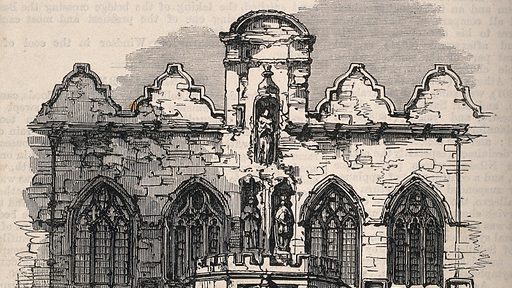
Sitting across from the short, bespectacled man in the tight suit, it was hard to believe he had been the focus of the past weeks’ controversy. Beyond Cofnas’s anxious window-glancing and uninspiring public speaking, the library felt like a poorly attended late-night JCR meeting. The only things reminding us of the external onslaught were the unwavering chants of “is your mother proud of you?” and “your views are pseudoscience” echoing from the quad below, and the journalists glancing at their watches.
I’d started my evening by interviewing Oriel friends as they gathered in solidarity in Oriel’s second quad to protest against the talk. Everyone was outraged that the Oxon Universities’ Reform Society had invited such a person to express his views in their college. Oriel students’ home was being dragged through the dirt, and as the protesters outside chanted “Oriel we know you like some old eugenics”, I felt almost embarrassed walking into the talk under their gaze. Once inside, my job was simple: to report the goings-on of the talk to the Cherwell journalists outside so that they could publish live updates.
I decided to try my hand at getting to know the audience. “No comment” was the first response I received. One stern-looking American defiantly said this before I barely had the chance to open my mouth. I moved on to the jovial middle-aged man putting on a larger-than-life appearance. He argued for the importance of listening to “new ideas” which will always threaten “those committed to the old”. He brought up philosophers of science (who I thought would only ever be mentioned in my tutorials) to defend the importance of attending Cofnas’s talk. It was Edward Dutton, I later found out, the far-right influencer and race pseudo-scientist. A skittish local writer, Joshua Webster, in tapered red chinos who claimed to be “undecided on the topic”, convinced me that I had observed a complete cross-section of the audience, so I resigned myself to networking with the other journalists while we waited.
The Oxon Universities’ Reform Society President, Vittorio Cuneo-Flood, reassured us that the talk was going ahead. The ongoing siege was merely a delay. Another 15 minutes passed. Inside, the hushed chatter of those labelled as racists. Outside, the cacophony of the protest. And then he arrived. Vittorio read a pre-written statement on behalf of the Proctors outlining that we were not to interrupt the talk. Then, an introduction by an Oxon Universities’ Reform Society moderator outlining Cofnas’s troubled history with academic institutions.
Cofnas was met by loud applause from a small group sitting at the front. The rest of us sat at the back awkwardly engaged in sporadic note-taking. His argument was divided into two parts: a condemnation of the “equality principle” underwriting DEI, followed by a history of how his own view had become marginalised and discredited. An incoherent, rambling style made Cofnas’s lecture appear like the words of a man desperate to share the thoughts ruminating in his head.
The noise of the protest outside was unrelenting. It would undulate, an endless backdrop to Cofnas’s inflammatory and provocative comments, turning the heads of the audience and speaker alike with every spike in intensity. Meanwhile, Cofnas droned on, constantly citing studies by forgotten and disproven academics. It was an hour of listening to a host of outrageous claims concerning the “substantial differences in overall brain size of different races” and insensitive comments alleging that Jason Arday was the author of plagiarised articles. The trouble was that I was neither interested in what he had to say, nor able to at that moment call out his lies – for I could never be as well-read on “racial realism” as any of the extremists in the room.
So I sat, and I waited. The talk continued mostly uninterrupted, except for a moment when the doors behind us were closed. Only later did I find out that my editor had considered telling me to leave for my own safety. Cofnas was given a microphone to help him speak over the chants booming from beyond the windows. Soon enough, Vittorio hurried him along to the end of his talk. A quick Q&A followed, where a Guardian journalist asked Cofnas whether he would “apologise to Jason Arday’s family”, to which Cofnas unremorsefully snarked that “the implication is that I’ve done something wrong by pointing out corruption by a powerful public figure… is that it?” and that others should be the ones to “receive these pointed questions”. It was a nice contrast to the other questions, which seemed designed to appease Cofnas and treat him as a legitimate academic. Afterwards, Cofnas slithered away through a back door into the night, escorted by proctors and security.
Then limbo: I found myself stuck in a room with unsavoury characters with whom I shared the common project of survival. Unsure how I would be received outside, I texted “don’t shoot” to my friends in the protest and was able to confidently walk out the front door and return to the embrace of familiar arms in the quad below. Luckily, I had made my status as a reporter known before, so I was greeted with smiles rather than boos.
I’ve since wondered who the real winners and losers of the situation have been. Despite the strength of the public outcry, Cofnas and his supporters have never had a bigger platform. It is true that fewer than 30 of the 110 seats were filled in the hall, but there is not a student in Oxford who doesn’t know Nathan Cofnas’s name or views now. All this for an uncharismatic and tainted man. It seems that Oxon Universities’ Reform Society, and in particular Vittorio, have succeeded in making themselves known. When otherwise they should have been just a footnote in Oxford’s long history of controversial speakers, their cause is now championed by right-wing news outlets such as GB News – with Free Speech Union external affairs officer Connie Shaw reporting on the talk.
My college has been shaken. Not just by the experience of the night, which involved students being locked out of their home and being intimidated by protesters, but also by the hostile coverage of their college. Oriel’s JCR Vice-President Gabriela Panova lamented that “comments online have substantially misrepresented both the role of Oriel College and the actions undertaken by the JCR”, which attempted to “provide students with meaningful opportunities to express their concerns”. Indeed, Oriel’s Provost reiterated in his address the morning after the event: “We [Oriel] did not ask for this event at our college.” One need look no further than the JCR’s statement condemning the event (which received 135 out of 149 votes) alongside similar MCR and SCR statements to understand how the student and governing body feel. Watching a man whose stated views actively target members of our community being hosted in our home to spread his hate speech has been nothing short of nightmarish.
So an event held under false pretences with a dull speaker and a small, discredited audience has spread racist thought and ideology. Even the instigators, Oxon Universities’ Reform Society, can’t be said to have benefitted. They find themselves officially distanced from Reform UK and rightfully ostracised. Perhaps this was a success of the protest. An added consequence has been the besmirching of the name of a community which did its best to cope under the circumstances, as well as the direct harm caused to the members of that community – most notably to the beloved head porter who was stampeded while protecting students. We must reflect on how things reached such a tragic state, and how our supposedly inclusive learning space was invaded by a man such as Nathan Cofnas.
Civil wars rarely have winners, and this was certainly no different.
In response, Nathan Cofnas told Cherwell: “Brain size is moderately correlated with intelligence. On average, Africans have smaller brains than Europeans, who have smaller brains than East Asians. These facts are not disputed in the scientific literature. Any informed person who says otherwise is lying.
“An argument is considered “outrageous and insensitive” if it poses a serious threat to wokism. My view is that we should be allowed to challenge that false ideology.”
In response, Oriel College also told Cherwell: “Oriel College did not choose to bring this event to our community but acted correctly to ensure the safety of our students while securing lawful freedom of speech for all. Thames Valley Police are responsible for managing public protests.”