

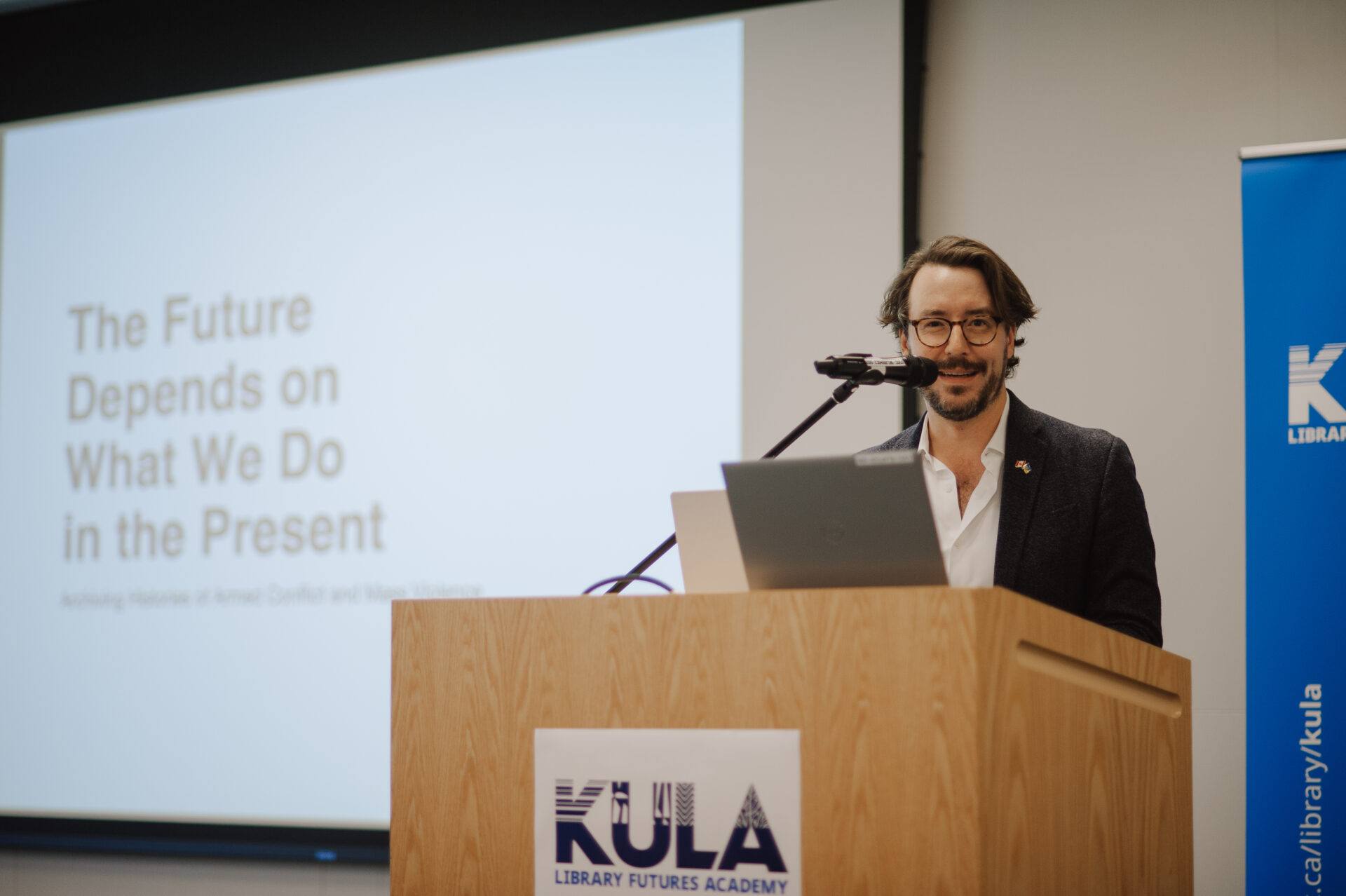
The photographs that accompany Dr Nathaniel Brunt’s talk are both beautiful and harrowing, as scenes of daily Yazidi life are interspersed with images of the funerals of young Kashmiri men caught up in militant insurgency. Brunt observes: “Anybody can look at a photograph and draw something from it.” His work certainly elicits a powerful emotional response.
I sat down with Brunt a day before his talk at the Weston Library, in which he discussed his work as a documentary photographer and scholar working primarily in Kashmir and Northern Iraq. He first visited the Kashmir Valley in 2013, where the long-standing territorial dispute between India and Pakistan has led to almost eight decades of violence. Encountering family photographs that offered an alternative perspective of the conflict and the lives shaped by it led Brunt to reflect on how these “vernacular archives” intersected with his own photographic practice. His PhD research brought together various disciplines – photojournalism, historical research, and archival practice – to interrogate how conflict is represented visually.
We begin our conversation by discussing what makes photography such an effective medium for understanding conflict. For Brunt, its potential lies in its apparent simplicity: “It is a very simple medium, a very simple means of communication.” The immediacy of a photograph and its affective power over the viewer is perhaps also explained by the medium’s ubiquity in today’s world. With smartphones having vastly expanded access to image-making and sharing, Brunt sees images as an integral “part of our language and our day-to-day lives”, allowing them to speak across languages and cultures.
Yet in the complex reality of war, photographs can distort as much as they can illuminate. A single image, Brunt explains, can flatten the nuances of conflict: “There is probably a binary between good and evil going on, victim and perpetrator, these kinds of things. And the reality of any sort of conflict is it’s often far more complex than that.”
Later in our discussion, Brunt expands on the problems with the ways that Western media captures war: “We want conflicts to be clean in the sense [that] we want a good guy, and we want a bad guy. We want to be able to support one side and see the other as an enemy. Whereas in the kind of conflicts that I’ve covered, like Kashmir, it’s changed very much over time. Especially in an insurgency, with the blending of insurgent groups with civil society groups and human rights groups, it is very hard to pick out who’s necessarily a good guy or a bad guy. It is all very murky.”
By bringing his images into dialogue with other visual materials within a culture, Brunt’s projects seek to resist these kinds of overly simplistic and reductionist interpretations: “I’ve started to think about it over time as this process of stepping back and trying to understand the position of my image as a very small contribution to the broader ecosystem of photography that may go on in a conflict.”
This commitment to a richer, more multifaceted understanding of conflict is central to The Sersal Project, which focuses on the Yazidis in Northern Iraq and its diaspora population. Brunt founded the project with his colleague Marc Marin Webb in 2024, after Webb unearthed a collection of photographs of daily Yazidi life, which were taken on an American archaeological expedition in the 1930s and held at the University of Pennsylvania’s museum. Their aim was to repatriate these photographs from an inaccessible institutional archive and reunite them with the Yazidi community by exhibiting them in the places where they had originally been taken.
In the context of the genocide perpetrated by the Islamic State of Iraq and Syria (ISIS) against the Yazidis in Sinjar in 2014, these photographs carry immense significance. During the atrocities of the two-week campaign, where more than 5000 Yazidis were executed and over 6000 women and children were trafficked into slavery, family photo albums were abandoned as people fled their homes, resulting in much of the personal visual history of the Yazidis being lost.
ISIS also actively targeted the Yazidis’ cultural heritage, destroying the places through which collective memory is sustained in their oral culture. Brunt explains: “ISIS went around and blew up all the shrines, which are the core aspects of the ways that history is communicated to younger generations.”
By displaying images of everyday life in the streets of places such as Bashiqa-Bahzani, where the walls still bear the scars of the brutality of 2014 through bullet markings and murals depicting the abductions of children, The Sersal Project introduces an alternative depiction of Yazidi life into these spaces.
Brunt describes how more than a decade after the genocide, many Yazidis want to be seen as more than victims: “Most of the people in the West know the Yazidis only for those two weeks that they were stuck on the mountain or for the women who were captured and sold into sexual slavery.” Whilst having photographic documentation of ISIS’s crimes is important as a form of evidence and recognition, Brunt explains how the project creates space for a different kind of visual representation, one where the Yazidi community can see themselves beyond and distinct from the horrors of their recent history. The photographs from an archaeological dig over a hundred years ago now take on a new meaning and purpose in this context: “Something they can be proud of in their culture, a positive aspect of their culture.”
For Brunt, one of the central questions of his work is thinking about the ways in which archival materials can be activated and put to use in places like Iraq and Kashmir. “Preservation in a weird way is not our major priority”, Brunt explains, “we’re really interested in the potential of what an archive represents”. Indeed, the project collaborated with a local music group in Sinjar, the Mirzo Music School, whose members performed traditional folk songs at the exhibition and developed new music in response to the images. Brunt describes how this multidimensional encounter between visual and oral culture enabled an “interesting dialogue between past and present” and transformed remembrance into an active, collective process in the Yazidi community.
One example that has clearly stayed with Brunt powerfully illustrates the project’s tangible impact in these communities. When someone recognised the groom in a series of wedding photographs from the institutional collection, Brunt and his team were led to the very house in Bashiqa depicted in the images, which had miraculously survived the 2014 attacks. There, they were introduced to the groom’s grandson, who had never seen the images of his grandparents’ wedding. Just a few months ago, Brunt met the groom’s son, now living in Germany, and used these photographs to open a conversation about his family’s story. It is exactly this kind of encounter that Brunt’s work makes possible.
I ask Brunt about how he establishes the relationships necessary to undertake a project of such weight and with such delicate sensitivities. His response reflects the truly collaborative and participatory methodology that he has spent decades cultivating: “These kinds of projects are not things that you could do through a Zoom call. You’ve got to be there on the ground, meeting people, developing relationships … you’re often sitting down for a million glasses of tea and smoking a million cigarettes, especially being in Iraq.”
Time is essential not only to ensuring that a project remains strongly aligned with the community it represents but also to allowing Brunt to reflect critically on his own approach: “I keep coming back to the idea about time, but it’s the idea of slowness. I have been able to come back each year, back to work that I’ve been doing in the field and spend a lot of time with it and really think about what I’m doing.” This pace, he explains, creates room to consider the ethical questions at the heart of his practice: “What are we trying to actually achieve here, and how are we actually trying to do something positive for the community that we are working with?”
The digitisation of the photographs is central to this ethos, reflecting the project’s commitment to activating the images beyond the project itself. Through a QR code, anyone can access a digital drive containing the images, enabling them to circulate throughout the Yazidi diaspora. As Brunt explains, the photographs are repurposed in new contexts, shared across platforms and even made into AI-generated videos, allowing people to connect with these images on their own terms: “It is about making things usable, so that people can use the raw resources of the photographs and do something with them.”
For younger generations of Yazidis, and especially those displaced by ISIS’ campaign, this is particularly important. Brunt observes how young people growing up in internally displaced person (IDP) camps in Iraq, and in Germany, where Brunt is currently working, are curious about their history and culture: “They have a lot of questions about where they came from, and there’s been a real drive to really dig into this kind of stuff.” The Sersal Project responds to this need, offering a way to reconnect with a heritage brutally disrupted after 2014.
Looking ahead, the next phase of the project will focus on scaling its work globally. Brunt hopes to expand into Syria, where there is a significant Yazidi population, and in 2027, funding will support initial exploratory work in the United States and Canada, where substantial diaspora communities also offer opportunities to extend the project’s reach. Ultimately, the ambition is to develop an adaptable model that can operate beyond the Yazidi context and support other communities seeking to engage with their visual heritage.
Towards the end of our discussion, Brunt observes: “it’s becoming increasingly complex to even visualise what modern war is.” Indeed, the images emerging from the battlefield of Ukraine, where drone footage enables every aspect of war to be recorded, or from Gaza, where the sheer scale of the destruction challenges the limits of representation, underscore the difficulty of making contemporary warfare comprehensible.
For Brunt, a possible solution lies in shifting the focus towards the personal and familial realities of conflict, looking at “the way that war or mass violence completely disrupts the domestic space and families. There’s something really powerful about that for me at least”. Brunt’s work not only offers a means of comprehending the nature of modern conflict, but also serves as an important point of connection and recognition for the communities whose experiences it seeks to represent.