
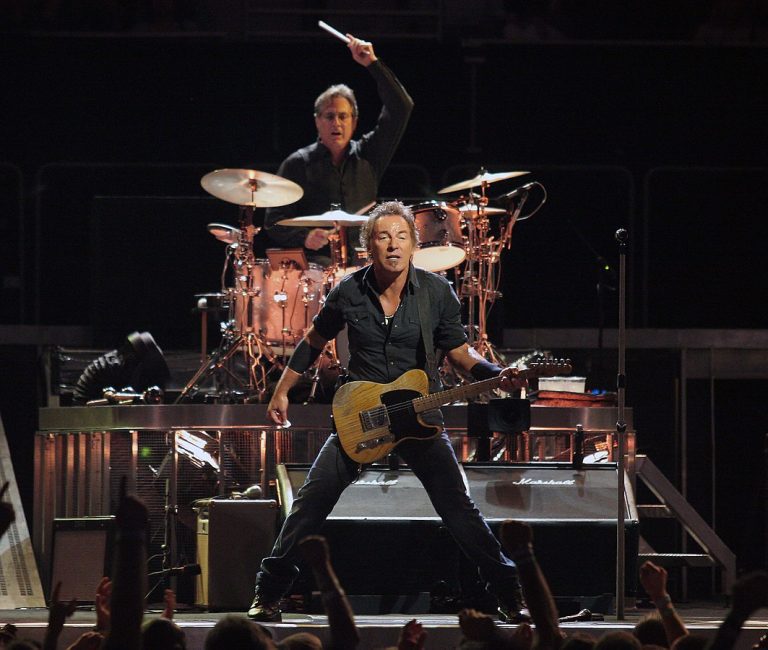
A tantalising balance of folk, country, soul, and rock ’n’ roll, Bruce Springsteen is a master storyteller. His songs are ballads in the strictest sense of the word: almost every track narrates a story.
In calling Springsteen’s songs ‘elegies’, I do not only mean that these stories explore sorrow. These songs tackle sorrow by remembering and honouring the complex narratives of those who suffered. They commemorate, protect, and preserve stories.
Springsteen eulogises blue-collar America. He writes ballads about working in factories, on the highway, navigating union construction jobs in order to pay the bills. His lyrics are delivered from the perspectives of working class women and men, outlaws, and estranged families. From Darkness on the Edge of Town (1978) onwards, Springsteen’s music delivers a vision of America’s fragility during the 70s and 80s.
‘Factory’ heralds the workers whose lives are consumed by labour. ‘The River’ is the story of teenagers pulled into marriage too early by an unexpected pregnancy. ‘Used Cars’ expresses the aspirations of a boy who longs to win the lottery and relieve his parents of an asphyxiating financial burden. ‘The Price You Pay’ addresses guilt and bewilderment in the aftermath of the Vietnam War. In the midst of economic, political, and emotional crises, these are all songs that interrogate and undermine the American Dream. From the desolate Midwest to the Utah desert, the notion of a ‘promised land’ haunts communities. It is an ideal slowly being eroded from within.
Above all, these are stories of escape. They take place on the run. They are delivered by speakers who long to break free from cycles of generational trauma and poverty, from the stifling confines of small-town life, from the poison of regrets and lost loves. The speaker of ‘Highway Patrolman’, Joe Roberts, pulls over in his cruiser and watches Frankie escape across the Canadian border to absolve himself of the pain of having to arrest his own brother. “Independence Day” of The River (1980) rips my heart open as a son, on the eve of departing from home, acknowledges the wounded relationship he has with his father: “They can’t touch me now, and you can’t touch me now, they ain’t gonna do to me what I watched them do to you.”
I find ‘Bobby Jean’ of Born in the U.S.A. (1970) devastatingly beautiful not only because it depicts the sweet sublimity of teenage friendship, but because it is a song about escape. The speaker sings of a friend whom he treasured through his high-school years, in hopes that she may hear him and remember him: “I’m just calling one last time, not to change your mind – but to say I miss you, baby.” In this elegy, he pursues a girl who left him behind to chase her own dreams. He grieves her absence all the while respecting her decision to find freedom.
The highway, in Springsteen’s writing, is a site of freedom and desolation. As these characters thirst for freedom, they are equally paralysed by the fear of change. These are songs about how big and empty the world is when there’s no one left to holler you home. The only thing left is chasing the people and the things we love. We can never hold onto them tightly enough.
There’s a ragged hope in even the saddest of Springsteen’s lyrics. There’s a strange, volatile beauty in the hunger of wanting as we lose ourselves in a ruthless pursuit, claiming our delusions even when what we want could never be ours. The chase – your foot down on the gas, the wind lashed through your hair, bloodshot eyes on the horizon – is what makes this large, loveless world worth it.
But what, exactly, is this world that Springsteen writes about? Much as these songs speak on behalf of communities, the experiences they express are not generalised. These are not commentaries, manifestos, on behalf of a group or a nation. These are stories. Each song tackles not a universal tragedy but the ‘little world’ of a human being.
Springsteen’s narratives are preoccupied with individuals, with characters. His storytelling brings to mind not only elegy, but epic. These characters are defined by their economic and socio-political circumstances. But they are also defined by pain and joy, by love and loathing. They are concerned with the smallness of life: with food, with woodwork, with electricity, with the basic pleasure of splitting a bottle of beer with a lover at sunset.
The River (1980) is my favorite album not only for its woeful ballads, but also for its more lighthearted, licentious songs such as ‘Sherry Darling’, ‘Out on the Street”’ and ‘Ramrod’. These are ballads of snarky, hot-headed young boys serenading women. This is youth before it could tell the difference between lust and love. When I close my eyes to the music, I savor how vividly Springsteen conveys that world to us. It’s a hot summer evening, and our blood is on fire.
These characters loved and raged and lived. They ate, danced, laughed, and mourned. They built highways, and mended roofs, and felt the wind in their hair. Their stories are no less glorious than they are ordinary. They are, in a sense, epic.
I’m a cynic. But Springsteen breaks down my defenses. He’s the chink in my armour. I cannot bring myself to believe that anything but love could’ve produced the eight-minute epic, ‘Drive All Night’, a song so achingly intimate it makes me falter before my next step, my next task, my next turn of the page. I want the world to rest a little just for the span of a song. The soft wail of a saxophone beckons me into a sleepy solace where all rationality may dissolve, step after tottering step, into the night’s velvet. The drumbeat keeps time. A voice croons. This is love, I think, and this is what it feels like to love someone with a bass and a few bars of piano.
I’m a coward. I want to jump from the cliff, to put my bare, breakable heart on the line, to be the wildest, wiliest that I can be – but to do these things is scary, and I am scared often. I want to do the brave thing, the thing that leaves me torn in pieces on jagged rocks because I dared to jump.
It is this razor-sharp edge between terror and the sublime at the heart of ‘Dancing in the Dark’. The song expresses that bravery is vulnerability. In the midst of desperation and catharsis, ‘Dancing in the Dark’ acknowledges that to be vulnerable in the act of loving is the bravest thing anyone could do. Springsteen reminds me, every time, of what I need to remember: that you could never really live if you sit around crying over a broken heart, or worrying about your little world falling apart. He reminds me that I can start my own fires.
Springsteen’s highway elegies are songs about ‘little worlds’. And what is each of us, if not a little world? These songs are grounded in the culture and social landscapes in which they are set, but the extraordinary mundanity in the lyrics’ narratives transcends boundaries of time, space, nation, and belief. Springsteen tells us that the long, open road that is our life is not only a site of sorrow but of limitless possibility. Go on and live, he says. Drive all night. Be true, be brave. Take the highway by storm. Keep chasing. Remember, in the end, that you were born to run.