Thursday 9th July 2026
Blog Page 811

Oxford beaten by Cambridge again in latest Guardian rankings

0

Oxford remains in second place in the Guardian’s 2019 university league tables as Cambridge clinched the top spot.

It is the third consecutive year that Oxford, Cambridge, and St Andrews have occupied the top three positions in the table.

The yearly ranking system scores colleges out of 100 based on courses, satisfaction, funding per student, teaching quality, and student-staff ratio among other measures.

Oxford’s overall score out of 100 fell by 0.7 from 98.1 in 2018.

The list also ranks colleges for their performance in subjects. Oxford rose to the top spot in Anthropology this year, beating out London School of Economics from last year.

The University remained the best in the country for Business, Chemistry, Music, Geography, and Maths, among others.

King’s College London suffered the biggest drop, falling 19 places to 58 from 39 last year.

Trinity St David’s and Westminster were the biggest risers, as both climbed 27 places. Trinity St David’s shot up from 112 to 85, while Westminster rose from 108 to 81.

Science is not just for boys

Under 30% of Maths freshers at Oxford are female. When I was the only girl in my Further Maths class at school, naïvely, it never crossed my mind that it would be the same here. It’s not just maths – women are disproportionately represented in many Stem (Science, Technology, Engineering and Mathematics) degrees. But where does this problem start? How serious is it? And what – if anything – should Oxford be doing about it?

“Good tactical move picking a subject with lots of boys – plenty of choice for a boyfriend,” a family friend joked when I told them I’d chosen to study Maths at university. I laughed, and brushed off the comment.

She was right about Maths being dominated by “lots of boys”, but, clearly, this isn’t appealing enough to get more young women into Stem degrees. Statistics from A-Level students in Summer 2017 show that women are actually 36% more likely to carry on to higher education than their male counterparts. Women are well-represented in higher education as a whole, and this representation is even evident in Oxford: there were 27 male and 30 female applicants per 10,000 population in 2017.

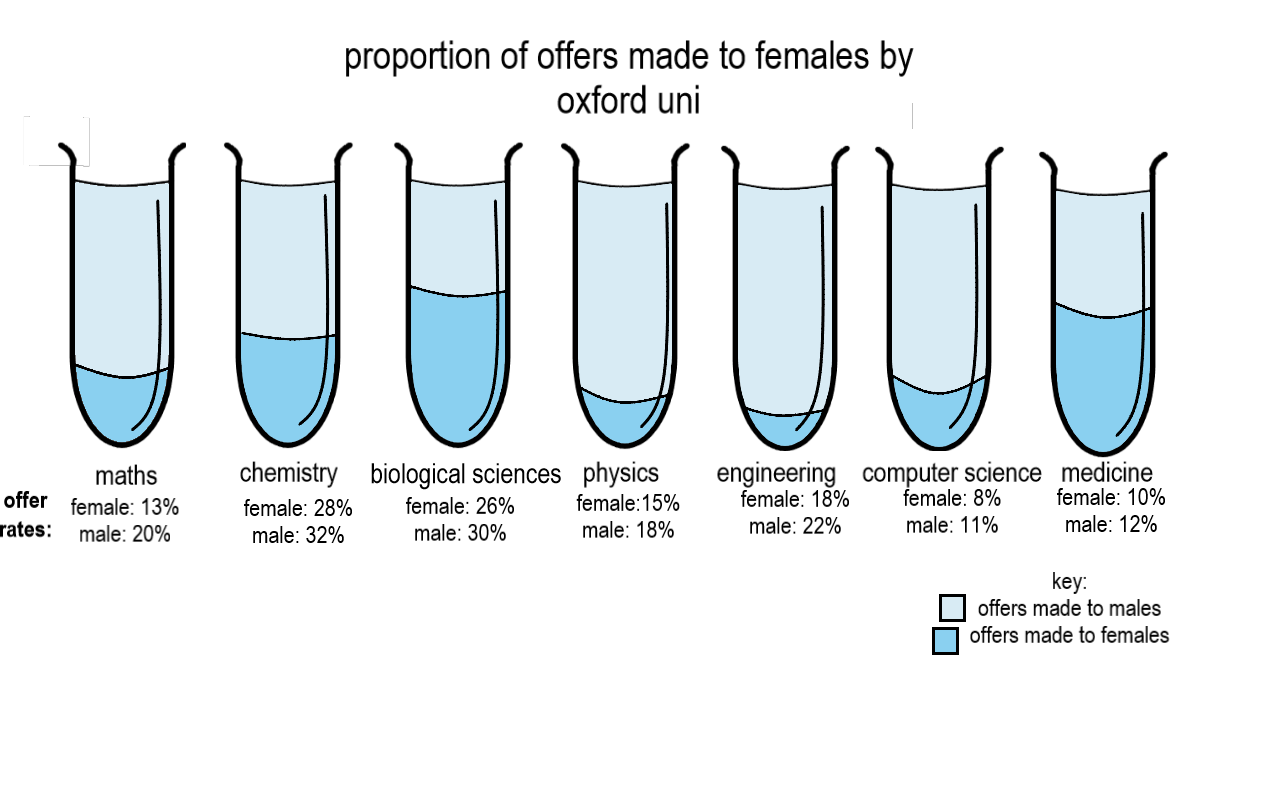
Oxford is closer to gender equity in some Stem subjects than universities nationally. At Oxford, as an average from 2014-16, Biology and Medicine made a slightly higher proportions of undergraduate offers to female than to male applicants (58% and 53% respectively).

National figures illustrate 60% of graduates in Biology and 81% in Medicine were female in the UK in 2016-17, showing them to be, on average, much more female-dominated subjects. Oxford’s equality doesn’t, however, seem to stretch to the traditionally male-dominated subjects. In Maths, 27% of offers were made to women by Oxford University (2014-16), 20% for Physics and 14% for Computer Science. Compared to the number of female graduates in these subjects nationally, it seems that Oxford is considerably worse than other universities at recruiting women in Stem subjects.

Proportion of offers made to women by Oxford University

In the UK in 2016-17, Maths, Physics, and Computer Science had 39%, 41%, and 15% female graduates respectively. In light of the massive underrepresentation of females in these Stem subjects, any efforts by Oxford toward achieving the previously mentioned equality for Biology and Medicine seem slightly misguided. It’s hard not to question why one of the world’s leading institutions makes an effort to close the gender gap in subjects where men are generally worse represented but seems to ignore the shocking disparity in most other Stem subjects.

Seven-year-old Maya’s response to the prompt, “Draw a scientist”

So, why aren’t there more women studying Maths and other Stem subjects at Oxford? In fact, the gender gap in admissions is more pronounced in Oxford across all stem subjects. In Biochemistry, for example, the admissions rates are 16% for female applicants compared to 27% for male applicants.

For many subjects, the difference is only by a couple of percentage points, but this is seen consistently across all Stem subjects, even for those where fewer women apply. Admissions tutors aren’t discriminating against female applicants as such, but the lack of any positive discrimination in preference of women is indicative of little awareness of how marked the gender imbalance is. This may not be an intentional bias, but as MP and former Higher Education Minister David Lammy suggested in his most recent critique of Oxbridge admissions, interviewers are thought to subconsciously recruit their own image, and science tutors are overwhelmingly male. For Mathematical, Physical, and Life Sciences (MPLS), just 6.5% of professors and 12.5% of associate professors are women. The result is that most Stem interviews are conducted by men – I was the only woman in the room for all ve of my interviews, even though there were two interviewers in each. Looking at these proportions of male staff, this must have been the case for many other applicants.

Nationally, Stem degrees tend to be less appealing to women than men, made clear by the previous statistics on graduates. But does this gap between Oxford and national averages mean that Oxford Stem courses are especially unappealing?

It may be that many young women don’t think they are good enough to be studying at Oxford, especially not a Stem subject. Computer Science, Maths, Biomedical Sciences and Medicine are all in the top ten most competitive Oxford courses in terms of offer rates, which could be deterring women from applying.

A study conducted in 2003 by David Dunning and Joyce Ehrlinger is just one of many that examines relationship between female confidence and competence, showing that women tend to be less con dent than men, and that the lack of this self-assurance can obstruct their personal progress. Similarly, a review of personnel records at Hewlett-Packard found that women working there only applied for a promotion when they felt they met 100% of listed job requirements, in comparison to men who were happy to apply when they thought they met 60% of these.

Applying to Oxford could be seen as somewhat comparable – women are less confident in their own abilities and so are less likely to apply. This seems to resonate with our student population. Jess, a Maths student at Somerville, said that she receives feedback from her tutors to “be more con dent in [her] work” and believes that this lack of confidence results from being in a minority of women on her course. This is especially noteworthy in light of the fact these are the women that have applied successfully for a Stem degree.

They have not been dissuaded by perceived male dominance, but are still aware of a contrast in self-belief. One can only imagine how endemic the problem must be if even the women who are successfully studying Maths at Oxford still find themselves lacking confidence in comparison to their male peers. Beth, a Maths student at Balliol, agrees: “the girls I know are very modest about their maths ability and most are surprised to have [been offered] places”.

The lack of female professors within the MPLS departments here at Oxford may be discouraging female applicants, who face a stark lack of inspiring female academics to model themselves on. With far more women now in a position where they have the opportunity to conduct scientific research compared to several hundred years ago, female scientists are only just coming to the forefront of scientific discovery. Yet there is a need to better recognise the achievements of both historic and contemporary female scientists in the syllabus at degree level. Ella, a Biology student at St Catherine’s, says that of the scientists that learn about behind key discoveries, “there’s very few females, maybe one in ten.”

A ‘Feminist Philosophy’ module has recently been added to the first-year Philosophy course as part of an attempt to tackle the gender imbalance (PPE is a subject with below 30% female undergraduates). The hope is that this will increase the popularity of the course with girls, and a similar approach should be taken within the sciences. Gender equality cannot be achieved without recognising female achievement in such a male-dominated eld in a concrete manner.

The gap is, however, clearly already evident before university entry, and so whilst they have an important role to play, the problem is too complex to be the sole responsibility of higher education institutions. So where do these differences first become evident?

Looking at girls’ achievement in science GCSEs (which are generally compulsory), they appear to perform very similarly to, if not better than their male counterparts in terms of proportion receiving A-A* grades. These higher achievements do not translate into girls choosing the subjects for A-level, however.In Physics, the proportion achieving A-A* was 42% for both male and female students, but a mere 21% of those sitting Physics A-level in summer 2017 were female.

Interestingly, Computer Science is the only Stem subject that already has a noticeable gap as early as GCSEs. The subject is also the only optional one at GCSE level, making it clear that the issue isn’t that female students are less intelligent than their male counterparts, but that something is putting them off these subjects to such an extent that the gender gap emerges as soon as an element of choice is involved.

Around 13,200 female and 53,500 male students took Computer Science GCSE. This makes it less surprising that the gap in terms of numbers of students taking the subject remains at A-level; in 2017 only 9% of those sitting Computer Science A-level were female.

Despite female students’ achievement at GCSE, they are not then choosing Stem related subjects at A-level. Whilst taking a subject at A-level doesn’t necessarily mean you go on to study it in higher education, a lot of Stem degrees do require Science A-levels, so by not choosing the subjects at this stage, the option for these studies in higher education is removed. Hence, once this difference in academic choices is established, it’s almost inevitable that this translates to degree level. Girls in single-sex schools are known to do better in GCSEs but according to Alice Sullivan, director of the Centre for Longitudinal Studies, at the UCL Institute of Education, they are also “more likely to take male-dominated subjects such as Maths and Science at school.” This strongly suggests that having boys within your learning environment has a negative impact on whether girls choose Stem subjects. Perhaps, girls are discouraged from studying subjects when they know they’ll be surrounded by boys in their classes or that at mixed schools the efforts of getting pupils into these subjects is focused on boys.

Proportion of girls taking Stem subjects at A-Level

It is important to highlight that many boys only select Physics and Maths-related subjects. Gender inequality is not simply an issue of an absence of girls in Stem, but also the lack of boys in the more traditionally ‘female’ A- levels too. For example, just 27% of students sitting English A-level in 2017 were male. The problem of a lack of girls in Stem-related subjects cannot be expected to be solved without promoting a more diverse range of subjects to anyone regardless of gender.

According to a paper published by Psychology professors Gijsbert Stoet and David Geary, girls did as well as or outperformed boys in science tests they conducted in a number of countries.

In relative terms, boys were strongest in maths and girls were strongest in reading, which could underpin subject choices for some girls in higher education. Proportion- ately, Science was their best subject for 24% of girls, for 25% it was Maths, and for 51% read- ing, whilst 38% of boys achieved their highest scores in Science, 42% in Maths, and just 20% for reading.

This study perhaps helps explain why girls aren’t going on to pick science-related A- levels – they are outperforming boys in other subjects too, and are choosing to go into these areas instead. This also indicates why there is a large concentration of boys in the sciences – they are simply performing slightly better in these subjects on an individual level.

Whilst this perhaps help us better understand the gender differences in subject choice at A-level, I’m not convinced this means it has to be the case. What this mostly implies is that girls are as capable as their male counterparts of study- ing Science or Maths A-levels but are not do- ing so, and are consequently unable to take these options later.

Where girls are clearly academically capable of Science A-levels, it would be great to see schools encouraging them more. When I told the career guidance counsellor I wanted to study Structural Engineering, she told me she’d never met a girl interested in it, and questioned whether I wanted to study such a male-dominated subject. I changed my mind about my degree further down the line, but at the time, as a 15-year-old who lacked self-confidence, her uncertainty massively affected me and I doubted whether I was actually interested in or going to enjoy a degree “for boys”.

There is already evidence of Oxford University making a clear effort to encourage women into Stem. Many colleges, including Trinity, Jesus and St Catz, held ‘Women in Science’ open days in February for those studying science at A-level. The days included talks from top academics, and aimed to encourage girls into choosing a Stem degree. Although the feedback for the days was overwhelmingly positive, it did primarily attract those who already knew they wanted to do a science- related degree.

To ensure efforts like these aren’t being made too late, it would be positive to see these open days supplemented by one earlier on during compulsory education, considering that the data suggests the gender gap can be as early as GCSE, where Stem subjects are optional. Open days like these can change people’s minds – Beth found meeting like- minded girls at the ‘It All Adds Up’ Oxford Maths open day aimed at girls “helped change [her] view that Maths at uni was a male-only subject”.

Students in the Mirzakhani Society, which promotes the welfare of women studying Maths at Oxford, will be handing out flyers at the upcoming Maths open days, with the aim to encourage women to apply. The flyers will include comments from current female Maths undergrads. I found the Maths open day at Oxford incredibly intimidating – confident boys were eager to ask and answer questions during the talks, and it left me doubting that I was good enough to apply. Something like these leaflets, showcasing the valuable experiences of women currently studying at Oxford, might have made a difference to how I felt.

A better gender balance in Science departments will take time, and until all the obstacles that currently prevent women from applying and gaining places on Stem courses here are eradicated, Oxford will not be selecting the best students possible. The steps they are taking currently are promising for the future of girls in Stem, but action needs to be taken earlier in girls’ school careers, and therefore more school involvement is pivotal.

The future is perhaps looking more positive – in analysis by David Miller of results of ‘Draw-a-scientist’ studies which prompt children to draw a scientist, the proportion drawing a woman has increased from 1% in the 1960s and 1970s, to 28% today.

Author note: Oxford University’s data currently only categorises students as ‘male’ or ‘female’.

Oxford academic forced to leave after Home Office dispute

0

One of Oxford University’s “brightest” new recruits was forced to leave her post and return to China, after the Home Office declined a visa for her 22-month-old baby.

Fengying Liu, a postdoctoral researcher in pathology, was recruited to Oxford’s Sir William Dunn School of Pathology in October last year after completing her PhD in Germany, where she lived with her husband and child.

On being offered the Oxford position, she moved to the UK without her husband and daughter, having made the decision to apply for their visas separately to make the costs more manageable.

However, a technicality in UK immigration law that requires parents to seek visas together with their children meant that the separate application for Dr Liu’s baby was refused.

“The reason my daughter got rejected is because we did not apply as a family,” Dr Liu told Times Higher Education. “I did not understand this at the time. It was also too expensive – about €1,400 [£1,226] per person for the visa application alone.”

Employer-sponsored UK visas cost up to £3,220 including an immigration health surcharge of £400 per year. However, family members require their own visas too, meaning the cost of moving to the UK even for a short period of time can increase rapidly.

While Oxford was able to reimburse Dr Liu’s own visa costs, it is not the University’s policy to extend this to dependents.

Her departure has raised further concerns over Oxford’s ability to recruit talented academics from around the world after Brexit, with several academics expressing their failed attempt to recruit suitably qualified staff.

Ulrike Gruneberg, the principal investigator of the laboratory that recruited Dr Liu, said that she already faced “extreme problems” hiring suitable candidates, which she attributed in part to the “complicated and flawed” nature of the UK immigration system.

She added: “[We] don’t get any applications from the EU now and there are hardly any qualified British candidates for postdoc positions, so it becomes much more important for us to be able to employ people from outside the EU.

“My concern is that British science is just going to collapse.”

Professor Gruneberg told Cherwell: “Clearly the underlying law is the problem, but from my (very limited) experience the immigration team at the University could have definitely been more helpful.

“I don’t think Dr Liu was made aware of possible problems with bringing her family when she accepted the job in my lab, and as scientists we rely on the University to take care of these aspects of hiring.”

Oxford vice chancellor, Louise Richardson, said earlier this month that British institutions like Oxford could struggle attract talent once the UK leaves the EU.

Richardson said: “Personally, I think we are all in trouble in England, Ireland and the rest of the EU over Brexit. We know [our elite status] rests on the excellence of research from people who [come] from abroad… It is painful for many of us as committed internationalists, citizens of the world, to find our country turning inward.”

Had Eno-ugh of revision? Give ‘Ascent’ a listen

0

t’s never easy when it comes to choosing a revision playlist. Depending on how far away your exams are, some songs may be entirely useless.

If you play Sigur Ros too early into the process, you’ll be lulled into a sense of false calm and relaxation. If you play Dragonforce’s ‘Through the Fire and Flames’ too late, then you won’t get the exhilarating push you need just before you move into the final ambient tunes. However, there are some songs that stand alone: the ones that you can play over and over again and never lose your appreciation, the ones where you can focus on your revision and rarely get distracted. These tunes stand in the pantheon of greatness, unrivaled by their inferiors. Brian Eno’s ‘Ascent’ is one of these tracks.

Having listened to this song, and this song only, several thousand times during my A-level revision, I can confirm that it’s a fine piece of music that won’t wear thin with repeated listenings. One of its key advantages is the complete absence of lyrics. You don’t need to get distracted working out any abstract meanings or symbolism. All you need to do is let Eno’s synth chords wash over you.

Despite a lack of dramatic progression, change in structure or even a conventionally repetitive melody, ‘Ascent’ still manages the difficult balancing act of engaging the listener while also allowing them to hold a clear focus on other activities. Eno’s frequent use of dissolves allow each chord to flow into the next one, creating an other-worldly sound that’s ideal for the stressed student.

It allows you to lift off into a different atmosphere. The song was originally composed for the 1989 NASA documentary For All Mankind, so it’s not surprising that Eno strives to evoke such a moving, ethereal awe in every chord. ‘Ascent’ has also been used in Steven Soderbergh’s Traffic and Danny Boyle’s 28 Days Later to create similar atmospheres of calm and relief. It forms a universal connection with listeners because of its transcendent synth tones, and Eno’s DX-7 synthesiser feels like the perfect instrument to create the mesmeric beauty of space, time and existence.

So whether you’re trying to absorb a lengthy quote from James Joyce’s Ulysses for English,
revise some inscrutable logic for Philosophy, or craft an exemplary piece for Fine Art, there’s no doubt that ‘Ascent’ will help you break through barriers and realise your full potential.

New colleges would not improve Oxford’s access

2

The Higher Eduation Policy Institute’s suggestion of creating new colleges for under-represented groups is well-intentioned, but it misses the real root of Oxford’s access problem, and would only perpetuate socio-economic segregation. The misguided proposal implies that students from under-privileged backgrounds should be shunted off into separate spaces, whilst existing colleges continue to be woefully inadequate in their diversification and access programmes.

Oxbridge’s imbalanced intake is almost certainly not a result of insufficient spaces, but rather that they aren’t fairly used. Around 41% of Oxbridge’s intake is privately educated, and over 80% come from the top two social classes. 48% of offers go to students in the South East and London, and between 2010 and 2015, 13 Oxford colleges did not admit a single black student. The idea that simply providing a greater number of spaces through the establishment of new colleges would solve this verges on the nonsensical: this is more than evident in the admissions statistics. There are plenty of privileged applicants who currently miss out on Oxbridge places. What’s to say new colleges wouldn’t simply provide more places for them, rather than boosting student representation?

The alternative would be the somewhat disturbing possibility of these proposed new colleges being targeted solely at disadvantaged demographics. Placing these students apart from their more socially privileged peers, in colleges which would likely be less wealthy and more geographically distant than existing ones, is more grudging tokenism than real inclusion. If access solutions can be offered, they must not be limited to a few colleges, but put into place across the whole university.

This isn’t even an ‘if’ question: it has been done. Around 15 years ago, my own college, Mansfield, set out to improve its diversity and it has succeeded – over 90% of my year are state-educated, and this percentage is set to increase further. Financially, we are very much one of the least wealthy undergraduate colleges: the excuse that other colleges are too strapped for cash and resources to do anything doesn’t cut it. Mansfield is, as yet, an anomaly in the Oxbridge establishment, but the success of its access initiative proves similar progress can and must be made by other colleges.

Recipe Corner: Asian-style Pesto Soba

I like to think of this dish as the summery lovechild of Itsu and pesto pasta.

It consists of a soba noodle base dressed in a zesty homemade pesto that only resembles the half-eaten contents of the trusty jar residing in your fridge door in name.

This dish works well served either hot or as a cold salad.

If you fancy the crisp freshness of the latter, just give the noodles a quick wash with cold water once they are cooked and drained, before mixing in the pesto.

This tangy take on a well-loved student staple will make your friends think twice before doubting your culinary prowess.

Don’t just throw together an- other depressing pasta and sauce combo.

Whip up an exciting new take on the age old favourite, and revolutionise your next batch of pesto pasta/pasta pesto.

Ingredients:

For the Asian Pesto:

  • A handful of coriander
  • A handful of parsley
  • A handful of mint
  • 1/2 of a red chilli
  • A thumb of fresh root ginger, grated
  • 1 garlic clove, finely chopped
  • 1 tbsp toasted sesame oil
  • 1 tbsp lime juice
  • 1 tbsp agave syrup

Everything else:

  • 320g Drived buckwheat (soba) noodles
  • 2 ripe avocados
  • Sesame seeds
  • Pine nuts

Method: 

Blend together all of the pesto ingredients using a blender.

Do this until you achieve aconsistency thats a bit leafier andchunkier than a standard Tesco or supermarket-bought pesto.

Cook the noodles in a saucepan of boiling water for around six minutes (or according to packet instructions).

Drain the noodles once they are cooked.

Remember to give them a cold wash if you want a salad-type dish. Then mix in the pesto, using as much as you would like.To serve, top with chopped avocado and sprinkle with sesame seeds and pine nuts.

Blind Date: “I had to reclaim my seat from a toddler having a tantrum.”

0

Emily Westlake First Year, PPE, Keble

Finding Elliot was easy – I just had to look out for the other solo per- son awkwardly loitering, and fol- low the Life editor’s non-specific descriptors such as ‘relatively tall’. Finding a table however was slightly more challenging – brave to choose Turf as a meeting point on such a warm summers evening – but a small table shared at close quarters with two strangers adds a certain comfort to plunging into one on one conversation with a totally new person. Conversation flowed easily – admittedly, as two PPEists, we had common ground in talking about politics. I never like to judge a book by its cover, nor do I like to jump to any conclusions, but I remember thinking he was a little bit older, so it came as a sur- prise that he’s a second year, and actually younger than me (cougar alert)!

First impressions? 

I remember thinking he was a bit older.

Quality of the chat?

Political. With a few awkward silences.

Most awkward moment?

An unexpected third party (a baby).

Kiss or miss?

We parted with a friendly hug.

Elliot Gulliver-Needham, Second Year, PPE, Corpus Christi

I was waiting outside Turf Tavern, anxiously scanning every person who walked past, when Emily showed up. When we walked in to get a drink, I was surprised by how not-awkward it was, even when a toddler tried to steal my spot at the table we were sitting on. After finally getting the toddler to leave, we ended up chatting mostly about politics (both of us are PPE students). But I won’t say who was (or seemed) more informed. As the date went on and the pints flowed, I ended up spilling embarrassing secrets about my Tumblr past, as well as talk- ing about how much the 2015 election hurt me personally (it was the night I found out I was allergic to cats). I was particularly jealous of her stories of working on the American election. After a few hours and many Peronis, we parted ways and I went and got an Ahmed’s (on my own). A good ending to a good date.

First impressions?

She was down to earth and laid back.

Quality of the chat?

Surprisingly high.

Most awkward moment?

Trying to reclaim my seat from a toddler having a tantrum.

Kiss or miss?

Kiss.


Talk Matters

“Come on Max, if you’d just go for a walk you’d feel heaps better.”

Behind this comment is a loving parent: what makes the comment so alarming is that they show how serious mental health issues continue to be dangerously misunderstood. When I was diagnosed with Bipolar Disorder Type II, I sat my parents down to explain how the condition had affected me in the past and meant for the future. They retorted, “Oh, we thought you were just being a difficult little shit.”

These comments highlight a critical fault in the way we don’t understand the limits in the agency people with mental illnesses have over their moods and behaviours. To an extent, people are right to think that the same things that help them when they’re feeling a bit sad or stressed, for example, might help someone with a mood disorder that throws them into the extreme depths of depression and anxiety. However, what characterises a mood disorder is precisely that they are severe enough to cause “difficult”, undesired behaviours and that they don’t respond well to interventions that might help less severe moods.

In recent years, much has been done to improve understanding of depression and anxiety. Yet, in their more extreme forms, these (and other mood disorders) are still shamefully misunderstood.

Perhaps this is an issue with the language in ‘mental illness’ as a term: it has more in common with a long-term disease such as diabetes – needing long-term treatment and restricting the lives of sufferers – than with an illness such as the flu, which has a negative impact but goes away after a relatively short period of care. Mood disorders have resulted in me feeling, at various points, depressed – unable to move, tired, with aches and pains, lacking in appetite and motivation, confused, and suicidal. Or at other points manic – with racing and incoherent thoughts, inflated self-esteem, excessively talkative and distractible, sexually driven, spending excessive amounts, and sometimes experiencing delusions and hallucinations. What’s more, there’s also a significant likelihood that people with bipolar disorder develop an anxiety disorder (about three quarters do), or an addiction problem (like about half of people with bipolar), and the rate of suicide is fifteen times higher than in the general population. Only about 20% of people with bipolar disorder are considered “high-functioning”, with the other four in five struggling to stay employed long-term or keep in touch with their social peers.

It’s a heavy set of statistics, one that illustrates quite how heavily the odds are stacked against people with bipolar disorder – and mood disorders more widely – being able to live balanced lives. Above all, diagnoses of mood disorders are lifelong: this means that, according to psychologists, they can be managed, but never cured, and that people experiencing them will have to stay alert their whole lives or risk spiralling into the grip of a severe mood episode.

Considering the agency of people with mental illnesses and the time frames of their conditions, it seems that referring to disease or disability is more adequate: appropriately, Oxford University provides support for people with mental illness through the Disability Advisory Service. However, the connotations of mental disease (associated with neurological degeneracy) or of mental disability (typically referring to intellectual disability such as Down syndrome) mean that the language of mental illness will have to suffice for this article. I hope that the meaning of illness can be questioned, and understood through a wider, less discriminatory lens.

Sadly, the unfortunate effects of a condition that one cannot opt out of are frequently compounded by issues arising from people’s perception of such conditions. Far too often, people carry a misconception that those with mental illness are in some way failing to do enough to control it. This wrongly and damagingly assumes agency in people with mental illness where there is little to none. It’s easy to see how it comes about – perhaps the neuro-typical observer witnesses behaviours that exceed their own reaction (such as a screaming or sobbing fit) in the sufferer. “I might have done that,” they think, “but I pulled myself together so that I wouldn’t. Why can’t they do the same?”

We’re not all equally good at pulling ourselves together, whether mentally ill or not. However, to look at the behaviour of someone with a mood disorder and think it to result from incompetence in dealing with tough situations is misguided and can lead to counter-productive attitudes and interventions. The options for someone with a mental illness in such a situation might range from sobbing (at best), to darker, suicidal moods. The behaviour they exhibit having strived their hardest to resist their mental illness’ negative pull might match up with the behaviour a neurotypical person could foresee themselves having if they ‘allowed’ themselves to feel worse.

If the standard of agency that neuro-typical people have is used to judge those with mental illness, we end up with a very skewed perception of how well someone with a disorder is managing their mood. They might have been fighting their hardest to reach what, to others, looks like a low point. When we assume in such ways that the behaviours of those with a mental illness are in some sense an indulgence or a failure on their part, we drastically underestimate the great forces at work on them and the great strength required to face up to such forces.

What’s more, this flawed thinking actually undermines how we think of the actual capabilities of someone with a mental illness, disempowering them in the process. Confusing the limitation in choices available to them with the variety of ways they can react to these, those with mental health problems are often thought of as reckless, unhinged, or lazy.

Surely it only takes looking at the great lengths they go to in order to live less affected lives to dispel such an impression: consider the time needed to regularly go to appointments with doctors, psychiatrists, therapists and support groups; consider, too, the alarming side effects that they put up with because of medications or medical interventions (a far from exhaustive list could include such things as nausea, memory loss, skin problems like psoriasis, hyper- or insomnia, potential kidney failure and – with a dark irony – suicidal thoughts). Consider quite how terrifying treatments like electroshock therapy and deep brain stimulation are, both involving having electrical shocks administered to the brain, the organ that constitutes your identity as a person. If those with mental health issues are subjecting themselves to such things in the name of being healthier, the toll that not intervening takes on them surely is remarkable, and their strength, assiduity and bravery in trying to manage their condition is commendable.

Of course, not everyone who experiences a mental health problem will seek the sorts of treatments outlined here, and many are right not to do so and to manage their condition in another way. There is no best solution to the problem of mental health: different treatments are effective in varying degrees and they are likely to affect each of us differently. Some of us will struggle with therapy, others will find it really helps them understand and address issues. Some will do better without medication, others will find it essential in allowing them to be in control of their lives.

However, the obvious stakes at play in the treatments above demonstrate the severity of people’s conditions regardless of the treatment chosen and the strength of character so many of them have in facing up to them. The pursuit of mental health is anything but reckless or lazy. The sooner this can be acknowledged, the sooner we can give those who experience it credit for their defiance of the complex neural mechanisms which attempt to sabotage their lives in every way.

Rather than a “pull yourself together” comment delivered at a time of crisis, praise for the steps they are already taking and offers of help where useful would go a long way to help the situation. This will help them receive more accurate feedback as to their character so as to construct a self-image that is less negative and less skewed. Given the unfortunate effect that mental illness has on self-esteem, this may well be a good way to empower those who experience it in fighting the unfairly negative feedback their brains are constantly providing them with. If you know someone with a serious mental illness, consider quite how many victories they have had: as morbid as it sounds, if they are still alive then they’ve already got one thing to be proud of. If they are managing to keep in touch, that’s another. Feeding themselves daily is too.

Though I have, until this point, made much of the seriousness of mental illnesses, it should also be stressed that increasing awareness of their severity shouldn’t come at the cost of downplaying mental suffering on the less severe end of the spectrum. Demanding more realistic attitudes and better treatments for those with chronic mental issues doesn’t mean abandoning those whose distress is less permanent. Unfortunately, there seems to be a line drawn in the sand which changes as often as the tide comes in and which separates “significant” conditions from fleeting discomfort, and, more problematically, considers the latter kind as something not worthy of treatment or help.

Any degree of undue suffering is undesirable, and worthy of being addressed. I continue to be shocked by the number of people I know that suffer from mental illness to a large extent but, for a long time, don’t consider themselves worthy of treatment. Part of this is the illness itself: if your self-esteem is low, then your ability to feel you’re deserving of services that people with serious difficulties use is greatly diminished. It’s easy for people with mental illness to admonish themselves for using others’ time and money to get better when there must be someone suffering more than them (this, of course, is wrong on many levels). However, the way mental illness is understood by society at large also feeds into these damaging perceptions, and can troublingly reinforce the distortions they might believe because of low self-esteem.

Oxford University’s counselling system does seem to approach this issue relatively successfully. Anyone going to the service is set up with two-to-three sessions to begin with. For many, a few hours of frankly reviewing the issues they face and the factors at play will be a good way of taking account of how they are doing and how they should address issues going forward. For some, though, this won’t prove sufficient, and they are given the option to have more sessions if they wish.

Options like this are crucial for bridging the gap between neurotypical and mentally ill populations, and for intervening before suffering escalates to a chronic level. The counselling service is unfortunately under-appreciated for its ability to help out in this realm, with many thinking of it as being “reserved” for those with serious conditions. In fact, almost the opposite is true: the counselling service is probably best placed to help precisely those who are going through a rough patch, before their mental health deteriorates to the point of needing psychiatric intervention.

Oxford has the second highest budget of any British university for mental health services, so, though the counselling service can be quite busy, they do have the resources to deal with students wanting help. Furthermore, the Disability Advisory Service can help make arrangements from exam scheduling to housing for those with more chronic forms of mental illness, and peer supporters and Nightline are on hand to listen to your issues and struggles. Raising awareness of both the University’s many services and others such as the Samaritans, Mind, and Warneford Mood Clinic is a worthwhile pursuit, as it will help people with any degree of mental suffering understand that they need not face their struggles alone, as well as informing their friends on the best ways to support them.

Above all, the guilt and stigma around both needing help and seeking help must be fought. This takes many forms, and means bringing an end to “pull yourself together!” comments and the mentalities behind them, not shying away from discussions about mental health, and, where possible, “coming out” about your own mental struggles. When it’s safe to do so, starting conversations about your experience of mental illness will help alleviate the shame of being affected by it, much of which simply results from such topics being taboo.

Mental illness permeates humanity. Not only do you personally know several people who are affected, you also constantly engage in the creations of people with mental illness: you have read some Edgar Allen Poe or perhaps some Virginia Woolf. You have heard the music of Tchaikovsky or Joy Division’s Ian Curtis. You have seen the art of Michelangelo or Van Gogh. You have watched the performances of Carrie Fisher or Catherine Zeta Jones. You are reading this article.

Mental illness is a major part of normal society, and it’s time it be treated as such. Mental health is just another factor that affects our abilities to go about our lives day-by-day, and as such is nothing to be ashamed of. I feel lucky that, when seeing friends, it’s become fairly normal to ask each other how our mental health is, much like asking if someone slept well or if their ankle is recovering after a sprain.

This acknowledges that mental health is like any other form of health: just as consulting a friend on a toothache might lead to them giving you valuable advice to go to a doctor if it seems severe from their perspective, asking about each other’s mental health means you’re more likely to spot issues before they get too severe. We can provide each other with somewhat educated help rather than just wondering why someone looks glum and not knowing what to do. Not only does opening up like this lead to deeper, more meaningful friendships, it also chips away just a little at the stigma around mental illness in encouraging those in your entourage to see it as an acceptable thing to be affected by, struggle with, and talk about. We’ll start to accept the important basic facts about mental illness: it affects millions of people in the UK to differing degrees, it permeates your social groups, it often can’t be cured, but it can be managed, and those affected by it can live fulfilled lives. Those fulfilled lives start with this acceptance and the wider the acceptance, the better for us all.


Georgian independence petition discovered at Bodleian

0

A century-old petition calling for Georgian independence was revealed on Friday by the Bodleian Libraries to honour the centenary of the county’s independence.

The petition contains a number of objections against the occupying Russians as well as appeals to the international community to stop the atrocities and pogroms unfolding in Western and Central Georgia.

The petition was signed by 3000 men and women of all classes from across the country. The Bodleian Libraires claims that those signing the petition were doing so “at great personal risk.”

The document has been in the Bodleian Libraries’ possession since 1920, however it was only over the past few weeks that have researchers realised its importance.

Originally presented at the 1907 Hague International Conference, the petition is the first documented occasion of the Georgian population protesting for further rights as a nation.

Georgian independence was achieved in 1918, eleven years after the petition first surfaced.

The document was part of a collection donated by Sir Oliver Wardrop, who – along with his sister, Marjory – was friendly with the petition’s instigator, Varlam Chrkezishvili, an exiled Georgian nationalist. The Wardrop siblings were both the founders and major benefactors of Kartvelian (Georgian) studies at Oxford.

The the significance of the document was realised and researched by Dr Beka Kobakhidze, Dr Nikoloz Aleksidze, and Dr Gillian Evison.

Dr Kobakhidze said that he was “honoured” for his role in making “forgotten names public after 111 years”.

He said: “At a time when there was no compulsory education and a high rate of illiteracy, the petition is the first documented instance when the Georgian national historic narrative of the Georgian-Russian relationship comes not from elite groups, but from ordinary people of all social classes.

“Men and women, entrepreneurs, workers, nobles, peasants, clergymen, and teachers from all regions of Georgia put their signatures to this address to the political west.

“Looking through the petition I had a feeling that I was interacting with my ancestors, people who stood for national liberties while risking their lives.”

Kobakhidze added that many Georgians might be interested to see the names of their relatives on the petition.

Bodleian Librarian Richard Ovenden claimed that the discovery of the petition made clear the importance of Libraries and archives and showed the “role [they] play in the preservation and dissemination of information.”

Ovenden also hoped that the attention generated by the document “will encourage greater scholarship on Georgia, the Wardrops, and this turbulent period of history.”

Dr Evison noted the “striking” nature of the document, stating: “Signatures have been collected on many different sheets of paper – accounting paper, on the back of the petitions, and written in ink, or pencil – so it tells its own story of how keen Georgians were to make their mark through whatever means were available to them.”

Former president of Oxford’s Georgian Society, Nikoloz Aleksidze, told Cherwell: “The petition is remarkable for a number of reasons. It undermines the commonly articulated view that the 1918 independence was merely an accident and that Georgians never wanted or tried to secure independence from the Russian Empire.

“The document proves that the unanimous Georgian protest against the Russian Imperial Rule and colonialism has a long history from the early 19th-century rebellions to the 1918 Declaration of Independence and later 1991 restoration of Independence from the Soviet Union. The petition is a crucial chapter in this history of resistance.

“From the point of view of Georgian-British relations, the document was edited by later British High Commissioner to Transcaucasia, Oliver Wardrop, who was the most meticulous and ardent defender of Georgia’s independence in the West during his entire life.

“Britain’s support for Georgia’s independence, territorial integrity and European integration, spearheaded by Oliver Wardrop, was reinvigorated after the restoration of Georgia’s independence in 1991.”

The 29-page document is now publicly available online.

Exposed expenses hide a darker truth

0

The parliamentary expenses scandal of 2009 led to new standards of transparency and accountability in public life and demonstrated that the public will not tolerate blatant misuse of funds and cronyism.

Almost ten years on, it seems that Oxford has yet to learn this lesson. Last week, Freedom of Information requests sent by Cherwell revealed exorbitant expenses claimed by college heads. Even worse, over half of colleges contacted failed to give detailed breakdowns of expenses despite their legal obligation to do so.

Even the shamefully incomplete responses from colleges hint at possible scandal without further details. Take, for instance, the former warden of New College, Sir Curtis Price. Last year, he claimed a whopping £1200 from New College from his exploits at the Knickerbocker Club, a highly secretive New York gentlemen’s club, and the private member’s club, Soho House Chicago in a matter of days. It’s hard to think of a reasonable explanation for such use of college funds, and somewhat predictably both New College and Sir Curtis Price have declined to comment. As a bare minimum, expense claims must be open to scrutiny and accountable to college members to prevent questionable use or indeed misuse of college funds.

I don’t mean to suggest that expenses are never justifiable. Some expenses claims are certainly legitimate; for instance, college staff members ought to be reimbursed for travel or accommodation costs, incurred whilst doing their job. Rather than screaming blue murder at the sight of any large expense claim, we must use our common sense to evaluate the reasonableness of such claims. For example, consider the fact that St Edmund Hall’s Principal Keith Gull claimed almost £500 on presents and gifts in 2015. Without any context, this claim seems to drift into questionable territory and raises the ugly possibility that the Principal could be siphoning off college money for his own gain.

However, it would be extremely unfair to jump to this conclusion, as Mr Gull clarified to Cherwell that this money was spent on Christmas presents for the entirety of the college staff. Of course, it can be debated whether £500 was too much (or perhaps even too little) to spend on this annual gesture funded by the college given the number of staff involved, but the point is that we should not be too quick to judge.

Nevertheless, colleges ought to be far more transparent with how they spend their money. As students, we have a right to know how our fees are being spent, which includes the right to be indignant at unjustifiably lavish expense claims. That’s why perhaps the most concerning result of Cherwell’s Freedom of Information requests is what they failed to reveal. Several colleges failed to respond to the requests entirely, whilst others refused to provide any breakdown of the annual expenses claimed. This is a big problem: with no accountability to students, alumni or the wider public, there is the potential for expenses to be excessive, used inappropriately, and open to fraud.

It is an unfortunate consequence of the collegiate system that the existence of multiple colleges fosters this opacity. Freedom of Information requests are less effective across so many colleges since each one responds to these requests with varying levels of detail (if they do respond at all). This lack of consistency means that the transparency of colleges varies widely. Not only is this unfair to students attending less transparent colleges, but this also means that it is more difficult to hold individual colleges to account. Instead of being able to petition the University as a whole to release vital records on past expense claims, students must petition their individual college.

Consequently, no mass student action can be taken to demand greater transparency, and individual colleges can continue to hide away their expense claims without fear of critique. Compare the situation at Oxford to that of other UK universities such as the Universities of Glasgow and Edinburgh, where Freedom of Information requests have resulted in the complete breakdown of the expenses of their vice chancellors right down to receipts for the purchase of a slice of cake and a bottle of water. This is the kind of transparency which Oxford colleges ought to provide, and it is a sorry state of affairs when less than half of the colleges actually do so.

Nevertheless, the student body should lead by example. At present, JCR accounts are often only scrutinised by students directly involved in JCR finances rather than the college student community at large. This is particularly lamentable given that the spending of JCR money is frequently determined by those few students who are interested enough to attend General Meetings, typically without consideration of budgets. As a result, JCR expenditure has the potential to be highly partisan and excessive, and so all JCRs should publicise a breakdown of their spending online to JCR members in the interests of transparency and accountability.

Ultimately, colleges must be more transparent with their use of college funds. Senior college staff should not claim expenses unless they are willing to publicly defend them. Having contributed to college funds ourselves, we have a right to know how college money is being spent and to judge for ourselves whether the expenses accrued are justified. Excessive expense claims are deplorable, but the current complete lack of transparency on behalf of many of the colleges is the true scandal.