


Friday 24th July 2026
Blog Page 391

Behind the Screens: The Good, the Bad and the Ugly of Referencing in Film

Referencing in Hollywood is a bit like a currency at the moment; writers can buy some pre-existing emotional attachment, with very little effort on their part, to enhance their film. Certainly, the discourse around referencing the past (often manifesting as nostalgia) has made it seem like a cheap alternative to originality. The complaints over the Disney remakes make this abundantly clear. However, nostalgia and referencing, on the whole, isn’t the entire opposite of originality, but can instead coexist to create something more than a film. We all know films don’t exist in a vacuum, and so when a screenwriter references something from the past, the outside world, or the film’s inner world, it broadens the film’s scope by connecting it to pre-existing ideas. It can add emotion and understanding, but it also risks being safe, boring and predictable. There’s a line that a film has to walk between, and, particularly nowadays, it is toed repeatedly, with varying results. 

We seem to live in an age of nostalgia, and, of course, because capitalism exists, this is being exploited by Disney in the live-action remakes of their animated classics. Remakes cleverly broaden a target audience to include both the original generation and a new one, meaning more revenue. Yet, simply harking back and tapping into audience’s nostalgia doesn’t necessarily make a film good; Disney seems to rely on the premade connection audiences have with the original and does very little with it. The majority of the live-action Disney remakes have flopped critically and in audience reviews, because the audience knows they are being played – regurgitating films feels cheap. Thus, the key to successful nostalgia in films is knowing what the essence of the original was and knowing what can change. 

There is one Disney remake that I saw as relatively successful, Cinderella (2015). It shows a deep understanding of the original source material whilst keeping the story at once fresh and nostalgic. Two examples of this are the dress and the romance between The Prince and Ella; both are revised, but both keep the quintessential elegance that Cinderella is famous for. I thought it was an interesting choice to not include the songs from the original in the remake. Quite astutely, the writers recognised that the songs are not a fundamental part of the film, unlike many Disney princess movies. The film remains in character but reconfigured to create something different. 

Star Wars Episode VII does this to a certain degree, as the plot is an almost carbon copy of Episode IV, yet they manage to reinvent some characters and ideas. Simply, it seems, the key to nostalgia is to add something slightly new. There needs to be a reason why someone watches the new film rather than their beloved favourite. If we think of nostalgia in more general terms, for an era, Stranger Things is an example of where they create something new, but grounded in 80s references, enabling the audience to reminisce, even if you weren’t alive at the time. It recalls a ‘simpler’ time, not just the 80s, but childhood. 

We all know the power that nostalgia has over us, but to make nostalgia work in a film it needs to give us more than a reference. Intertextuality is described as ‘the interrelationship between two texts, especially two works of literature’, especially how one helps the understanding of another. This can be applied to films as well. I first heard the term in reference to Pan’s Labyrinth in the YouTube video by Nerdwriter, a video I would seriously recommend. Nerdwriter notices that, in regards to referencing, director Del Toro constantly uses references to other historical events, other fairy tales and other stories to elevate the film to be more than just a stand-alone movie. The references enable the audience to understand the central theme of disobedience and allow Ofelia to escape death and, in a sense, live in the references she makes. In these multiple references, such as to Shelley’s Frankenstein, Del Toro creates a new fairy tale from the body parts of others. Similarly, Stranger Things references Stephen King and 80s classic films, but by having no one source, it becomes a homage rather than stale and predictable. These references mean that an otherwise solitary movie suddenly has a wide range of cultural associations to connect itself to, and it more easily embeds itself into the culture on the whole. Indeed, referencing can make a film more than just a film; it affords a film both greater longevity and emotional impact.

Thanks to Marvel, the idea of a cinematic Universe is something we’ve all become familiar with now. Love it or hate it, you cannot fault Marvel for the unprecedented task of connecting all its stories into a cohesive film experience. In-film referencing has become a standard for the MCU, as it produces interconnected films that are entertaining for audience after audience. How do they do it? It’s a combination of clever, thoroughly planned writing and an understanding of the desires of the viewer. The first film following a new superhero uses far less referencing than sequels do, and often in a more understated way. They understand that the audience needs time to understand the new hero in their own right, and this allows non-Marvel fans to see the movie and enjoy it as well. Every time a new superhero is crafted, it creates the opportunity for new audiences to get hooked on the Marvel bug. For the studio as well, having a more isolated first film means that they can limit the superhero in future sequels if audiences react poorly to them. References are still integral to the Marvel Cinematic Universe, but their placement shows a deep understanding of what the audience needs in order to enjoy the film. As their films progress, however, this will become increasingly difficult to achieve. Referencing a universe that the audience has to learn via films is a balancing act, between making the references important enough to be relevant and exciting, but accessible enough to not alienate first-time viewers.

Referencing appears everywhere in film, especially nowadays. We are awfully self-aware about where we came from and where we are going. Our brains are hardwired to make connections between things; it only makes sense for films to use this in their favour. However, we cannot keep rehashing the past and expect something exciting. We have to connect old and new, familiar and exceptional, to truly make referencing funny, emotional or thrilling. Otherwise, it is, quite literally, a case of been there done that. 
Dame Sarah Gilbert to deliver Richard Dimbleby Lecture

0

Dame Sarah Gilbert, Saïd Professor of Vaccinology and co-developer of the Oxford-AstraZeneca Covid vaccine, will be delivering the prestigious Richard Dimbleby Lecture on December 6th

The lecture, named in honour of journalist Richard Dimbleby, is delivered by influential figures in business, science, or politics and is broadcast annually by the BBC. This year, Dame Gilbert will add her name to a roster including Sir Tim Berners-Lee, inventor of the World Wide Web, and Former President Bill Clinton. 

The past two Dimbleby lectures have been halted by the pandemic. It seems appropriate, therefore, that the speaker to restart the series was at the forefront of tackling Covid-19. The BBC Head of Daytime, Carla-Maria Lawson, told the Evening Standard that “the integral role Dame Sarah has played in the race to protect us from coronavirus and her ground-breaking work in pioneering lifesaving drugs make her truly inspirational.”

Gilbert has spent over 10 years developing vaccinations. Her research has focused on inducing a T cell response to fight viral diseases, malaria, and cancer. In 2014, Gilbert led the first trial of an Ebola vaccine, and when the Middle East Respiratory Syndrome (MERS) virus struck, she worked on developing a vaccine from Saudi Arabia. 

In early 2020, when COVID was first emerging in China, Gilbert and her team began developing a vaccine to fight the disease. Because of their rapid and rigorous research, the Oxford-AstraZeneca vaccine was among the first vaccines to be approved for rollout in the UK. It demonstrated an efficacy of 76% and has since been used in over 170 countries. 

Early doses of the vaccine were manufactured here in Oxford at the Clinical Bio-Manufacturing Facility before the vaccine production was moved to an external manufacturer in Italy. Vice-Chancellor Louise Richardson credits the knowledge and experience of researchers including Gilbert as the key to Oxford’s development of the vaccine “at lighting speed”.

Thanks to the work of Dame Gilbert and others on developing this vaccine, the road to a Covid-free future has become more passable. Boris Johnson, who has himself received two jabs of the vaccine, praised Gilbert’s team for helping the UK to “get back to the lives we miss so much” in an interview with the New York Times. 

Gilbert told the Evening Standard: “Whilst my natural home is working with my lab team on vaccine research and development, it’s an absolute honour to be asked to deliver this year’s Dimbleby Lecture.”

This is one more in a string of accolades received by the Oxford virologist. Mattel has created a Barbie doll in her honour, she has become a senior associated research fellow at Christ Church college, and a penguin has been named after her at the Sea Life London Aquarium.

Additionally, the endowment of Professor Sarah Gilbert’s Chair of Vaccinology by the Saïd family will boost further vaccine research and development, according to Vice-Chancellor Richardson. This will contribute to future ground-breaking findings and cement Oxford’s reputation at the forefront of medical research. Richardson believes that “this is how we transform the world for the better, forever, for everyone.”

Dame Gibert’s speech will be the 44th edition of the series, and it will be broadcast by BBC One and BBC iPlayer from Oxford University. 

“Vax” Oxford University Press word of the year

0

Remember the days when our language seemed less dramatic, less scientific? Back in the days when the Word of the Year was ‘chav’ (2004), or ‘selfie’ (2013), or even the crying face emoji (2015)? These words seem a far cry from the mass of jargon which has become our everyday vocabulary over the past two years, and, as usual, the announcement of Oxford University Press’s Word of the Year confirms these societal trends: ‘vax’ has been chosen as the the word which best summarizes the year of 2021.

It is unsurprising that after months of reports, discoveries, and protests, the language of vaccination has boomed. By September, the word ‘vax’ had become over 72 times more frequent than at the same time last year. In correspondence to this, lexical derivatives also surged, and terms such as, ‘vax sites’, ‘vax card’, and ‘vaxathon’ became the spoken, and written, norm.

The Oxford Word of the Year award, run by Oxford Languages, is intended to be a word that ‘reflects the ethos, mood, or preoccupations of that particular year and to have lasting potential as a word of cultural significance’. It is decided through various means, including individual social media suggestions, and high-tech software which scans millions of words from online publications over the past twelve months.

The last Word of the Year from 2020 remained unidentifiable. Oxford Languages instead incorporated the mass of language adaption and evolution in a report called ‘Words of an Unprecedented Year’. Perhaps we should take it as an optimistic sign then, that this year we have re-established our ability to be compressed into a single word. 

Alongside the main announcement of ‘vax’ as the Word of the Year, there also comes a full lexical report into the language of vaccines. With such rapid technological advancements that we have been observing and, indeed, been a part of, it is obvious that language would follow a similar development, much like lexicographers experienced during times such as the Industrial Revolution. As new inventions, theories and ideas are created, humans need to find ways to understand and communicate this, and so words, both new and reinvented, alter dramatically. 

For the first time ever, this year, the Word of the Year investigation has also decided to analyse other languages besides English. Given the international influence the pandemic has had, the report examines the terminology of vaccines in nine other languages, from Portuguese to Mandarin. It marks variations in terminology like England’s favouring of a ‘jab’, as opposed to the US’s ‘shot’ or ‘vax’. Another interesting, if predictable, finding to come out of the study is the ability to track the progress of the vaccine rollout scheme through lexis. 

We can see, therefore, that back in December 2020, the most frequently used vaccine related words were ‘vaccine candidate’, ‘vaccine trial’, ‘vaccine distribution’, and ‘vaccine development’. Things were hesitant but hopeful. By March 21, ‘vaccine rollout’ and ‘vaccine dose’ took the lead and then by September, we saw terms such as ‘vaccine mandate’, ‘vaccine passport’, ‘vaccine card’ and ‘vaccine booster’ join the lexicon. ‘Vaccine hesitancy’, which had entered the top ten most used ‘vaccine’ words by March, continues to be widely used. 

It is easy to witness and recall these stages of 2021 history when we see these words, and many have now become second nature to us. Speech which would previously have been exclusive to medics, has now become the everyday dialect of our society. Though sad, this may be an important representation of our engagement and interest in something which would have seemed incomprehensible back in 2019.

Speaking to News 24, Casper Grathwohl, the President of Oxford Languages, said that, “the evidence was everywhere, from dating apps (vax 4 vax) and pent-up frustrations (hot vax summer) to academic calendars (vaxx to school) and bureaucratic operations (vax pass). In monopolizing our discourse, it’s clear the language of vaccines is changing how we talk—and think—about public health, community, and ourselves.” 

‘Vax’ being our Word of the Year may be a positive sign. It reflects a move towards a greater normality that everyone has wished for. Let’s just hope that next year’s word might return to something more light-hearted like an emoji.

Image: Hakan Nural via unsplash.com

Keble college announces new Warden

0

Last week, Keble College announced the selection of Dr Sir Michael Jacobs as the new Warden. He will take office in Michaelmas Term 2022, replacing Sir Jonathan Phillips. He currently serves as Clinical Director of Infectious Diseases at the Royal Free Hospital. 

Dr Jacobs said: “I am deeply honoured to have been elected as the next Warden of Keble College. I work with an exceptionally talented, dedicated and principled team at the Royal Free London NHS Foundation Trust who have made incredible things happen in healthcare. I am thrilled to be joining a similar team in the higher education sector who continue to build on the proud and distinctive history of Keble College. The College was founded to broaden the social depth of the student body and I feel extremely privileged to be joining an outstanding place to work and study that is determinedly excellent, progressive, socially responsible and compassionate.”

Keble’s website listed Dr Jacobs’ main medical interests as “the most serious viral infections and medical countermeasures to combat them”. He was educated in Medicine at St John’s College, Oxford and St Bartholomew Hospital Medical School. He then trained as a physician specialising in infectious disease at Imperial College London.

The website also noted that Dr Jacobs “has a major interest in medical education and has had several leadership roles in postgraduate training programmes and examinations”. He served as a Wellcome Advanced Fellow at UCL between 2000 and 2004, and has published several research papers while serving in the NHS. 

He has chaired and participated in multiple advisory boards on dangerous viral infections and served as NHS England’s program director for High Consequence Infective Diseases.

In this role he was at the centre of the UK’s response to the Ebola crisis and led the team who treated Britain’s three patients. In 2016’s New Year’s Honours, he was knighted for his work on infectious diseases. The same team treated the UK’s first COVID-19 cases and continue to respond to the ongoing public health situation as the pandemic evolves. Dr Jacobs is currently taking part on UK, EU, and WHO programmes on vaccines and therapeutic drugs targeting COVID-19.

Outgoing Warden Sir Phillips has worked at Keble since 2010, following a senior role in the Civil Service where he served as Permanent Secretary of the Northern Ireland office. His tenure as Warden saw the opening of the HB Allen Centre, which houses over 200 graduate students, as well as the extension of the College’s outreach program.

Sir Phillips commented “I am really delighted that Michael Jacobs has been chosen to succeed me as Warden of Keble. He will bring great energy and enthusiasm to the role and his wide-ranging experience and distinction as a physician make him an ideal person to take our whole community forward in developing this wonderful institution.” 

Image Credit: Dimitry B/CC BY 2.0 via Wikimedia Commons

University Church in Oxford receives grant as part of the Culture Recovery Fund

0

The University Church of St. Mary the Virgin in Oxford has received £422,000 from the Government’s Culture Recovery Fund. The grant will go toward replacing the church’s nave and the restoration of stonework.

Reverend Dr. William Lamb told Oxford Mail that: “like many churches and historic buildings, our income dropped considerably during the pandemic as we were unable to welcome visitors for a long period of time, so without this grant from the Culture Recovery Fund, these vital repairs would have been impossible.”

While the exact origins of the church are nebulous, by the middle of the 11th century the church was standing. Over the years, St. Mary’s has played a large role in the life of Oxford University, and since the 13th century, it has functioned as the university church. In the early 14th century, the University built the Congregation House, which was converted into Vaults & Garden café in the 1990s, as well as the library above it, which, until the construction of Duke Humphrey’s library, served as the library for the University.

Furthermore, between the late 15th and early 16th centuries Oxford University paid to completely remodel the church. Gradually, as the University grew, and new buildings were added, graduations and the university government were moved away from St. Mary’s; however, a rapid increase in undergraduate numbers rendered the existing church’s space too small during important sermons and lectures. So, in 1827 the University installed new galleries on the west and north sides of the church. The west gallery still stands.

Given the Church’s long history, many restorations and remodels have taken place over the years. In the 17th, 18th, and 19th centuries the tower required frequent repair, and was fully repaired in the 1890s completing the Buckler Brother’s re-Gothicisation of the church. The most recent restoration took place between the 1930s and 1970s during which the interior of the church was gradually reordered.

The grant funding the restoration was created to tackle the issues facing the UK’s most loved cultural organisations and heritage sites. The Culture Recovery Fund, or CRF, dispersed nearly £2 billion in three installments to over 5,000 different organisations across the country.

Estimated to have supported 75,000 jobs in its first round of funding, the CRF’s second round of support supported 52,000 full-time jobs as well as 100,000 freelancers.

Having aided nationally significant organisations including the Royal Shakespeare Company, the Royal Albert Hall, and more locally significant organisations such as the Black Country Living Museum with its first two grants, the third round of the CRF is committed not only to supporting the full reopening of heritage sites and organisations following the pandemic, but also to the restoration of sites at risk in order to keep them in good condition and assist the workforce that cares for them.

Cultural Secretary Oliver Dowden said: “Our record-breaking Culture Recovery Fund has helped thousands of organisations across the country to survive and protected hundreds of thousands of jobs. Now, as we look forward to full reopening, this funding shows our commitment to stand behind culture and heritage all the way through the pandemic. This round of funding will provide a further boost to help organisations build back better and ensure we can support more of those in need – safeguarding our precious culture and heritage, and the jobs this supports.”

Image Credit: Tony Hisgett/CC BY 2.0 via flickr

Protest against Nationalities and Borders and Nationalities Bill

0

Protestors assembled at 5:15pm on Wednesday 20th at Carfax Tower to chant and give speeches against the Nationalities and Borders Bill. 

The Organisation Oxford Stand Up to Racism had announced the protest. The leaflet said: “If passed into law, the Nationality and Border Bill will deny many refugees the chance to seek sanctuary in the UK, criminalise many of those who try, isolate refugees in harmful out-of-town institutions, and undermine 70 years of international co-operation under the UN refugee convention… 

“It is a cruel and inhumane law which will worsen problems such as the large, growing backlog of people awaiting a decision on being accepted as a refugee, and the poverty and insecurity they suffer in the meantime.”

Around 30 people came to the protest, which was stationary at Carfax tower. They chanted slogans such as “Say it Here, Say it Clear, Refugees are welcome here”. The organisers invited people to to join in and to sign a petition against the bill. 

Caritas from the charity Asylum Welcome was at the protest. She said: “I am protesting against the new UK borders bill. … It’s a bit racist against minority people trying to come and seek safety in the UK. I think it shouldn’t be, I think it shouldn’t be like this. I think people should be allowed to seek safety. I think people should be safe anywhere they are, whether in the UK or anywhere else.”

Emma from the charity Oxford Against Immigration detention was also at the protest. Oxford Against immigration is the successor to the campaign to close Oxford Hampsfield, an immigration removal centre which stood for 25 years and closed in 2018. 

She said: “This idea that there are certain categories of people in this country to which basic human rights do not apply, that really is the source of the evil in the bill that we are opposing tonight … 

“Human rights ought to apply to everyone in the country. Refugees deserve our compassion. It’s shocking that in 2021 that is seen as a radical view.”

The UK government website states: 

“The Nationality and Borders Bill is the cornerstone of the government’s New Plan for Immigration, delivering the most comprehensive reform in decades to fix the broken asylum system.

The bill – and the wider plan – has 3 key objectives:

  1. To make the system fairer and more effective so that we can better protect and support those in genuine need of asylum
  2. To deter illegal entry into the UK breaking the business model of criminal trafficking networks and saving lives
  3. To remove from the UK those with no right to be here”

Image credit: Matilda Gettins

Pret A Manger or Pret A Danger

0

Whether I’m on holiday strutting down tiny decadent Italian sideroads, trampling the grey London pavements, or even simply frittering about Oxford like an imposter-syndromed buffoon, it is safe to say that I indefinitely am on the lookout for a laptop-whipped-out-main-character-I’m-too-busy-and-important café moment. Currently, I am in Paris on my year abroad and my hunt was surprisingly not even necessary. 

A week ago, I reached the end of my road and in front of my scavenging eyes lay the humbly brown-lettered PRET – unassuming and resplendent in all her glory. The euphoric vision of me tapping away behind my life’s protective shield of a MacBook magically materialized. I have my Pret, all is well, I am safe. 

This probably slightly disproportionate reaction to finding a “working” café may seem over the top, but I cannot stress enough how much a daily routine acts as the comfort blanket we couldn’t pack in our Ryanair-tailored suitcase. So, there I was for two weeks, tap tap tapping away being busy and important (“Is it true that cats have fewer toes on their backpaws” / “how to not interrupt people so much and be socially at peace with oneself”) when I see a man with a top-hat and long greasy curly hair sat across the room, An interesting anomaly to the perfected messy-bunned, pumpkin-spiced-latte-sipping and white-airforced-oned specimen theme, but I did not give him another thought. However, the next day, again tap tap tapping, I look up from my screen to find him at the table opposite mine, staring at me. But again, my concern remains with his pointy-shoed Rumple Stilt Skin peculiarity. 

In the next few days however, I started noticing a pattern of top-hatted 50-year-old sitting right in front of me – and only ever arriving twenty minutes after I’ve settled in my spot. In the freakish way that things can go from completely ordinary to profoundly creepy in the bat of an eyelid, his lurking, continuous presence made my stomach feel anything but easy. 

One day, top-hat man places himself literally at my table, whips out a tiny notebook, and I can feel his gaze, even from behind my silver shield with my eyes heavily focused on my laptop in 

front of me. I believe that he starts to draw me, looking up and then back down at his freakishly small notepad. This, again, for the next few days. Although, yes, I do want to be the main character of this Maddy-in-Paris life, I would like my experience to gear more towards a sexy-Parisian-waiter rom-com and not a Pret-A-Manger murder mystery. 

Yesterday, with much anger I packed up, abandoned my station, and moved to another table – one without the Paris-people-watching-capacity and perfectly dimmed but bright lighting. And just like that, the perfect café moment was shattered. We now enter the dangerous territory of compromise…  

I am aware that so far this has just been a rather random personal account of a slightly eerie experience, but other versions Rumplestiltskin top-hatted men have permeated many of the daily accounts of my fellow female students. We seldom convene for a weekend’s drink without an “omg, you won’t guess what happened to me on my way here *insert some somewhat entertaining/somewhat worrying story about creepy man*”. 

We are always forced to compromise, and it’s important to realise when we are. Suddenly it occurred to me that I found myself not wearing my favourite low-cut top and going for a turtle -neck jumper instead. Pret is already heavily heated and the coverage was not needed, so, I find myself not sitting in the view of a Paris boulevard feeling fresh, but instead sweating profusely, facing the WC sign. 

My friends have told me to change café. And as simple as this could be in cute-authentic-café-fuelled Paris, this somehow feels like too big a blow. We sway toward the question of safety versus principle. I do not particularly like the idea of having a possible café stalker and wish to avoid this at all costs, but I also do not like the idea of aborting my Pret mission. Girls constantly find themselves compromising without even realising it. The definition of compromise states “an agreement or settlement of a dispute that is reached by each side making concessions”. Now, the question remains: where is top-hat man making his concession? He certainly isn’t sitting where he does not want to sit. He certainly is wearing that foul hat and the pointy shoes. And he’s also certainly having his Pret cookie and eating it. So, I – like the fearless Parisian pigeons (and humans) who do not budge in their tracks and would bash straight into you if you’re distracted for a split second – will not abandon my café-moment mission. I owe it to Pret, but I also owe it to my creepy-man-story-fuelled girls. 

Take example from Ms Eiffel, she stands tall and proud and certainly does not compromise.

​​Political Corruption Gone Mad: Owen Paterson and Tory Sleaze

‘Selflessness. Integrity. Objectivity. Accountability. Openness. Honesty. Leadership.’ These are the Seven Principles devised by Lord Nolan’s 1994 Committee on Standards in Public Life to promote a code of conduct that all public servants should follow. Following the news in the last week, it is apparent that our country has elected a government that is attempting to uproot all of these rules.  Corruption is in some ways unavoidable in government. Ambition and greed are a permanent fixture in politics, and the drive to climb the greasy pole has always stirred questionable characters. As Lord Acton famously said: ‘power tends to corrupt, and absolute power corrupts absolutely’: ambitious people who think themselves untouchable tend to bend the rules for their purposes. Nonetheless, what shocks me is the level of corruption we are seeing in our country, and how this country has become numb to it. This is unsurprising based on our incumbent primus inter pares: Boris Johnson. The fish rots from the head down, and our Mr Blobby homage of a Prime Minister has paved the way for an unprecedented level of sleaze and scandal. Whether it was the dispute over who paid the furniture for Downing Street, dubiously funded holidays, or tennis matches with dodgy donors, Boris has pushed the envelope out of what it is acceptable for our political leaders to do. This has been apparent with the Owen Paterson lobbying scandal that has engulfed the government this week, but also in the numerous other corruption scandals in the last two years. Boris Johnson obviously did not cause all these scandals, but it was his nature of governing and what he views as acceptable that is seriously harming our political culture. 

‘My integrity, which I hold very dearly, has been repeatedly and publicly questioned. I maintain that I am totally innocent of what I have been accused of and acted at all times in the interests of public health and safety’, wrote former MP Owen Paterson following his resignation, insisting of no wrongdoing. Paterson’s lobbying row has unleashed a political maelstrom for the Conservative Party. Patterson faced suspension following an investigation by the parliamentary standards commissioner that discovered that he had been lobbying on behalf of two companies that had paid him at least £500,000. Under Comrade Bojo’s orders, Conservative MPs united in an attempt to block Paterson’s suspension. In heart-warming scenes, Tory MPs voted overwhelmingly  in Parliament to defend poor Paterson and overhaul the standards system. Despite their brave efforts, the uproar was so tremendous at such a blatant act of cronyism that the Tories immediately u-turned on their plan and Paterson resigned anyway. Labour frontbencher Thangam Debbonaire kindly said that this scandal had left the ‘government’s reputation in tatters’, implying that this government had a reputation to be trashed in the first place. Boris’ August 2019 prorogation of Parliament proved the Prime Minister’s utter disdain for parliamentary traditions, the Owen Paterson scandal is the logical endpoint of this. 

This specific financial scandal has been mirrored throughout Boris Johnson’s premiership, most notably with Secretary of State for Housing, Community and Local Government Robert Jenrick’s property scheme. An investigation revealed that he had approved the controversial property scheme on the Isle of Dogs: the Westferry Printworks. This development was funded by Tory party donor and billionaire property owner Richard Desmond. Only two weeks after Jenrick had approved of the Westferry Printworks scheme, Desmond made a cash donation of £12,000 to the Tories. This approval of this scheme went against the verdict of both the local council and independent planning inspectorate, and was so blatantly dodgy that professor of governance and integrity Elizabeth David-Barnett concluded that in any other government Jenrick ‘…would have resigned well before now’. But thankfully for this ‘People’s Government’, the goalposts have shifted and politicians can pirouette out of crisis with all the grace of John Sergeant on Strictly.

These instances of financial corruption have been performed with gusto by the government  throughout the COVID pandemic. This is wonderfully exemplified by Meller Designs Ltd who won £160m in deals to provide personal protective equipment to the NHS throughout the pandemic. The company claimed a record £13m in profit, stating that the pandemic provided an ‘unprecedented opportunity to support the government’. A truly moving story of British business succeeding through an entrepreneurial go-getting spirit. Except for the little fact that this company was co-owned by prominent Tory donor David Miller who personally lobbied health minister Lord Bethell to grant Meller Designs the contracts without competitive tender. But why let cronyism get in the way of a heartwarming story? A similar act of friendship and charity is former Health Secretary Matt Hancock’s neighbour and pub landlord winning Covid test kit work after messaging the Minister of State. Bourne was rewarded for his whatsapping by a distributor of medical products asking him to mass-produce COVID equipment like pipette tips and drop-wells. This was an instance of tit-for-tat, with a heavy emphasis on it

‘The evil of corruption reaches into every corner of the world. It lies at the heart of the most urgent problems we face… It is the cancer at the heart of so many of the world’s problems.’ A barnstorming quote many would agree with. Unfortunately, it is also a quote authored by one former Prime Minister David Cameron, a man at the centre of several burning corruption scandals including his lobbying for finance company Greensill Capital last year. I agree with Cameron, corruption is at the heart of many of the world’s problems, and that is thanks to men like him and Boris Johnson. Much like how Russia is said to be run by the ‘Mafia State’, Britain is run by the Bullingdon State; a chummy elite who are above pesky things like parliamentary standards and so-called ‘transparency’. 

Image via Unsplash

University of Oxford alumnus wins first prize for LGBTQ+ book award

0

A former University of Oxford student has won the First Book Prize for the 2021 Polari Book Award for his personal coming of age memoir.

Mohsin Zaidi, an award-winning author, commentator, and lawyer, has received recognition from the 2021 Polari Book Awards for his work entitled A Dutiful Boy. Zaidi’s memoir recounts his struggles growing up gay in a devout Muslim family, attempting to navigate the weight of his identities in young adulthood.

The piece addresses the complexities of race, class, sexuality, and mental health in “a simple yet sophisticated manner.” The Times called the book one that will save many lives.

Growing up in a disadvantaged part of London, Zaidi was the first person in his school to attend the University of Oxford where he describes his confrontation with “the broken parts of his identity and seeks a way to reconcile seemingly irreconcilable worlds.”

After Zaidi left Oxford, he became a criminal barrister with the firm Linklaters and now serves at one of the top chambers in England.

The Polari Book Awards, launched in 2011, are the United Kingdom’s first and largest LGBTQ+ book award, aiming to explore the LGBTQ+ experience and amplify diverse voices. It awards the Polari Book Prize and the Polari First Book Prize to two nominated authors yearly.

Rachel Holmes, judge of the Polari First Book Prize, stated, “With painful honesty, [Zaidi] shows how no community of class, race, faith or queerness is immune from suspicion and occasional hatred of otherness, nor mercifully from love, laughter and acceptance.”

Five other authors and their pieces were nominated for the prestigious award in 2021: Tomasz Jędrowski for Swimming in the Dark, Kevin Maxwell for Forced Out, Paul Mendez for Rainbow Milk, Douglas Stuart for Shuggie Bain, and Andreena Leeanne for Charre.

The awards were announced on 30th October. The Polari Book Prize went to Diana Souhami for her work No Modernism without Lesbians and Mohsin Zaidi taking the First Book Prize for A Dutiful Boy.

A Dutiful Boy has also received acclaim from other sources. GQ, The Guardian, and New Statesman named the memoir their Book of the Year. It has also been awarded the prestigious Lambda Literary Award.

Outside of his writing and legal career, Zaidi serves as an advocate for LGBTQ rights and representation and The Financial Times has named him as a top future LGBT leader. Attitude Magazine has recognized him as one of the top trailblazers to change the world.

Image credit: Tom Hermans via Unsplash

Little Amal Meets Alice: Oxford’s Local Response to a Global Child Displacement Story

0

On Tuesday 26th October, a local rendition of a global child displacement story unfolded in Oxford as crowds packed the streets to participate in ‘The Walk’, a public performance centered on ‘Little Amal’, a 3.5-metre Syrian refugee girl in giant, mobile puppet form. 

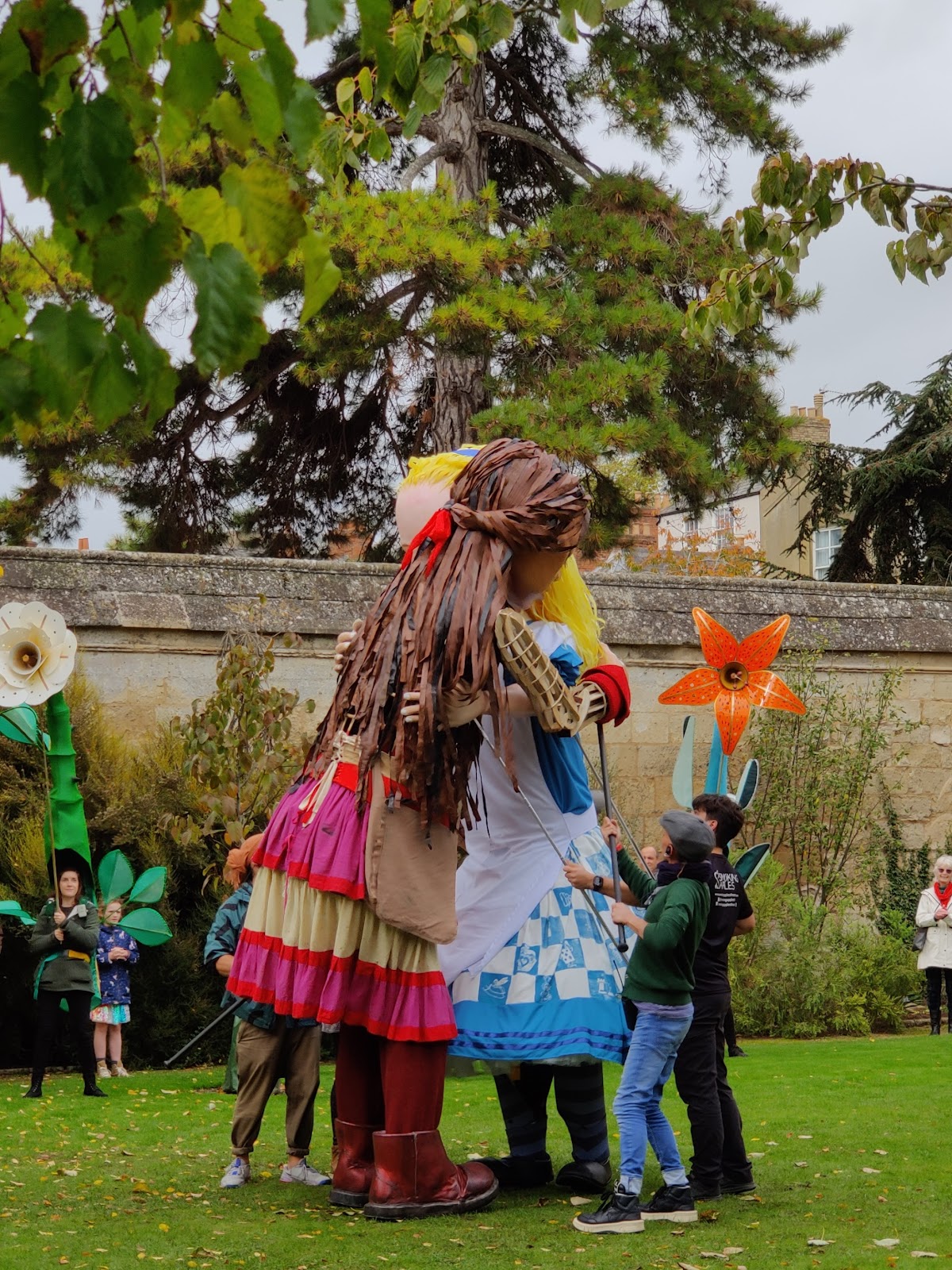
The Walk, spearheaded by Good Chance Theatre, draws together local stories and artistic expressions to depict the experiences of unaccompanied refugee children around the world. After travelling more than 5,000 miles and making stops in villages, towns, and cities across Europe, Little Amal was first greeted by a jovial crowd outside Oxford Botanic Garden before she ventured inside to meet a giant puppet of Lewis Carroll’s Alice, provided by the Story Museum, Lead Producer of Amal’s journey in Oxford. 

In the Botanic Garden performance, the Red Queen, one of Alice’s key nemeses, angrily scattered Amal’s memories across Oxford after interrogating her and demanding to search her bag. The two girls were compelled to search the city for the lost memories, making stops along High Street, Broad Street, Cornmarket Street, and Christ Church Meadow. 

The narrative for Amal and Alice’s meeting was penned by Syrian author and illustrator Nadine Kaadan and commissioned by the Story Museum, with creative direction by Jeremy James. Kaadan gathered material for Amal’s memories through a collective effort, by running a workshop with refugee women from Syria, Iraq, and Palestine living in Oxford. 

The idea of Amal carrying a ‘bag of memories’ was inspired by stories from Kaadan’s refugee friends, whose journeys in dinghy boats and through refugee camps permitted precious little luggage. “One of my friends packed USB disks with as many memories as possible from his laptop,” Kaadan recalls. “Your bag is empty, but it’s actually so heavy with so many memories, culture, and tradition that you’re bringing with you.”

Kaadan, who looks back on Amal’s visit as “one of the most overwhelming moments of [her] life”, enthused about the participation of Oxford locals, noting especially how many local refugees had contributed to and engaged with Amal, including many from her homeland. “The beauty of it,” she reflects, “is the community of Oxford coming together to create the event, rather than [it being] a tokenistic thing made by elitist artists.” 

Little Amal and Alice embrace upon meeting each other in Oxford Botanic Garden. Credit: Joshua Low.

Artistic, emotional, and political expression sprung up in response to Amal’s visit, with Oxford organisations, groups, and members of the general public weaving song, dance, protest, and other activities into the tapestry of the parade. Participants held small handmade puppets of Amal, created in workshops run by women’s community group Iraqi Women Art and War. On High Street, Amal relived her pre-war memories of after-school football by playing with children from the Rose Hill Youth Football Club. As she entered Christ Church Meadow, she was greeted by pupils from local schools and members of the public singing a Song of Welcome, composed by Holly Khan, Story Museum resident artist. 

Throughout the afternoon, Oxford community street band Horns of Plenty followed in the footsteps of Amal and Alice in a lively, jazz-infused procession. They were joined by the Red Queen, giant flower puppets, and young dancers who portrayed roles from the Red Queen’s minions to Amal’s childhood friends injured in the Syrian war. “If we could play at something like this every day, it would be heaven,” said Andrew, a trumpet player in the band, making a chef’s kiss gesture. 

Touches of Syrian and Levantine culture peppered the path of Amal’s search for her lost memories. Outside the Botanic Garden, Amal gifted a floral collared dress to Alice, which represented the new dress her mother had given her on the first day of Eid. In front of Weston Library, she opened a giant bilingual book that included illustrations of Amal, Alice, and the Clock of Homs, an iconic landmark of Homs, a city destroyed in the Syrian Civil War. In Merton Fields, the festive crowd shared stuffed grape leaves and other food common in the Levant region, as instructors from the Oxford Dabke group rallied people to dance the dabke, a Levantine folk dance, against the colourful backdrop of banners saying “Welcome” in multiple languages. 

“[These memories] empower refugees and remind everyone that they don’t have anything on their back, but they have so much more behind them with their memory and culture,” says Kaadan.  

Little Amal and Alice engage with crowds on High Street. Credit: Joshua Low.

Amal inspired many moments of emotional connection throughout the walk. Before entering the Botanic Garden, she paused to interact with parents and children lining Magdalen Bridge, extending a hand to those who did not have tickets to the performance in the Garden. In the middle of High Street, she bowed her head evocatively to greet a woman using a wheelchair. Lizzie, a drama practitioner in the procession, recalled the moment.

“One thing that made me cry was when the puppeteers were able to spot the woman, and Amal just stopped. I just went, ‘Oh!’ I had seen her just before, and she was a bit nervous and anxious that she wasn’t able to see – the crowd was moving so fast she couldn’t get anywhere else. That was so sweet.”

Political expression also appeared throughout the event. In the Botanic Garden performance, the Red Queen echoed real-life xenophobic and anti-refugee rhetoric with exclamations such as “You’re the wrong colour!” and “Go back to wherever you came from!” Oxford Against Immigration Detention (OAID) protested at the gates to Christ Church Meadow, with signs that proclaimed ‘Migrant Lives Matter’ and ‘Reunite Refugee Families’. 

Protesters from Oxford Against Immigration Detention (OAID) stand with signs outside Christ Church Meadow. Credit: Joshua Low.

Local politicians and leaders in support of refugee causes were heartened by Oxford’s response to Amal, including Edward Mundy, City Councillor for Holywell, and Tom Fletcher, Principal of Hertford College, University of Oxford.

“This is a very big crowd,” remarked Councillor Mundy. “It shows that people here care about refugees. They wouldn’t want legislation that would discriminate against refugees or make them lose their rights to cross borders. If there is a war here, we have the right to seek asylum in France or a neighbouring country. We can’t take that away from people.”

Fletcher, who served as British Ambassador to Lebanon when the country hosted 1 million refugees, says that the University and the Oxford community need to “turn this sense of solidarity and compassion [in the Walk] into hard, practical support” in the form of “initiatives to support security, justice and opportunity for refugees”. He urged refugee access programmes “at all points of the academic pipeline”, “research that has a practical impact on security, justice, and opportunity for refugee communities”, and advocacy using Oxford’s “powerful voice”. 

One such programme extending the impact of Amal’s visit has been the ‘Beyond Amal’ educational initiative, a collaboration between the Story Museum and Asylum Welcome which trains participants in storytelling and communication skills that they can bring to workplaces. 

Kadaan also called the project an “artistic intervention” that challenges the new Nationality and Borders Bill recently introduced by Home Secretary Priti Patel in Parliament, which criminalises refugees based on the routes they take to safety.

“All of the hard work is really just changing narratives about refugees.” Kaadan stresses.

“Everyone is there to have fun and celebrate, when refugees usually are pitied and looked at in a charitable way. That’s how I wanted to celebrate refugees—[for them] to be treated as a celebration other than as a burden.”

The award-winning Syrian author also voiced hope that the story about the “classic British character and a Syrian refugee” will “turn into a book that stays on our bookshelves.

“Events are amazing, but stories stay forever.”

Little Amal connects with a young girl next to Hertford College, University of Oxford. Credit: Bess Levin Markel.

As the crowds in Merton Field lingered long after Amal had moved on towards her next stop, drama practitioner Lizzie shared her view on the reasons for the Walk’s success: “The arts generally have three threads: aesthetics, personal expression, and  social change. That puppet is absolutely stunning – the face was so poignant and really well performed. The social change: the number one issue around this is to break down borders, to challenge racist migration and immigration policies. And then, you’ve got personal expression. Amal was so beautiful and had an emotional impact on people. I saw lots of people in tears. You’ve got the three threads happening beautifully and concurrently.”

“It has been very poignant,” Shaista Aziz, City Councillor for Rose Hill and Iffley, told Cherwell. “What Amal shows is the best of humanity in a time when we don’t see that very often in terms of the rhetoric of leaders of the country.” 

“The most wonderful thing is that people look happy, they are smiling, joyful, really, really excited to see Little Amal. And I think that is beautiful.”

Featured Image Credit: Joshua Low