

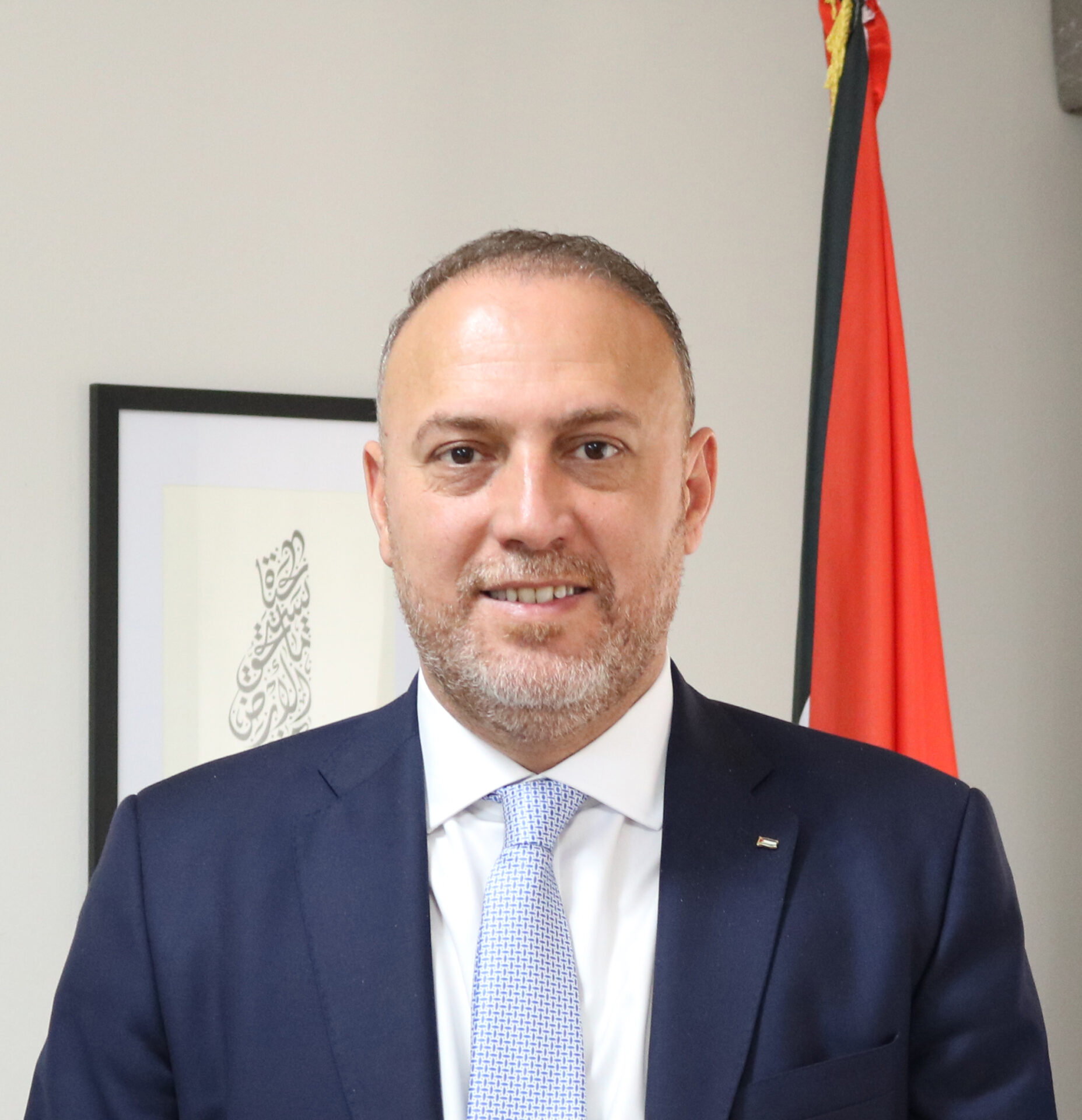
An unassuming building lies in the depths of a West London suburb. It is indistinguishable on a residential street, marked out only by a red, white, black, and green flag protruding from its entrance, a rectangular burst of colour against an otherwise monotone backdrop. Yet this unassuming building is historic. It houses the Embassy of the State of Palestine to the United Kingdom, officially inaugurated in January 2026 following the UK government’s formal recognition of Palestinian statehood. At its head stands Dr Husam Zomlot, Palestine’s ambassador to the UK.
As I enter his office, Zomlot offers me tea and welcomes my imperfect Arabic greetings. He suggests that we move from his desk to the more comfortable sofa and armchair for the interview, refilling his Iqos as we speak. Despite his relaxed manner, he is reluctant to make himself the subject of our conversation. He rejects the idea of a profile piece focused on him as an individual, with the weight of his responsibility as a representative of the Palestinian people evident in his insistence that there are other pressing issues to discuss. So, we do.
Zomlot’s parents were displaced from their home village of Simsim, northeast of Gaza, during the mass expulsion of Palestinians in the Nakba in 1948. Born a generation later, he spent his childhood in a refugee camp in Rafah, southern Gaza. “[It] was a happy childhood. I was a happy child. We did not have normal homes. It was makeshift homes and tents… but for a child, that’s home.”
Zomlot recalls a “very strong sense of community” in the camp, forged through the shared experience of displacement, remembering “the warmth of our parents, our families and our extended community, because all of them have gone through the experience of the Nakba. Our parents and grandparents made sure that we were, in a way, insulated from the tragedy of some years earlier”.
However, his family’s efforts to shield him from the political realities of displacement were impossible to sustain once he became exposed to life outside the refugee camp. His first experiences of travel, visiting Egypt and other Palestinian cities, exposed him to a world which stood in stark contrast to his own. “Something was not right. To see life beyond the refugee camp – definitely, something was not right.”
By his early teens, Zomlot began to understand the source of this unease. The outbreak of the First Intifada beginning in 1987, a sustained Palestinian resistance against Israel’s military occupation of the West Bank and the Gaza Strip, brought the realities of occupation into sharper focus. He participated in the uprising, experiencing the imposition of curfews and witnessing the arrests of classmates. “As we grew up, we came face to face with reality… the political reality started to really hit home.”
Alongside this growing awareness of the occupation, Zomlot’s childhood was shaped by a different external presence: the international community. The United Nations Relief and Works Agency for Palestine Refugees (UNRWA), which provided him with education and other essential services, was central to his upbringing.
“As a child I always thought that there was the bad – the bad was those with green military uniforms – and there are the goods with the blue hats and the blue flag and the 4x4s.” This distinction was, in his childhood understanding, a simple one. “The good people are the people who provided for us education, health, you know, a better future, cared for us. There was international care.”
“But there was also a bad aspect of the international community,” he adds, referring to the 1917 Balfour Declaration, in which the British government promised a “national home for the Jewish people” in Palestine. “The world has a lot to do with our agony, starting with Britain… promising our land to another people without consulting us.
“As I was growing, I also started realising with this First Intifada in the backdrop that, no matter what we do as Palestinians, without changing the international arena, and international conscience about us, and action about us, we cannot do it on our own.” This conviction in the international community’s capacity to protect Palestinian self-determination would shape Zomlot’s career, beginning with his first professional position as an economic adviser to the UN’s Middle East peace process coordinator. “My first job was with the United Nations. And that was by design. That was on purpose… thinking about the 4×4 as my army. So I wanted to join my army.”
Despite this early determination to engage with the international community, the ambassador’s path into diplomacy was far from straightforward. “Diplomacy, for me, is such an accidental evolution of who I am,” he remarks, describing a conception of diplomacy shaped more by Palestine’s struggle for self-determination than traditional statecraft.
The ambassador experienced firsthand the limitations of conventional diplomacy in the Palestinian context during President Trump’s closure of the Palestine Liberation Organisation’s delegation in Washington, which he headed at the time. As a result, his diplomatic visa was revoked, and his family were forced to leave the US. Given this experience, Zomlot explains, his responsibility extends beyond the diplomatic sphere.
“Our situation is a little bit different. We are under occupation and struggling for our freedom and our rights. So, for me, it is a combination of diplomacy… we have many diplomatic relations, diplomatic agreements, memoranda of understanding, trade, what have you – but also part of our work is advocacy. We see ourselves as the voice of our people, whatever and whenever we are posted.
“That’s what diplomacy is. Diplomacy is about really presenting the interest and the story of your people, no matter what.”
Engaging with and mobilising the public is, in Zomlot’s vision, central to achieving progress. “I, as an ambassador, who usually does not take part in demonstrations and marches and whatnot, I was marching almost every time.
“This is unusual in diplomacy, but we live in very unusual times. If you want to ask what most of my time was spent on, it’s the bottom, bottom as in the base, particularly the young generation.”
In light of the suppression of pro-Palestine protests on UK university campuses in recent years, Zomlot is passionate about highlighting the importance of youth participation within the Palestinian movement, situating student activism within a long history of popular pressure for political change. “The youth are the moral compass in any equation. You are oriented by one thing: humanity.
“You don’t have all the calculations the older generations have. You know, you’re just about to begin your journey in life. And the younger you are, the more moral, the more principled, the more social and just in your thinking about others.”
In particular, he emphasises Oxford University’s significant global influence in protecting students’ right to protest. “It’s not a responsibility of universities. It’s an obligation. The whole idea of these institutions that were established like yours, almost a thousand years ago, is to give the young the space to breathe, and to develop, and to evolve into the leaders we want for our societies.”
But for Zomlot, the obligation incumbent upon universities extends beyond upholding the right to student protest, as he calls for divestment from “any institution that is implicated in the genocide.
“They have an obligation to make sure that they do not invest in illegalities. We’re not talking about individual settlers or individual organisations here. We’re talking about the entire ecosystem of occupation. Universities have to pay attention. Otherwise, they are no longer a place of learning, a place of good.”
The question of institutional responsibility also applies to the Western media, where the ambassador sees Palestinian representation as equally consequential. Reflecting on his first interviews as head of the Palestinian mission to the UK, he emphasises the weight of representing Palestine to an international audience. “There was that heavy responsibility of a Palestinian who’s in London, who needs to speak to the English-speaking world and to the international media. It was not easy, and I know the responsibility.”
Zomlot’s early encounters with the British mainstream media left him frustrated with what he perceives as a persistent double standard in its coverage of Palestine. He accuses the media of “disfiguring the Palestinian struggle” by “stripping the story out of context all the time” and “trying to dissolve Israel of any responsibility”.
In particular, he highlights a viral interview with Piers Morgan, in which he was repeatedly pressed to condemn Hamas. “Hamas has committed crimes during these events. Targeting civilians is unacceptable. But the mainstream media, the BBCs and the Skys and the CNNs and all those, wanted to play the game of the last 80 years… to paint a picture that the aggressors are the Palestinians, and then Israel is just in a state of constant self-defence.”
“The game is always to extract from you that admission”, he explains. “Because then, once the question is asked, it doesn’t matter. You are guilty. You see? You are guilty. So we didn’t play that game.”
But due to a shift in British public opinion, Zomlot asserts, “there has been change under the pressure and the pushback. Things have begun to change. But this change is not enough for you to make sure that the main media outlets are there to tell the truth, and nothing but the truth. They haven’t done that for a long time.”
His frustration with powerful British institutions, however, does not diminish his conviction in Britain’s capacity to shape the international response to Palestine. Speaking at the UK Foreign Affairs Committee in 2024, the ambassador stated that the UK was “one of the few nations in the world in a position to step forward to fill a vacuum of global leadership”. When asked whether he maintains this position today, he responds with conviction: “One hundred per cent.”
“The UK is the penholder in international diplomacy,” he continues, highlighting its unique relations with both European countries and the US. “[It] has such a historic responsibility for the mistakes that were committed and the wrongs that were done, but also has the knowledge and the convening power.
“Washington is the head of the Western system… but London is the neck. When the neck moves, it’s moving definitely after a thorough assessment, moving in the right direction.”
The UK’s recent announcement of a proposed sanctions regime on 8th September, targeting entities involved in Israeli West Bank settlements, illegal under international law, marked an important development for the Palestinian ambassador. Having spent decades of his life campaigning for tangible measures like this, he recalls the significance of hearing the announcement. “I was there when Foreign Secretary Ed Miliband said, ‘We hear you.’ … Now, that is such a statement. Such a statement.”
At the same time as the UK’s announcement, eleven other countries announced similar measures, including France, Canada, Australia, and Spain. Zomlot sees this international mobilisation as evidence of the influential power of British diplomatic efforts. “If the UK leads, and we have a global regime of sanctions, and we have a coordinated effort to raise the cost of the illegality, then the calculus will change.”
But from the ambassador’s perspective, this hope for progress does not extend to the Trump administration, describing the US president’s political career as being characterised by “knee-jerk reactions”. Having represented Palestine in both the UK and US, he is uniquely positioned to compare the two: “The world does not consider Britain to be in that category. Britain is much more solid on the professional, legal, political assessments and the credibility of whatever decisions they make.”
Zomlot is equally reluctant to consider the announced sanctions a personal triumph. “I don’t live on expectations. I live on delivery and work. This is not the end of the road. It’s the beginning of the road. But it’s a powerful beginning, and we need to build on it. And we need to make sure that the government continues on this track.”
His insistence on delivery reflects a broader scepticism about the capacity of political change, on its own, to confront the scale of Palestinian suffering. At the time of our conversation, Israeli elections were approaching, yet the ambassador remained sceptical that a change in leadership would translate into meaningful progress. “There is almost a political consensus among the political Zionist parties in Israel not to recognise the Palestinian people and Palestinian rights, including the rights of determination.”
“Netanyahu is not the cause. Netanyahu is the product,” he adds. “The only difference would be that he would not be seen as the devil in the world. So the world might say, ‘okay, let’s give them a chance’. That’s the biggest issue.”
For Zomlot, the question of Palestine’s future cannot ultimately be answered by a change in Israeli leadership, nor solely in the conditions imposed by international actors. Rather, it rests on the Palestinian people’s own right to determine their political future. Yet the recent postponement of elections under Mahmoud Abbas, President of the State of Palestine and Palestinian National Authority, has been widely criticised, leaving Palestinians without a national election since 2006.
“Elections are a crucial thing, and the Palestinian people have the absolute sacred, inalienable right to elect their leaders. It’s long overdue, and we must do it. I was personally hoping that it would be done in November this year, as was promised and announced. But how can we do the elections under the current circumstances?” Zomlot says.
“The world needs to understand that we do not function in a normal situation. We function under the most severe segregation of apartheid system. How do you do real elections? Perfect elections, democratic elections, inclusive elections, under occupation?”
As our conversation draws to a close, Zomlot turns his attention to the generation that will inherit the consequences of today’s political decisions. He urges British students “to live up to the expectations and the reputation and the history of their parents and grandparents. The student movement of this country has always been at the forefront”.
For a man who has spent his career urging the international community to uphold its own principles, his parting words are a pointed reminder of the responsibility that falls on the next generation: “Fear nothing if what you’re doing is sticking by the values.”