

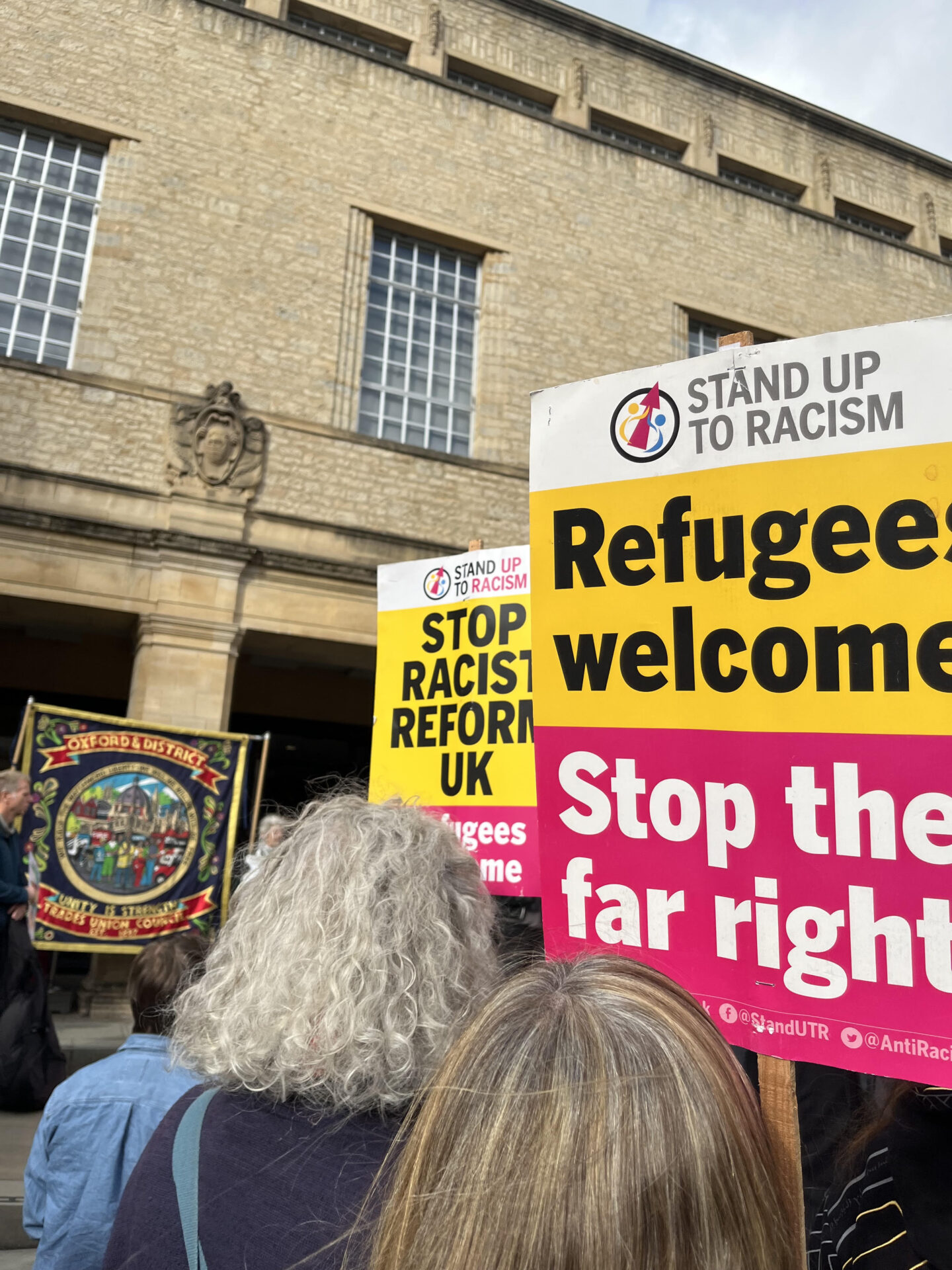
At a recent march in Oxford against the far right, one speaker’s words really struck a chord with me: “We need unity irrespective of our differences on other issues.” This declaration was all the more poignant given the eclectic mix of political groups represented at the protest, including those campaigning to keep Campsfield Immigration Removal Centre closed, the Oxford Labour Club, and Women Against the Far Right. An unshakeable sense of togetherness bound the groups together, and it was then that the antidote to the mess that we call British politics became clear: unity.
I’m aware that simply throwing out the word ‘unity’ as a quick fix to political turmoil seems ridiculous, as if proudly offering up a singular sandbag when a tsunami comes rolling in. What we don’t need is another ideological proposition, the likes of which can be discussed at length in a tutorial as the world falls apart around us. But unity is so much more than that; it is a rallying cry for anyone who can get behind a common goal. A goal that, in this case, is the protection of our communities from the far-right threat that is slowly but surely seeping in.
For too long, British politics has felt like an unending roundabout of infighting while the world falls apart around us. I am reminded of Ludwig Wittgenstein’s analogy of intellectuals as flies in a jar, endlessly talking over ideological minutiae rather than ever actually getting anywhere. Whilst I recognise the irony of referencing a philosopher when criticising unsatisfying conclusions, this analogy really does seem to resonate.
Following “the worst unrest seen in the UK for a decade” during the wave of anti-migrant riots in the summer of 2024, it was found that nearly three-quarters of the British public felt worried about right-wing extremism. However, in the two years since this statistic was produced, we have nothing to show for how we have countered these fears. If anything, these concerns have been strengthened and intensified, with groups like Patriot Platform filling the streets to preach about women’s safety, while clad in black balaclavas and chanting “stop the boats”. I’m left wondering where our collective terror of the growing extremist ideologies has disappeared to. Or, rather, where it has been channelled instead.
Whilst it is true that a large proportion of the UK fear the far-right, the recent action that has been taken speaks for itself. The Labour Party has been battling it out with the Conservatives in government in a treacherous game of who can seem the toughest on immigration, attempting to claw back lost voters. As a result, MPs from both parties are discussing immigration in a more hostile way than at almost any other point in the past century, according to a recent study by The Guardian. Meanwhile, despite their consistently anti-far-right rhetoric, the Greens are busy redefining Zionism and dividing their party supporters along the way. And to top it all off, Liberal Democrat leader Ed Davey is describing the surge in far-right ideologies and change in UK political opinion as a “historic opportunity to win many more seats”, rather than a threat to our nation’s diverse community. The people might agree on the issue, but finding the solution is a completely different story.
As it turns out, constant bickering about party politics doesn’t actually get us anywhere.
So what does? Saying that we should all work together to counter the rise of the far right is easier said than done – and feels a little too High School Musical-esque. But having political cohesion across parties is really not so far-fetched. We only have to look across the Channel to France to see how cross-party collaboration can be accomplished. In the French political system, elections involve two rounds of voting, with the first round eliminating candidates with the fewest votes. A benefit of this system is that between the first and second rounds of voting, it is common for parties to join forces to compile their votes. For example, in the 2024 legislative elections, between the rounds of voting a broadly left-wing party arose called Le Nouveau Front Populaire (NFP), made up of over six smaller parties hoping to combat the far-right party, Le Rassemblement National (RN). The result was a success: 182 seats for the NFP against 143 for the RN and its allies.
While French politics are clearly not flawless, and this system does mean learning a ridiculous number of acronyms for newly formed parties in every election cycle, it does teach a valuable lesson. Acting as a collective does not mean thinking as a hive mind, nor does it mean having exactly the same views on every issue. But what it does mean is showing unity in the face of opposition, particularly when that opposition threatens to push our fellow citizens out of the country.
And making governmental change is just the beginning. The reality of implementing unity in political action is something that can be done both day-to-day and in Parliamentary. Opening up conversations with peers about the far-right without veering into irrelevant discussions, and engaging with people from different political leanings to find common ground; these are the ways in which we become a collective.
So whilst the antidote of unity may not be a quick and easy fix, it can certainly help us in the long term. Our wonderfully diverse community is under threat, and our fears need to be channelled to inspire collective change. Maybe, after all, High School Musical was right – we truly are all in this together.