

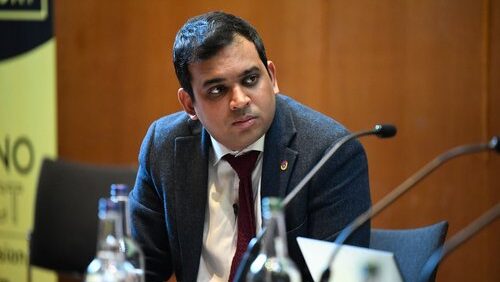
Tanjil Rashid is currently the Culture Editor of the New Statesman, although he has worked previously as a bookshop assistant and a civil servant and even, unfortunately, endured torrents of abuse as a comprehensive-school supply teacher. Having grown up in Ilford in East London, he now lives marginally to the north in Walthamstow. “I haven’t moved very far in life,” he jokes. In fact, he has been on quite a journey.
Rashid was born in 1990. “My parents had quite modest lives and I grew up in an immigrant Muslim Bengali family. My father immigrated to Britain to provide labour in the post-war economy, working up north in factories and then worked as a waiter and eventually getting an office job. My mother has been a housewife all her life. But they stressed education, as families like mine tend to; I went to a grammar school and became interested in literature and the arts. Public libraries were very good back then, they had lots of old books that you don’t find there anymore.”
He got into Cambridge and had a very good start in journalism at the Financial Times. After that he ended up landing in television, which he didn’t enjoy, and remained a freelance writer for many years until he was chosen to become the Culture editor of the New Statesman. He is doubtful, however, that people from backgrounds like his would in the future end up with such a prestigious position in the literary world.
“I grew up in a world that was changing and was still pretty analogue. The first fifteen years of my life were pretty much internet-free. Children from families like mine probably don’t have much exposure to print culture anymore. Children in intelligentsia families, the kind where they get the London Review of Books in the mail, probably still do. When I was growing up, my father was a great reader of newspapers, he’d sit there reading the paper while my mother was doing the shopping, and she also enjoyed reading Bengali newspapers.”
It was the early exposure to print culture which, though not a unique experience, turned Rashid towards the world of letters. “There are two kinds of people who go into journalism: one, people who really love news and current affairs; the other, people who like the written word. I’m someone who loves words, likes reading and writing. It’s hard to say why I specifically became interested in culture, art, fiction – I just for some reason got interested in that.” He pauses. “In some way literary journalism is a strange career to have. It’s not really a real career. It’s really too fun to be taken too seriously.”
Rashid, who has been a journalist for over a decade, is ruminative about the state of his chosen profession. “Fifty or a hundred years ago, it was in book reviewing and literary journalism that the great journalists were to be discovered.” Indeed, his predecessors as literary – now Culture – editors of the New Statesmen include V.S. Pritchett, Claire Tomalin, and Martin Amis.
While he does not agree the literary world is in the crisis some make it out to be in, he accepts changes are afoot. “The novel, like the epic poem, is no longer as central to the culture as it was. It’s impossible to know what new literary forms will take the place of the novel. The old ways of writing and understanding the world are changing. Critics must respond to this in a critically intelligent way. The people who are just being born or will be born in ten years’ time will express themselves as humans always do, but perhaps not writing novels. We recently did a piece, for instance, on how AI is reshaping the opera.” He stresses, however, that continuities remain. “Even now there are brilliant writers coming through in journalism. That supply of literary talent is proliferating. I’m constantly being amazed by youngsters who want to write about literature, and are remarkably well-read and write impressively.”
Identity is a recurring theme in Rashid’s writing. When I ask him about this, he reflects that this is not a conscious choice. “It happens to be the case that I am Muslim, I am British, and I am many other things, and these things inevitably shape what I write. These things are probably just noticed more because I have an – unusual identity. There aren’t many Bengali journalists in the media. There are so few of us that we often get mistaken for each other. For instance, I’m always getting mistaken for Faisal Islam, for some reason.” He laughs. “There are probably only two or three British Muslims in literary journalism. So, if you read my writings you’ll probably notice I have a slightly different identity, different perspective because of it. My identity doesn’t completely determine my perspective, but it certainly informs it.”
Earlier this year, Rashid interviewed Salman Rushdie. “Certainly, when it comes to a writer like Rushdie, a British Asian of Muslim heritage, there will be a way that I relate to his work and his life in a way that others don’t, because we share something of the world. There has been a lot of talk about diversity in the last decade or so but actually I don’t see the literary world becoming any less parochial. Things probably were better in decades past. In the decades after decolonisation you had Commonwealth writers such as VS Naipaul and Salman Rushdie being widely read and acclaimed, but today, even though we like to think of ourselves as more modern and contemporary and open, a novel such as Midnight’s Children would not be understood or read as widely.”
Identity certainly informs the multicultural Britain depicted in Rashid’s fiction. (As well as literary essays, articles, interviews, he has turned his hand to short stories, too.) “The Fanatic”, is particularly funny in the way it turns tropes and stereotypes on their head: it is the story of an imam who is expelled from his mosque for being a dangerous fanatic, but the fanaticism of which he stands accused is an inflexible, irrational love of Manchester United. “It was a wonderful thing to have short stories published in magazines and that sort of thing,” Rashid admits, “but it’s not a living.”
I ask him about his future ambitions. He pauses and looks down at the magazine – guess which one – that lies on the table. “My ambition, really, is to keep producing good literary coverage, good writing by the famous and brilliant writers I’m already publishing as well as finding new ones. The New Statesman has always been a venerable institution but since Tom McTague became editor the magazine has become absolutely essential to the national conversation – see the coverage of the Labour leadership contest, for instance. I would like to keep the literary pages of the New Statesman among the best in the world.” On the question of whether he might follow up his short stories with a novel, the reply, hesitantly given, is, “No comment.”
Many Cherwell readers – and certainly most Cherwell editors – are mulling over the prospect of a journalistic career, and will be seeking tips as to how to thrive in the profession. Rashid advises: “Have a day job: at this point in history, writing is an amateur sport, not a career. More importantly: Read. Read everything. Don’t just read what’s fashionable. Read science writing, travel writing, the Bible, read all kinds of words. Go back in time and read Shakespeare and Dickens. If you want to be a writer you have to understand language in all its subtleties, and to do that you have to read omnivorously.”