

When I heard that Jim Jarmusch had released a new anthology film, I fondly remembered watching Night on Earth (1991) some years ago. It’s a series of conversations between cab drivers and their eclectic customers, and each section contains its own kind of sentimentality, humour, or poignancy. Against the film’s still nighttime streets, one only has words and faces to focus on, and days after watching the film, I enjoyed comparing the feel and details of each neatly parcelled slice of life.
This time, in Father Mother Sister Brother, Jarmusch explores three visits of adult children to their parents. Instead of studying the nature of human contact through charming realist conversation as in Night on Earth, he dwells on the great dearth of things which family members – who ostensibly have known each other so long and well – often have to say to each other after time and distance have estranged them.
For lack of words, images, and impressions convey the predicaments of the fathers, mothers, sisters, and brothers. The opening ten minutes of the first short, Father, are taken up by Emily (Mayim Bialik) and Jeff’s (Adam Driver) drive through a snowy woodland to their reclusive, recovering addict father’s (Tom Waits as Tom Waits) house in New Jersey. I must admit, their conversation was so sparse and dull that I now realise I missed important exposition, but this cannot have communicated as much as the lingering, meandering camera. Close-ups of Emily gazing pensively out the window; Jeff steering too quietly and steadily, and a too-monotonous winter landscape, simultaneously leave much to be imagined and signal entry to a slowed-down foreign world pervaded by their father’s memory.
However, all this calculated vagueness is made much less evocative than it should be by a frankly interminable tranche of kooky dialogue. Upon entry, “Great to see you” and other pleasantries are uttered by Jeff and Emily slowly and with pauses. The father pays a strained compliment to his daughter’s coat. Everyone is at a loss for something to say, a point to make or come to. Awkwardness thus established, the father issues a few sub-par quirked-up gags to fill the silence: “your mother always loved water”, “you were always my favourite son” (to Jeff, his only son). A few arthouse fiends in the seats near mine laughed at these bits, and I almost did too, for Jarmusch starves us of proper comic moments. We understand within a minute the absurdity of the family’s conversational vacuum; of the contrast between prim Jeff and Emily and their demented dad, and how we’ve all been through the kind of incidents which the short caricatures. Why then is the point so insisted on, made so bizarre in its urgency?
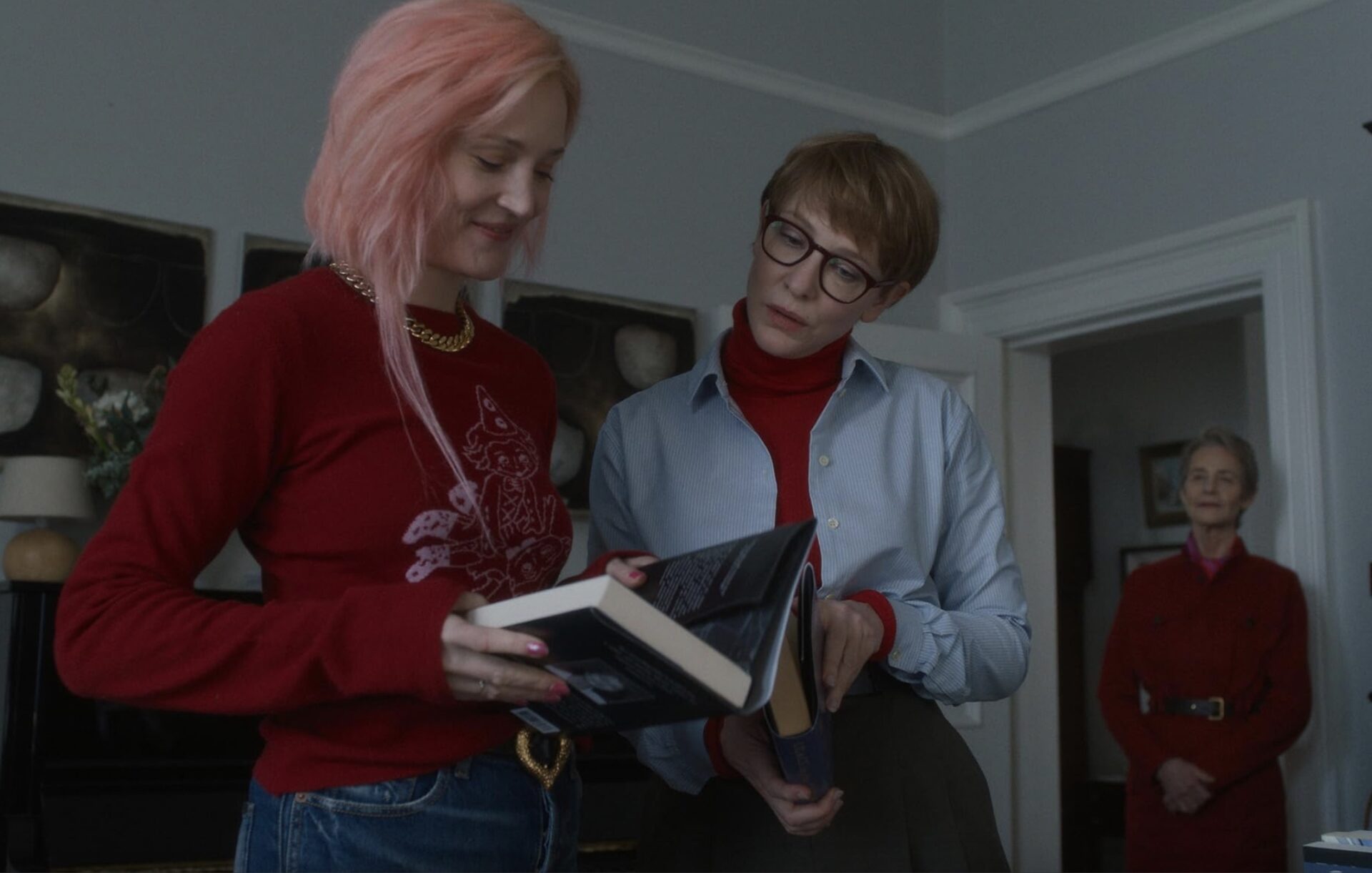
Mother is the middle short and far more fun than Father. It is set in Dublin and the English family involved is of a similar eccentric, upper-middle-class milieu to that of Jeff, Emily, and their father The short is enjoyably camped up, however,, by the sisters, Tim (Cate Blanchett) and Lilith (Vicki Krieps), and their mother (Charlotte Rampling) being vibrantly dressed arty types. We have by now adjusted to the aridness of the characters’ conversation, and the short’s rhetoric of contemporary clichés – the novelist mother glibly chats to her therapist before her daughters arrive, while Lilith loves to talk about her career as an influencer – is effectively offset by everyone’s strange demeanour, as well as our stronger sense of the group’s history and dynamics. The mother’s conversational stiltedness makes sense in light of her narcissism, manifest in her garishly sumptuous house.
Krieps’ performance does a lot to prop up Mother and is, by some margin, the most engaging of the whole film: spontaneously licking a cupcake or slighting her sister, she is both frivolous and vicious, and her deadpan lines are animated by her accent, a mix of German and posh English. We see that the mischievous and almost knowingly superficial Lilith is a chip off the old block, while Tim, though similar in outward style to her female relatives, has long felt their casual disdain. Obtuse Father left me cold, but I still ponder Mother’s intriguing tensions.
Unfortunately, the last short, Sister Brother, makes us forget the comedic edge of Mother. In Paris, siblings Skye and Billy (Indya Moore and Luka Sabbat) visit their late parents’ apartment before it is reclaimed. It seems like this would figure nicely as a coda; focus has turned from parents ageing to being grieved, and in the accompanying spirit of looseness and uncertainty, the action takes place in an open-top car and out on the streets, as opposed to the claustrophobic domestic settings of Father and Mother. But not much else is made of Skye and Billy’s situation. Curious questions are posed about their parents’ past and identities, but it is vapid chatter that dominates: “each moment is each moment”, it occurs to Skye, and Billy is thankful he doesn’t “lead a conventional life”.
More egregious than this, though, is the bizarre schmalz of the siblings’ relationship. As if drugged, Skye comments on how “dependable” her brother is, and no siblingly banter whatsoever counterweighs this. In fact, what Matt Zoller-Seitz finds to be ‘warm, natural chemistry’, comes across, plainly and appallingly, as sexual tension: affectionate hands on thighs, Billy’s mock-incredulous “Nooo!” at Skye’s suggestion that another woman is hotter than her, and many warm, lingering looks besides, all make for queasy and confusing viewing.
Worst of all, though, the saccharine tone of Brother Sister – never mind the suggestions of incest – spoils any sense of coherence between the three sections of the film. For me, this extreme incongruity underscores the main issue with Father Mother Sister Brother: whether you like its style or not, it’s undeniable that it is ultimately inconsistent, both in content and in quality. This is why I find myself reviewing the shorts as if they were three different films. Perhaps I missed an obscure through-line. In his defence,Jarmusch does try to tie things up by planting motifs – water, a Rolex watch, and colour-coordinated clothes – through the three segments. In spite of this,, I still far prefer the plain, pleasing fragmentation of Night on Earth.