

CW: Rape, sexual violence, paedophilia, sex trafficking.
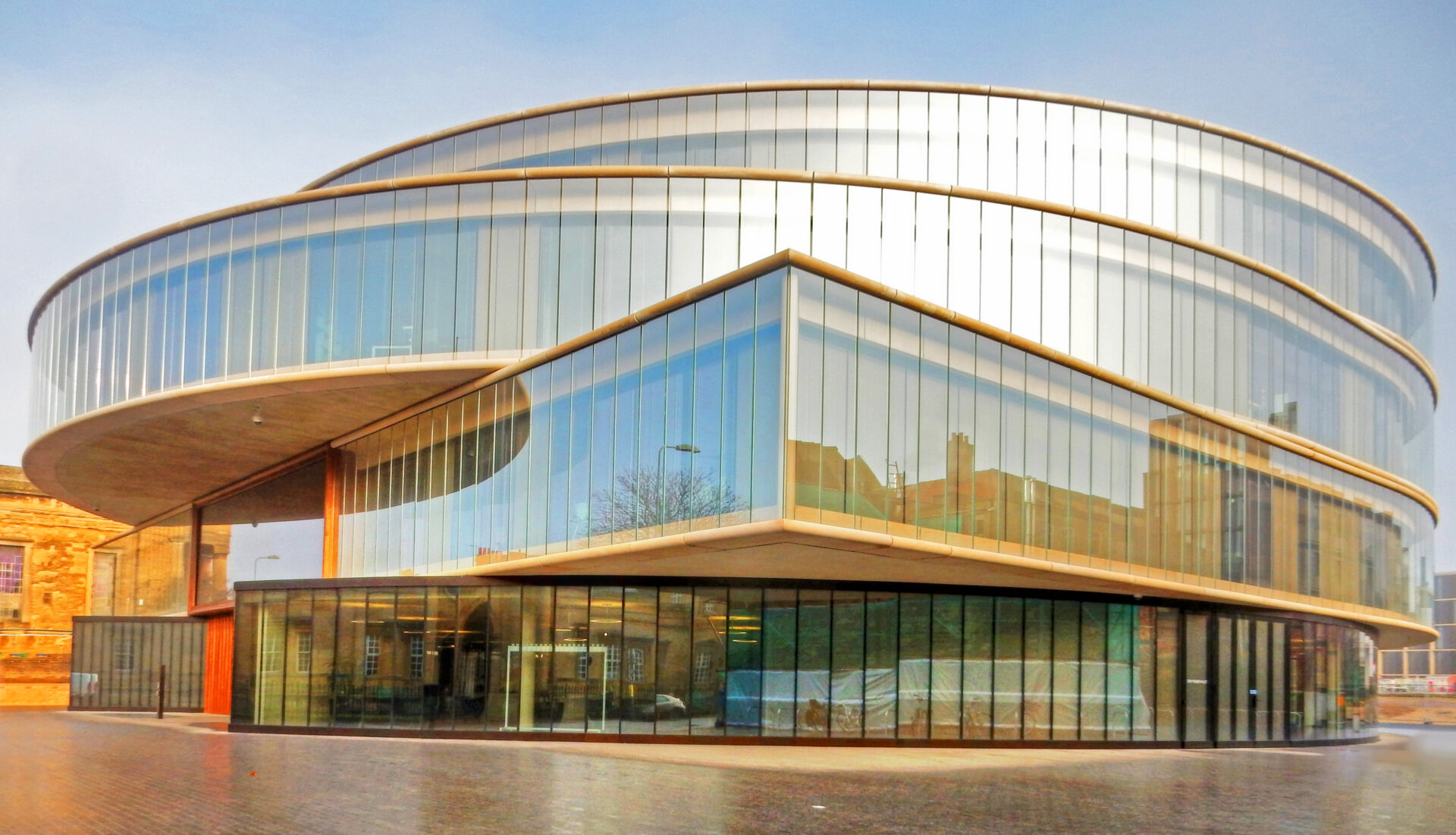
Stephen Schwarzman, Reid Hoffman, Len Blavatnik, David Reuben. These four billionaires have collectively donated over £340 million to the University of Oxford. They are the faces of the University’s financial strategy, which readily accepts the philanthropy of the rich and powerful, notwithstanding the controversy this can sometimes generate. In return, their names have been plastered across the city: from the Schwarzman Centre for the Humanities to the Blavatnik School of Government to Reuben College.
The ‘Epstein files’ – the documents held by the United States Department of Justice regarding the criminal investigations into the paedophile financier Jeffrey Epstein – feature the names of these donors amongst the various emails, schedules, and guest lists. All of these are dated after 2008, when Epstein was publicly accused and prosecuted for soliciting prostitution from a minor. While there is no evidence of wrongdoing on the part of any of these wealthy benefactors, the release of the files in the winter of 2025/2026 has undoubtedly added a new dimension to the perennial debate about the role of billionaire benefactors at Oxford University.
The release of the ‘Epstein files’
The process which eventually resulted in the release of the ‘Epstein files’ began more than 20 years ago. Investigation into the financier’s crimes was initiated in 2005, after a parent reported to police in Palm Beach, Florida, that Epstein had paid her 14-year-old stepdaughter to remove items of clothing and massage him. They soon identified more than 30 girls between the ages of 14 and 18 who had similar accounts of sexual abuse. This proved sufficient for a Palm Beach County grand jury to indict Epstein in 2006 on a state felony charge of soliciting prostitution.
The case was referred to the Federal Bureau of Investigation (FBI), raising the possibility that Epstein could be convicted on a federal charge, which could have landed him with a life imprisonment sentence. However, the US Attorney’s office for the Southern District of Florida instead offered Epstein a plea deal, promising to end its investigation if Epstein pleaded guilty to two state charges, agreed to accept a prison term, and was registered as a sex offender.
Crucially, the deal included a now-notorious non-prosecution agreement, in which the federal prosecutors’ office granted immunity against federal charges to Epstein and “any other co-conspirators”. Epstein’s victims were not informed of the non-prosecution agreement, which was filed under seal, and only became public knowledge in 2009 after a judge ordered its publication. Taking this deal, Epstein pleaded guilty to state charges of solicitation of prostitution and solicitation of prostitution of a minor under the age of 18 and was sentenced to 18 months in jail. During his imprisonment, he was granted leave for twelve hours a day to work at one of his foundations. In July 2009, he was released from jail, having served fewer than 13 months.
In the following years, more accusations emerged alleging an organised sex trafficking operation run by Epstein and Ghislaine Maxwell, his partner. The latter is now serving a 20-year prison term for conspiring with Epstein to sexually abuse minors. In July 2019, Epstein was arrested again and charged by federal prosecutors in New York with having sex trafficked minors, to which he pleaded not guilty. Before his trial could begin, however, Epstein was found dead in the Manhattan detention centre in which he was held; his death was ruled a suicide by New York authorities.
Since 2019, Epstein’s crimes have become the centre of a political maelstrom, partly on account of the litany of famous figures with whom he was frequently associated. In the United States, calls came from both sides of the political divide between Republicans and Democrats for the information held by the Department of Justice to be made publicly available.
This culminated in both houses of the US Congress voting in 2025 to pass the Epstein Files Transparency Act, which ordered the Justice Department to release all the material it had pertaining to the criminal investigation into Epstein by 19th December that year. The bill was signed by President Trump, whose position on it had been unclear; something many attributed to his own personal connections to the deceased financier.
The release of these ‘Epstein files’ has already unleashed significant political fallout on both sides of the Atlantic. In the UK, it resulted in the dismissal of Peter Mandelson – an Oxford University alumnus, former honorary fellow of St Catherine’s College, and, in 2024, candidate for Oxford University Chancellor – from his position as British Ambassador to the US, raising questions about the process of his appointment, which now threatens to destabilise Keir Starmer’s premiership.
Reid Hoffman
While Mandelson’s links to Epstein have generated headlines across the UK, and the University has sought to distance itself from association with him, another high-profile figure associated with the University of Oxford, and mentioned in the ‘Epstein files’, has received comparatively muted attention, namely Reid Hoffman. After graduating from Wolfson College with an MA in Philosophy in 1993, Hoffman accumulated his estimated net worth of $2.6 billion by founding LinkedIn, the career networking service. In 2016, he shared a portion of these profits with his alma mater, donating $1 million to establish The Oxford Foundry, an initiative to support entrepreneurship at the Saïd Business School.
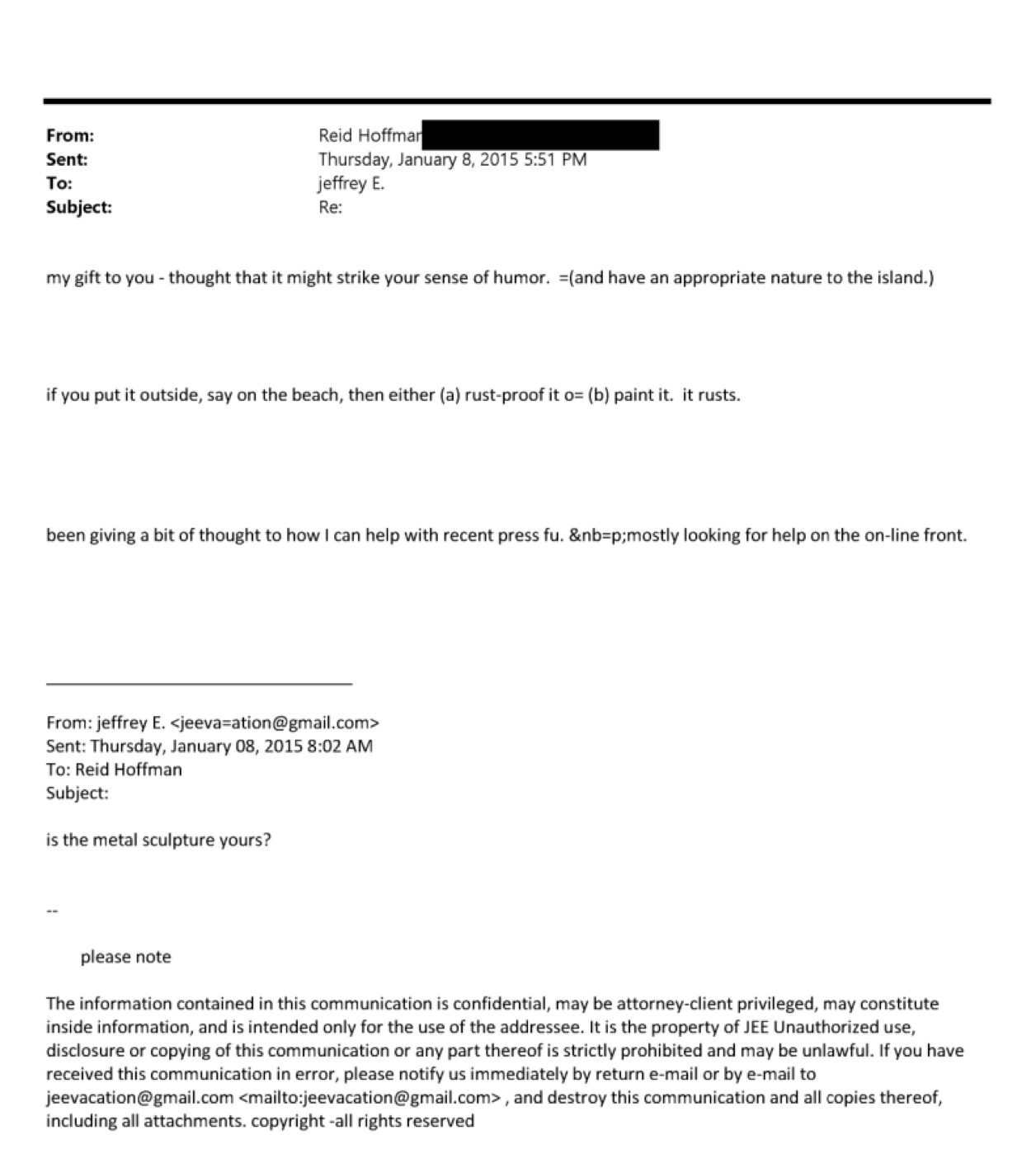
The publication of the ‘Epstein files’ revealed that Hoffman’s ties with the convicted sex offender were more extensive than Hoffman had previously stated. Initially meeting through Hoffman’s efforts to fundraise for the Massachusetts Institute of Technology (MIT), the LinkedIn founder’s relationship with Epstein included exchanging gifts – among them dumbbells and a metal surfer statue – as well as staying at Epstein’s island in the Caribbean.
Not only was Hoffman aware of Epstein’s criminal offences, but he actively sought to help protect the convicted paedophile from reputational damage. In 2014, Epstein was accused by a court filing in Florida of trafficking an underage girl to Andrew Mountbatten Windsor and forcing her to engage in sexual acts with him. Virginia Guiffre later revealed herself to be the girl in question. Mountbatten Windsor has repeatedly denied that he was involved in any wrongdoing. The Department of Justice files show that Hoffman not only did not disassociate himself from the financier but also offered to help with the media attention that had concentrated around him. In January 2015, Hoffman emailed Epstein saying, “been giving a bit of thought to how I can help with recent press fu…. Mostly looking for help on the on-line front [sic]”. “Nothing to do during a storm, but hunker down, and wait until it blows over”, came Epstein’s response.
Hoffman has issued several public statements about his “regret” over his relationship with Epstein. After the publication of the ‘Epstein files’ by the Department of Justice, Hoffman said on X: “I only knew Jeffrey Epstein because of a fundraising relationship with MIT which I very much regret.” Reid Hoffman has not been accused of any wrongdoing by the alleged victims of Epstein.
Hoffman did not respond to Cherwell’s request for comment.
Stephen Schwarzman
Another influential businessman who appears in the ‘Epstein Files’ is Stephen Schwarzman, co-founder of Blackstone and the principal donor behind the Schwarzman Centre for the Humanities. His £150 million gift to Oxford, announced in 2019 (later increased to £185 million), was celebrated as transformative. However, his political and social entanglements have long provoked controversy. His connections to Republican politicians have drawn criticism from parts of the University community, notably leading to the formation of the campaign Oxford Against Schwarzman, uneasy about the optics of accepting funds from figures associated with polarising administrations.
According to the released documents, Epstein’s interest in Schwarzman dates back to at least 2010. In one email exchange, the redacted correspondent suggests approaching the billionaire for a business venture: “I think attaching to Blackstone might be good idea. What do you think ? [sic]”. Epstein appears to agree, though not without some reservations: “at the right level , yes. , however the egos their are rampant [sic].” Concerning Schwarzman himself, however, Epstein’s assessment seems to be rather more positive, calling him “terrific”. The cache of emails does not contain evidence of direct correspondence or interaction, either prior to or following this email exchange, between the two men.
The Department of Justice files show that, in February 2013, Epstein received an email from an external Public Relations (PR) agency purportedly inviting Epstein on behalf of Schwarzman, Jared Kushner, Donald Trump, Harvey Weinstein, and 24 others, to “cocktails and light supper” to celebrate the 25th anniversary of the New York Observer. It is not known whether Epstein ended up attending the small gathering.
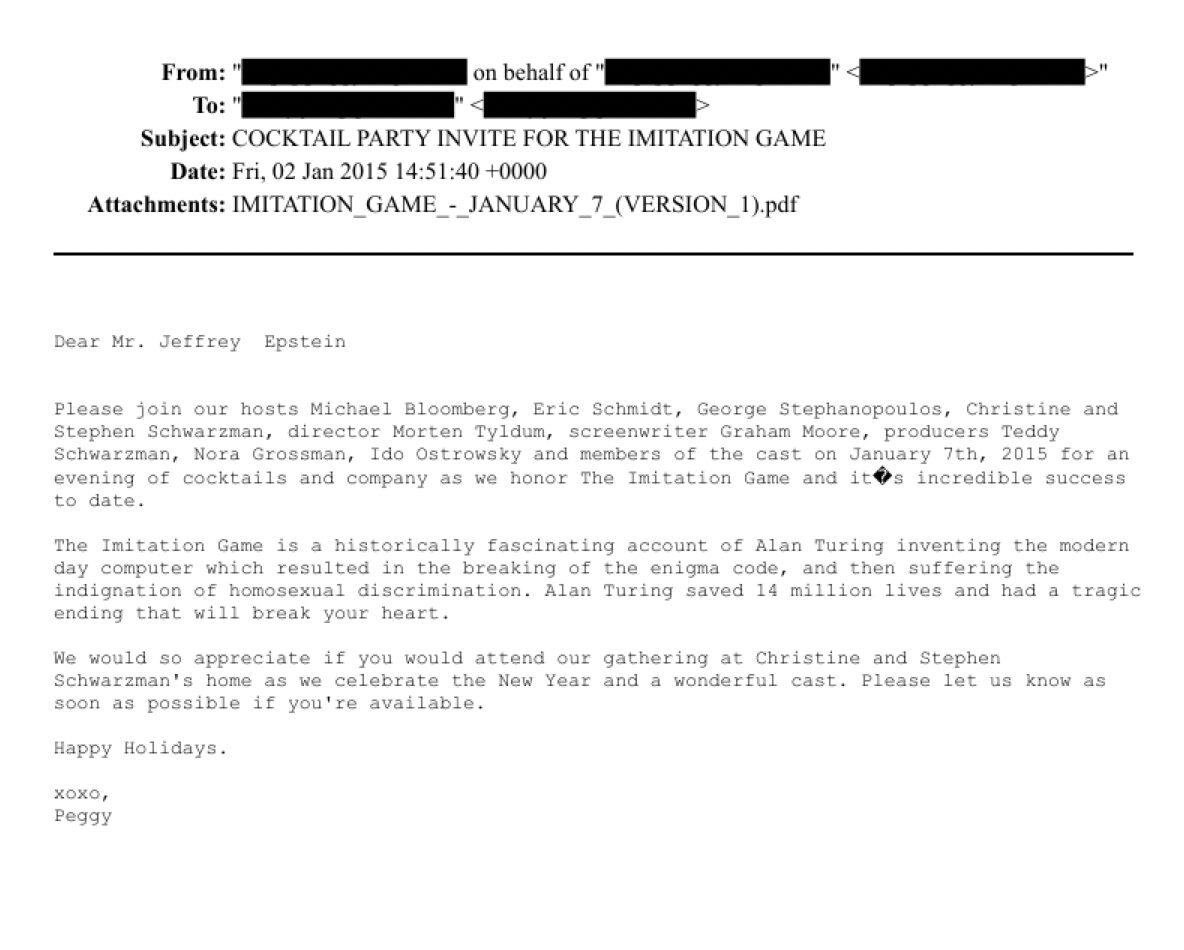
Nor was this the last invitation the convicted paedophile would receive. In January 2015, Epstein received another email from the same PR agency inviting him, on behalf of Christine and Stephen Schwarzman, among eight others, to “attend our gathering at Christine and Stephen Schwarzman’s home” to celebrate the “incredible success” of the film The Imitation Game, which was produced by Schwarzman’s son. It is not known whether Epstein accepted this invitation. There is no evidence in either case that Schwarzman himself personally sought or knew of the invitation to Epstein.
Stephen Schwarzman has not been accused of any wrongdoing by alleged victims of Jeffrey Epstein. There is no evidence of direct correspondence or association between Schwarzman and Jeffrey Epstein in the released files. A spokesperson for Schwarzman said: “It would be categorically false and grossly irresponsible to claim or imply that Steve had any relationship with this despicable individual… Blackstone is one of the world’s largest financial institutions and it is hardly surprising that someone working in finance would be aware of our firm. But that does not in any way suggest a relationship between Blackstone and this individual.”
David Reuben
David Reuben is another influential Oxford donor whose name makes an appearance in the files released by the Department of Justice. Making his billions with his brother Simon in the metals business, David Reuben now focuses his efforts on venture capital, private equity, and the real estate business.
The University of Oxford has benefited substantially from the philanthropy of the Reuben brothers. In 2012, the Reuben Foundation established the Reuben Scholarship programme for undergraduates from socio-economically disadvantaged backgrounds. In 2020, the University received an £80 million donation from the foundation, which they marked by renaming Parks College, the first new Oxford college since 1990, to Reuben College. In 2022, the University awarded the Reuben brothers the Sheldon Medal, the highest honour the University can bestow upon donors.
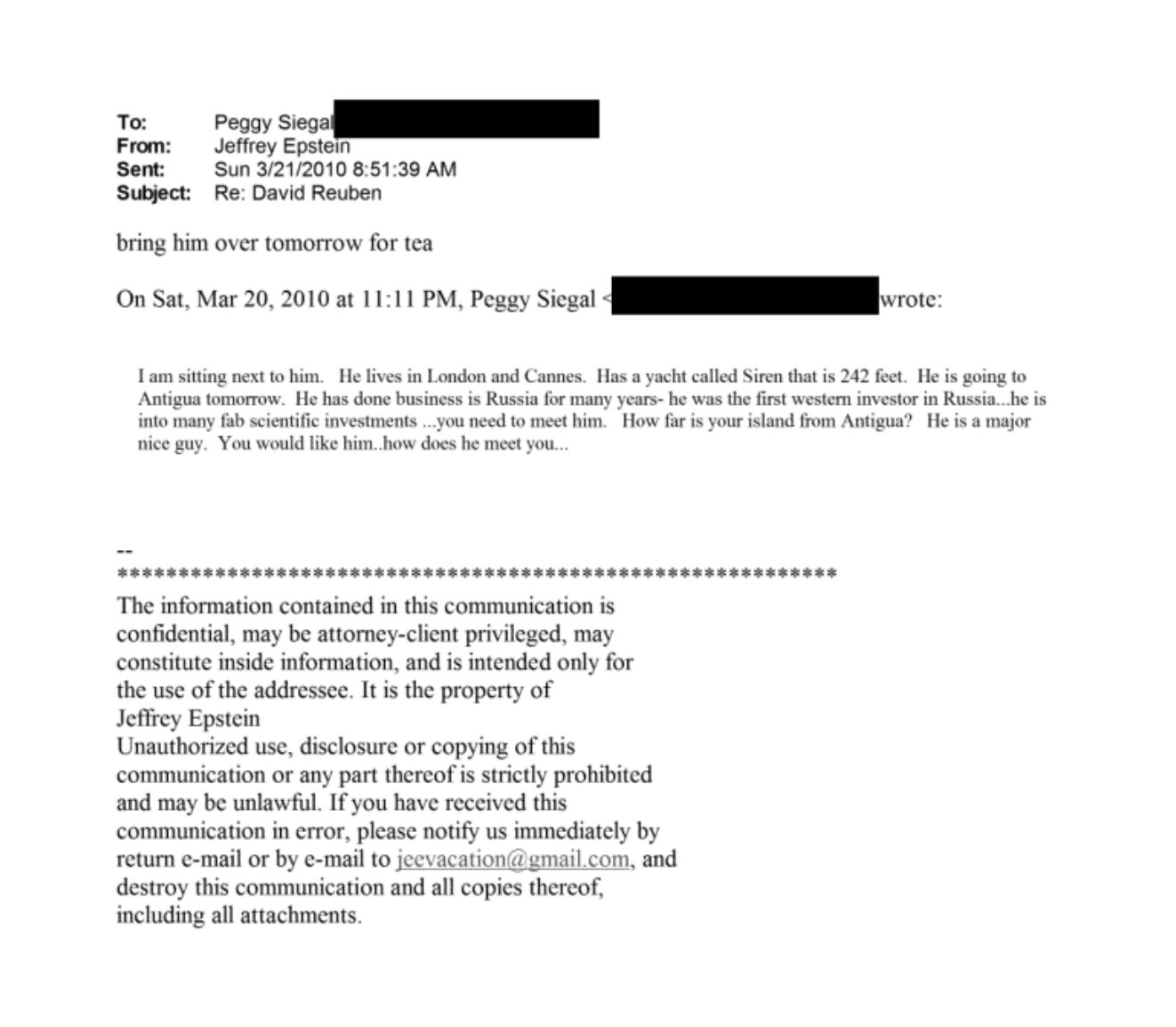
David Reuben seems to have appeared on Epstein’s radar in 2010, less than a year after the paedophile’s release from jail. Peggy Siegal, an American media and entertainment publicist and regular correspondent of Epstein, described Reuben as “a major nice guy”, and told Epstein “you need to meet him… you would like him.” This appears to have piqued Epstein’s curiosity, as he tells Siegal to “bring him over tomorrow for tea”.
On the same day, prior to their proposed meeting, Epstein can be seen attempting to find out more about Reuben; in one email, the redacted correspondent mentions his “very murky past”, as well as his “huge assets”. In addition to this, Epstein contacted Peter Mandelson in an effort to dig up more information on Reuben: “david reuben, wants to come see me today„ do you know him [sic]”.
David Reuben has not been accused of wrongdoing by any alleged victims of Jeffrey Epstein. There is no evidence of direct correspondence between David Reuben and Jeffrey Epstein.
David Reuben did not respond to Cherwell’s request for comment.
Len Blavatnik
The billionaire business magnate, Len Blavatnik, currently the third richest man in Britain, is one of the most recognisable names among the University’s primary beneficiaries. In 2010, he donated £75 million to the University to fund the Blavatnik School of Government, which offers a number of postgraduate courses in public policy. The University’s acceptance of the donation was met with controversy at the time, largely on account of the billionaire’s alleged links to sanctioned Russian oligarchs.
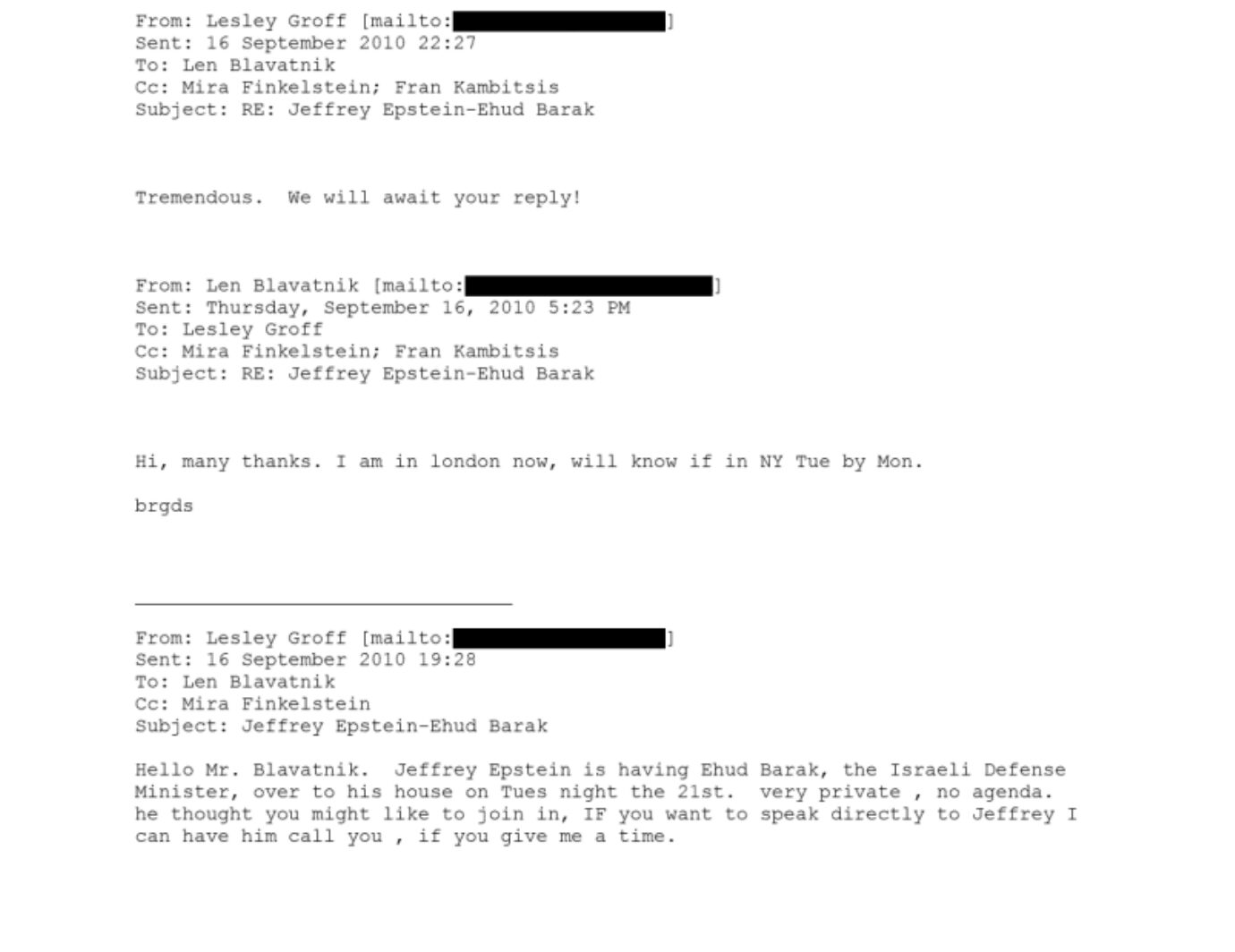
As far as can be ascertained from the email exchanges found in the released files, Epstein sought to foster an association with Blavatnik over the course of several years. On 16th September 2010, Epstein’s executive assistant, Lesley Groff, extended an invitation to the billionaire to his New York townhouse for dinner with Epstein and Ehud Barak, the Israeli Defence Minister. The meeting was described as “very private , no agenda [sic]”. On the same day, Blavatnik responded, confirming receipt of the invitation. A few days later, he emailed again: “it seems like i will not be able to be there. many thansk and say hello to Jeffrey [sic]”.
In 2012, the former US Secretary of the Treasury Larry Summers, in an email exchange with Epstein, informed him that he “visited Len Blavatnik he is your neighbor”. In the same year, an email from Allison Reddington details Epstein’s schedule for his visit to Cannes. The itinerary for the 20th May includes “Harvey Weinstein and Len Blavatnik lunch on boat”. There is no indication of whether this lunch took place.
The chain of correspondence seems to indicate that Blavatnik remained in Epstein’s social sphere. An email from Groff to Epstein on the 12th May 2014 titled ‘Reminder: Possible Dinner Party Mon. May 19th?’ lists “Len Blavatnik” under the heading “Guests”. Other invitees included Woody Allen, Larry Summers, and “Schwartman [sic]”. Epstein’s regard for Blavatnik appears to have continued well into the 2010s. In an email exchange dated to the 24th September 2017, the redacted correspondent asks Epstein: “btw, do you know any adequate Russian oligarchs?” Epstein replied: “adequate? len blavatnik”.
Len Blavatnik has not been accused of any wrongdoing by alleged victims of Epstein. Blavatnik declined to comment.
The University of Oxford was approached for comment.