

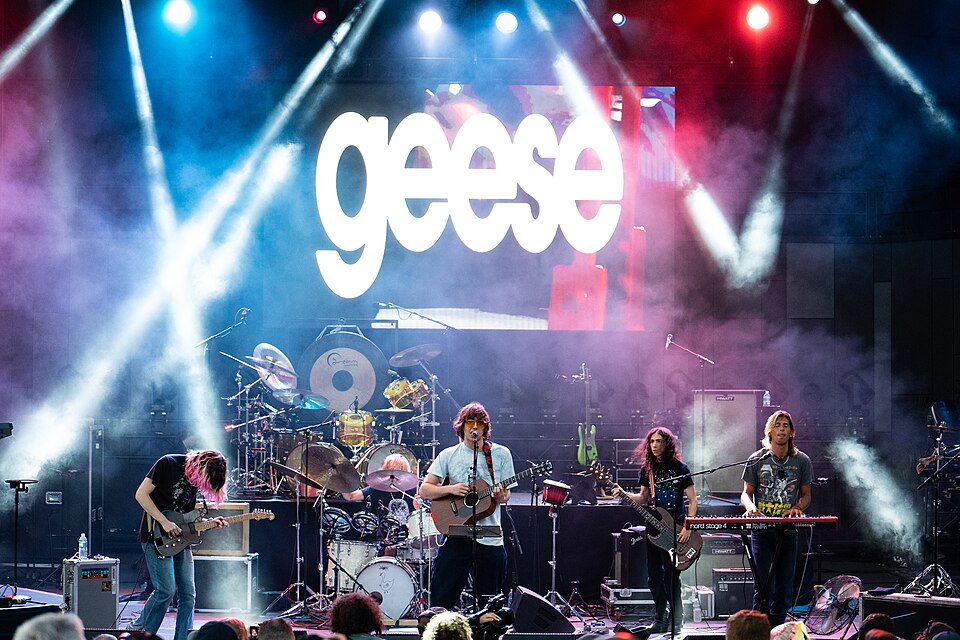
When I first planned to write about Geese, I was far more interested in their newly emerging influence upon the indie rock scene, especially the way they have skyrocketed in UK circles as much as they have in the US. Back in March, all five of the shows they played here sold out, even after being upgraded to larger venues as the fanfare accelerated. Their name has been on everybody’s lips. Great statistics could be drawn up about how often men in Oxford will want to talk to me about Geese.
Of course, there were always detractors. While their fourth album, Getting Killed, was hailed by many as a year-defining sensation for the genre when it dropped last September, a decent number of people also couldn’t seem to get behind them for a variety of reasons. Claims of pretentiousness, “industry plants”, and, as is always classic, Cameron Winter as a “nepo baby” (for the record, his mother is a writer and his dad is a composer – well-off enough, but not famous) have been thrown around, honestly to death.
Winter is a charismatic frontman, that can be said with absolute certainty; on his solo album, Heavy Metal, released in 2024, it felt as though his lyricism was going through a period of experimentation, shifting into something dark and lamenting that can also be felt on the Geese record. His unique vocal abilities capture something both youthful and eternal, reminiscent of many of his rock predecessors. I think the Jim Morrison comparison is the most fun; ambiguous enough that it can be the highest praise or the greatest insult, usually the precise place one wants to sit as a good frontman. It can certainly be argued that an eagerness for something fresh and more musically interesting, when our palettes are simply aching for the unconventional, is part of Geese’s success. Their work feels surreal and astute, not something that would be fed to you by an algorithm. Which is why the controversy they’ve ended up in over the last month has been so fascinating.
At the end of March, Billboard interviewed Jesse Coren and Andrew Spelman, from the digital marketing company Chaotic Good, who revealed their methodology for making songs go viral in an age of short-form content. This involves studying previous examples of viral songs and “simulating a trend” by attempting to make the same thing work but for less palatable tracks. They also claim to focus on online “discourse” by creating narratives around the people they work with, essentially feeding off the natural desire for storytelling that weaves its way into artists’ campaigns. Part of this is about creating social media accounts that will post about the musicians and do their campaign work for them, as well as making TikToks or reels with the songs in the background, in order to simulate greater interest in the work. Geese are affiliated with this company, but so are Zara Larsson, Alex Warren, Sombr, Oklou, and Dijon. If you spend enough time online, none of these would be particularly surprising.
This has led to significant controversy. The idea that people can rise to fame without even having any real initial backing, their fans only ghosts of the internet, is haunting stuff. This can especially seem inauthentic if an artist has “come out of nowhere” and suddenly amassed popularity. Somehow this has been particularly concentrated in the case of Geese, which seems odd, as they wouldn’t exactly be the shoo-in when it comes to obvious success on the basis of a singular song or narrative. Chaotic Good then took down any mention of the artists they are affiliated with off their website, which only fuelled the fire. Their statement was that they did this “so our artist partners don’t get wrapped up in false accusations or misconceptions about how their music was discovered”. Genuine or not, it could be useful to know who is reliant on fake fanbases to generate interest in their music. Though I err on the side that, normally, you can kind of tell?
And, well, everything on the internet is fabricated, and music right now is running on viral marketing moments. We all already live and die by algorithms. People will form the entire basis of their being around content they’ve seen, to the point where everybody is just an amalgamation of their interests, the things they “endorse”. Is it so unreasonable that we would be at the point where musical hype would also be fabricated? Geese also seem like maybe the least egregious case, so why jump on this train with them in mind specifically? To a lot of people, their music was already inaccessible, and despite filling up spots at major festivals this summer, interest in the band still seems to be heavily concentrated in specific demographics. The rock fans who like them love them, and are the same people who would pay money to see them live, while most people probably won’t give them the time of day. Unlike some of the other clientele of Chaotic Good, they’re not exactly receiving radio play. They haven’t even cracked two million monthly listeners on Spotify; most “major” artists sit somewhere upwards of ten, and this isn’t even accounting for the biggest artists potentially inflating those streams. This still isn’t a massive band by any stretch of the imagination.
It is also undeniable that there is something alluring about the band, and about Winter more specifically. Is it so much of a reach to assume that a post-punk band of 24-year-old Brooklynites wanting to provoke and intrigue would be so successful among the exact demographic they belong to?
Everything seems to live in extremes. Not only does everyone need to only love or hate something in the cultural imagination, but also invent a justification for that opinion. Sometimes, it is just enough to say that something isn’t for you and move on.