

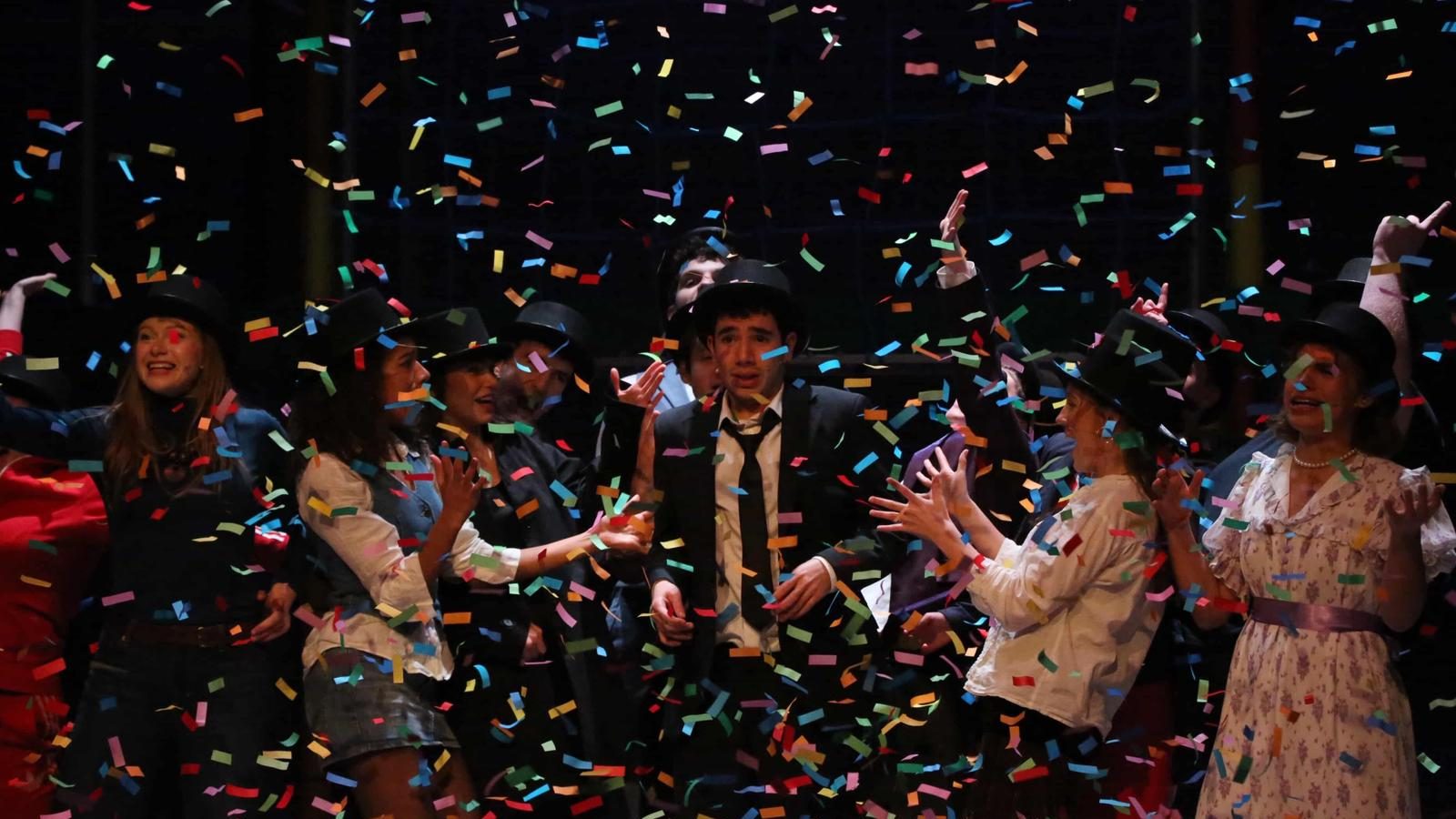
With flashing lights and a shower of confetti, Fennec Fox Productions’ Company bursts onto the Playhouse stage to deliver its exuberant portrayal of romantic pessimism, just in time for Valentine’s Day.
George Furth’s classic ‘concept’ musical (1970), centered around the life of middle-aged New Yorker Bobby (Aaron Gelkoff), takes the audience through a series of vignettes, grounded by the repeated scene of Bobby’s 35th birthday. With the unifying themes of marriage, relationships, and commitment threaded throughout, the play explores a range of perspectives on romantic love, focalised through Bobby’s married friends.
The play is very much character-driven, and the cast do not fail to do it justice. Gelkoff’s performance achieves the impossible: making me actually feel sorry for a straight, middle-aged man living in New York. In spite of the character’s fundamental unlikeability, and his penchant for blurting out the wrong thing at the wrong time (how does he have so many friends in his 30s?), his compelling charisma and witty delivery establish an easy rapport with the audience, so that they find themselves invested in each revelation about his shallow life.
The show’s specificity, capturing the zeitgeist of 70s New York, means that it’s difficult to ensure its continued pertinence, particularly when transposed to 21st century Oxford. The production veers away from overt modernisation, and leans into the 70s aesthetic, from marujiana-smoking hippies to tracksuit-wearing dieters. Yet far from alienating the modern audience, the play’s themes of frustrated connection continue to resonate, even among students, so that the production’s decision to situate it within its original context ultimately emphasises the perennial nature of its concerns.
The standout performance is Rosie Sutton’s Amy, delivering the iconic number ‘Getting Married Today’ with a manic intensity that vacillates between hilarious and alarming. The hurtling momentum of the patter song gives the impression of spiralling panic, belying her masterful breath control. Such an emotionally fraught scene was pushed to comic extremes by the zany juxtaposition of her anxiety and the serene trilling of the priest.
The live music from the orchestra, if a little too loud at times, cleverly punctuates the action, with jaunty riffs and well-timed bursts of melody. Sondheim’s score is played with brilliant vivacity; its insistent intrusions aptly reflect the suffocating aspects of social life as Bobby is surrounded on all sides by a barrage of conflicting demands on his attention.
The high-level choreography is a highlight, accompanying the songs with endlessly energetic and impressively synchronised dance routines. The fast pace and high intensity of many of the numbers, such as ‘Company’ or ‘You Could Drive a Person Crazy’, means that the slower songs drag a little. This was the case with ‘Sorry-Grateful’ (the ‘Mister Cellophane’ of the musical), which, although the singing was of a high quality, was comparatively underwhelming.
Holly Rust’s set, mimicking an indoor soft play area, is perhaps a little heavy-handed in its metaphorical import, but definitely makes the show visually arresting, and contributes greatly to its physical comedy as characters enter the main stage area via a brightly-coloured slide. The pair of swings, descending from the ceiling, are an ingenious conceit, transforming seamlessly from playground swings into overhead handrails on the subway, before being used as the vehicle by which Bobby is literally pulled back and forth by his friends. The fire exit door through which Bobby departs at the finale amid a stream of white light was a little on-the-nose, reminiscent of The Truman Show.
The play as a whole is characterised by a certain superficial profundity, projecting the vacuous impression of emotional, and even philosophical, depth onto the actions of a largely unexceptional man. But this is, of course, a result of Furth’s script, not any failing on the part of Fennec Fox Productions, and the energy invested into the performances more than makes up for this.
The awkward niceties of social life are pushed enjoyably ad absurdum, with the music, staging, and visuals lending the drama an exaggerated, sitcom-esque aspect. As the action redoubles, smoothing the boundaries between past events and counterfactuals, it indulges in a kind of oneiric surrealism, a breakdown in technicolour. The production was a well-executed marriage of humour – physical, visual, and sonic – and cynicism, a vastly entertaining staging of this musical theatre classic.