

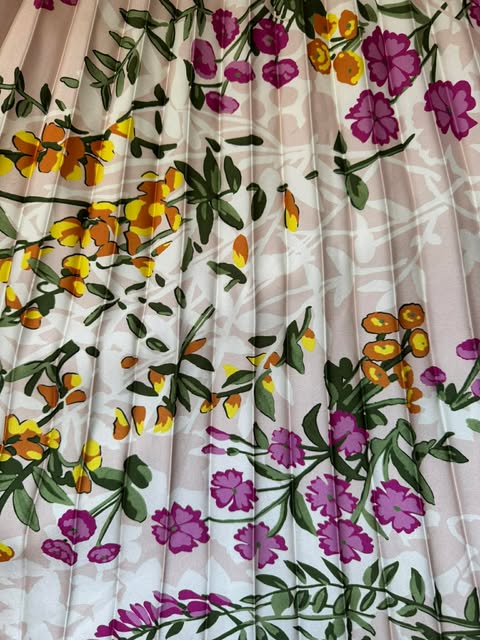
“Florals? For spring? Groundbreaking.” So speaks the withering sarcasm of Miranda Priestly in The Devil Wears Prada, condemning all flowery fabrics to uncoolness even ten years after its release. Her dismissal implies that the floral print is basic – the horror of all fashion’s avant-garde. Oxford’s seeming aversion to pattern shows leftovers of this logic, with style shown through outfit styling rather than design details. Textiles often fall secondary to an ensemble’s overall impact, with florals seldom regarded as revolutionary. Yet in Oxford’s wealthy male-centred microcosm – and well beyond it – they prove to be a tool of subversion, intentional or not. Flower prints are muddy with complexity, and ripe for revisioning.
Woven, printed, or embroidered, flowers are easily the most familiar motifs in fashion history. They have become associated with opposing constructions of femininity, with Christian Dior’s ‘flower women’ of the post-war period, petal-skirted in their essentialist embodiment. However, it was his floral-printed day dresses that influenced a generation of women, reaffirming nip-waisted body ideals and linking flowers as pretty, domesticated visions of nature with the ‘domestic goddess’ housewife trope. This is reflected today through a resurgence in the trad wife aesthetic, coupling homemade bagels with flowery, floaty gowns. Celia Birtwell’s sheer chiffons show 1960s reactionism to Dior’s ‘New Look’: the Hippie generation sought to shake off their mothers’ fashioning of femininity, with Birtwell’s prints evoking psychedelia and Pop Art through a feminist lens. Indeed, her Mystic Daisy print is a model for how cool florals can be, outfitting every It-Girl under the sixties sun. Jane Birkin famously wore it for a Vogue photoshoot (back when it was acceptable just to wear one outfit for your fashion call) and Liza Minnelli dons a Mystic Daisy shirt in Cabaret. However, for Anna Wintour, florals are fundamental in crafting her timeless elegance, becoming a motif that is reconfigured and coloured to fit current modernities. Each new series of Bridgerton makes this clearer, with florals used to connect Regency dress with contemporary fashion – and the more diverse narratives that come with it. Bridging nature and art, these biological bouquets have dressed ideological divides, making floral prints unexpectedly contentious.
Rich with jewel-toned realism, the Ashmolean’s In Bloom exhibition captures how flora has afforded creative and economic agency to women specifically. In the museum collection, Rachel Ruysch’s still lifes convey how studies of natural subjects enabled women access into the patriarchal art world without violating their prohibition from art schools. Flowers presented a readily available subject: symbolising female propriety, such blooms – exotic or commonplace – also allowed women to exploit Enlightenment interest in botany. Mary Moser’s flower still lifes gained her enough acclaim to become one of the two female founders of the Royal Academy of Arts and even established within the royal court, demonstrating flora as an entry point into traditionally male professions. Indeed, In Bloom displays a coloured engraving by Maria Sibylla Merian. It depicts a banana blossom with the life cycle of a Bullseye moth, capturing the utmost biological detail in unique composition. Retrospectively, Merian is considered one of the earliest entomologists. Yet the agency afforded by flowers to women shaped the art world’s dismissal of floral depictions. The association between flowers and femaleness has helped and hindered women, extending to their bodies through fashion.
High fashion has recently revamped the floral print. Springing from Paris’s latest catwalk extravaganza, Sarah Burton’s Givenchy collection problematised the prejudicial concept of Old Masters, dressing the modern woman in the Dutch Golden Age world of Rachel Ruysch’s paintings. The standout dress sees jewel pigments of tulips run in embroidery threads, effectively turning flowers into fringing. No daintily-coloured pastels to be seen here – these flowers are wonderfully gothic, outstepping their assumptions as passive embellishment and giving movement and flair to the wearer as she walks. If Jonathan Anderson’s fall/winter Dior show is anything to go by, the floral reformation is set to colour accessories too, romping all through summer in gorgeous water lily heels. This is a welcome step away from literalising the feminine flower at Dior, leaning into a more tongue-in-cheek, youthful use of the founder’s sourcebook. Riotously rosy, Dries Van Noten also saw men in floral-printed splendour, showing how flowers are dying out as binary statements of outmoded fashionings of femininity. This may not seem all that revolutionary in 2026, but in a city that still appears surprised to see a female physicist, the floral print still has a place as a vehicle of gender subversion. Come Trinity, the floral print poses a destabilising antithesis to Oxford’s unpatterned fashion staples, rooted in upper-class fashionings of male exclusivity. Floral fabrics are more than ready to be reclaimed from bastions of prairie-dress-wearing trad wives. They still have the power to be groundbreaking, regardless of what The Devil Wears Prada 2 might soon have to say.