


CW: Sexual assault, rape
A Cherwell investigation found that only 5 of 40 sexual misconduct complaints reported to the University of Oxford’s Proctors’ Office in the past 7 years were accepted for investigation. Excluding the four reports complainants withdrew, 86% of reports resulted in a No Further Action outcome.
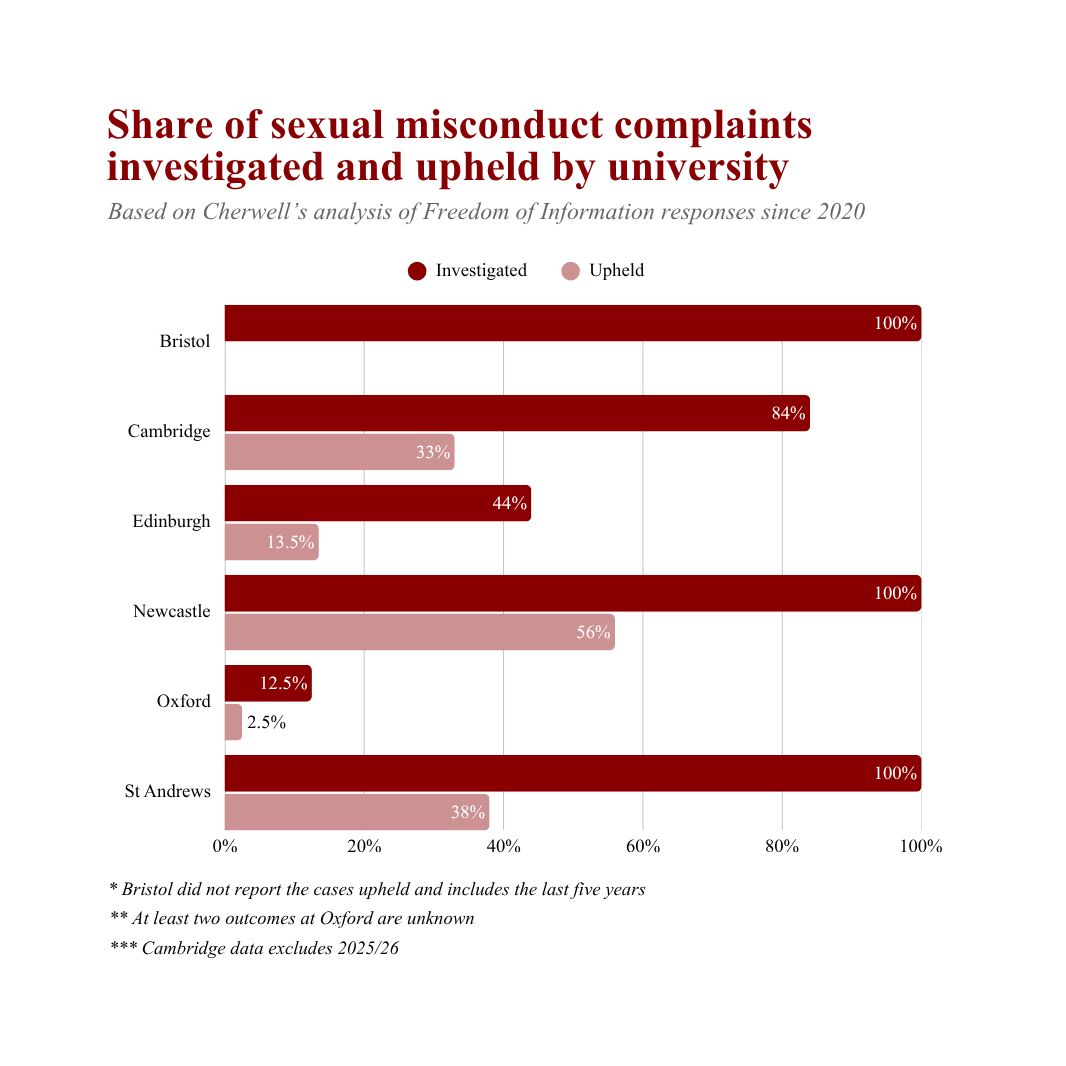
In contrast, the University of Cambridge investigated 84% of reports made through its Student Disciplinary Procedure in the same period, and upheld 33% of total complaints.
In the course of this investigation, Cherwell spoke to students who said that their assaults were referred to as “misunderstandings” by staff, that they were discouraged from reporting as they were told it would be a devastating process, and that they were told that Oxford prefers to resolve these matters with “informal conversations” between the victim and the accused rather than disciplinary action.
At Oxford, if a student experiences misconduct from a student at their own college, they can make a report to their college dean. Each college has its own disciplinary procedure, which the dean can then use to investigate the report. If, however, a student experiences misconduct by a student at another college, the student must contact the Proctors – the two academic officers who oversee student discipline across the entire University. The Proctors would then consider whether to investigate under their own disciplinary procedure.
Freedom of Information (FOI) responses show that policy restrictions were the main reason cases were not accepted for investigation by the Proctors.
Fourteen cases, or 35% of the total number of reports, were referred to another body. Of these, ten were referred to the police, two were referred to colleges, and two were referred to investigation by other bodies.
Referrals to colleges occur when both the reporting student and the accused student attend the same college, so the complaint falls within the jurisdiction of the college dean.
Referrals to the police occur when the matter involves “serious criminal conduct”. The University stated in a FOI response that, under its Serious Criminal Conduct Policy, it “will not usually investigate a report of conduct that could constitute serious criminal conduct until it has passed through a Police procedure”.
Seven reports were refused investigation because the alleged incident occurred outside the context of the University. Two were refused investigation because too much time had elapsed between the alleged misconduct and the report. An additional report was refused investigation because both reasons applied.
Three complaints did not progress because one of the parties left the University. One was refused investigation because the student was about to finish and was dealt with under a No Contact Arrangement. Three cases received a No Further Action outcome with no reason recorded.
Of the five cases the University investigated, one was upheld with a formal disciplinary sanction, two were referred to the Student Disciplinary Panel with outcomes unknown, and the other two did not result in disciplinary sanctions. As a result, the percentage of reports made to the Proctors’ Office which end in a disciplinary sanction falls between 2.5% and 7.5%.
The University’s investigation and complaint-upholding rate are markedly lower than those of the colleges. Of the 14 colleges that responded to FOI requests with exact figures, 50% of reports were investigated, and 35% were upheld.
Cherwell also compared Oxford’s investigation rates and complaint-upholding rates against other universities. Of all the universities that responded to Cherwell’s FOI request, Oxford’s Proctors’ Office had the lowest investigation rate: Cambridge investigated 84% of complaints in the same period and upheld 33% of them; the University of St Andrews investigated 100% and upheld 38%; the University of Edinburgh investigated 44% and upheld 13.5%; the University of Newcastle investigated 100% and upheld 56%; and the University of Bristol did not specify how many cases were upheld, but investigated 100% of cases in the past five years.
[Graph]
These figures raise questions about whether Oxford is doing enough to take action against sexual assault and harassment, as well as supporting those who are victims of it.
The University’s Non-Academic Disciplinary Procedure classifies “sexual intercourse or engaging in a sexual act without consent” as a Category 4 Breach, the most serious category, with an indicative penalty of expulsion. “Touching inappropriately through clothes without consent” is Category 3, with an indicative penalty of suspension.
On paper, this suggests the University recognises sexual assault among the most serious forms of misconduct – one which merits severe punishment. In practice, however, the data suggest the University is highly unlikely to take formal action against it.
The data also highlights likely under-reporting at Oxford. Across the 30 colleges that responded with figures, between 85 and 111 formal sexual misconduct complaints involving members of the college were recorded in the last 7 years. Combined with the 40 formal complaints received by the Proctors in the same period, this averages 18-22 reports per year. Even though this excludes some colleges, this suggests that, in a University of 26,000 students, sexual misconduct is under-reported.
This is consistent with findings from Oxford’s Sexual Harassment and Violence Support Service, which found that among students using the service in 2023/24, only 16% reported to the Proctors’ Office and 11% reported to their college. It explicitly says students choose not to report because of concerns about negative outcomes or that no action will be taken.
An OURSPACE survey by sexual violence researchers, administered to Oxford students in 2021, found that 76 respondents reported they had been raped in the past year at Oxford. One hundred and fifty said they had experienced unwanted sexual touching, and 188 reported that they had been stalked. The survey included 1,314 respondents, only around 5% of the total student population. Because students chose whether to respond, the survey may not represent the wider student body, so it cannot tell what proportion of all students experienced sexual violence that year. But it does strongly suggest that the real number of sexual violence incidents dwarfs the number of formal reports received.
University context
Oxford’s Student Disciplinary Procedure states the University will not investigate conduct that occurs outside a University context. Conduct occurs in a University context if it takes place on University or college premises, or in the course of University activity.
In a FOI response, the University stated its rationale, and in doing so, referred to sexual assault and harassment that happens outside of a University context as “disputes amongst individuals” that were outside of the intended aims of University procedure. They told Cherwell: “The purpose of the disciplinary procedure is to address misconduct by students, rather than to resolve disputes between individuals.”
The policy makes no provision for the effects on the victim of being denied the opportunity for an investigation.
Serious Criminal Conduct Policy
The provision that the University “will not usually investigate a report of conduct that could constitute serious criminal conduct until it has passed through a Police procedure” was referred to in an email as its “Serious Criminal Conduct Policy”.
Oxford’s adoption of such a restrictive policy is an outlier amongst UK universities. For instance, Cambridge, Durham University, Edinburgh, and University College London all expressly allow disciplinary investigations into allegations of serious sexual misconduct to proceed without a police investigation having occurred first. Standard practice across most universities is to pause procedures only if a police investigation is occurring at the same time.
Referring cases of serious criminal conduct to the police, with the University willing to intervene once their investigation concludes, can sound like it gives serious misconduct the weight it deserves. But in practice, it often means that survivors cannot achieve justice from either body, and those accused walk free.
Home Office statistics show that rape investigations leading to a charge or summons took a median of around 14 months to reach that outcome in the year ending March 2026.
The same figures show that around 5% of rapes recorded by the police in that time resulted in a suspect being charged or summoned. Combined with the rate of conviction once a case reaches trial, around 3% of rapes reported to the police result in a conviction. The majority of rape survivors have trauma-related symptoms or PTSD and are required to relive their most distressing moments in order for the investigation to proceed.
The policy meant survivors were required to put themselves through a lengthy and potentially retraumatising ordeal, with no conviction in the majority of cases, for the University to investigate their case.
In theory, reporting students could ask for a University process after a police investigation has completed. But in practice, none of the ten students who refused a University process on this basis came back to ask the University to take on their case once a police process had concluded. It is highly plausible that the demanding nature of the policy means survivors were likely to disengage from the system before that point.
When contacted, Oxford said it introduced changes in 2025 that strengthen the University’s ability to investigate serious misconduct and allow it to investigate more cases without a reporter first having to make a report to the police.
Time constraints
As Oxford’s FOI responses show, there have been three cases in the past seven years where an investigation by the Proctors was refused on the basis of a delay in reporting.
The University changed its Student Disciplinary Procedure in 2025 to allow discretion to investigate cases beyond the six-month timeframe, noting that there are more likely to be good reasons for delayed reporting in cases of sexual misconduct, harassment, bullying, or conduct involving violence or a threat of violence.
Currently, the procedure states that it will not investigate a report made more than six months after the incident, unless “there are good reasons for the delay in the Report being made or there is a strong interest in the investigation proceeding regardless of the delay in the Report being made”.
From a trauma-informed perspective, delayed disclosure in cases of sexual assault and harassment is common. The current policy means survivors reporting beyond the six-month limit have to advocate for themselves to justify that they had a good reason for not reporting earlier, and the Proctors then decide whether their argument is valid.
Despite the procedure being revised to allow discretion in investigating cases beyond the six-month time frame, a sexual misconduct case was still refused investigation on the basis of a delay in reporting in the academic year 2025/26.
ItHappensHere, Oxford University’s student-led anti-sexual violence group, criticised the University’s multiple restrictions on investigating sexual misconduct. They told Cherwell: “It can be unbelievably traumatic for a survivor of sexual violence to be denied the chance to have their voice heard and their experiences treated seriously, and we hope the University policies are able to change to reflect this. Only around 3% of cases of sexual assault reported to the police result in someone being charged, let alone convicted, and many people choose not to go to the police at all due to fears of being disbelieved, blamed, retraumatised, or seeing no action taken. This leaves people with their only chance for justice being at the university level, and the statistics show this is being denied due to unreasonable policies that don’t align with either the colleges’ or those of other universities.
“We’re looking to work with the university on this issue and to make sure survivors are supported, and cases properly investigated to protect all students. If you’ve been affected by sexual violence, there is support out there and people who believe you, and we’re working on making the university a safer, more supportive place for everyone.
“We’ve heard so many stories of survivors being silenced by the university. Students do not trust that the university or its colleges will take reports of sexual violence seriously or handle them sensitively, and many are afraid of retaliatory action. There is a collective responsibility to change the culture of silence, and that starts with changing policies that prevent cases being heard at all.”
Colleges
Among the 30 colleges that responded with figures, between 85 and 111 formal sexual misconduct complaints were recorded in the last seven years. That averages 2.6 to 3.4 per college.
A higher number of reports does not necessarily indicate a higher incidence of sexual misconduct: other factors that affect the number of reports may be the culture around reporting, students’ confidence in the college’s response, and staff’s attitudes.
Colleges often offer the provision of an informal meeting to advise students considering making a complaint. Whether deans or principals appear encouraging or discouraging in such meetings can affect whether a student goes ahead to make a formal report.
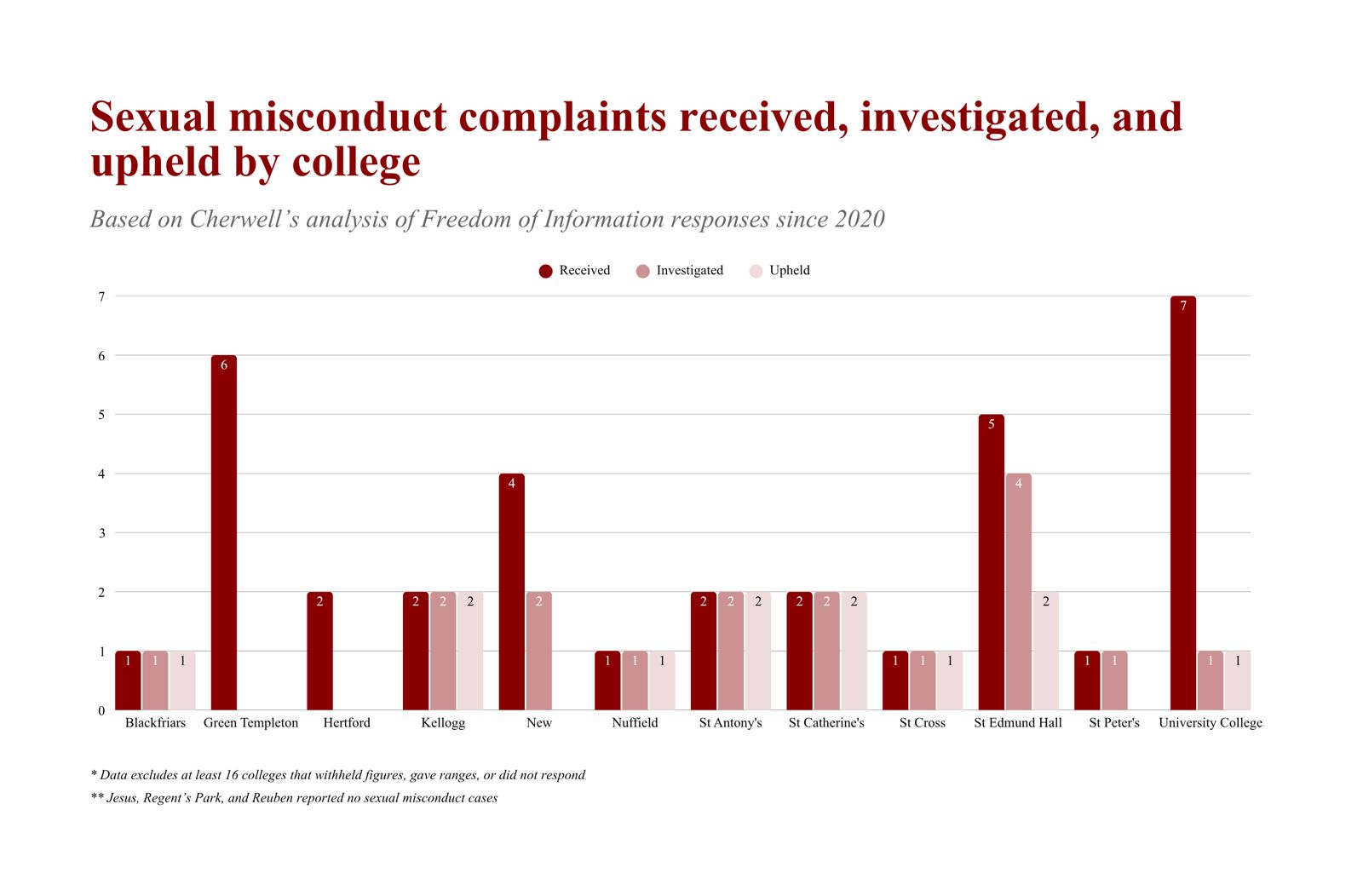
Jesus, Regent’s Park, and Reuben were the only responding colleges that recorded no formal complaints. The three colleges together represent thousands of students passing through over the period, so the absence of any formal complaints across these colleges raises questions about whether students who experience sexual misconduct are being adequately encouraged and supported to report it.
Like the Proctors’ disciplinary procedure, many colleges include a provision stating that a dean will not normally investigate an incident if more than six months have elapsed since it occurred. Balliol, Brasenose, Christ Church, Lady Margaret Hall, Lincoln, Mansfield, Regent’s Park, St Hilda’s, St John’s, Trinity, and Wadham all have such a provision. Harris Manchester and Keble have an equivalent provision of 3 months, and Merton offers 60 days.
These provisions often state that a dean may investigate in “extraordinary circumstances”, with considerations like “risk of harm”, “reasons for a delay in reporting”, and “the gravity of the alleged breach” viewed as making such circumstances more likely.
“Risk of harm” is not defined in any of these policies, and it does not specify whether it refers to the risk of reoffence or whether it includes any psychological harm to the reporting student of having their case denied an investigation. In practice, both are highly likely to be the case in instances of sexual misconduct. Research shows that rates of recidivism for sexual offences are significant: one study in the U.S. found that of 238 students who reported committing at least one act of sexual coercion or assault, 68% committed another act during the four-year period, and a separate study analysed data from 12,624 male students and found that more than 87% of alcohol-driven sexual assaults were committed by serial perpetrators. This raises questions about whether perpetrators who routinely escape formal accountability are emboldened to continue their behaviour, and thus pose a safeguarding risk.
Without internal guidance on how to interpret “risk of harm”, the attitudes of deans and wardens may vary, meaning the same circumstances could result in an investigation at one college but be rejected on the basis of the time limit at another.
Student testimonies
Cherwell sent out a survey to ask students about their experiences of reporting sexual misconduct, or their decision not to report. The survey had 27 respondents.
30% of respondents said they reported their experience of sexual misconduct, while 70% said they did not. Of the options listed, the most prominent factor influencing students not to report was fear of social consequences, with 18 respondents citing this. The second most prominent factor was a lack of trust in the colleges’ or the University’s procedures, cited by 15 respondents. Third was the fear of a counter-complaint initiated by the perpetrator, cited by eight. Six respondents cited a lack of information on reporting channels, three cited policy barriers, and the “Other” category included concerns that the respondent wouldn’t be believed and concerns that the matter wouldn’t be taken seriously since the perpetrator was a woman.
Of the eight respondents who said they reported their experience, three said they were “very dissatisfied” with the University or college’s response, two said they were “somewhat dissatisfied”, two said they were “somewhat satisfied”, and one said they were “neither satisfied nor dissatisfied”.
Cecily
Cecily (name changed to protect the student’s identity) told Cherwell that one of the reasons she did not report her alleged sexual assault was that multiple members of staff at her college warned against making a formal complaint, telling her the process would be devastating.
“They were deeply against reporting because in most cases it causes more harm to the victim than it does help,” she said. “I was told they would go through my whole history, anything I’d ever done, and tear me to shreds. And that it would be very humiliating.”
She added that her College Chaplain told her the University’s response to cases like hers was often to encourage an “informal resolution” where the two parties attend a supervised meeting to “talk through their issues”. She said that in a case which revolved around sexual assault, she “could not see how this would help at all”, and demonstrated the University’s lack of awareness around issues of sexual violence.
She also claimed that before he assaulted her, her alleged perpetrator had already been investigated for sexual misconduct by a different college, but this had resulted in no formal consequences.
Another reason Cecily did not report her alleged assault was the response of some of her peers when she told them that she had been sexually assaulted. Some did not believe what happened, while others believed her but continued to be friends with the alleged perpetrator. Some encouraged her to remain friends with him herself.
She said that this made her feel “horrible and invalidated”, and that her diagnosed PTSD was made worse by her peers’ response.
“All this happened even though it was deeply traumatic and negative, and affected everything in my life for months,” she said. Cecily says she had to go on antidepressants as a result of her PTSD.
“I think there are more people who will invalidate you by saying ‘it’s sexual assault, but there is still room to forgive’ than there are people who will invalidate you by denying there was any assault at all.”
“Not all rape culture is as explicit as denial and disbelief – a lot of it is playing things down and trying to pretend they never happened.”
Hannah
Hannah (name changed to protect the student’s identity) describes waking up to a male friend who was pressing his body against hers and rubbing his hands up and down her body. She said it took her several months to realise that what she experienced was sexual assault.
She says she spoke informally with her College Dean about reporting her alleged assault, and says he discouraged her from making a complaint. She was told by the Dean that it would be her word against his, and that if she made a formal complaint, it probably would not go far. Instead, it was suggested that she speak to the student who assaulted her to resolve the situation, which the Dean referred to as a “misunderstanding”.
Hannah also said she was put off making a complaint by the fact that the harassment advisor in her college was one of the alleged perpetrator’s tutors.
She told Cherwell: “There is definitely a rife culture of typically privileged male students who do not have any concept of the meaning of consent and do as they please, pushing boundaries to the point where they assault girls.”
Hannah said she later witnessed the man who assaulted her making unwanted physical contact with other women, and that she was concerned that if no formal authority ever intervened, he would continue to engage in such behaviour.
Emily
Emily (name changed to protect the student’s identity) told Cherwell that she experienced sexual coercion and physical assault from another student at Oxford, and that her alleged perpetrator retaliated against her when she expressed an interest in seeking a No Contact Order against him.
She said she did not formally report her perpetrator’s conduct due to a fear of retaliation. However, she said she did tell him she would ask her College to apply for a No Contact Order from the Proctors, and this was enough to trigger what she believes is the retaliation she feared.
According to her, her perpetrator made a series of allegations and vexatious complaints to every society and workplace she had been involved in. It took three months of investigation before they were deemed vexatious and dropped.
While the investigations were ongoing, Emily says she received an email from college instructing her not to talk about the complaints made against her. The email read: “For your own wellbeing you must keep this information strictly confidential, make no reference to the complaint or allude to its existence in any way in communication on social media / email / etc.”
Emily says she feels this was likely reputational damage control by the college, and that she felt alienated from them as a result.
She says she also received an email from the perpetrator’s college saying she was banned from its premises, with no explanation. As well as this, her College did not end up making an application for a No Contact Order to the Proctors because the alleged perpetrator’s College had applied for one and received it before they could.
Emily says that while some members of staff at her College were verbally supportive, she feels her College Dean was unempathetic, and that her perpetrator’s College was more effective in supporting his retaliatory counter-complaints than her own College was in supporting her.
Retaliation in response to allegations of misconduct is classified as “victimisation” by the University. Oxford’s Harassment Policy and Procedures says that the University defines victimisation as any instance where someone is subjected to detrimental treatment because they have, in good faith, made an allegation of harassment, indicated an intention to make such an allegation, or taken any other steps in connection with the policy and procedure, or are suspected of having done any of these things.
The Policy says that: “The University does not tolerate any form of harassment or victimisation”. It states that those in positions of authority “have a duty to implement this Policy and to make every effort to ensure that harassment and victimisation do not occur”.
Emily says that the University let her down by allowing victimisation to occur against her, despite its stated no-tolerance position towards it.
She says her alleged perpetrator had been previously reported to his college by another student, but that no action had been taken against him at the time. She told Cherwell: “I was horrified to find out his college had already received reports against him. By not dealing with his behaviour from his very first victim, it allowed him to continue hurting other individuals, and then hurting me.”
Dan
Dan (name changed to protect the student’s identity) told Cherwell that he reported a member of staff for harassment at his college. Allegedly, Dan said he had personally witnessed the member of staff engaging in unwanted physical contact of a sexual nature with other staff, and that they were known to make sexually charged comments to students. He claims this member of staff’s behaviour was an “open secret” in the college for at least two years.
He added that while many of his peers supported him in bringing forward a complaint, others discouraged him. He said that since the member of staff was known to give free wine and formals to their favourite students, some discouraged him as it meant they would lose these “perks”.
Dan said that when he and his friend spoke to the Head of Welfare at his college, they were told not to let the information relating to the complaint “take on a life of its own”. He says he later found out that another student overheard another member of staff making disparaging comments in public about him and his friend for reporting. This included being annoyed that they wanted to take it further, and claiming that they had no proof.
Dan says this made him feel discouraged from taking his complaint further, and powerless in addressing the harassment he was witnessing.
Dan ended up deciding to take it to senior staff, where he felt his complaint was taken on board seriously and swiftly. The college human resources team began an investigation into the matter, during which the member of staff in question left his position.
Dan said that while he was pleased that his complaint was taken seriously when it was escalated to senior level, he felt his experience “speaks to a culture of open secrets, underhanded benefits, and a feeling that honest reporting is discouraged”.
Isla
Isla (name changed to protect the student’s identity) said that she was raped after a college ball. She said that after her assault, she stopped going to lectures, stopped going to the Schwarzman Centre, and fell massively behind on her academic work. She said she felt “in a constant state of anxiety, as [she] no longer felt safe in Oxford”.
She told Cherwell that a man had left her college ball with her when she was intoxicated and struggling to walk, and then taken her into his accommodation at his college and raped her. Afterwards, the college’s porters saw her trying to leave the man’s accommodation, and they came to try and help her. Allegedly, they saw her slurring her words and struggling to form coherent sentences. They offered her a taxi to get home, which, in her drunk state, she refused.
Isla says she felt it was a mistake for the porters to do this, as she was clearly in no state to walk home alone. Her house was a ten-minute walk away, but she only got there an hour later, after having to be dropped off in a police car.
Isla says that after that night, she was dismayed that no one from the man’s college followed up with her. She said she found it hard to believe that people whose profession is in security would be unable to spot the signs of danger, such as an intoxicated woman being taken into an accommodation by a non-intoxicated man. Instead, she found out that the college had gotten involved, but only to Dean the student for breaching the college’s guest policy. She told Cherwell: “I was frustrated that the extent of the college inquiry into the matter was to Dean the student to discuss guest policy, and require only that he apologise to the porters.”
The student also admitted to her that he had been deaned in the past after another drunk girl was seen trying to leave his accommodation – again, for a breach of the college’s Guest Policy.
Isla said she then tried to obtain CCTV footage of her trying to leave the man’s accommodation in case she needed it. She went to speak with the porters and was told she couldn’t see the footage herself for data protection reasons. Instead, she was told that she should email the Head Porter. Isla says she saw this obstacle as a reason to give up, given her lack of trust in the porters after she felt they had failed to follow up with her after that night, and her deteriorating mental state following her rape.
Later, when the term finished, she felt more able to make a formal report as she knew she would not have to see her rapist again. She contacted the Head Porter and was told the CCTV footage she was looking for had been deleted, as all footage is deleted after 23 days unless a request is made to keep it. She was “baffled” that they did not think to keep it regardless, as she had come in to request it, and expected that a welfare concern would have been flagged.
*name changed to protect the student’s identity
When asked for comment, Oxford University said: “Sexual misconduct, harassment and violence have no place at the University of Oxford. We are committed to fostering a safe and respectful community and to preventing and responding effectively to misconduct. In 2025, we made significant changes to our disciplinary procedures, informed by student feedback and consultation with student groups. These changes removed some of the barriers to reporting sexual misconduct and harassment, although we recognise that cases are under-reported relative to the number of students seeking welfare support.
“The University’s complaint-handling processes provide clear routes for concerns to be raised, considered and acted on. Changes to Statute XI, approved by Congregation in 2025, strengthen the University’s ability to investigate serious misconduct, including sexual violence, and allow the University to investigate more cases without a Reporter first having to make a report to the police.
“The changes also make disciplinary processes clearer and more accessible, and support compliance with Office for Students requirements on harassment and sexual misconduct. The revised procedures allow discretion for the University to investigate cases beyond the six-month timeframe, noting that there are more likely to be good reasons for delayed reporting in cases of sexual misconduct, harassment, bullying or conduct involving violence or a threat of violence.
“This term, all students starting a course at Oxford are required to complete the University’s Harassment and Sexual Misconduct online training. Developed with Oxford students, it reflects Oxford’s collegiate structure and signposts students to both college and central University support. This complements Healthy Relationships and Consent workshops delivered by trained student facilitators, with support from the Sexual Harassment and Violence Support Service.”
Mansfield College said: “Although our published procedure references a time limit, investigations are in practice guided by the wishes of the student raising the complaint, not by the length of time between incident and complaint. We will shortly be publishing an updated policy to reflect this.”
Regent’s Park College said: “Regent’s Park College places the highest priority on the safety, welfare and wellbeing of our students and staff. The College takes reports of harassment and sexual misconduct extremely seriously and is committed to ensuring that all concerns are considered fairly, sensitively and with appropriate regard to safeguarding. Our policies, including our Non-Academic Disciplinary Policy and Procedure, are regularly reviewed and follow University and Conference of Colleges guidance.
The policy to which you refer follows guidance issued by the Conference of Colleges. As the policy makes clear, the six-month period is not an absolute time limit: provision is made for allegations to be considered outside this period in exceptional circumstances, and the policy specifically recognises that exceptional circumstances are more likely to exist in reports of sexual violence and harassment.”
Lincoln College said: “The College’s Non-Academic Misconduct Disciplinary Procedure states that reports concerning alleged breaches of discipline occurring more than six months previously will not normally be investigated. However, this is not an absolute cut-off: the Procedure expressly allows the Senior Dean to investigate where they judge that there is a compelling reason to do so.
“In reaching a decision to investigate, the Senior Dean is required to consider the gravity of the alleged breach; whether it was an isolated event or part of an alleged course of conduct; the length of any delay in reporting; the reasons for that delay; and any barriers to reporting. The Senior Dean may also take account of risk to others when considering whether there is a compelling reason to investigate.”
Brasenose College said: “Our student handbook includes more detail on the exceptional circumstances, noting in particular the emphasis on sexual misconduct and/or violence:
“In deciding whether there are exceptional circumstances, the Dean will place particular weight on whether there is a risk of harm to any current member or members of the College and whether there are safeguarding considerations. The Dean may also consider factors such as the severity of the alleged misconduct, whether the alleged misconduct was an isolated event, how much time has passed since the alleged misconduct, and any barriers to disclosure or reporting of the misconduct. Exceptional circumstances are more likely to be found to exist in cases of sexual misconduct and/or violence.”
St John’s College said: “‘Risk of harm’ has intentionally not been defined in order to allow for the possibility of a broad interpretation. The non-academic disciplinary procedure states under 3.2. Formal Resolution ‘The College recognises that exceptional circumstances warranting the consideration of a report after more than 6 months may be particularly likely in cases of sexual misconduct or violence.’
“This implies that the 6-month time restriction would not be applied in cases of alleged sexual harassment or misconduct, and that such reports would be investigated in accordance with the procedure.”
If you have been affected by any of the issues raised in this article and would like to seek support, please reach out to any of the following:
It Happens Here: https://www.ithappenshere.co.uk/need-support
Oxford Sexual Abuse and Rape Crisis Centre: https://www.osarcc.org.uk/
University of Oxford Sexual Assault Support Service: https://www.ox.ac.uk/students/welfare/supportservice