

With Anna Wintour trotting around New York and cosying up with Lauren Sanchez Bezos, it is no surprise that the 2026 Met Gala is hitting highly controversial seas. The gala itself needs no introduction: as the Metropolitan Museum of Art’s fundraiser, it is undoubtedly the world’s highest profile fashion event, with the red (or pink, or blue) carpet rolled out every first Monday in May to a galaxy of camera flashbulbs. Instantly dubbed the party of the year, it was founded in 1948 by publicist Eleanor Lambert to establish the self-funded Costume Institute. High-flying dictators of fashion – like Diana Vreeland and Anna Wintour today – have turned the Met Gala from a New York high-society dinner into a global phenomenon pumped with star power.
Wintour has co-chaired almost every gala since 1995, icily manning high fashion’s gates. Even the Kardashians – having become a fixture at the Met – were barred until they had seemingly ‘proved’ their fashion force in 2013. However, Wintour’s endorsement of Sanchez Bezos as co-chair and lead sponsor has led many to question the Met Gala’s stance on Trump’s tech-tycoon administration, enabling the purchasing of cultural capital alongside political power. Their combination of sunglasses and cinched Galliano is a poor formulation for this year’s glamour. The price of a ticket is $75,000; a table, $350,000. Seeming increasingly in the pockets of America’s billionaires, the Met Gala is no longer the escapism it used to be.
All that said, this year’s theme of Costume Art posits an interesting stance on fashion. The newly released catalogue cover speaks volumes about the complicated stance of the body as an artistic and biological symbol: Jacques Fabien Gautier Dagoty’s flayed image of a woman’s back (with her coyly – and very oddly – looking over her shoulder at the viewer) draws on corsetry fashions rather than actual anatomy, evoking fashion’s aestheticising power on art – even in the slightly gory case of a woman’s ribs. Robert Wun and Thomas Browne Couture have since offered their own interpretations, with muscular, dressed embodiment implied through sequins and tissue-thin leaves of fabric.
However, bodily shapes also resurface in art, with Niki de Saint Phalle’s exuberantly coloured, full-figured woman in her sculpture Nana and Serpent, adversely conjuring the extraordinary corsetry of Michaela Stark. Stark’s garments redefine beauty ideals through reshaping the body in an unconventional way, maintaining a respect for the individual wearer’s physique by emphasising curves in a technique combining custom-made lingerie and references to the Shibari rope-tying method. The theme essentially conveys a deeply embodied artistic and sensual relationship with the body, at a time when getting back in touch with our own humanity is no bad thing.
Of course, such themes often get lost in the Met Gala’s media whirlwind. Craftsmanship falls secondary to the celebrity, completing the paradox that the stars provide an unmissable platform for a brand’s garments, often footing the bill for celebrity attendance. Yet costume art (when taken more literally) also implies the painstaking haute couture process used to create the gowns: a slow, personally tailored technique antithetical to fast fashion’s constant churn. Unfortunately, not the paradigm of sustainability either, the slower ethos of high fashion is nonetheless applicable to student wardrobes. Elevating her second-hand shopping to Gucci for the 2022 Met Gala, Billie Eilish’s pale green and peach gown used deadstock fabric to create an ensemble from entirely pre-existing elements. This evokes recent online trends for garment embellishment, using simple and quick sewing techniques to upgrade an item that owners had fallen out of love with. It proves a cheaper way of updating personal style, as well as a welcome revision break. Following a viral recreation of a cardigan worn by Harry Styles in lockdown, JW Anderson released the original crochet pattern with a tutorial. Sustainability in fashion is collaborative, as healthy for our wellbeing as for our wardrobes.
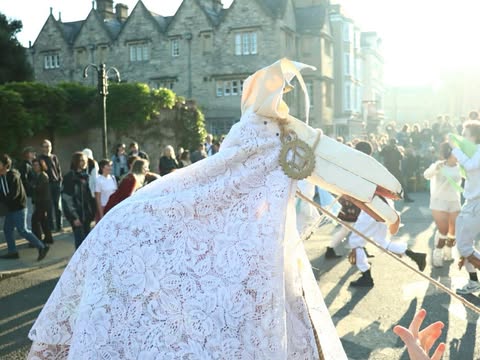
The prime example of sustainable, collaborative costume art in Oxford comes from an unexpected tradition. Oxford’s month of May is heralded by an altogether different celebration than the Met Gala, marking the start of summer through pagan and Celtic origins. For many students, the early morning at Magdalen Tower is addled with hangovers and sleep deprivation, but it is still often possible to spot the Green Man in the crowds and various Morris dancing troupes. With feathers, flowers, and leaves in hair, the materials used to indicate summer’s return are naturally tied to the season. Furthermore, the costumes worn by such celebratory groups are often collaboratively handmade or embellished, passed down and adjusted through generations.
Social media slow fashion trends reflect what has long been embedded in folk and May Day traditions. This is most evident with the Jack in the Green figure, a more modern spectacle in Oxford tradition that involves someone donning a huge wicker frame, which is covered in greenery and ribbons. Of course, this is linked to a more spiritual vision of costume art, posing a locally-grounded perspective on clothing sustainability. The Met’s own take on the theme will inevitably come outfitted with billionaires and celebrities vying for coverage at an event that feels notably detached from the current economically divided world. Yet, as Oxford students, we can take a theme already embedded in city traditions and use it as a sustainable fashion impetus for rewearing.