

Sunday 2nd August 2026
Blog Page 524

Unclichéd and unabashed: LGBTQ+ storytelling at its best

Many a list of the ‘Top 10 LGBT films’ can be found online. Undoubtedly, another handful of these lists have popped up during pride month this year. At Cherwell, we have decided against adding to the somewhat knackered tradition of ranking the same old favourites in a similar order. Why rank? Why be so rigid when discussing the subversive and expansive world of LGBT+ cinema? Why be so ‘straight’ about queer film?

Instead, we have asked some of our LGBTQ+ identifying contributors to share their very favourite moments of joyous LGBTQ+ non-conformity on screen. From the often-quiet queerness of God’s Own Country to the irreverence and flamboyance of Female Trouble, our list is a testament to the fact that LGBTQ+ cinema has no single aesthetic, or scale, or pitch, or story line. It can look like Divine in cha cha heels and it can sound like the wind carrying the cries of a new-born lamb on an isolated Yorkshire farm.

God’s Own Country (2017) Directed by Francis Lee

Image credit: Salzgeber & Co. media

“And I want you to come back. With me. And I want us to be together. I don’t want to be a fuck-up anymore”

God’s Own Country is not a flashy film. The script is a mere 15 pages long, the interactions between Johnny Saxby (Josh O’Conner) and Gheorghe Ionescu (Alec Secăreanu) as sparse yet sublime as Yorkshire’s landscape around them. It is, however, a beautiful film, a discovery of love and hope in a bleak situation.

Culminating in a desperate attempt by Johnny to win Gheorghe back, Johnny learns the importance of vulnerability, of dropping his I-can-deal-with-it bravado and letting himself be seen and accepted for who he really is. The key moment is Johnny’s confession ‘I don’t want to be a fuck-up anymore’, a declaration of his intentions to change and become a better, more independent person who is capable of loving others. Unlike many LGBTQ+ films, God’s Own Country is not a story about accepting sexuality, but rather about accepting love and having hope for a better future, be it with a handsome Romanian farmer who saves your sheep and steals your heart, or whatever else you’re into.

By Lizzie Harvey

A Fantastic Woman (2017) Directed by Sebastián Lelio
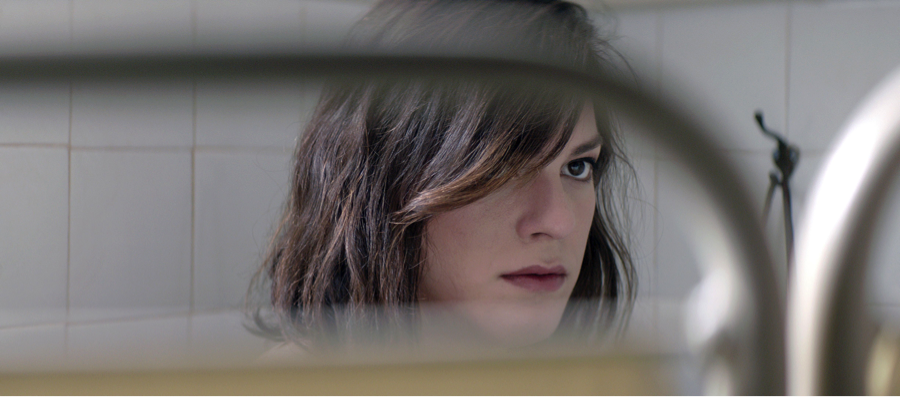
Image via Film Criticism

This Chilean movie was the country’s first Academy Award nomination for Best Foreign Film. Its excellence in delicately and sensibly approaching trans issues pertinent to Latin proves just how deserving it was of said title. Daniela Vega’s lead is so mesmerising that one finds it almost impossible to believe it is her debut, and Sebastian Lelio’s direction elevates her without ever being in second plane.

As a cis gay man, I find it extremely important to actively seek out movies made in close collaboration with trans individuals so as to broaden my perspective and strengthen my allyship towards the trans community in this time of increasing socio-political turmoil. The movie’s triumph lies not in educating its viewers, but in depicting trans realities, far removed from many of our lives, in a way that is multifaceted and complex.

Such was the impact of this film that LGBTQ+ activists in Chile used its success as a major, positive point to help pass of one of country’s gender identity bills that would allow citizens to legally change their details. It is a true example of a film that dissolves past the borders of the silver screen and into its realities of its viewers. Such films are now more urgent than ever and I would urge people of all sexual/gender identities to watch it in hopes of having the same connection to it as I, and so many others, did.

By Antonio Gullo

Female Trouble (1974) Directed by John Waters

Life is never easy for the bullied, beaten and often very sad protagonists of queer cinema. If they find love, it is ‘forbidden.’ If they have sex, it hurts. If, in a moment of weakness, they tell someone about their predicament, they are shipped to Utah, to live out their adolescence alongside some sexy but sexless Mormon flagellants until they cave in, and take a wife.

So helpless are the queer characters of cinema that it takes a straight woman, albeit played by a gay man, for us to have some fun. Introducing Dawn Davenport, star of John Waters’ Female Trouble. “Nice girls don’t wear cha-cha heels,” warns her stuffy, boring parents, who dare to love her. She pays them no attention, screaming “I blew Richard Speck,” before hitching a ride to a junkyard, where she has sex with a toothless man on a discarded mattress. 

In Female Trouble, conventional, ‘heterosexual’ morality is inverted. Crime is beauty. Religion is degenerate. Murder is joyous spectacle. If you are successful enough to end your life in the electric chair, then that is an honour, for “the world of the heterosexual is a sick and boring life.”

Female Trouble asked its 1970s audience: why court acceptance when flagrant immorality is so much fun?

By Johnathan Trevelyan

Maurice (1987) Directed by James Ivory
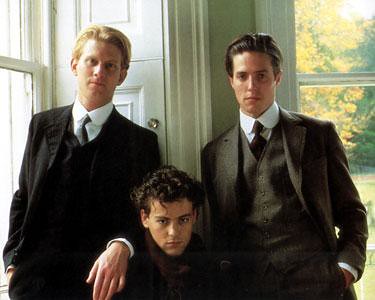
Image via Flickr

The release of 1987 film adaptation of E.M. Forster’s Maurice marked a watershed moment in the history of queer cinema. The production company Merchant Ivory had made themselves known for their period films, many of which were adaptations of E.M. Forster’s novels set in stuffy, strait-laced Edwardian England. Maurice was only published after Forster’s death – it was considered unpublishable due to its depiction of romantic love between two men – and had been eclipsed by other works such as A Room with a View and Howards End and the film adaptations that followed. “Gay films” were few and far between at the time, let alone those with a happy ending. Even now, the vast majority of on-screen gay romances seem to end in death or despair, and so an uplifting love story between two men is a true diamond in the rough.

The film only becomes more poignant when considered alongside the backdrop of the AIDS crisis. In Thatcher’s Britain the LGBTQ+ community were silenced by the government, shunned by the public and dying rapidly from a mysterious new illness. The film’s release could not have been more timely. Initially overlooked by critics, Maurice has achieved iconic status in recent years as a beacon of queer joy – and of hope during one of the darkest periods in history for the LGBTQ+ community.

By Alison Hall

Maccies After Midnight

Sauce sacrilege Lucas Jones

Is food subjective? It’s an age-old question that seems to have an obvious answer. Within reason, surely everyone has their own tastes. Nothing can be objectively disgusting, can it? Ever since mum started shovelling broccoli onto my plate I’ve been taught to believe that it’s just a matter of acquiring a taste for something, and I believed her right up until last term. My best mate from home (we’ll call him Barry) managed to change the way I look at food with a single kebab shop order: chips and mint sauce.

In my friend’s frankly undeserved defence, he didn’t choose that out of the blue. Hussain, the proprietor of our lovely local kebab van, was rattling through the available sauces. After listing off the regulars; barbecue, ketchup, mayonnaise and so forth, he gave us a cheeky grin. “Or mint sauce…” It was obviously a joke, but Barry’s eyes lit up. Hussain and I made nervous eye contact. Surely not? “Mint sauce, please!” The reply was a timid “are you sure?”, countered with a heartfelt nod. Hussain set to work with the grim conviction of an undertaker, and when my turn to order came, my appetite was long gone. 

The chips arrived, drenched in a dull white sauce. Barry tucked in, shovelling mint sauce in with each strip of potato. He insisted that I try one, so I conceded as we swung into college and tried to pick out the least sullied chip. 

The experience was refreshing, which is not a good word for a kebab shop order. Mint sauce is great with lamb. It’s lovely with falafel as well, and I’m sure that people enjoy it responsibly every day. But it doesn’t belong on chips. Mint sauce is designed to counter other flavours, so when they aren’t there the experience is like eating toothpaste. The worst, however, was still to come. 

When we woke up the next morning, a bit hungover and very hungry, I absentmindedly reached for the carton of chips on my dresser. Without even opening my eyes I managed to eat the most minty chip in the packet. It was bad enough hot, but in the morning the mint sauce had had time to congeal into clumps. I can’t fathom how that experience could ever be appealing, least of all with a blinding hangover. 

If you’re reading this thinking: “that doesn’t sound too bad,” my friend would love to hear from you. If that’s piqued your interest, order that the next time you’re staggering past your local kebab van. If nothing else, it’ll leave your breath smelling lovely.

Accidentally famous Anonymous 

My rise to fame in Maccies (or, the night I totally should have asked for free food) happened one night when, on our way back to college after what had no doubt been another wild night at Parky, we made the customary visit to Maccies. While we waited for our order, out of the corner of my eye, I noticed the security guard whispering intently to two of the cleaners – and they kept glancing with wide eyes in my direction. I guessed they were just commenting on our no-doubt dishevelled appearances. I mean, no one actually looks presentable after stumbling out of Parky at half two in the morning.

We grabbed our food and were just about to leave when we were suddenly stopped at the door. It was the very same security guard, who turned to me and said: “Excuse me, who is your dad?”

“My…dad?” I replied with raised eyebrows.

“Your dad is Shah Rukh Khan, isn’t he?” he said with a knowing look on his face.

In case you don’t know, Shah Rukh Khan is perhaps the most famous Indian actor in the world. I vaguely knew that he has three children – none of them are me. I just stood there for a moment and stared at him, a box of 19 chicken nuggets in one hand (the one I had already started eating in the other). I think I would have been less shocked if he had told me I was under arrest.

I was about to tell him he was quite mistaken, but my friend had other ideas. She conspiratorially told the security guard that he was absolutely right, and that we were keeping it on the down-low to avoid me getting too much attention. Soon enough, my other friends had joined in, telling the cleaners that they were my bodyguards. The security guard began speaking very intently to me in Hindi, telling me that I shouldn’t try to hide who my dad was and that I should be so proud of him. If I had been the real daughter (who, a later Google search revealed is a year older than me and actually studying at NYU), it would probably have been rather sweet. One of the cleaners asked for my autograph which my ‘bodyguard’ refused, saying I wasn’t doing autographs right now.

My ‘bodyguards’ did not stop laughing the whole way back to college, especially when we discovered I look nothing like his daughter. Safe to say, I avoided Maccies for a while after that – some of us just can’t deal with the spotlight, you see.

Heartbreak at Hassan’s – Mia Sorenti

The end of every night out always follows an almost identical sequence; finally leaving the club after an hour of craving something fried and covered in cheese, queuing (often in sub-zero temperatures) around the block for Hassan’s, before eventually nursing a warm carton of life-saving carbs back to college. However, one particularly bizarre encounter will be ingrained in my mind for a long time. 

After tumbling out of some sweaty, strobe-lighted cesspit, my group of friends practically sprinted down Broad Street towards the familiar light of Hassan’s food truck. Settling in for the wait (always worth it), we clocked a couple dressed as Mario and Luigi ahead of us in the queue. My friend’s face immediately lit up at the sight of fancy dress. 

“I like your outfit!”. Stony silence.

We exchanged bemused looks. My friend tried again, but again no response. Mario stared ahead, eyes fixed on the truck’s glowing interior with an alarming intensity. 

We nervously resumed our conversations, occasionally glancing at the couple, who remained steadfastly silent as they stood half a metre apart. I realised that the girl (Luigi) had been crying, her mascara running into the corners of her fake mustache which had clearly already weathered a serious storm. They stayed like this for the whole 20 minutes of queuing, not speaking a word to each other or anyone else before finally collecting their orders and disappearing into the night.

What had gone down at the fancy dress event? Why were they so determined to queue for chips in excruciating silence? Did they manage to patch things up? Whatever happened, I’ll always have a grudging respect for that commitment to post-night out carbs; he might break your heart, but he’ll still buy you falafel.

The problem with Pornhub: and how they get away with it

0

CW: mentions of sexual assault and rape

In many ways, PornHub has become synonymous with porn in the public eye, and with its daily traffic of 100 million users, it is easy to see why. MindGeek, the corporate behemoth which owns companies including PornHub, YouPorn and RedTube, has a significant presence in the commercial porn industry. In providing practically infinite free adult content, such ‘tube’ sites have single-handedly transformed the industry, generating billions in revenue per year. Over the past few months, PornHub has faced public outcry after a campaign exposed a series of cases where exploitative sexual content (videos of underage participants, rape, revenge porn and coercion) was platformed on the website. 

Although demands for repercussions have only recently become widespread, some of these cases date back to 2009 (CW: rape). The fact that such material has been surfacing for decades demands a closer look into the issues deeply rooted in the foundations of PornHub, and ‘tube’ sites in general. Whilst pornography in itself does not have to be inherently exploitative, the unique business model which ensures the corporation’s dominance in the field is the very reason its platforming of abuse content is inevitable.

At the time of writing, the ‘TraffickingHub’ petition, which demands that PornHub is shut down and that its executives are held accountable for “enabling, hosting, and profiting from videos of child rape, sex trafficking, and other forms of non-consensual content exploiting women and minors”, has over 1.5 million signatures. Pornhub has firmly refuted these claims of its complicity, citing its “steadfast commitment to eradicating and fighting any and all illegal content on the internet, including non-consensual content and child sexual abuse material.” On the surface, these defensive statements seem to ring true – PornHub’s strict community guidelines contain policies on child sexual abuse material and non-consensual content, facilitated by a coherent flagging system and enforced by teams of human moderators and automated detection technologies such as Microsoft’s PhotoDNA and Vobile, designed to find, remove and report illegal and inappropriate content.

Yet these post-publication checks ultimately prove inadequate, as abuse content continues to slip through the net. In order to prevent exploitative content of this nature being published and platformed, pre-publication checks are essential. But it is here that the deeply ingrained issues of PornHub come to light, as whilst these measures are integral to ensuring this platform is abuse-free, they are incompatible with the business model upon which PornHub has built its success.

A brief look into the specific legislation for the adult industry proves revealing; 18 U.S.C. 2257 is a law which requires all producers of sexually explicit material to obtain proof of age for every model they shoot, and retain those records. A statement demonstrating compliance with this law can be found in the footnotes of all porn sites. However, along with its sister sites under the MindGeek umbrella, Pornhub is classed as a ‘tube’ site: anyone can upload content, and users can browse and watch anything uploaded for free. This model provides them with a legal loophole to skirt responsibility for the content they publish. They are able to effectively wash their hands of the issue; as a publisher, rather than a producer of adult content, they claim it would be impossible for them to keep records on whether the performers involved in this content are of age and consenting. Here we can see a dangerous grey area: PornHub insists on operating and being regulated as a content publisher similar to YouTube, in spite of its sexually explicit content which ultimately demands compliance to a different legal framework. An analogy by ‘Girl on the Net’ clearly expresses how PornHub can implement all the post-upload checks it wants, but by its very nature as a ‘free porn’ platform which allows user uploads without pre-publishing checks, it will always be open to abuse content. 

It would certainly be possible for tube sites to alter their framework in light of this scandal. New measures, such as only publishing content from verified producers – including amateur ones – would make it far easier for them to comply with the 2257 regulations, thus safeguarding against the publication of abuse content. Yet these changes would significantly impact the amount of the content which can be uploaded to the site – last year 6.83 million new videos were uploaded to PornHub. Currently estimated to be worth $2,747,500,000, the corporation has little incentive to tweak their system in such a way which would impact their revenue and therefore their dominance in the market. The tube model enables maximum content, thus maximum traffic, thus maximum revenue. 

The bottom line is that abuse content is inevitable on a porn site which fails to demand pre-publication checks. But when did this business model become accepted in public consciousness, and popularised to the extent it eclipses all other porn producers who are accountable to the law? In many ways this conversation demands an examination of the broader cultural issue of how we engage with porn as consumers. Tube sites like PornHub have conditioned us to expect that porn should always be free; but as demonstrated above, this convenience has a cost. 

So what can we do on an individual level? A good place to start is to source your porn directly from its producers, instead of via tube sites. This ensures the content you are consuming is produced within the legal framework, as these companies are required to comply with the 2257 regulations and readily keep records attaining to the age and consent of their performers.

Most significantly though, we need to reframe porn as a form of work that deserves to be paid for. The fact that porn is free and readily available via the likes of PornHub means that paying for it is seen as a radical step. However, supporting those creators and businesses committed to ethical practice is key. When you pay for porn from these companies, you pay for production with more professional and legal guidelines, which ensure everyone involved is a consenting adult. No matter what you’re into, there will be people out there making it – you might just have to shop around a little (see here and here to start). The bonus is that these companies often produce porn which is more diverse and ‘authentic’ than the stuff presented by PornHub’s ranking algorithms. PornHub’s dominance in the industry means they are unlikely to change anytime soon, but paying for the practice you want to see off and on camera ensures those porn producers who do prioritise ethical practices aren’t eclipsed by those who cut corners.

This article has been amended to clarify phrasing with regards to MindGeek’s presence in the porn industry

Seven Flowers for Midsummer

0

There were seven flowers and seven days
And nights, seven too, devoid of armour.
On seventh day while Lords were resting, blinking, looking the other way
I slept in euphemistic sense in bedless bowers
Uncrowned by deflowering daisies
Uncrowned by petals falling to the rhythm of he loves you not
and night skies were dark and mechanical, slick in the grease on chains round bicycles 

From there, dance backwards round the maypole to the beat of
Seven days and seven nights and do it twice
The comfort of the coupling of doubling
the softening of evening an odd.
Dance and find the day that lies there in the middle
The even night, the equinox, where light can wrap a mantle around night
And cradle it till out of kilter 

It is a day, and night, which brims in fairies
and women cults and sprites and mothers.
It is a day where girls not yet deflowered
ought to pick seven wildflowers and weave them into the tapestries of dreams,
Hex themselves to wander what it is to wonder in the dark with the next day’s love,
to wonder what it is to plant deep roots in fertile beds and grow with them
to bower and not cower at the otherness of man

Today, a day of sevens, I do not dance but wander none the less 
Pluck seven flowers from the gaps between my toes 
Find mushrooms in the folds behind my ears 
and hunt in fairy circles of lady’s mantle flowers 
for the quiet boom of an earthy pulse or seven pomegranate seeds to snack on.
The flowers in the bell-jar of my hand don’t know how gears work on a bike 
or what to cycle hell for leather from in dark shadow

I have a yearn for thread under my fingers
To weave a web through bristled legs 
and in it catch each drop of dew from the cold congealed by twilight
To camouflage the opalescence of pearled eggs 
and keep them safe in the inner vortex of my belly 
But threads go threadbare, slip and bristle 
are cut and joined by star filled fates with better tools and flowers which do not bend.

As I pick posies to alight upon tonight, I look with wariness upon the field
Avoid the noxious hemlock or foxgloved finger hiding bee 
and puzzle over names so I am sure that in my spell I skirt the love-in-idleness
That in my waking what I look upon is not pursued with souls and bellyfuls of love
But seen with bright eyes reflecting moonbeams
That dreams stay dreams and teeter from the twilight of the nightmare 

Before I sleep on breathless days I read that I must count to seven 
Inspiring it, then holding it, then pushing it outerwards three times over 
where it is life force, an equinox of vapours noxious and divine.
Tonight my breath is full of the dampness of thunderstorms 
and before I dream I weave my fingers into crosses, textured overlapping ribbons on a maypole 
So that the breaking petals that crush under my head 
might make me dream of sisters also dreaming
and not of greasy loves which grind mechanically through gears of yesterdays or tomorrow. 

Illustration by Anja Segmüller

Reviving my Childhood – Avatar: The Last Airbender

0

I began watching Avatar: The Last Airbender when I was six years old. The year was 2005 and at the time, it was just another Nickelodeon show I’d force my sister to sit through with me. But it quickly became more than that. I found myself in a weekly cycle of anticipation and satisfaction, with both my investment and enjoyment growing each week. By the end of the first season, I was as hooked as any six-year-old could be.

In the years that followed, I found myself a silent supporter of the show’s cult-like following, a purveyor of video-essays and fan-by-extension of both the sequel and live-action movie. (I cannot, in good faith, recommend the live-action movie to anyone.) But despite my exposure to the internet’s fanatic devotion, I didn’t expect a sixteen-year-old children’s show to top Netflix’s charts, and I certainly didn’t expect to see scenes from the show going viral on TikTok. Avatar: The Last Airbender has managed to transcend both genre and time. Critics have hailed it the fantasy series that succeeded where Game of Thrones failed.

Avatar: The Last Airbender is the story of a world at war. It is about honour, genocide, the consequences of one-hundred years of conflict, and balance. The show’s creators do not shy away from the darker sides of the world they have built, but instead challenge their viewers’ budding moral capacities. They do not hide violence, wrongs, or moral ambiguities in subtext, but instead place them beside the childlike mirth that colours the show.

The entire series is summarised neatly in the introduction to each episode. There are four elements and four nations. For the past hundred years, the Fire Nation has been at war with the other three. But instead of stopping the Fire Nation, the Avatar, master of all four elements, disappeared. One hundred years later, the new Avatar –  Aang – is discovered in an iceberg. The story follows Aang and his travelling companions as he learns to master the four elements, and eventually saves the world.

This setup thrusts the responsibility of the entire world onto the shoulders of a carefree, twelve-year-old Aang, and follows his journey as he awakens the godlike power of the Avatar (which refers in Hinduism to an incarnation of a deity) and seeks to fulfil his destiny. By the end of the second episode, the show has already told its viewers exactly what to expect: Aang will save the world; water-bender Katara and her brother Sokka will travel with Aang and help him mature, facing their own challenges alongside him; Fire-prince Zuko will follow the Avatar and embark upon a quest for his honour, aided by his uncle Iroh. So clear are the show’s aims that when Aang’s earth-bending teacher Toph and Zuko’s sister Azula are both introduced in the second season, their roles in the character developments of Aang and Zuko, respectively, are already clear.

Every character in the series has their own past, motivations, and role to play in the story. Even the world itself is carefully crafted to confound the heroes and viewers with moral quandaries. The third episode of the series forces Aang to reckon with the loss of his people and culture. Later, our heroes encounter vigilantes who would rather destroy towns than see them colonised, armies furious at Aang for his one-hundred-year disappearance, an information-state stronghold that refuses to acknowledge the existence of the war, and citizens of the Fire Nation who prove to be as much victims of the war as they are perpetrators, if not more.

Despite the show’s depth and darkness, Avatar: The Last Airbender provides as good an escape from reality as any story could. The early episodes are jovial, mirthful, and light. They are largely self-contained (as with most 20-minute serials), but each diversion challenges the morals and motivations of both the heroes and the villains.

As the characters grow, so too does the show. While the first season examines residents of the Earth Kingdom and Water Tribes individually, the second and third confront the brutal realities of war on a broader scale. The story forces its viewers and characters into both the perspective of the oppressed and the oppressor. Aang must reconcile the genocide of his people with the realisation that citizens of the country responsible are not all evil. Zuko has to confront the lies he has been told about the Fire Nation and the true nature of the war. Katara struggles with learning and using responsibly the secret arts of water-bending. Sokka thinks and practises past the inherent disadvantages of being a non-bender. Toph struggles with conflicts between independence and family. However, at no point do intricacy or depth of character overshadow the light-hearted joviality throughout, and even to the end, each episode cannot help but draw smiles and laughs from viewers.

When I sat down to re-watch Avatar: The Last Airbender, I was afraid it wouldn’t stand up. I dreaded the possibility that the judgement of the six-year-old me was in some ways lacking, and that by returning to something I had cherished for so long I would only find myself disappointed and disillusioned. But I found myself neither disappointed nor disillusioned. Upon seeing it again, I realised that Avatar: The Last Airbender had succeeded where so many shows had failed and written a story that stands the test of time – a story that really is as good as I remembered.

Image via Sketchport

Lockdown Eats: Galette Recipe

0

I’ve been using lockdown to hone my cooking skills. More than once I have had a pot on the hob during a tutorial. Towards the end of term, one bemused classmate demanded, ‘Izzy what’s that awful noise!’ as I was clattering pans and shutting drawers. I thought I was on mute. And while I’ve been baking, cooking, grilling and frying my way through these long lockdown days, there’s one creation that I’ve returned to time and again – the galette. No, not the savoury cousin of the crêpe – though oozing with cheese, wilted spinach, and perhaps some mushrooms, I would highly recommend this Breton speciality – on the table today is a somewhat ersatz, rustic, rough-and-ready tart. With no complex techniques, weird gadgets, or tricksy flan rings, yet sufficiently impressive, this is the perfect party piece for any time of year. 

So, you’re stuck indoors, probably still in pyjamas even though it’s three in the afternoon, and cooking seems like the ideal form of productive procrastination. How to begin? 

For the pastry 

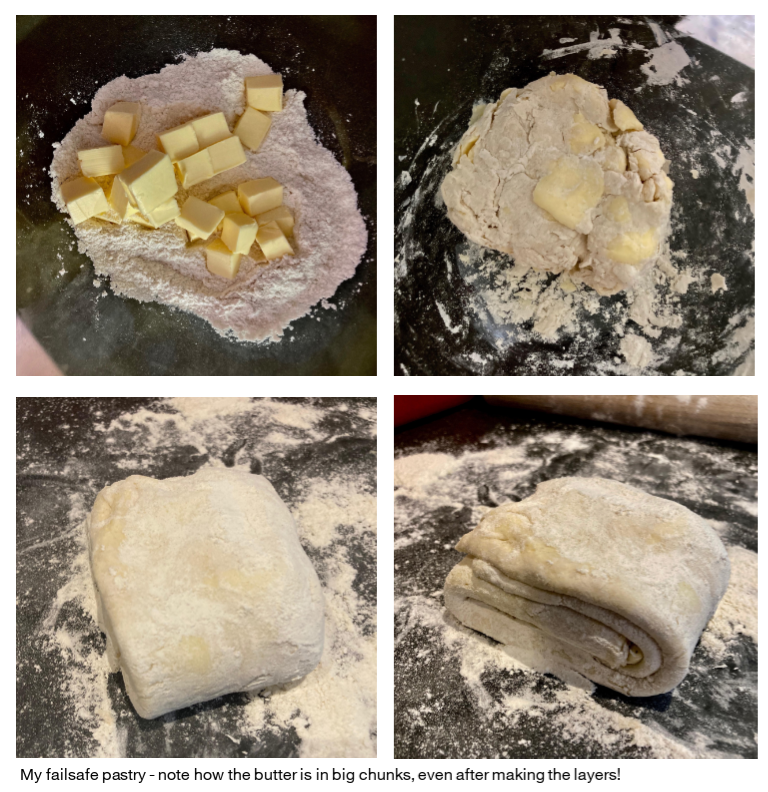
Pastry has a bad reputation for being very difficult to get right, something best left to the professionals. Not true. Here is a foolproof recipe, adapted from Serious Eats – after trying several pastry recipes and many adjustments, I’ve found this to be the tastiest and most reliable version. 

Ingredients

  • 120g all purpose flour 
  • A generous pinch of salt 
  • 120g butter, cut into cm cubes, fridge cold 
  • 60ml water, freezer cold

Method

Combine flour with the salt in a medium mixing bowl. Add the cold butter and toss to combine, so each cube is covered in flour. Smush the butter flat, but do not rub in! This is really important. Stir in the water with a spoon and knead only until the pastry forms a ball. Wrap in cling film and put in the fridge for ten minutes.

Flour a surface and roll out the pastry into a rectangle about 25cm x 40cm. In your imagination, divide the dough into four lengthwise. Fold the two outer quarters over the middle two quarters. Then, as though you were shutting a book, close the two sides together. You should have a long thin rectangle. Fold one third into the middle, then the other third. Into the fridge again!

After another ten minutes, take the pastry out of the fridge and roll it out into a big circle on a well-floured surface. Don’t worry if it’s uneven, that is part of the charm! Transfer onto a baking tray, cover with cling film and put this in the fridge for at least two hours. 

For the filling

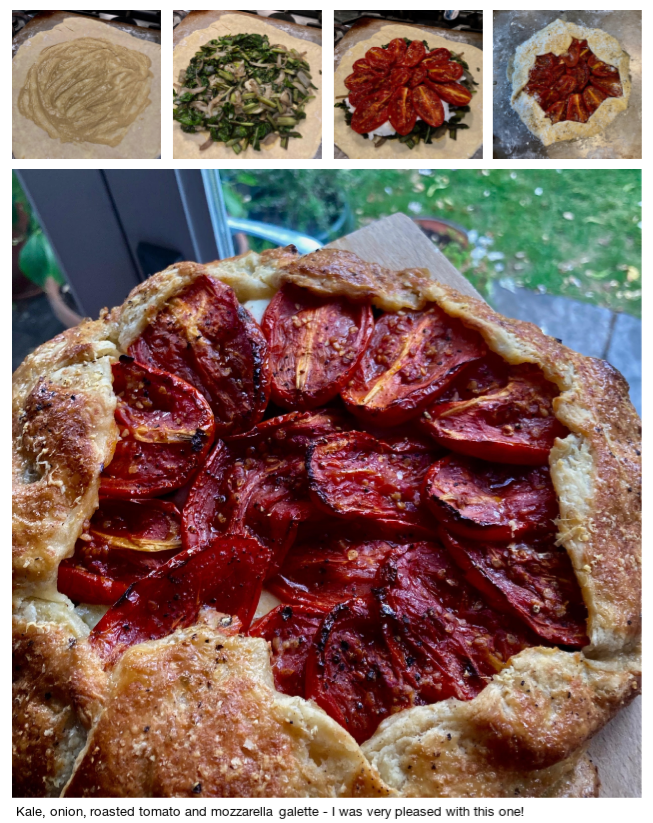
And so to the filling! There is no one recipe for this part  – it really depends on what’s in season and what you have in the fridge, making it the perfect lockdown recipe. Some sad-looking onions sitting in a corner, a tonne of tomatoes on the turn, a bunch of asparagus if you’re lucky, and hey presto, you’ve got the makings of a delicious pie filling. Or should that be hey pesto?! More on that later…

Pick two or three vegetables. Of course there are some classic combinations (mushroom and leek, for instance) but really anything goes! Onions are nice caramelised in a big saucepan, tomatoes love a good roasting in the oven, watery vegetables like spinach or mushrooms should be sautéed until the water has been cooked off. Once prepared, allow your filling to cool down. 

Construction

Preheat your oven to 175°C fan, then get ready for some speedy galette construction! To ensure the butter in the pastry doesn’t melt, pre-prepare all your toppings and keep them to hand. If you’re using cheese, grate it (cheddar or gruyere) or slice it (goat or mozzarella). Break an egg into a bowl and whisk, ready with a pastry brush if you have one. 

Once refrigerated for the full two hours, take your pastry circle out of the fridge. This is where the pesto comes in. Spread a thin layer in the middle of the pastry, leaving a two-inch border around the edge. Alternatively, for an onion or tomato filling, mustard would make a good substitute for the pesto. Then, working quickly, layer your filling on top. Again, this doesn’t have to be precise, although I like to have two layers of cheese, one in the middle and one on the very top. When all the filling has been used up, fold the edges of the galette over the filling, brush the pastry with egg (adding a sprinkle of parmesan, if you feel like it!) and put it into the oven. 

Bake for 25 minutes, or until the pastry is golden; place a foil cap over it to prevent burning. After another ten minutes or so, take it out of the oven with a flourish, and marvel that you’ve made something so gorgeous! One galette feeds my family (four of us) and is perfect with a side salad. 

So that’s it! I promised it was simple and I really hope you will give it a go. A galette is also highly adaptable. If you feel like spicing things up a bit, roast some sweet potato, squash, or pumpkin with a bit of cumin, ginger, or even chilli powder. A Provençal take may feature rosemary, thyme, and oregano-roasted tomatoes. If you’re a pie fanatic, why not make double the pastry and fill the second circle with fruit? Strawberries, peaches, plums, blackberries, blueberries and rhubarb would all work wonderfully. A sprinkle of demerara sugar just before the galette goes into the oven creates a glorious golden effect. 

Here are some websites to look at for further inspiration. There are also vegan and gluten-free versions, so keep an eye out for those if you’re interested. Finally, subscribe to #greens_and_grains for more delicious dishes and colourful creations! 

https://food52.com/blog/11538-how-to-make-any-savory-galette-without-a-recipe

https://www.seriouseats.com/2019/05/how-to-make-savory-vegetable-galettes.html

https://tasty.co/article/hannahloewentheil/sweet-and-savory-galette-recipes

https://www.bonappetit.com/recipes/slideshow/galette-recipes

https://www.brit.co/savory-galette-recipes

Images via Isobel Saunders

Oriel College announces details of Independent Commission of Inquiry into Rhodes Statue

0

Oriel College has announced details of the Independent Commission of Inquiry into the Rhodes statue. Whilst the Oriel College Governing Body has expressed its wish to see the statue removed, the Commission has the license to consider a full range of options for the statue’s future.

Carole Sauter CBE, a former Chief Executive of the National Heritage Memorial Fund and current Master of St. Cross College, will be chairing the Commission. In addition to the Chair, there are eight members of the Commission, including former Conservative Shadow Secretary of State for Culture Peter Ainsworth, Chair of the Royal African Society Zeinab Badawi and Michelle Codrington-Rogers, current President of the NASUWT Teacher’s Union.

Welcoming the Commission, Carole Sauter said: “Each of [the new Commissioners] has already made a significant contribution to the advancement of knowledge, access and diversity within their relevant sphere of expertise, and I look forward to chairing their discussions on how the Rhodes legacy can best inform the future of Oriel College.”

A website set up by the Commission states that between July and September 2020, the Commission “will specifically invite contributions from members of the College (including students, faculty, staff and alumni), from Oxford City Council, from the Rhodes Must Fall movement, from other interested parties in the city, and from individuals with particular expertise in aspects of its terms of reference.”

The Commission has committed to undertaking research relating to the legacy of Cecil Rhodes, including the Oriel College statue, as well as discussing “access, inclusion and diversity with particular reference to BAME undergraduates, graduate students and faculty”. However, the Commission has stated that it will not consider racial discrimination at the College, but instead discuss “the role of the leadership and culture at the College and how it fosters a welcoming environment for students from a BAME background”.

Between the months of October and November, “the commission will invite expert witnesses, with diverse views, to contribute to online public sessions, along the lines of parliamentary select committees. (Online sessions will enable a wider audience to engage than sessions held in Oxford.)” The Commission has stated that it intends to record and upload all public evidence sessions to its website.

Submissions to the Inquiry can be made via the website: www.oriel-rhodes-commission.co.uk/share-your-view or by post to: Commission of Inquiry, c/o Oriel College, Oriel Square, Oxford, OX1 4EW.

The Commission’s final report is set to be published in January 2021. Before this date, the Commission has stated it will not release any interim findings. All final decisions will lie with the Governing Body of Oriel College.

The beauty of bedroom pop

0

The bedroom can feel like an inner sanctum, a personal hideout away from the public. Therefore, there seems to be a contradiction in bedroom pop becoming a new genre dominating worldwide media, rather than remaining isolated in the private intimacy of the bedroom. As a result of technological convulsions and the surge of online platforms, bedroom pop has ultimately manifested the ideology that creating and producing music is easily accessible to all.

Clairo, Rex Orange County, Steve Lacy and Billie Eilish are some of the most prominent avatars of bedroom pop, boasting millions of streams on platforms such as Spotify, YouTube and Soundcloud. Ironically, their success has moved their music production out of the modesty of the bedroom, and into professional studios, arguably losing the intimacy and DIY appeal of a track made independently. Their success raises some fundamental questions: what defines bedroom pop? And is this terminology merely a launching point for future rising artists?

Bedroom pop is typically characterised by lo-fi, relaxed aesthetics and the imperfections of home produced, self-recorded tracks. Commonly associated with the soundscape of scratchy recordings are slightly out of tune guitars, muffled audio from laptop microphones and cheesy pre-set drum machine loops.

Claire Cottrill, also known as Clairo, exemplifies the beauty of simplicity and the appeal of DIY ethos. Her music video accompanying ‘Pretty Girl’ was created on a laptop webcam, taking under thirty minutes to create. The singer has a youthful, naive persona as she nonchalantly lip-syncs to the lyrics. While the video is reminiscent of homemade videos created on Video Star in Year 8, ‘Pretty Girl’ has accumulated 51 million views on YouTube. Clairo’s early music, such as her EP Diary 001 (2018),is the epitome of bedroom pop; the rudimentary synths and sweet-like-candy vocals encapsulate the raw honesty and naivety this new wave is about.

However, the simplicity of bedroom pop should not be underestimated. Some of the genre’s viral gems have been down to its simplicity, suggesting anyone with a laptop can become an internet success. Twenty-year-old Beabadoobee’s first hit was from the off chance of uploading her first song ever written to Bandcamp on a whim in 2017. Yet it has now crystallised into popularity on TikTok, racking up over 39 million streams on Spotify, and 500 million streams of the remix. ‘Coffee’ finds appeal in its delicate aesthetic, alluding to the listener that they’re in a nostalgic and romantic love story. The track consists of four soft guitar chords, lightly strummed alongside Bea’s ethereal voice, who sings so softly that it’s almost a whisper. The varying tempo throughout the song opposes the judging ticking of a studio metronome, the muffled dialogue at the end perpetuating the colloquiality of a home recording.

Though as with Clairo, Beabadoobee and many other bedroom pop creators, finding success on the internet provides the opportunities of record label signings, debut album contracts and ultimately, a chance in a professional studio. Clairo’s debut album, Immunity (2019), is sonically cohesive in maintaining the intimacy of soft vocals and confessional, personal lyrics throughout. However, it is clear her sound is broadening, as her use of professional equipment becomes increasingly apparent; low quality sounding audio has been replaced with high tech microphones, and cheesy pre-set drum loops have been replaced with professional drummers. Equally, Beabadoobee’s signing to Dirty Hit has allowed her to stray away from the early days of acoustic guitars. Her most recent EP, Space Cadet (2019), finds a new sonic solar system similar to indie rock, with roaring electric guitars, punchier vocals and drums powerful enough to mosh to. With more ambitious production, should we still classify these artists under the category of bedroom pop?

Unlike most genres, bedroom pop cannot truly be identified by its sound. In fact, artists that fall under this category do not have to share a similar sound at all. Bedroom pop may vary from sounding similar to indie folk, teenage heartthrob tracks to 808 hi-hats of R&B, or even a fusion of both. The main appeal of using software such as Logic Pro X, GarageBand or Ableton Live is that the possible outcomes are endless. Bedroom pop, therefore, has recently been identifiable more as a community rather than a particular soundscape. One of the strongest appeals that remains for bedroom pop is individualism. Artists of this community prioritise the ideology of independence and authenticity, ensuring it permeates throughout their records. What’s important is that the initial writing process of lyrics and chords remains where it started: in the bedroom. Taking these ideas into the studio merely enhances their capabilities as musicians.

Bedroom pop is a refreshing antidote to the mass corporate mainstream pop churned out on the radio. Rather than music created with corporate success, streaming algorithms, or a mainstream audience in mind, bedroom pop finds comfort in its raw honesty, and its expressive freedom.


Image: Original image of beabadoobee by john

More than a hashtag: the media’s portrayal of young activism

0

TW: transphobia

The removal of Baroness Nicholson from her position as honorary vice president of the Booker Prize Foundation and the resurgence of the Black Lives Matter movement have garnered large amounts of media coverage. Much of this has been positive support. There are some journalists, however, who have unfairly portrayed young activism as dangerous and little more than a trendy hashtag.  

This recent development, particularly in terms of Baroness Nicholson, has led to a resurgence in the conversation over ‘cancel culture’. When discussing current activism; Clare Foges claimed that young activists ‘cancel people who they don’t like.’ Janice Turner echoed her, arguing that young activists do not want to engage with those that they disagree with and that this is a problem. Although cancel culture can be used by some to shut down any public figure who angers them on social media; this is not always the case. Baroness Nicholson was partly removed from her honorary position because of her views on same-sex marriage, but principally because of her transphobic comments. Baroness Nicholson bullied the transgender model and activist Munroe Bergdorf, calling her a ‘weird creature’ and retweeting transphobic memes. Her removal from the Booker Prize Foundation is not an example of young activists succeeding in cancelling those they disagree with; rather it is young activists succeeding in a small way to protect minorities from harassment and bullying.

Of course, I would agree that cancel culture can be both ineffective and harmful. For example, to ‘cancel’ someone over their views on Brexit would be wrong; political views such as these are entitled to free and open debate. Moreover, there are questions over how helpful ‘cancelling’ one high profile figure can actually be to a movement, as it can easily become little more than performative activism. However, it should also be remembered that cancel culture is often an umbrella term used to label a wide range of actions. It is not necessarily a total annihilation of someone’s career and reputation; many wanted to ‘cancel’ Taylor Swift after she lied about her agreement with Kanye West to use a song lyric about her – yet her career lives on. Aside from celebrity feuds, there are a number of occasions where cancel culture may be necessary and effective for activism if followed by meaningful change – I would argue this was one. The backlash that resulted in the removal of Baroness Nicholson from her honorary position sends a signal that transphobic bullying is never excusable. The same people who called for the Baroness to be ‘cancelled’ must follow this with support for lasting and real change to protect trans rights.

Others, like Iain Martin and Higo Rifkind, have labelled young activists fighting for progress as ‘intolerant’. If we are intolerant, it is of intolerance, of those who try to prevent progression towards a safer and more inclusive society. But this is required to realise our vision for a society which is anything but intolerant. Young activists are fighting for a society where real diversity is celebrated, and equality is the norm.

There is a tendency among some journalists to present young activism as nothing more than a trend, a bandwagon to be hopped on, with many labelling it as ‘woke’. This minimises the efforts of activists; depicting it as an empty trend with no real substance and a lack of urgency. Of course, there has been a fair amount of ‘virtue signalling’ recently, such as the Black Lives Matter hashtag challenge on Instagram, which appeared both unhelpful and insensitive. However, this is not the majority of the Black Lives Matter movement. From protests to petitions it is clear that most involved want real change and are taking real steps to get there.

This is missed by the journalists who believe that companies are congratulated for merely posting a generic statement in support of the movement. Janice Turner wrote that businesses who comply ‘by issuing a woke press release’ will ‘avoid the social media storm’. This could not be further from the truth. Companies who have tried to do so have been quickly called out. For example, when L’Oréal posted on Instagram in support of the Black Lives Matter movement, they received instant backlash. Many pointed out the irony of their ‘support’; in 2017, they fired an influencer for speaking up about racism. Similarly, the clothing brand Reformation posted support for Black Lives Matter on their Instagram but were widely criticised themselves after allegations of racism within the company emerged.

Furthermore, there seems to be little recognition, by some, of the power of social media. It is of course only a starting point, and not a solution in and of itself. But it is undeniable that social media is a big part of young activism. Clare Foges writes that social media has ‘tendency to simplify and enrage, its echo chambers to egg things on’. I agree that social media cannot be relied on to do all the work especially when it can so easily make us forget that many do not agree with us. However, it is a good place to start. For example, the visual focus of Instagram makes information punchy and quickly accessible. The ability to connect across continents allows movements to accelerate much faster than they could have in the past. Take Munroe Bergdorf, whose Instagram post about the bullying she received reached hundreds of thousands of people within seconds. And sure enough, change was seen in a matter of days. The latest information can be easily broadcast on social media. For activism this is a huge advantage over the slower mainstream press. Social media has not only allowed petitions, fundraisers and educational resources to be shared, but has also helped protests to be organised. And this has led to tangible change; a petition shared on social media played a large part in re-opening the case of Elijah McClain. The fight for change must be seen within the real world but the role social media can play should not be so easily criticised and discredited.

The portrayal of young activism by some journalists is both generalised and incorrect, and I worry that those who get most of their news from the mainstream press may be left with a false and unfair image of this type of political engagement. This threatens to prevent wide-spread support and to hinder the change that is so vitally needed.

Oxford coronavirus vaccine safe and trains immune system

The University of Oxford coronavirus vaccine appears to train the immune system without safety concerns, the University has announced.

In the first stage of trials, the vaccine was tested on more than 1,000 healthy adult volunteers aged between 18 and 55 years.

Participants had detectable neutralising antibodies, which researchers believe is important for protection. 100% of participants showed neutralising activity against the virus. The strength of response ranged, but vaccine antibody levels were in the same range as those of people who had previously had COVID-19.

Tests show the vaccine produced white blood cells within 14 days of vaccination and an antibody response within 28 days. The strongest immune responses occurred in the ten participants who received two doses of the vaccine.

Researchers will now focus on confirming that the virus can effectively protect against SARs-CoV-2 infection. This trial drew from young, healthy, British volunteers. The authors of the study have stated that “Phase 3 trials are now underway in Brazil, South Africa, and the UK and will evaluate vaccine efficacy in diverse populations”. Additionally, “Older age groups with comorbidities, health-care workers, and those with higher risk for SARS-CoV-2 exposure are being recruited and assessed.”

The University is working with the biopharmaceutical company AstraZeneca for further development.

The Chief investigator of the trial, Professor Andrew Pollard, said: “The Phase I/II data for our coronavirus vaccine shows that the vaccine did not lead to any unexpected reactions and had a similar safety profile to previous vaccines of this type.

“The immune responses observed following vaccination are in line with what previous animal studies have shown are associated with protection against the SARS-CoV-2 virus, although we must continue with our rigorous clinical trial programme to confirm this in humans.”

“We saw the strongest immune response in the 10 participants who received two doses of the vaccine, indicating that this might be a good strategy for vaccination.” 

Business Secretary Alok Sharma said: “Today’s results are extremely encouraging, taking us one step closer to finding a successful vaccine to protect millions in the UK and across the world.

“Backed by £84 million Government investment for the vaccine’s development and manufacture, the agility and speed with which the University of Oxford have been working is outstanding. I am very proud of what they have achieved so far.”

Image attribution: https://pixabay.com/photos/laboratory-medical-medicine-hand-3827745/