


By NED REMINGTON
Three local authorities top domestic applications for over half of undergraduate courses at the University of Oxford, a Cherwell investigation has found.
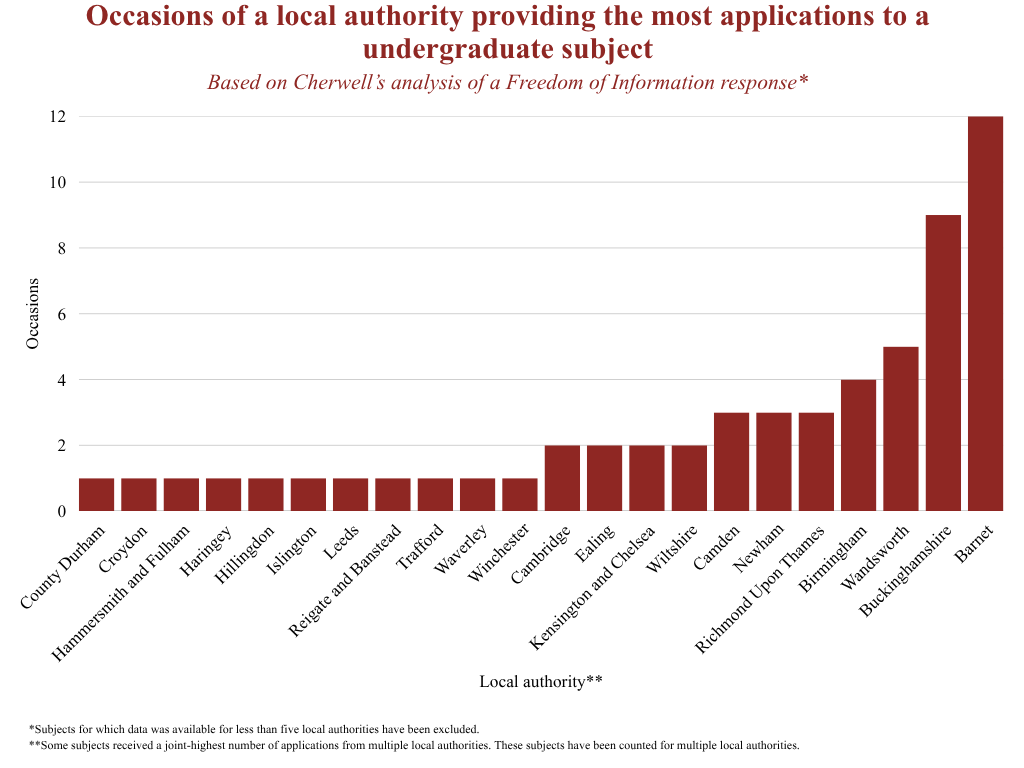
Barnet, Buckinghamshire, and Wandsworth provided the most domestic applications for 52% of the 44 analysed courses. Over 70% of courses received the most applications from a London borough in the 2023-2025 application cycles, with 27% of courses receiving the most applications from the same London borough, Barnet. No local authorities outside of England housed the highest number of domestic applicants for any subject.
While Oxford publishes data on the total number of applications for each course, and the total number of applications to all subjects by local authority, this is the first time it has broken down applications by the geographical makeup for each subject. Cherwell obtained data for the 2022-2025 admissions cycles, grouped by subject code, through a Freedom of Information (FOI) request. The data excludes figures where fewer than three applications for a course came from a particular local authority over the three-year period, for privacy reasons. Cherwell analysed data for 44 Oxford undergraduate courses, excluding subjects for which figures were available for fewer than five local authorities. Most of those excluded were dual-honours Modern Languages degrees.
London and the South East dominate applications
With Barnet providing the most applications to 12 of 44 courses, the borough ranked in the top 3 local authorities for applications to half of the courses analysed (22). The south-eastern county of Buckinghamshire accounted for the most applications to nine subjects, including Classics, Human Sciences, and Music. The London borough of Wandsworth topped applications for five, including History (Ancient and Modern) and Theology and Religion.
London and South East England continued to dominate across almost all subjects. The exception was Birmingham, which provided the most applications for four popular Oxford subjects: Law, Medicine, History and Politics, and Biomedical Sciences. Some subjects received a joint-highest number of applications from multiple local authorities. Trafford, Leeds, and County Durham topped applications for one subject each.
Cherwell’s analysis exposes the geographical disparities clear in subject-by-subject applications. The figures complement existing data published by the University, which shows that Barnet accounted for the highest number of total applications to Oxford over the same period, with 258 applications, closely followed by Buckinghamshire with 256. Birmingham came third, submitting 235 applications, whilst Wandsworth and Richmond Upon Thames came in joint 4th place with 204. Eight out of the ten local authorities submitting the most Oxford applications were London boroughs.
Oxford applications do not consistently match national spread of A level
Annual figures published by the Department for Education allow us to compare Oxford applications to the total number of A level students in each English local authority, and to the percentage of students in each local authority achieving AAA or above in their A Level exams, the most common entry requirements for an Oxford undergraduate degree. This data does not account for domestic students studying other Level 3 qualifications, for example the International Baccalaureate.
In 2025, Barnet had the 13th highest number of state school students sitting A levels out of English local authorities, at 3504 students, with Buckinghamshire in 9th place at 3839, and Birmingham in 6th place at 4725 pupils. In the same year, Barnet had the 8th highest percentage of state school students achieving AAA or above in A level results in England at 25%, with Buckinghamshire coming 7th at 28% and Birmingham in 28th place at 17%.
Despite topping applications for the third highest number of Oxford subjects and accounting for a significant number of total applications, Wandsworth was only ranked 58th in England by number of A level students, and ranked 69th for percentage of students achieving AAA or above. Richmond Upon Thames was ranked 14th for percentage of A Level students receiving AAA or above at 21%, but 110th for total number of A level students at 934 pupils in 2025. The local authority with the highest percentage of students achieving AAA or above, Sutton, was ranked 36th in total number of Oxford applications for 2023-2025, and did not top applications for any subject.
Whilst many of the areas responsible for the most Oxford applications are also home to high numbers of A Level students with the grades to apply, it is clear a disparity remains between the two. Oxford’s latest Annual Admissions Statistical Report highlights the disparity on a larger regional level, with 28.3% of the University’s applicants coming from London in 2023-2025 and a further 20.3% coming from the South East, compared to just 2.1% from the North-East and 4.9% from the West Midlands.
Barnet tops applications for PPE, Birmingham leads in Law and Medicine
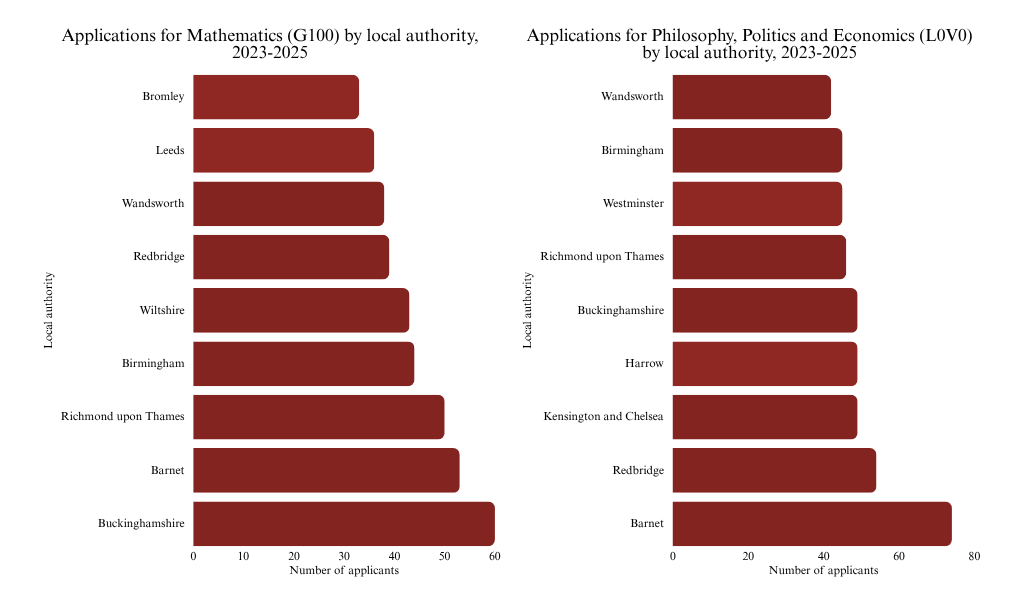
Oxford’s most popular subject by applications in 2025, Mathematics, received 60 applications from Buckinghamshire from the 2023 to 2025 application cycles, followed by Barnet with 53, the London borough of Richmond Upon Thames with 50 and Birmingham with 44 applications. Physics, Oxford’s next most popular STEM subject in 2025, received 46 applications from Barnet over the last three application cycles, followed by 43 from Buckinghamshire and 42 from Bromley.
Oxford’s PPE degree, which received the second-highest number of total applications last year, received 74 applications from Barnet alone from 2023-2025, followed by 54 from Redbridge and 49 each from both Kensington and Chelsea and Harrow. Economics and Management also received the most applications from Barnet at 57, followed by Buckinghamshire at 52 and Wandsworth at 51.
However, Law, Oxford’s third most popular subject, received the most applications from Birmingham by a large margin, with the UK’s second-largest city submitting 86 applications, followed by Buckinghamshire on 51 and Redbridge on 47. Birmingham similarly submitted the most applications for Engineering Science, followed closely by Ealing on 21. For Medicine, Birmingham submitted 102 applications, the highest number of applications from any local authority for any subject, followed by Buckinghamshire on 69.
London and South East lead across subject divisions
Of the 24 analysed undergraduate courses in the Humanities Division, only 2 received the most applications from a local authority outside London and the South East, with 16 out of 24 receiving the most applications from a London borough. Similarly, in the Social Sciences Division, 10 out of 12 analysed subjects received the most applications from a local authority in London or the South East. Cross-disciplinary dual honours degrees were counted for both relevant subject divisions.
In the Mathematics, Physical, and Life Sciences (MLPS) Division, two out of nine subjects received the most applications from a council outside London and the South East. Medicine and Biomedical Sciences, two out of the four undergraduate courses in the Medical Sciences Division, received the most applications from Birmingham, with Buckinghamshire topping the list for Experimental Psychology, and Biochemistry receiving its highest number of applicants from Richmond Upon Thames.
Disparity between UK nations continues at the subject level
Local authorities in Scotland, Northern Ireland, and Wales do not provide the most applications for any subject, according to data obtained by Cherwell, correlating with figures published by the University showing that only 3.4% of Oxford applicants were from Wales from 2023-2025, 1.8% from Scotland, and 0.7% from Northern Ireland.
Responding to Cherwell’s findings, the Oxford University Scottish Society told Cherwell: “It is very difficult for people to think of Oxford as a place where you could belong – even just for a couple years. To have this build-up of certain geographical areas means that students from other regions can often end up feeling on the outside, even after having made it to Oxford, or will be uneasy applying in the first place.
“The job of outreach should be to help applicants see Oxford as a possibility, regardless of where they come from, which would then help create a less geographically concentrated student body.”
Cymdeithas Dafydd ap Gwilym, the University’s Welsh society, told Cherwell: “It’s hardly surprising that Welsh students remain underrepresented when the University and its colleges continue to fall short in supporting Welsh students.
“Jesus College, historically regarded as Oxford’s Welsh college, illustrates this contradiction. The Meyricke Endowment, established in 1713 to maintain Welsh scholars, is now worth over £20 million. Yet in 2024/25, £631,000 was released into the College’s general income, while the only surviving Welsh-gated graduate award is worth just £900 a year, with a maximum of two recipients … an institution cannot celebrate its custodianship of Welsh heritage while failing to invest in the scholars who sustain it.”
In a response, Jesus College told Cherwell: “Jesus College is extremely proud of its Welsh heritage, and supports and celebrates the Welsh members of its community…The College’s financial report for the year 2024/25 shows that £421k of the £631k in unrestricted funds drawn from the Meyricke Endowment went directly towards grants, bursaries and prizes for both its undergraduate and postgraduate students – including those from Wales. Other (unpublished) funding directed to Welsh education comes from within the College’s core budgets.”
Many factors affect application numbers for different UK nations, including the guarantee of free university education at Scottish Universities for Scottish students. Among Scottish local authorities, the City of Edinburgh submitted the most applications for all the most popular Oxford undergraduate courses, including Mathematics, PPE, Law and Medicine. In Wales, Cardiff topped applications for Mathematics, Law, Economics & Management and Medicine, while Swansea accounted for the most applications for PPE, and Rhondda Cynon Taf was home to the most Physics applicants. The picture was more mixed in Northern Ireland, with Belfast topping applications for Mathematics, Antrim and Newtonabbey housing the most Physics applicants, and Ards and North Down topping the list for Law.
University Response
Responding to the findings, the University told Cherwell: “Oxford’s students come from a wide range of backgrounds and from across the UK. The regional distribution of applications to Oxford is influenced by a number of factors, including population size, educational attainment and regional differences in university application patterns.”
The University added: “We are committed over the long term to supporting educational aspiration and potential across the country, and engage with partners, schools and students through regional outreach and access initiatives to encourage more applications from under-represented parts of the UK, including through our Oxplore Festival which has recently visited Cornwall, Bradford and Birmingham, and BeUniq in Bradford, Birmingham and Oldham.”
Additional reporting by Anisha Mohammed