

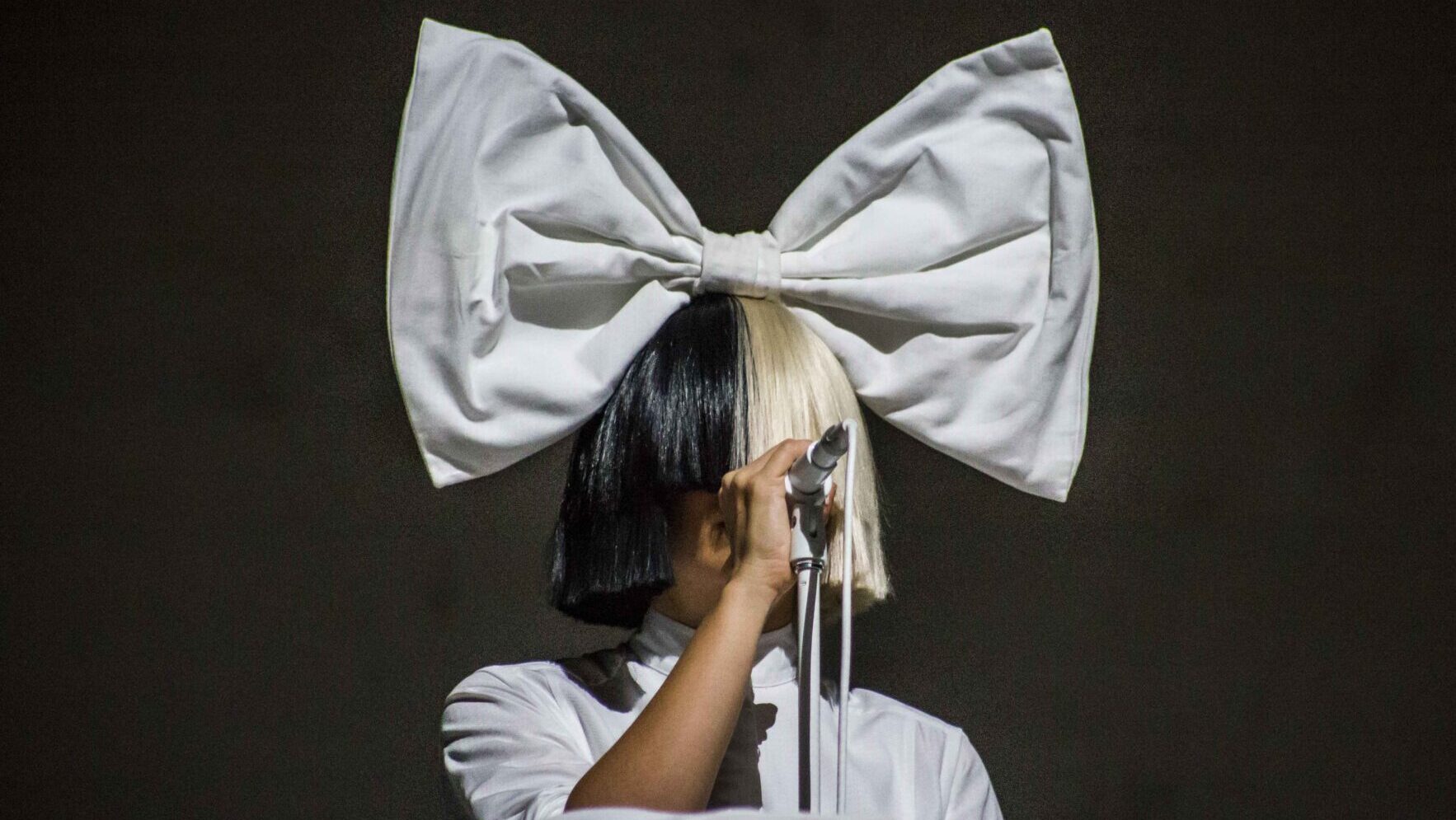
We can all name at least one musician who has performed behind a balaclava, helmet, or hood. Whether to preserve anonymity, cultivate mystery, or construct an entirely new artistic identity, masking the face is common among those under the limelight.
Mask-wearing among musicians is hardly new. The French electronic music duo Daft Punk famously traded their faces for futuristic robotic helmets in 1999 – certainly an upgrade from the black fabric bags they donned in their early days. Similarly, the oversized, two-tone wigs the Australian pop singer Sia is known for have become a hallmark of her style, while the American music producer Marshmello fittingly sports a white, marshmallow-shaped helmet punctuated by a black, cartoonish face. Names like Deadmau5, MF Doom, Planningtorock, and Angine de Poitrine might also spring to mind.
One of the most recent faceless sensations, EsDeeKid, is a Scouse rapper who has exploded out of the UK underground scene. His meteoric success has seen him allegedly signing the biggest-ever record deal for a UK rapper, all while keeping his face obscured.
From late 2025, rumours that the rapper was actually the actor Timothée Chalamet made it as far as The Guardian, GQ, and Rolling Stone. This theory, often but not always tongue-in-cheek, eventually led to Chalamet featuring on a remix of EsDeeKid’s ‘4 Raws’, with the accompanying video accumulating over 40 million views on TikTok and over 15 million on YouTube.
Fascination with EsDeeKid’s ‘true identity’ – synonymous with his government name and facial features – reveals a curious assumption: that the obscuration of his face is deemed an obscuration of his identity as a whole. Yet there is actually a great deal we know about him: that he is from Liverpool, that he grew up with a single mum in a council house, that he has a penchant for marijuana, that he hates when the plug uses AI art. Without a face to tether them to, these details are somehow insufficient. The face rules all: conceal it and identity melts away.
For many musicians, the unavoidable anatomical fact of the face is a burden, and masking up hardly eliminates the public’s fixation on it. The rumours surrounding EsDeeKid expose this thirst for the face, with one user on the r/EsDeeKidd subreddit confessing that their “head is churning out crazy ideas about who he really is … I can’t stand the desperation”. Rather than accepting the concealed face, fans claw at the mask, superimposing recognisable faces onto the void it creates, even if only as ironic placeholders. On a societal level, it seems that we cannot look away, that we are pathologically incapable of laying a face to rest.
Yet, is a faceless singer such a surprise when the voice is supposedly the locus of transfixion? Most listeners familiar with an artist can instantly identify them at the sound of their vocals. The face, however, remains the seemingly irreducible nucleus of identity, even in its absence. EsDeeKid’s balaclava is arguably as iconic as his Scouse accent, the absence of his face equally as remarkable as his music.
The desire to conceal one’s face extends far beyond the music industry, and while it may evoke associations with criminality, it can also stem from entirely innocuous motivation – think of the self-described intergalactic space warrior and UK politician Count Binface, frontline healthcare workers, and religious veil wearers. Yet beyond political satire, medical necessity, and religious motivation, facial concealment is a growing response to increasingly pervasive surveillance in the UK and beyond. With extensive CCTV networks, commercial biometric authentication, and the rise of facial recognition technology, faces are no longer merely means of expression and communication but sources of data from which identity can be constructed, recorded, and tracked. Perhaps, then, in the 21st century, masks offer relief from the omnipresent gaze which renders faces readily observable and knowable objects.
Here lies the paradox of the modern face: at the same time as identity is seen to crystallise on its surface, this surface is increasingly malleable and transformable. The musician SOPHIE, for instance, leans into the plasticity of the 21st-century face in her well-known music video for ‘Faceshopping’, in which her digitally rendered face is twisted, remoulded and spliced. As both surgical and digital technologies make faces ever easier to transform, the notion of the all-telling face becomes increasingly difficult to sustain. Vis-à-vis the unknown, the question remains of whether the facial imaginary will warp accordingly.
And so, we wonder: will tomorrow’s musicians hide their faces or invent entirely new ones, polyfaciality trumping the mask? If so, what exactly would a ‘face reveal’ reveal if yet another is ready to take its place?