

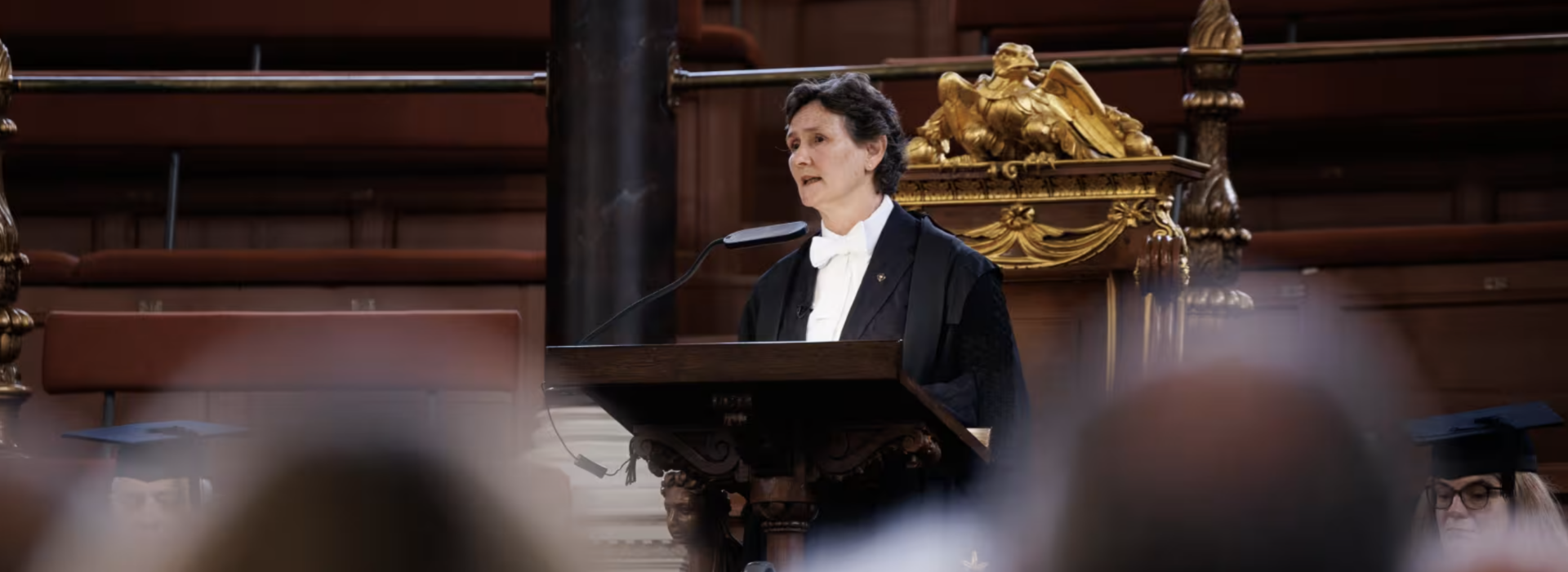
Vice-Chancellor Professor Irene Tracey opened the new academic year on Wednesday, 7th October, with the annual Oration at the Sheldonian Theatre.
The Oration allows the Vice-Chancellor to define the priorities of the University’s highest office and reflect upon the past year at the University. This year, these include AI ethics, bridging the gap between “town and gown”, and the increasing importance of scientific innovation for the University.
The Vice-Chancellor commented on the University’s influential role in shaping the AI landscape, both through technical research and noting work on AI governance from the newly launched Oxford Institute of Technology and Justice. Tracey referenced the university-wide rollout of ChatGPT-5 last year, while stressing the need for places where “students are taught to think critically and independently”. She identified Oxford’s tutorial system as a “unique asset” in combating the potential pitfalls of AI in learning.
Tracey also spoke about local community work, such as partnering with the homelessness charity Emmaus Oxford: “I want my hometown people to actually feel that having the world’s number one university on their doorstep really does make their lives better.”
From the start, the Vice-Chancellor also referenced that the turmoil facing British politics today might reflect “a nation not sure of its identity”.
As for Oxford’s identity, Tracey pointed at the role of innovation and STEM, lauding a dizzying array of successes.“It is estimated that over two billion people worldwide are using or benefiting from a piece of research that came from Oxford… that’s impact,” the Vice-Chancellor said.
The Vice-Chancellor also praised the “eye-watering investment” that Oxford quantum spin-outs have attracted. One such spinout, Oxford Ionics, was acquired for $1.075 billion by US-listed IonQ last year, while Oxford Quantum Circuits (OQC) closed a £260 million funding round this June – the highest ever won in Europe by a quantum computing company.
“I sense we’re more comfortable now owning [innovation] as part of our identity,” the Vice-Chancellor said.
For a university traditionally prized for the humanities and philosophy, with eight out of the last eleven prime ministers studying at Oxford, this is a notable shift.
The Vice-Chancellor went on to link these achievements in innovation to strong investment, referencing the University’s £6.9 billion in net asset value. In it, she thanked the Syrian-Saudi Arabian businessman and philanthropist Wafic Saïd for a “transformational” £15 million donation to the new Global Leadership Centre.
The Vice-Chancellor then spoke about Oxford’s unique financial stability amongst struggling UK universities, calling for “that difficult national conversation about how we fund the UK higher education sector”. Just last week Nottingham University confirmed the closures of all modern language and music degree courses. However, Oxford is not immune to financial pressures. Oxford University Press workers are also still striking over offshoring jobs to India.
The Vice-Chancellor also affirmed her support for diversity in higher education. She said: “If you are serious about excellence, the potential for excellence and finding top talent, you will end up with a diverse team.” “Look at the Premier League, or my beloved Everton”, she said.
As said at the beginning of this year’s oration, the Vice-Chancellor concluded by arguing that “at this critical point in our collective history”, the University would make a mark on Britain’s identity as a “place of ambition, excellence, kindness and hope”.