

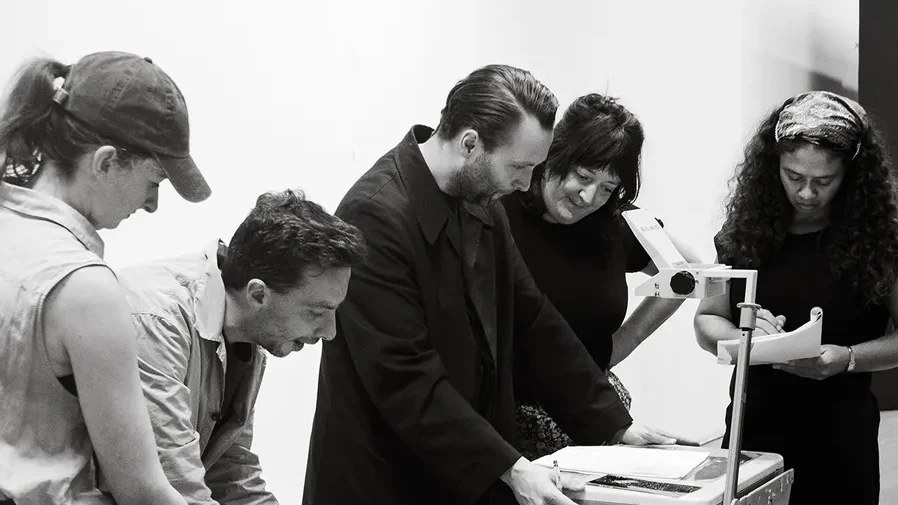
During the odd ‘in-between’ space that is Week 0, I searched for a show to give me something to do, amid the random dilly-dallying and the odd collection currently occupying my time. It was in this rather dull moment that the Breach Theatre and Schwarzman Centre production, Burning Down the House, stumbled across me.
Upon assessing the general idea of the piece, I was hooked; Professor Kirsten Shepherd, fellow of St Catherine’s College, approached playwrights Ellice Stevens and Billy Barrett in 2021 with the idea of merging academic research and theatre. It is this play which aims to uncover the untold, previously neglected inspirations for Henrik Ibsen’s prolific A Doll’s House. Admittedly, I sat down in the Schwarzman Centre with certain expectations. The space used for the performance, after all, was the very same space used for my own lectures, and so my mind had already associated the show with academic excursions and a research-informed uncovering of the past. Seems relatively straightforward, no? Yet what unfolded onstage was something surprising, striking, and altogether a performance that left me with more questions walking home than I had entering the theatre. What was initially, for me, a historical recovery became, instead, an investigation into the instability of storytelling itself and how, throughout history, artistic endeavour has come at the cost of violent exploitation. For a production concerned with uncovering the past, Burning Down the House had a remarkable way of forcing the present into uncertainty.
The production began with a rather rusty Henrik Ibsen, played by Peter Clements, ambling onto the stage and taking a seat to tell his own story. The slight foggy mist traipsing through the air hinted at what would come next, a literal interruption. Laura Kieler (Jacoba Williams) burst into the theatre, unsettling the audience with a reckoning scream. Clements’ Ibsen halted whilst Williams’ Kieler was confrontational and ultimately unforgiving. Already, my attention darted around the stage, and it was chaotic – yet it is within this chaos that Director Barrett begins to push the questions onto the audience. Kieler’s interruption, whilst theatrical, also removed the authority from Ibsen’s own narrative control.
From here, shocking truths unravel as competing versions of history collide, subsequently separate and clash once more before the eyes of the audience. In a small physical space, the intensity of the performance was consistently astonishing and played with the audience’s own sense of stability in the theatre. One narrative seemed to establish itself, and then another emerged to challenge it. Throughout this Punch-and-Judy process, I was left little chance to comfortably settle into any single version of events, and it was this perpetual uncertainty that I found most compelling.
As the abstract house structure shifted around the stage, repeatedly constructed only to be manually dismantled once more, I became increasingly aware of the deliberateness of storytelling, in that the stories we inherit are carefully shaped by those with the power to tell them. The actors moving the house around the stage became, to me, a metaphor for the forces through which historical narratives are built, often at the expense of those who they claim to represent. Ibsen refused to call himself a feminist, which now feels disturbing after witnessing the devastating immobility of Williams’ Kieler. She stood helpless amid the relentless movement, her stillness exposing the painful contradiction lying at the crux of the production: the woman who inspired Ibsen’s arguable magnum opus can no longer control her own story. Indeed, the visible presence of the actual crew during this made it feel much more visceral, suggesting how the narratives we inherit are continually founded, broken down and then reshaped.
An aspect of the performance I found to be especially intriguing was that of Sophie Steer. Throughout the production, though she mainly played Suzannah Ibsen, the wife of Henrik Ibsen, she also mastered multiple other roles. Steer told Cherwell that “it felt like the show had a brilliant bedrock”, which is certainly true. The way in which Shepherd’s thorough research informed the foundations of the script, in my opinion, allowed it to become more experimental and, at times, almost surreal. Steer’s performance was simply magnetic; her capabilities as an actress held my attention, even though the production seemed to depend on erratic movement and consequent disorientation. Her rendition as both Kieler’s Uncle and baby was poignant in what she referred to as the “nightmare section”. It is within this scene that instability climaxes – reality becomes warped, and meanings become somewhat meaningless; thus, it becomes hard to gain a sense of what is going on. Language could no longer communicate effectively, but rather primal noise operated within this medium of theatrical disorder, as though the characters’ experiences were too overwhelming to be captured by ordinary speech. This resulted in Steer flickering between both the enraged uncle and the bewailing child in a moment of culminating tension during Kieler’s labour. For Steer, her method was to go in “strong and wrong”, and she told Cherwell that she “found” the uncle and the high scream of the baby. It’s almost ironic, since within a production centred on Kieler’s lack of agency, Steer’s audacious performance was rooted in her own creative freedom. The result of such a show was truly arresting. In a moment’s notice, Steer transformed herself from a figure of authority to one of complete dependence, shattering any distinction between power and vulnerability. Her incisive control over this felt particularly fitting within a production concerned with the denial of agency. It was here that instability became a feature of identity and not merely of narrative or staging of that matter.
Ultimately, Burning Down the House was far from what I had first expected. Barrett’s production seemed obsessed with dismantling our conceived understanding of history; the chaotic staging, quickly shifting performances and refusal to offer certainty in any shape made for a deeply unsettling, yet equally fantastic, experience. In terms of what struck me most, I believe it to be how the production continues past just recovering a piece of forgotten history. Instead, it continues to question the very ways in which stories become forgotten, and who causes this to happen. That night, I left the Schwarzman Centre feeling truly befuddled, unsure what to really think – it was all quite bonkers to be honest! Yet I think that’s where its brilliance lies. In telling the neglected story of Laura Kieler, who was denied any control of her own story, it left me wondering how this is not solely contained to the 19th century. After all, the forces that silenced Laura Kieler have hardly vanished – they have taken different forms.