

CW: Eating disorders.
We’re sitting at a makeshift dining table at the foothills of the Pyrenees, the mystic beauty of the mountains enveloping our little group. Stretched out before us is rich tomato pasta, savoury soups, cold chicken, and crusty baguette from the best bakery in Tournefeuille. A ‘quick lunch’ in the midst of a busy choir tour. An impossibility in the French mind. The main course is naturally followed by a litany of post-lunch titbits: cheese, compote, coffee. I enjoy my food without anxiety – the mountains have made me hungry, and I relish each bite.
I have not always felt so liberated in my enjoyment of food as I did that day in the Pyrenees. I never really considered our relationship to be damaged – it was just the natural suspicion of something which might affect my weight, and thus my worth. Calories occupied my thoughts, but I had never restricted myself so much as to cause a physical problem, which meant that there was no problem.
As someone who developed at a young age and towered over primary school friends, I found it hard not to be conscious of the space I took up. At secondary school, while other fears crept in, that one, the one about my body, seemed to fade out. Yet almost immediately after starting my first year at Oxford, I felt it return, this time stronger than before and reinforced with a healthy dose of imposter syndrome.
My academic and social status felt newly intertwined with how my body looked. I remember excruciating conversations at formals – the declaration of the confident maxim that “everyone here is skinny!” – and feeling my stomach drop, thinking that I was not included in this “everyone”. Looking back, such thoughts were paranoid and irrational, and the decision to only very occasionally eat breakfast during first year made me tired and unhappy at a time when my tutorial essays were exhausting enough.
Something began to shift in my second year. Having faced down Prelims, I had a greater confidence in my academic ability and started exercising regularly, which necessitated eating more food. I also started going out with someone who loves cooking and eating as much as I do, and I’m happy to say that the enjoyment of delicious food continues to be a core part of our relationship. Despite this, food still played on my mind. I enjoyed a regular breakfast, but fears of calories loomed and I only allotted myself one sweet treat every two days (or often every three, or four).
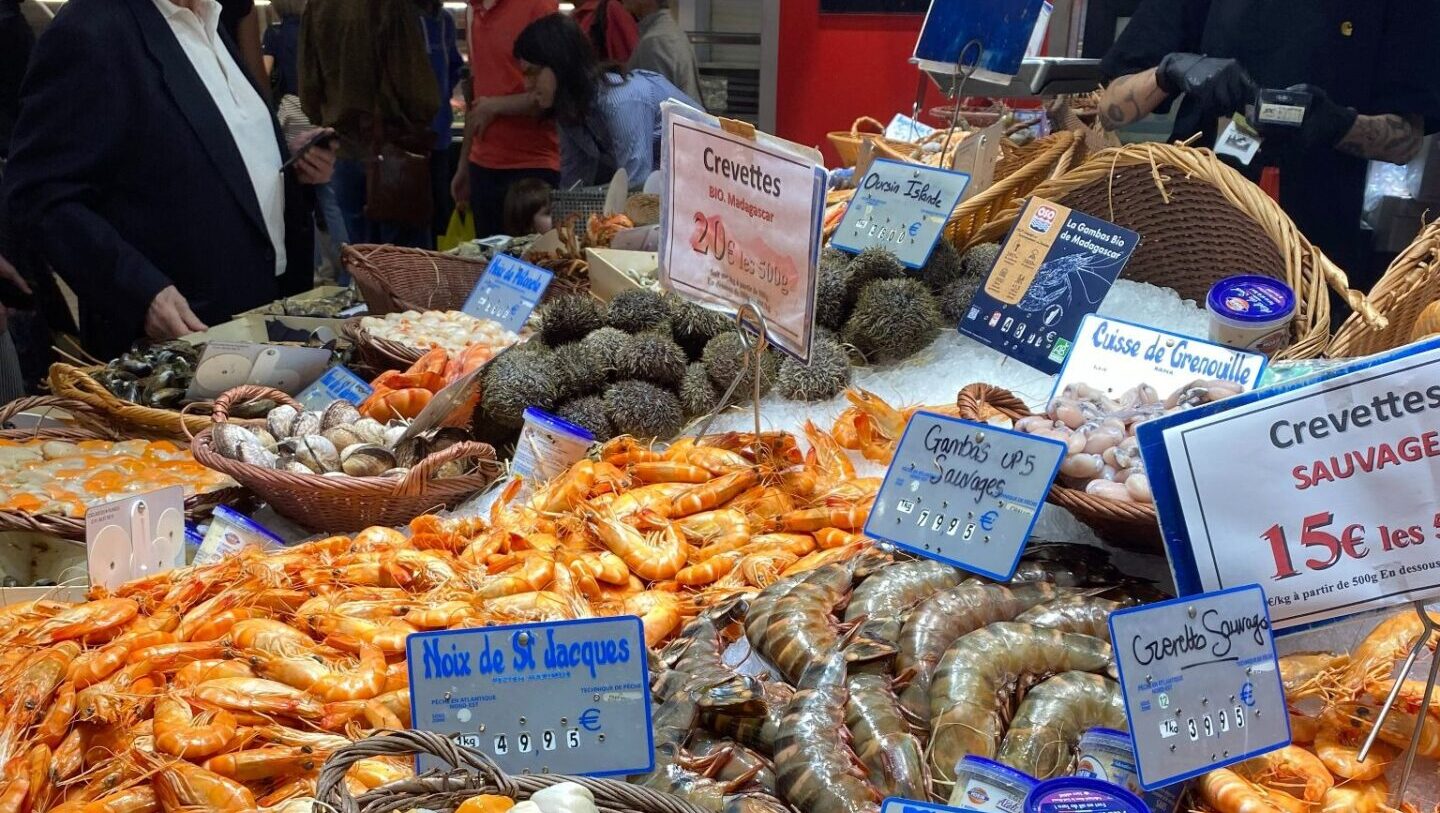
Enter the year abroad. On my second day in Toulouse, where I would study for one semester, we lunched with family friends at a food market that could be classed as one of the ‘Seven Wonders of the Modern World’. Stalls sold glossily sheened and butter-enriched pastries, every cut of meat imaginable, and an exotic variety of fish, including sea urchins. All this wonderment preceded a long lunch upstairs, which observed the restaurant’s formule (a concept I came to know extremely well). Naturally, the meal started with an apéritif, followed by crusty bread and two courses. Though at this first, emblematic encounter I instinctively wanted to excuse my indulgence with thoughts of “it’s okay to eat like this because I’m technically on holiday”, I would soon come to break this pattern of thinking – my delight in French cuisine had only just begun.
In French culture, dining is about conversation as much as food. I quickly noticed that Toulousains often sat for hours, chatting, over meals. A combination of reasonably priced restaurant menus – free from the shackles of calories (thanks, Boris!) – the travesty of my student accommodation prison kitchen, and a rapidly formed friend group of fellow Erasmus students, quickly allowed me to assimilate into this alluring way of life.
Of course, my student lifestyle in Toulouse did afford me much more time than I ever had in Oxford. Post-Brideshead Revisited, most of us rarely have time for a three hour long lunch in between lectures and tutorials. However, even working 9am to 5pm for six months in Paris, I found space to regularly enjoy an apero with my friends and relish a superb sandwich from my favourite boulangerie. I was fortunate to live in an unusual student residence in Paris which offered a daily breakfast of tartines to all inhabitants, a practice which both saved me money and facilitated some of the most interesting conversations I had during my time in France.
My relationship with food had changed without me realising it. I no longer limited my intake of sweet things to twice or thrice weekly, instead relying on my own intuition. Sometimes that final course doesn’t seem appealing at a restaurant, but equally one sometimes must acknowledge the futility of denying oneself a particularly appealing patisserie. The year abroad was transformative for me in so many ways – not only did my relationship with food begin to heal, but I also had the luxury of time to reflect on how I was changing as a person, which, in turn, motivated me to maintain these positive changes.
I do not mean to say that diet culture and eating disorders do not exist in France – of course they do. Through conversations with French friends and colleagues, I learnt that fatphobia is also rampant, as is the favourite French appetite suppressant: the cigarette. Nor is French culture unique in granting the dining table a hallowed status – I recently learnt that in the Antioquian culture of Colombia, it is customary to spend the first hour of dinner discussing the quality of the food.
I am reluctant to claim that my relationship with food is completely healed. Like learning a language, the process has been a non-linear one – some days are worse than others. There is no doubt, however, that my time in France has irretrievably altered this crucial relationship for the better, and I expect to continue this healing process as I rejoin Oxford life.