

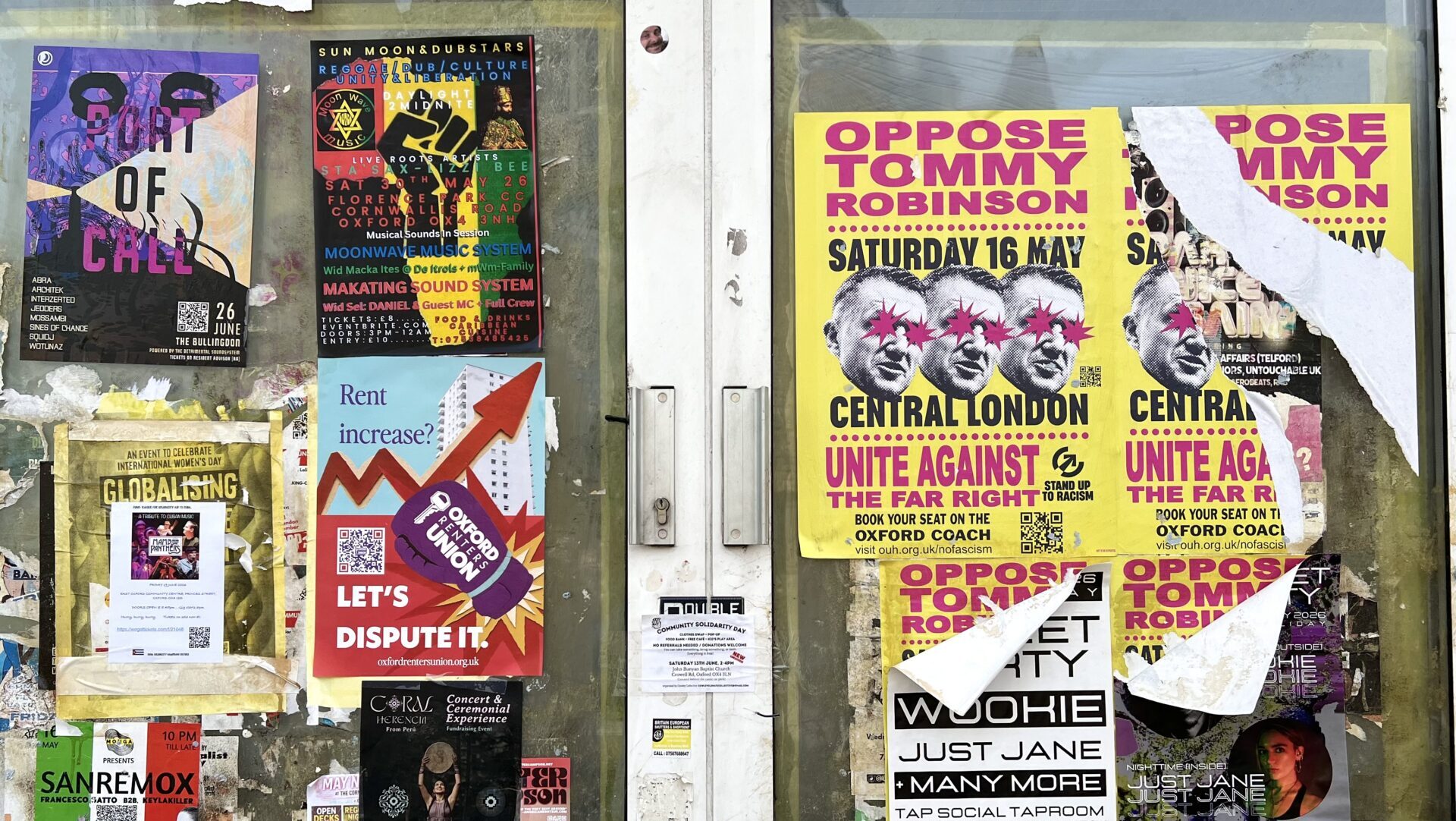
One of the most enduring images of grassroots politics is the pamphlet and the pamphleteer: the putting up of flyers, the taking over of public surfaces, the giddy circulation of agitational print, the vexation of the powers that be. “Is not all the controversy, whose slaves the poor shall be?” demanded a Leveller pamphlet in 1648, during the English Civil War. If, in the past, such material emerged from societies of lettered men and small printers, today Oxford residents walking down Cowley Road or George Street will easily find entire ecosystems of posters covering abandoned shops, construction hoardings, and disused telephone booths. They call out to passersby to campaign for affordable rent, attend an internationalist feminist protest, organise against animal abuse, or, provocatively, to smash the Epstein class. The peeling leaflets reveal older ones underneath. Lampposts and bus stops throughout town have an impressive past (and present) life in stickers. The distribution of print as a means of political communication remains as strategic and ungovernable as it has historically been.
It is just as well that street posters appear and crumble away through storied cycles of their own; yet much of mass organising today has migrated online, and finds its widest reach and most calculable impact there. It leaves the impression that physical media is somehow marginal, or touchingly quaint. Who takes notice of these posters? How do they speak to us, or fail to? In practice, different causes and their aesthetics find themselves fighting for space, literally, on Oxford’s streets. Paper is ephemeral; flyering is decentralised; anyone can as freely put one poster up as tear down another. This quiet, tactile, relentless agency shapes what our streets look like all the time. Street posters form a living, changing map of the communities and persuasions that inhabit a town.
You might begin to plot that map at the closed Debenhams in Oxford city centre. It is a hotspot for flyering of all kinds, due to the significant foot traffic the intersection receives. In May, the shop’s exterior displayed Stand Up to Racism’s “Oppose Tommy Robinson” posters – one of them already half-ripped – under which lay Together Alliance’s older, anti-far-right protest posters from March. Later that month, these remnants were also pasted over by the Oxford Renters Union’s newest campaign leaflets, to be found on various deserted shop windows and scaffolding sites elsewhere in town as well. The Union tells Cherwell that these leaflets are a crucial link between the Union and anyone struggling in a housing system that, year by year, increasingly disadvantages the socioeconomically vulnerable.
Those current leaflets all concern the Union’s resisting rent increases campaign, part of a broader national campaign demanding an end to unaffordable housing. They all display a QR code that takes you directly to the Union’s home page. In it, one finds the pledge to challenge the next rent increase at the First-tier Tribunal, as well as information on renters’ rights, legal recourse for when a landlord hikes up the rent, and exactly how much money one could save by making an appeal at a rent tribunal, even if the appeal fails. A mass campaign at a tribunal could delay verdicts, thereby extending the rent freeze period, and possibly help lower the fair market rate for everyone. For many, the public flyer provides an entry point to all of this.
Union spokesperson Maisie Wilson told Cherwell: “Leaflets and posters help us reach people who don’t have easy access to social media – which will be more and more people if we don’t fight the housing crisis.
“When we’ve leafleted about events, many people, especially older people, have said how glad they are that we leafleted: they wouldn’t have known about it otherwise as they don’t have an online presence. Our Union is for everyone who rents, not just those who are tech savvy!”
Oxford City Council reported in March 2026 that the number of Oxford households requiring temporary accommodation had more than doubled over the past several years. Homeless Oxfordshire drew attention to the fact that, in 2024-25, the number of Oxford households owed a prevention duty (meaning they faced imminent eviction) had risen by 111%. The rising threat of homelessness comes from the nationwide cost-of-living crisis, rapidly increasing local private rents, and the shortage of affordable social and private housing in Oxford and its environs. Excluding London, Oxford consistently yields the highest average rent in the UK. The average monthly private rent in Oxford increased by 6.6% in the twelve months leading up to May this year, and had, in August 2025, reached a staggering 11.7%.
Those struggling to keep a roof over their head, or to accommodate a family, hardly have the luxury of spending hours on the internet untangling policy documents to figure out what rights they are entitled to and how to uphold them, or seeking resources for collective advocacy for affordable rent. The visibility and simplicity of Union flyers lining a city’s main streets make such resources patently more accessible, and offer up the plain fact that a struggling renter is not alone. Wilson also states that the Union would like to further increase their accessibility by producing leaflets and posters in other languages. Immigrant households are, after all, more likely to be in the private rent sector due to lower home-ownership, and were the head of 22% of households assessed to be homeless or at risk of homelessness in the 2023-24 financial year.
“Grassroots activism is still vital in political organising, and it is very important that this is seen to be taking place within people’s own communities rather than exclusively online”, the non-profit animal rights organisation Animal Aid told Cherwell, echoing the Union. “And physical media is vital for this.”
Indeed, there is an entire repertoire of visual strategies surrounding the work of being seen, and of being seen in community. With the survival of the Ultimate Picture Palace at risk due to Oriel College’s graduate accommodation plans, a notable number of shops in Cowley have put up “Save the UPP” flyers on their doors and shop windows. A bold icon of the deeply beloved local independent cinema is depicted against a simple green, pink or red background, and one only needs to take a walk in the area to feel the solidarity. Oxford Stand Up to Racism and Animal Aid both supply leaflets to groups and individuals to use as they choose, with the former stating that, aside from putting up posters in city streets for the general public to see, “flyering from campaign stalls and distributing posters for workplaces are also important to involve people in collective activity”.
Joseph Miller, the director of PauseAI UK, a volunteer-led movement dedicated to incentivising governments to regulate frontier AI development, similarly says that flyering is “a good activity in itself, for the community to work on, for people to get to know each other and contribute in a useful way”. These posters visualise the identity and stated goals of a cause as much as mutual recognition between its people.
Thought also goes into where the flyers go up, or, more precisely, where they are allowed to. The latter-day pamphleteer in this country deals less with persecution of free speech than with the fine tangles of public property. Flyposting on public property is not permitted and could lead to legal ramifications; Oxford City Council investigates resident reports, submitted via FixMyStreet, of unauthorised posters, stickers, and advertisements, then works to remove them from street furniture within seven working days. Flyposting on private property, such as empty shops, is the responsibility of the property owner. The reactive nature of anti-flyposting law enforcement means that pockets of the flyer landscape could get systemically rubbed out every once in a while, or, alternatively, preserved for an impressive duration if no one is offended enough by the sight to report it. Organisations tend to post on surfaces that are highly visible in high-footfall areas, and whose legal ownership isn’t quite so straightforward or sacrosanct in practice.
“We mostly just find those spots where you can put wheatpaste on a surface and then stick up the poster and not have it be in anybody’s way”, says Miller. “So these are places like electrical boxes…or building sites where there are lots of people passing by.”
Quantity, however, might matter more than the exact location: “Often just having it in lots of different places is more important than where it is, because people might not notice it the first time or the second time, but the third time they see it, they’ll actually look at it.”
After all, we, the passersby, are vital participants in this politics of looking and seeing. The posters, small or large, plain or strikingly designed, each in their own way call for our attention and reaction. Often they persuade the viewer to take practical steps: to sign a petition, attend an event, participate in a boycott, seek help, or make contact with an organisation. When asked how PauseAI links bottom-up involvement to its lobbying of national or even global institutions, Miller explains that their flyers and events encourage people to show up at protests, sign open letters, or email their local MPs for support on such issues as PauseAI’s ongoing AI liability campaign. The campaign pushes for the UK Parliament to introduce legislation holding AI companies accountable when their models enable critical harm, such as security breaches of national infrastructure and biosecurity threats.
Regarding the people that tend to respond to PauseAI’s projects, Miller observes that “our biggest demographic is people who work in AI themselves, people who are experts in technology in some way”. The tech industry in London has provided a large inflow into the movement, as has climate change activist circles, and academic populations in cities such as Leicester and Oxford itself. There may be a limit to how far posters can induce someone to reconsider an opinion or notice something they previously hadn’t, if they don’t go out of their way to look at them. What the posters are best at, perhaps, is inspiring action in towns already politically amenable to what the posters call for, and in people for whom AI, or rent, or Oxford Union platforming, or the far right, is already a pertinent issue.
Still, leaflets and posters might simply seek to educate. According to Miller, PauseAI is interested in raising awareness of AI’s risks, including deskilling workers, facilitating cyberattacks and other safety hazards, and enabling an “extreme concentration of power to a small number of tech companies”. This may be done through talks and discussion groups advertised by flyers, or information shared by the flyers themselves.
Likewise, Animal Aid told Cherwell that their leaflets “may simply exist to inform the public about an issue”. On their anti-horseracing leaflets that have appeared on High Street, most of the space is taken up by information on the British horseracing industry, whose profit-driven exploitation of racehorses is well documented. “Around 200 horses are killed each year on British racecourses”, the pamphlet reads. When their racing careers are over, large numbers of thoroughbreds “are sent to the slaughterhouse…either unwanted or broken down through injuries”. It also tells the story of the racehorse Underwriter, who, upon his retirement, was sent to a sale and to almost certain death, until the Hillside Animal Sanctuary in Norfolk rescued him by bidding directly against the slaughterhouse. “Many horses are not so lucky”, the text reminds us. The bottom of the sheet shows Animal Aid’s contacts, and the option to donate to a sanctuary.
There is a simple humility to these walls of paper-and-print, which speak of affairs vast and small to whoever might listen, emerging and dwindling wherever there is street activity. Among the hundreds of other things that constitute life in Oxford, the streets themselves tell us what manner of a place it is we inhabit, and how we move through and belong to it. They are a palimpsest of how people make their demands known, and where we finally pick up on what others have been saying, perhaps for a very long time.