

I saw an Instagram reel recently in which the comedian Kyla Cobbler, standing at the top of a hill, holds up a rusted piece of coiled metal, pretending to be a doctor who is trying to sell the idea of the contraceptive coil to their patient. “Women’s health has just come such a long way, hasn’t it?” Cobbler wryly remarks. One thing was clear from the comments: whilst it may be the 21st century, the science and discussions surrounding women’s health are often medieval in nature, to the point of absurdity.
This is something which Olivia Plender’s exhibition, Little Fennel’s Complaint, is painfully aware of, and is even evident in the title itself. The title is a composite, reflecting the irony behind the double meaning of the word ‘complaint’, which can refer both to a medical problem as well as to the (often incredibly gendered) act of complaining about something in general; ‘Little Fennel’ is taken from the name of the protagonist in the original version of the fairy tale Rapunzel, in which a pregnant woman exchanges her baby for the herb in the witch’s garden – fennel is thought to have been used to induce abortion, leading some to suspect that the exchange was a metaphor for abortion.
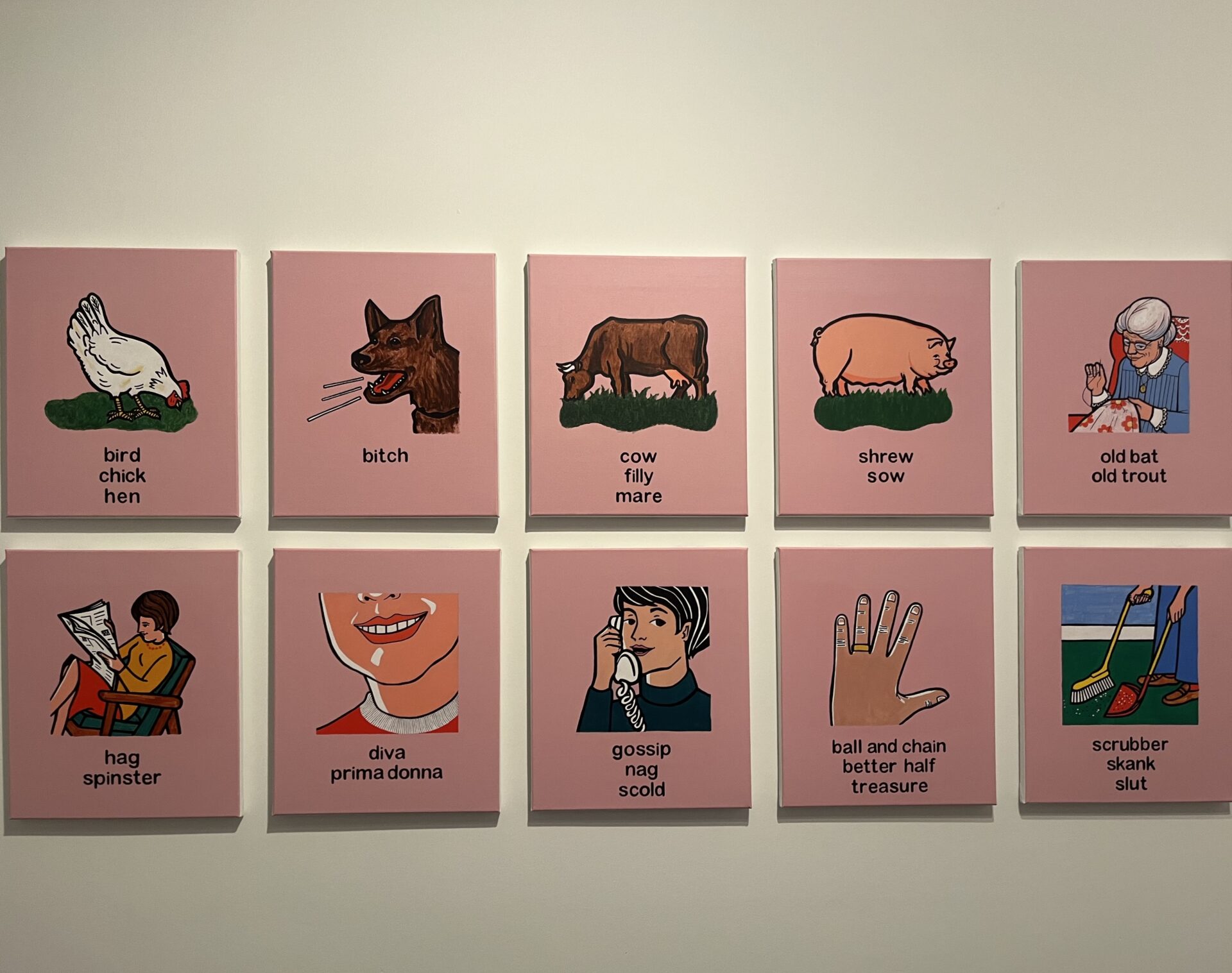
It is this combination of an examination of archaic methods and attitudes surrounding women’s bodies, and the idea of the ‘nagging’ woman, which runs right the way through Plender’s exhibition. Even upon entering the exhibition, I was confronted by a recorded chorus of muffled voices echoing from another room, repeating the words “witch, wife, wench” over and over, before switching to other alliterative patterns like “hag, nag, harpy, hen”. Struggling to focus on the first installation, Our Bodies are Not the Problem, which detailed, through the use of whiteboards displaying sketches of patients alongside text bubbles detailing their experiences navigating health problems, I eventually caved, following the voices to the second installation, Mastering the Voice. The cacophonous voices repeating these word patterns were actually a recording of a vocal exercise led by a voice coach, and complemented the adjacent paintings, which mimicked illustrations in early learning books, each one displaying a word or group of similar words alongside a picture. A rendering of a woman using a typewriter was, for example, accompanied by the words “ball breaker, battle axe, bombshell”. As a student of both modern and ancient languages myself, this installation was one of my favourite elements of the exhibition, capturing as it did the narratives about women which are built up around certain words. One thing that particularly struck me was how much of this language relates to animals – “bird”, “chick”, “hen”, and “bitch” were among some of the repeated words in the sound work.
As I made my way through the exhibition, however, I couldn’t help thinking that none of it really surprised me (which is perhaps a sign that the ideal target audience was probably not me and the other sole woman in attendance). It is perhaps a characteristic of discussions around women’s health, and the taboos our society has constructed around certain topics, but I went into the exhibition thinking that I would find something shocking – a hospital horror story perhaps, or a representation of the visceral pain of childbirth. But instead what I found was the same story repeated again and again: in Our Bodies are Not the Problem, the subjects often discussed the performance required for a successful visit to the GP, with one remarking, “you have to learn how to be a professional patient”, in cataloguing symptoms, wording, even down to clothing. However, a remark made by another subject, depicted as tilting her head thoughtfully in a slightly hunched over position, struck a chord with me. “I managed the symptoms as best as I could. Your life shrinks, and you just accept it”, she remarked. As someone who has dealt with the volatile and often debilitating symptoms of PMDD (pre-menstrual dysphoric disorder) for most of my life, yet not having a name for the condition until fairly recently, the idea of your life shrinking is a familiar one. Perhaps that is the true horror story – a system which attempts to diminish your feelings and experiences until they are little more than a few words on a referral form, or the doctor’s handwriting on a prescription.
Yet this was an exhibition which refused to shrink itself, spanning numerous media from acrylic paintings on canvas, to laser-printed wood, to embroidered textiles. The large embroidered wall hanging, titled The Witches’ Sabbat, was particularly striking with its vivid combination of colours and textures, not to mention impressively hand-sewn – a gallery attendant told me that Plender was still adding final details to the textile right up to just before the exhibition was opened to the public. The hanging, inspired by Henrich Kramer’s 1486 treatise on witchcraft, the Malleus Maleficarum, is an ode to male insecurity: the treatise expresses anxieties, for example, about witches stealing men’s penises and hiding them in trees, a grievance which Plender responds to with a gleeful depiction of a cat slinking away, a penis between its teeth, whilst a magpie looks on jealously.
It is precisely this attention to detail which Little Fennel’s Complaint had in spades. The space was used thoughtfully, from the privacy curtains which divided up Our Bodies are Not the Problem to the painted hospital lines on the floor, whilst the neighbouring exhibition, Kira Preije’s Unspeak the Chorus, provided an apt tone-setting, with its disparate metal skeletons foregrounding the question of bodily autonomy which is so central to Plender’s work. Whilst it is true that the sound work in Mastering the Voice at times threatened to dominate the experience of viewing the other installations, I suspect that Plender deliberately wanted to create a disquieting atmosphere – even though we often attempt to cope the day-to-day disparaging comments and gaslighting with humour (as the Instagram reel demonstrates), issues surrounding women’s health and female agency in general are, and should be, at the forefront of any discussion which takes place around medicine and the health system, even when it’s uncomfortable.