

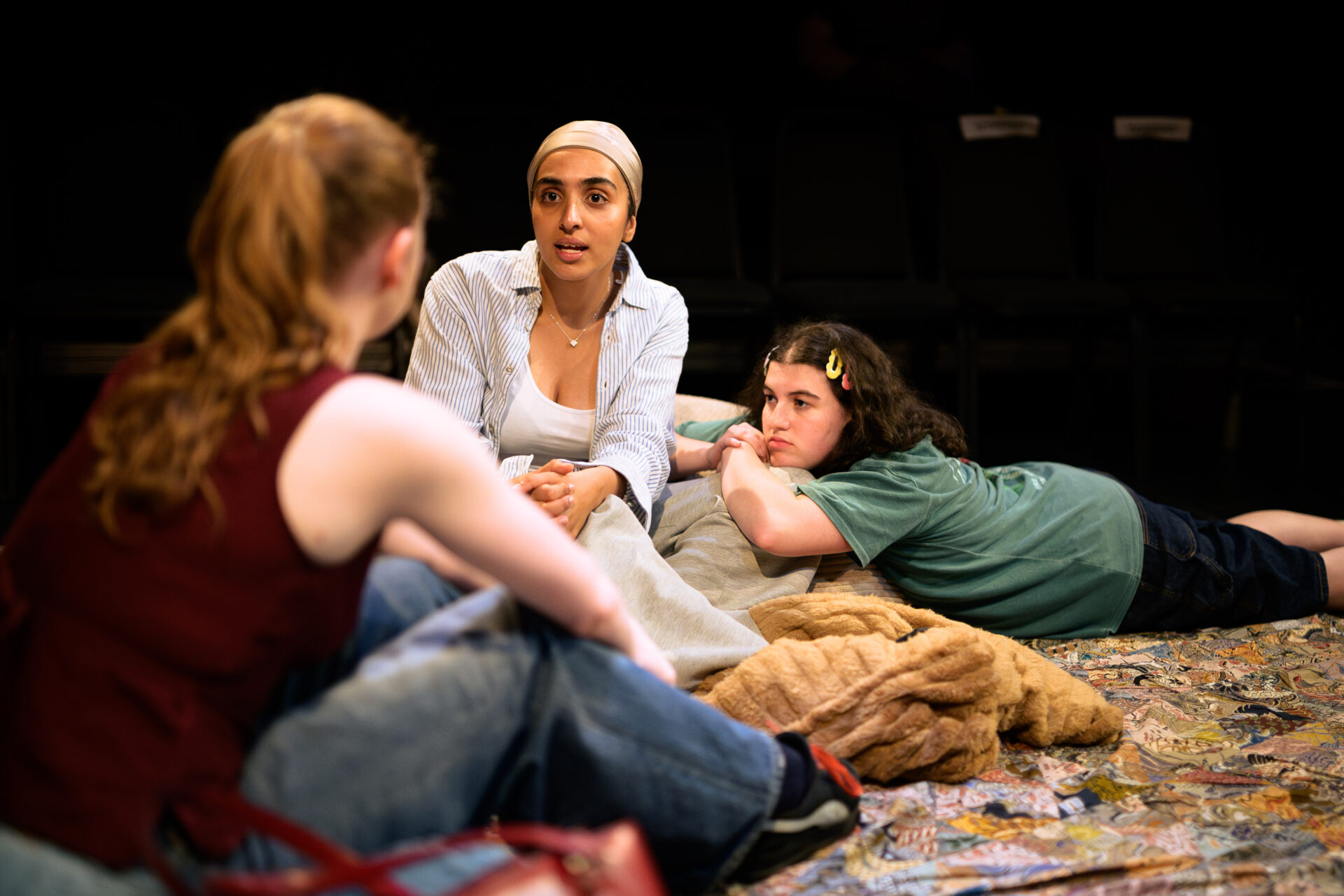
Scenes with Girls deserves to be seen as one of Labyrinth Productions’ (Rosie Morgan-Males and Emily Cullinan) most impressive accolades. It displayed the tension inside a female friendship to such a believable extent that at points the audience were silenced entirely. It felt particularly relevant given this year’s right-wing coverage of an emerging “angry woman” who refuses to conform to established beauty ideals, creating the concern amongst men that she may, horror-of-horrors, renounce them entirely.
The play centres the friendship of flatmates Tosh (Juliet Taub) and Lou (Sanaa Pasha), and their ex-flatmate Fran (Georgina Cooper), and forces the audience to consider what it means to live as a feminist in today’s day and age. Each character symbolises a varying degree of conformity to the standard “narrative” – the conventional life path ascribed to women which lacks space for female platonic intimacy, and foregrounds the pursuit of heteronormative romantic relationships. Lou persistently seeks sex with men, but wishes she could leave her body as it happens, Tosh chooses not to associate with men at all, and Fran becomes the object of their ridicule as she, in their eyes, allows herself to be dominated by her boyfriend.
The play questions whether following the narratives we’re fed makes us flawed. Underlying the flatmates’ attempts to define a new feminist consciousness is a sense of sexual competitiveness written into their psyches since “girls’ school”, and ironically it is Tosh who chooses the “desire to be desired” over forging an alternative lifestyle with Lou, briefly doing a “really good impression of a girlfriend” before the two reunite. This production was remarkable for its ability to use laughter to make the audience think. Lines which were instantly funny, such as Taub begging her boyfriend to repeat himself and him saying “you’re so fit”, prompted reflection on the reality of women allowing men’s assessment of their physical appearance to dictate their happiness. Hearing conversations after the performance’s end made me certain that this production will have an enduring impact on viewers’ understanding of heterosexual romance.
The actors’ versatility prevented the physically intense emotional scenes from losing pace, and Rosie Morgan-Males’ stellar directing allowed the audience to observe when each friend was craving the other’s approval. In such an intimate relationship, tension was physical. Blocking made evident to everyone but Lou that Tosh wanted her undivided attention. Lou’s incessant mentions of sex made Tosh’s shoulders visibly slump, and her dissatisfied expression at times where Lou seemed more focused on her phone gave context to later anger. Later, having been persuaded that she ought to renounce men entirely, Lou is placed behind Tosh so that the audience can notice her hopeful looks as she asserts to Fran that she no longer wants to talk about boys: in a weak imitation of Tosh’s all out separatism, Lou murmurs that she now finds them “gross”.
Cooper as Fran was a comedic highlight, and Morgan-Males’ choice to push her over-enthusiastic reactions to extremity was well enacted. Cooper’s focus was commendable: the audience could see that while constantly smiling, Fran was also constantly listening, never looking away from the relationship between the two women. This made her later assertion that she “is not stupid” and sees herself worthy of pursuing their feminist lifestyle believable.
Pasha too is a fantastic emotional actor and it was in her character’s moments of defeat that she shone most. After Tosh confronts her and explains that she is obsessed by “the shit version of love they [men] give you”, her physicality destabilises and for much of the rest of the play she appears untethered, at one stage collapsing on the floor. The sense that she is struggling to avoid a total breakdown was impressively acted, her eyes glazing with tears as she tells Fran that she feels “mad”.
Taub was impossible not to watch, especially in moments of climactic anger. Her ability to move between a cynical “dead-inside” attitude and brutal anger was phenomenal. In particular, her dogged confrontation of Pasha had the audience visibly uncomfortable.
The embodiment of the joy as well as pain within Tosh and Lou’s platonic relationship was a highlight. No holds-barred descriptions of Tosh’s sex life, in which the men were always viscerally denounced – “the conversational equivalent of a nosebleed in a swimming pool” – were interspersed with tableaus that convincingly represented the pair as two friends placed firmly in our generation. Non-sensical jokes were thrown at each other while sat apart engrossed in their phone screens. In the parts of the script where their friendship was strongest they sprawled their limbs across each other. It was these unspoken moments that made their friendship seem most real: jokingly poking each other’s legs, or wrestling each other to the ground.
The actors’ boldness and commitment to every movement gave the play its glowing quality. Their hugs – most memorably after Tosh demands that Lou “dig into this” – successfully transferred an appearance of platonic passion. Alongside whole-hearted physical intimacy, the toilet at the back of the stage was an effective way to demonstrate the lack of boundaries between the characters. The lack of bodily privacy between the two was reflected in its openness to the audience, with some of the most compelling dialogue delivered by Tosh from the toilet seat. In an extremely powerful exchange taking advantage of this set-up, a visibly defeated Taub asked “am I mentally ill?”.
The “messiness” of the physical intimacy was well complimented by the set, with clothes strewn across the floor. It felt like an illusion to Tracey Emin’s My Bed in an era where women’s lack of total cleanliness is no longer seen as shocking. The simplicity of the costumes (relaxed tops and tracksuits, designed by Clara Woodhead and Mimi Finney) were another indicator of the friend’s closeness.
The script, like female friendships themselves, is complicated, but the actors tackled it with professional quality. It is rare that a student production is capable of making an audience both laugh out loud, and fall completely silent. To use a cliche, it was jaw-dropping.


 most impressive accolades.)