

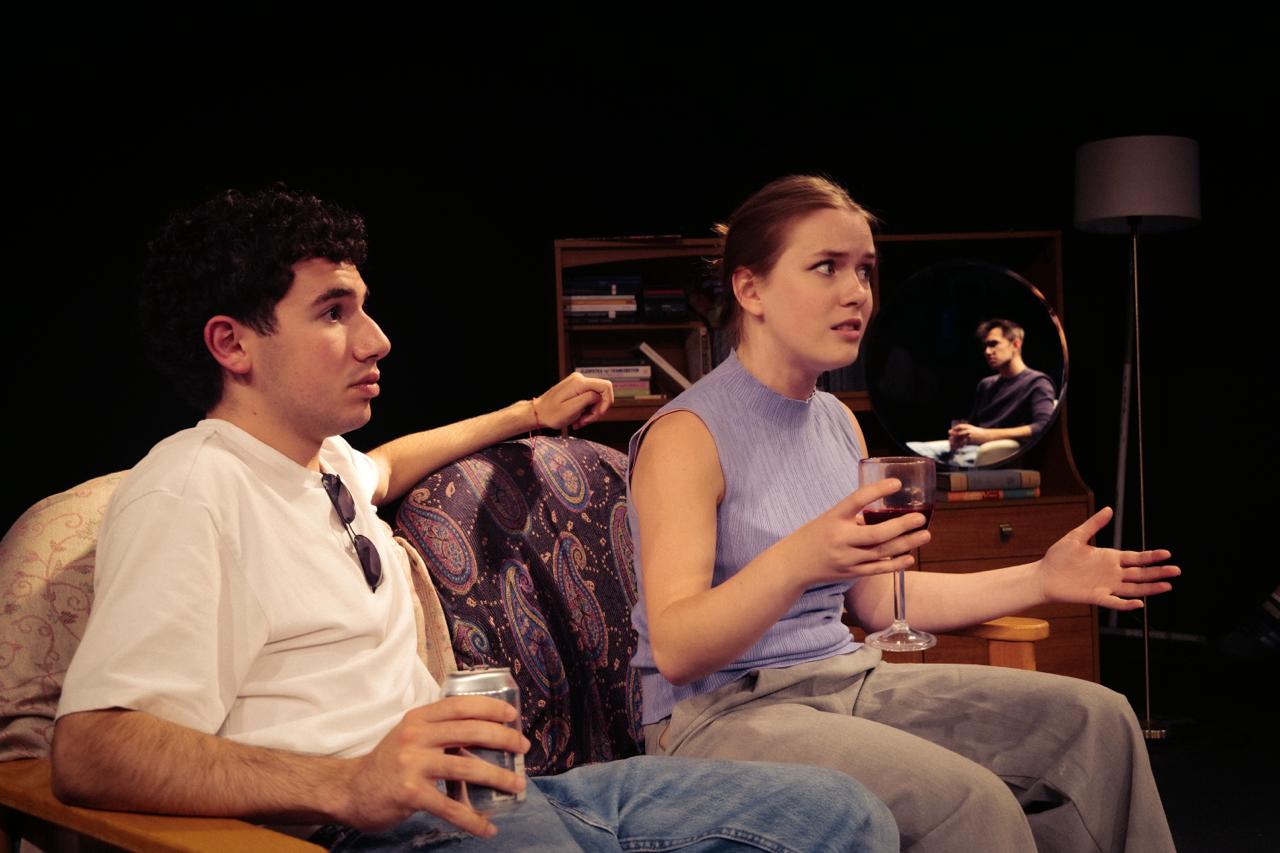
Anyone who describes reviewing a student play as a burden simply hasn’t watched a good play for some time. A free seat to watch young actors, directors, cast, and crew put all their effort into a production with minimal funding and frills is always an incredible experience. Ulster American is one such production. In the limited space of the Burton Taylor studio, set amazingly by Naomi Flexman and well lit according to the conditions of the play by Gabrielle Panova, the creative and personal struggle between the trio within the director’s apartment is brought to life.
Whilst David Ireland is a fantastic playwright, with his work drawing such names as Woody Harrelson, Andy Serkis, and Matthew Broderick, the play itself is not fantastically well known, and so directors Kate Burke and Robyn Hayward were confronted with a challenge when producing this black comedy. How to communicate to the audience that the entire play shouldn’t be watched in stony silence, but that its seriousness should also be grasped? The directors, producer Frankie Maino, and welfare officer Madeleine Evans faced an almost impossible challenge, particularly given the sensitive material the play touches on.
But it is a challenge they have pulled off adeptly, helped by a fantastic cast. With Aaron Gelkoff playing Jay Conway, an American actor almost stereotypically self-centred and shallow, Rohan Joshi as Leigh Carver, the anxious-to-please and superficially sensitive director, the play’s opening thirty minutes were well secured. Gelkoff gave an unforgettable performance that never fell into cliché, even as he played the sort of publicly quasi-intellectual American actor most people can imagine – think Brad Pitt. Joshi gave what I believe to be the finest performance of the night, acting as the cantilever of the play, a director increasingly desperately attempting to keep his production aloft. Conway lauded over Carver with skin-deep soul-searching and quizzical observations that Carver, in his desire to avoid any obstructions to his play, accepts, only raising a swiftly muted challenge when Conway describes a particular debauched and morally bankrupt thought.
A decent way into the play, the arrival of Caeli Colgan as Ruth Davenport, the playwright, upsets the unchallenged dynamic that had prevailed thus far. Davenport, as the eponymous’ play’s auteur, engages with the themes the audience might expect as a product of Ireland. She is brilliant, challenging Conway where Carver had been willing to let issues slide – after her brief awe at his celebrity wanes, of course. Arriving following a car crash with her mother, Davenport’s family looms large over the play, as her own identity as a Protestant Unionist rubs both the quintessential Guardian-reading upper middle class liberal Carver, and the self-righteous Conway, the wrong way. Carver fundamentally fails to grasp the basis for unionist identity, whilst Conway’s idiocy and lack of interest in the play itself – communicated with repetitive, deliberate contradictions by Gelkoff – leads this supposedly proud Irish American to express horror at the fact that, rather than being written by an Irish Catholic, ‘the play was written by a Unionist Protestant Brit.
The energy of the play doesn’t abate once the trio assemble, and the comic elements are used fantastically – it, unlike some black comedies, never fails to elicit laughs from the audience, even as the play thundered towards its dramatic conclusion. But there was something left on the table as the audience stood and applauded and began to file out. For a play that pertained to be about Irishness and the intricacies of Northern Ireland, juxtaposed with those of America, little examination of either appeared for long. That is partly David Ireland’s sin, but I think that the directors could have been bolder in how they approached his work. Having two women in the play, for example, rather than one woman against two men, would have greatly changed the power dynamics regarding discussions of Britishness, Irishness, and its relation to the blunt brutality of the American actor’s wishes; again, this is a sin of Ireland’s, not the cast or crew. The actors are fantastic, and are reliable fixtures of the OUDS circuit that improve with every performance.
Ulster American’s great performances and direction have, however, left its contentious script unchallenged. The ending of the play captures this well. However, whilst it is in line with a black comedy to have Conway and Carver claim credit for Davenport’s success, whilst lumping her with a gendered accusation of mental health issues, this fails to deliver on the promise raised earlier in the play. Davenport – again, played fantastically by Caeli Cogan – is clearly Ireland’s favourite, but she, like Conway, is a character that never reaches the depths of her own morality.
Joshi’s Carver steals the limelight in large part because he reaches beyond the bounds of Ireland’s limits and lends depth and intricacy to the character. He appreciates the experimental element of student theatre, his character attempting to ensure the play’s survival, his own success and conception of himself as a liberal and friend to Davenport. The high drama at the end of the play, featuring an addition not part of the original script, is effective, but the addition is unnecessary. It undermines the nuances to Conway’s character and hamfists what had been a subtle but palpable inequality of power running throughout the play, and serves as a fine allegory for the production itself.
It is superbly acted, fantastically staged and lit, and the production of the play is star-quality. But a failure of directorial ambition, not in producing a poorly directed play but in failing to challenge, or meaningfully amend, Ulster American, precludes it from being a truly great play.