

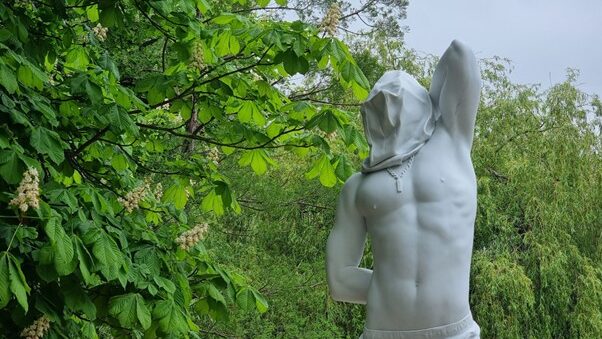
I was recently given the opportunity to attend the press view of Worcester College’s new sculpture exhibition, The Storytellers. Set in the college’s breathtaking gardens, the exhibition, expertly curated by Iwona Blazwick and Katie Delamere, is a journey through contemporary figurative sculpture, mostly from the 2020s. It is also a rare example of an exhibition whose setting complements and transforms the artworks. From the first moments, The Storytellers feels unusually thoughtful, generous, and alive.
The exhibition, which is free of charge, covers a lot of ground, both literally and figuratively. Despite its breadth, though, , The Storytellers is one of the best-curated exhibitions I have seen in a long time. Covering a large area of the college’s gardens, The Storytellers is split into five ‘acts’, each named after a line from Shakespeare, in an homage to the Buskins, the college’s student drama troupe. These acts cover far-reaching themes: “One touch of nature makes the whole world kin” (from Troilus and Cressida) shows sculptures which morph the human with the vegetal, while “Thou, Nature, art my goddess” (from King Lear) delves into cultural tradition with its depictions of totemic deities. This kind of structure could easily have felt forced, but instead it gives the exhibition a theatrical logic.
There was clearly a lot of thought put into the curation of this exhibition, as combined with their intrinsic meaning, each sculpture’s location fits with its aesthetic appearance. Artworks emerge from hedges, sit beside water, or contrast against the college architecture. This makes for a cohesive, engaging, and visually interesting experience, in which every artwork is perfectly and poignantly placed, rewarding both close attention and casual wandering.
The artists featured are greatly varied, with 14 artists coming from all over the world, all with something vastly different to say in their work. Despite this, The Storytellers doesn’t feel as though it is spreading itself too thin – I found that the overarching theme of ‘human in conversation with nature’ binds together all of the pieces, despite their differences in material, scale, or mood. The artworks vary in quality from ‘nice’ to ‘beautiful’, with no real lowlights, and there are enough highlights for something to resonate with anybody who visits. For me, it was Daniel Silver’s duo of sculptures, Fly With Me and Me, found in the main quad, that were the most striking. Silver has said that he wants to create “something you can look at and feel looked back by”, and these works achieve precisely that. By having all of the sculptures be of figures, the exhibition allows the viewer to engage in dialogue with the artworks, and in Silver’s figures, the reciprocal gaze is palpable.
As if that wasn’t enough, the exhibition is checkpointed by various works of performance art. The first, performed by recent Ruskin graduate Jarad Jackson, was a mesmerising piece of postmodern dance, bringing movement and bodily presence into conversation with the stillness of the sculptures. The second, performed by Lorna Ough, Hazel Dowling, and Lauren Dyer-Amazeen, created a delicate acoustic soundscape against the backdrop of the gardens. These performances felt less like decorative additions than extensions of the exhibition’s central concern of the relationship between bodies, stories, and place, and they helped make the exhibition feel like a living encounter, rather than a static display.
However, the star of The Storytellers is, of course, the gardens themselves. Though I have visited them before for an afternoon stroll, this exhibition made me appreciate the beauty of Worcester College’s natural scenery in a way I never did before. As I travelled across the quads, around the lake, and through the orchard, I felt totally at peace, even on the cloudy day on which I saw it. The sculptures appeared as figures emerging from the setting, rather than objects simply placed there. The Storytellers is an exhibition which is completely dependent on the natural environment around it, and this is one of its greatest strengths. As new flowers blossom in the late spring, and as the sun reemerges from the clouds, the exhibition will change, and the pieces will take on new meaning. Shadows will fall differently; surfaces will catch the light in new ways; the gardens themselves will become part of the storytelling. Few exhibitions make such persuasive use of time, weather, and place.
I therefore find myself strongly encouraging readers to visit this exhibition this term, before it closes on the 5th of July. If not for the sculptures, which are as varied and thought-provoking as they are nice to look at, then for the gardens, which in the coming few weeks will only get more beautiful to stroll through. At its best, the exhibition does what outdoor sculpture should: it changes the way you look at the space around it. The Storytellers, for me, is both one of Oxford’s hidden gems this term, and one of its most rewarding cultural experiences.