

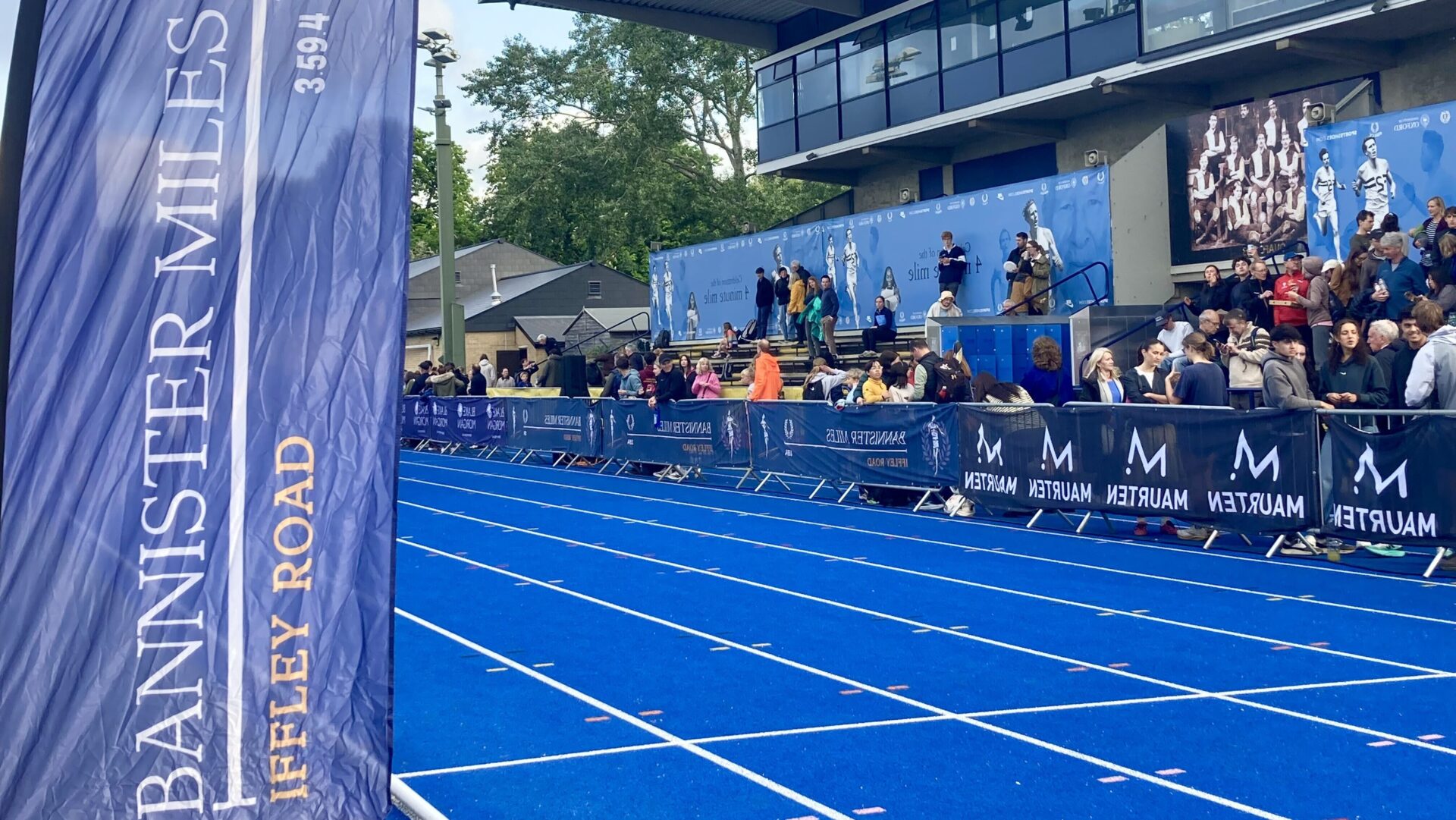
The legacy of Roger Bannister and his famous sub-four-minute mile is etched all over the Iffley Sports Centre. This year’s celebration marked the 72nd anniversary of Roger Bannister’s achievement, and was set to be particularly special. Accompanied by perfect conditions, Olympic silver medallist Laura Muir, former world champion and current Commonwealth champion, came to grace Oxford with a stand-alone performance in the elite women’s race. With Muir’s personal best in the mile standing at 4:15.24, there was little doubt that she might renew Sonia O’Sullivan’s 2004 track record for the women’s mile, currently standing at 4:27.79. Hopes were also high for the elite men’s race, with top athletes aiming to challenge the four-minute mark.
On the 6th of May 1954, Roger Bannister ran the mile in a time of 3:59.4. This athletic accomplishment marked a turning point in running; previously, it had been thought impossible for anyone to run a mile in under four minutes. Then, after Bannister’s achievement, it was only a matter of weeks before his feat was replicated by John Landy. In the summer of 1954, during the Commonwealth Games, these two top runners both ran sub-four-minute miles in an exhilarating final. Bannister took the victory.
Established in 2024 to commemorate the 70th anniversary of Sir Roger Bannister’s world athletic record, Bannister Miles is an annual event, building up to its 75th anniversary in 2029.
The Bannister Miles celebration is open to all: in the morning, a community mile sees members of the public run from St Aldates Road to the Roger Bannister track at Iffley. Later in the day, elite athletes try their luck on the famous Roger Bannister track, pushing their limits and hunting down rapid mile times while going head-to-head with the Bannister legacy. Throughout the day, Iffley Road hosted an exciting atmosphere, serving food and drinks in the build-up to the elite races.
The atmosphere reached a crescendo around 5:45 pm; Laura Muir’s race was set to begin, the first event on her 2026 calendar. Ready to challenge Muir were some of middle-distance running’s young elite, including English Schools champion Kiera Brady-Jones and one of Oxford’s finest, BUCS 800m gold medallist Charlotte Buckley. The cheers of the crowd testified to the excitement of watching a world-renowned champion compete with some of the sport’s rising stars.
Setting an infernal speed, the pacer was adamant to lead Muir to a new track record. This strung the race out, meaning all tactics went out of the window. Muir quickly separated herself from the rest of the field. At the halfway point, when the pacer dropped off, a track record was on the cards. Muir found herself alone at the front of the race, with no pacers or competitors to spur her on – a truly daunting position. Nevertheless, previous experience allowed Muir to maintain the pace: spurred on by the crowd, she was able to put further time between herself and the rest of the field. Finishing in 4:34.06, ten seconds ahead of her competitors, Muir had delivered an impressive feat – a strong start to her Commonwealth campaign. Buckley, Oxford University’s star, crossed the line in a narrowly contested third place, having held on to silver for the best part of two laps.
The main event of the day was, of course, the Bannister Mile. A race around the same track, at the same time of day, during the same time of year in which Bannister’s famous achievement occurred. Every year, runners compete not only against their competitors for first place, but also against the clock. At the stroke of 6pm, the race began. The pacer set off perfectly, with the first lap completed in 59 seconds. The others followed, bunched up, three abreast along the track. This race produced not only a fast pace, but tactical interest: after lap three, the runners were exactly on pace. Some athletes made early bids, accelerating in an attempt to break down their other competitor, a physical and mental game. However, the race was decided down the final stretch, with a four-way sprint for the line. This was won by the 17-year-old Freddy Rowe, fresh from passing his driving test, as the commentators made sure to announce, with a startling time of 4:00.88. Tantalisingly close to replicating Bannister’s achievement, Rowe promises a record-breaking future.
This year also brought back the relatively new discipline of steeplechase miles. Being a relatively new discipline, specialists were expected to challenge the world’s best times for the steeplechase mile. Two former winners, Will Battershill and Mark Pearce, were to go head-to-head. From the beginning, it was clear that these two athletes were going to produce an excellent race, as the rest of their competitors steadily fell behind. Battershill and Pearce proved especially adept at clearing all the barriers, particularly the tricky water jump. Coming into the final 200 metres, Battershill strove ahead to open up a decisive gap. With a time of 4:20.40, the athlete achieved a new world best in the relatively new category of the steeplechase mile. Pearce finished only a second later, separated from the third-place chaser by over ten seconds. A thrilling spectacle, the steeplechase mile proved deserving of long-term establishment in the Bannister Miles celebration for years to come.
These results demonstrate how difficult mile running truly is. A notoriously challenging discipline, Muir and Rowe showed exceptional talent to win their races, despite falling slightly short of the pre-race fantasies.
The event is rightly celebrated as a massive step beyond the bounds of human limitation. While the mile world record of 3:43.13 has not been broken since 1999, other historic records continue to fall. In the recent London Marathon, the first and second ever official sub-two-hour marathons were run. This marathon record was another ‘impossible’ barrier in distance running, which has now been shattered, mirroring Roger Bannister’s accomplishment. Years on, these races still show us just how extraordinary Bannister’s achievement actually was, and why this feat of human achievement is deservedly celebrated 72 years later.