

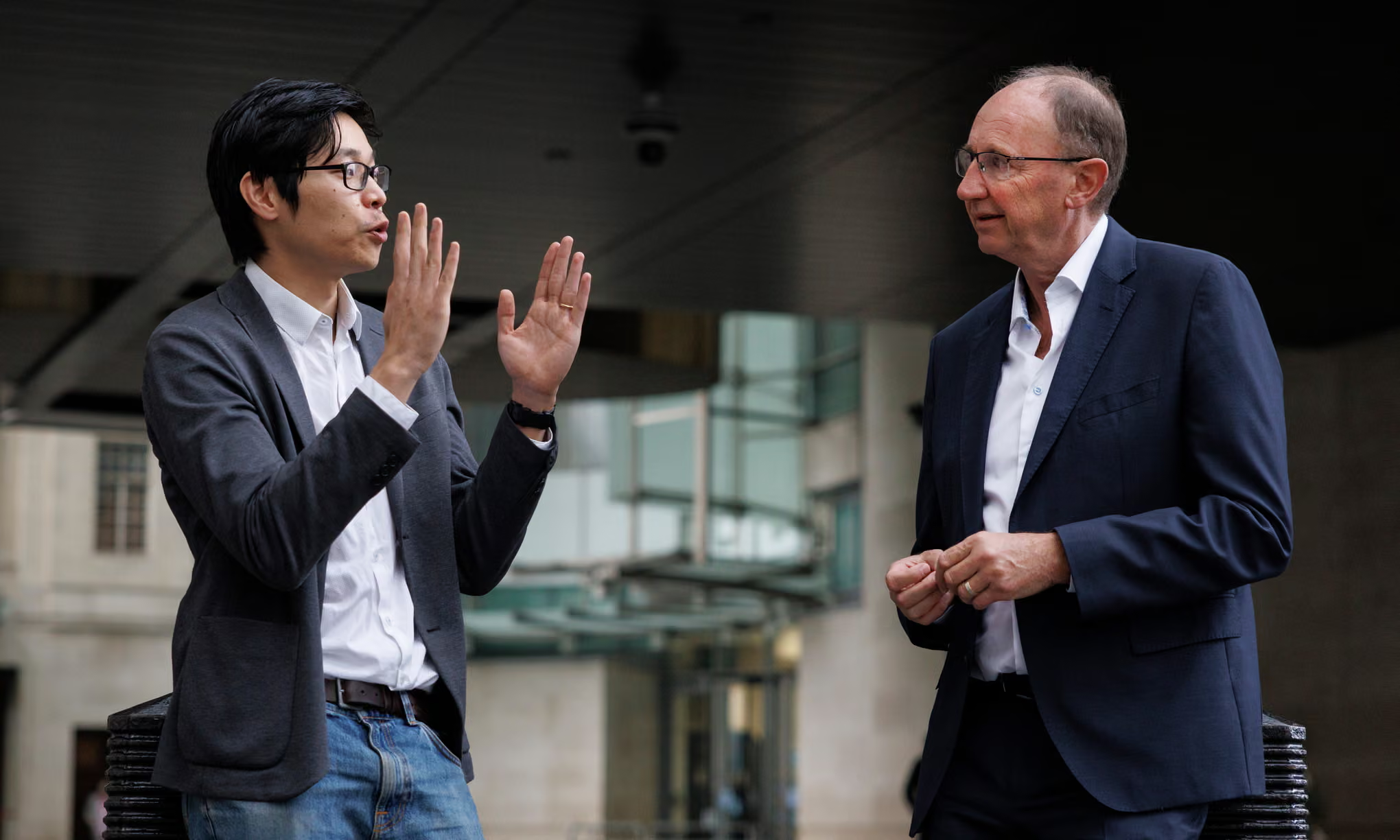
Jonathan Liew is a sportswriter and Opinion columnist for The Guardian. He has been named Young Sports Writer of the Year, Sports Writer of the Year, and Sports Columnist of the Year at the annual British Sports Journalism Awards.
When the call connects, Jonathan Liew spends the first five minutes asking me instead about whether you can get through an Oxford tutorial having not read the book your essay is about and what the news diet for students my age looks like. People don’t want to read, I say. They want to scroll past snappy, shareable quotes blown up on an Instagram post. Do you think that’s where news consumption’s going?
“Arguably, that’s where it’s been for ages”, Liew, previously a full-time sportswriter and now writing across both Sports and Opinion for The Guardian, counters. “These questions were being asked when television was introduced: a huge portion of every society has not really wanted to read. We’re always fighting these battles – and winning.”
But social media’s different; you had to sit down in front of the television, I point out. Now you can look at it all day, every day, in the palm of your hand.
“Well, the means of consumption are obviously changing”, Liew begins, before he pauses and swivels back towards the camera, like a fox that’s just clocked the silent jaws of the trap around its leg. “Has the interview started?”
Yes and no. In many ways, the shrinking attention span of the modern reader has steered the journalism we consume towards the digital and visual modes. “A lot of future long-form journalism isn’t going to be presented directly to audiences”, Liew predicts, in the same way that TikToks are often a summary of articles that already exist. The Guardian, he tells me, is working out how to tell their written stories in more visual forms, and paragraphs of his work often end up being repackaged for vertical video.
This highlight-reel approach sounds antithetical to how a well-crafted piece should be consumed. To Liew, however, it’s not a threat, merely a different form of consumption: “To some extent, we’re all writing for screenshots these days”, he says. “You’re trying to hit high notes in the same way that a musician who’s making an album is also trying to make catchy hooks. Of course, my main intention is for people to experience reading it front to back, but [these Reels] are a way of propagating what I do to people who weren’t ever going to read it in the first place.”
The duty of engagement, he believes, falls instead to the writer. “An infinite scroll does not work with writing. If you write a paragraph that bores someone, that allows them to switch off and click somewhere else, that’s your fault.”
Is there a distinction, then, between a great journalist and a great writer? (Imagine, if you will, that you can see the capital G on ‘great’.) “Undoubtedly”, Liew agrees. Football transfer journalist David Ornstein, who has four million followers on X and is 2025’s Sportswriter Of The Year: “A brilliant journalist. Is he a brilliant writer? He’d tell you: obviously not.”
What we’re seeing is a shift, an increase in demand for the work of journalists as opposed to that of writers. Most people engage with sports through the lens of fandom, and fandom is, by its very nature, “fanatically obsessive” and driven by a desire to consume. “People will read [the same piece of news about a player’s injury] twenty different ways, just because the player’s from your club, and you’ll want to consume everything you can about your club”. That’s the predominant business model for media outlets: The Athletic, for instance, will have Chelsea writers producing Chelsea content for Chelsea fans, leading to a narrower and narrower chamber, a singular obsession with a singular subject.
But it’s not that writing’s getting worse; it’s just that the proliferation of said made-to-order content is making the good stuff harder to find. The quality of sports journalism can’t suffer if “it wasn’t very good to start with”. Growing up in the 1990s, Liew remembers the standard of football writing being far worse than it is today; he calls the 2010s a golden age for sports writing – any kind of writing, really – because the “democratising, disruptive force of the Internet pushed new names and ideas and styles which would never have gotten through traditional media to the forefront”.
And now? In this age of the Internet, where writing has seemingly become more democratised than ever, and everyone can produce a podcast, start a Substack, write a blog? “Now it’s easier than ever to publish”, Liew says with a rueful smile. “But it’s harder than ever to have a voice.
“The big fish in the pond have a much better idea of how to dominate the information environment in a way that was not remotely true ten years ago […] take the football podcast market: it’s dominated by Lineker’s podcast, by Gary Neville’s, Peter Crouch’s, Wayne Rooney’s.”
It’s true that plenty of people will passively accept a diet of middling-quality news from legacy media. Liew, though, is persistently optimistic about the countercultural impulse to seek out the new and interesting, to push back against mainstream content and elevate smaller, unconventional voices: “Humans are drawn to those sorts of people – I am, certainly. And I do honestly believe that people will find your writing if it’s really good, because we’re able to recognise brilliant things.”
I push: What exactly makes brilliant writing, then? Uniqueness and urgency, Liew answers after some thought. “It has to be of its time. And that’s why live sports writing is some of the best sports writing – it’s so entirely and thoroughly soaked in the moment it was produced, it’s time-stamped like the rings inside a tree.”
As for uniqueness, he draws his own inspiration from sources across genres: “Bill Bryson – this travel and science writer – [what I took from him was that] a piece of writing could both inform and entertain. Daniel Kitson, a comedian: an awareness of what words sound funny, an awareness of the audience.” And a name that will undoubtedly be more familiar: “I was incredibly influenced by Zadie Smith, and so for a while I was trying to write football match reports in her flat, clean, beautiful style. Very often, I’ll think: what if Zadie Smith were writing about the World Darts Championship? And even though those two things have never aligned, I’ll [use that question to] create something that is both incredibly derivative but also entirely original.”
But as a sports journalist, Liew’s favourite kind of writing is the kind that depicts “what sport does to athletes, to fans, to countries” instead of pieces produced purely to keep up with the pressures of the endless content mill. “Sometimes”, he suggests, “[the Sport section of The Guardian] should just say: got nothing for you today. I feel that way about some of the columns I’ve written: you didn’t need to hear from me. That piece wasn’t necessary”.
So which ones are? “Opinions that are a conduit to greater understanding or better policy or simply a more humane and empathetic world. If you’ve written an opinion and you’re not trying to do one of those things, then it was pointless.” Take Liew’s columns about the racist abuse players like Vinicius Jr regularly experience. “There’s a huge proportion of the sports journalism world that doesn’t think about racism or sexism or transphobia. You can tell from their coverage that what their articles are really saying is: it’s a shame we have to talk about creating a more equal society instead of about set pieces and VAR.”
He maintains that beyond the subject matter of his columns, it’s his craft that both facilitates and embodies the message of his work: “If something is pleasant to read, you’re much more likely to consume it, and thereby the message contained within it.
“In this day and age, to aspire to write well, to aspire to write floridly and not hide your intelligence under a bushel, is itself a quietly subversive act in an age of mindless content and young people like you being told to give up your arts degree. There is something intrinsically political in wanting to create art. And I don’t shy away from the fact that that’s what I’m trying to do, even if I’m writing up press conference quotes from the San Siro. If you’re not aspiring to make something lasting, I don’t know why you’re doing it.”
The final question I have for Liew is also probably one of the most asked: how does one balance a love for sport with the labour that writing about it constantly demands?
To answer that, we look back instead of forward. It’s 11th December, and England has just lost 2-1 to France in the quarterfinal of the 2022 World Cup. Liew is standing outside the stadium in Qatar; from inside comes the sound of joy and the silence of despair. He’s thinking: I don’t want to be here anymore. He’s thinking: Thousands of people would give a kidney to be in my position. He thinks and thinks, and finally he asks The Guardian: Can I fly home? “I gave up a World Cup final because I wanted to see my family”, Liew finishes. He doesn’t look regretful in the slightest, only thoughtful.
“Inversely, since writing about sport a lot less, I’ve started watching it a lot more”, he tells me. “I’m no longer asking the question: is this leisure, or is this work? The Champions League and the Premier League are incredible products, which were eventually ruined for me by having to write about them several hundred times in a row. And I suppose now I stand to have politics sullied for me in the same way”, he concludes, before he’s called away and we have to hastily wrap up our chat.
Sitting here, I ask myself, as Liew did: was this research or enjoyment? Was this fun? Yes. More so, perhaps, if I didn’t have to write about it. Then again, it wouldn’t be a story if I didn’t.