

As Prime Minister Andy Burnham constantly reminds us, we are in a cost of living crisis, with the price of nearly everything rising. So, on a limited student budget, and hoping to vary my food beyond Tesco meal deals and late-night kebabs, I decided to give Too Good To Go a go.
Too Good To Go is an app that allows users to pick up so-called ‘surprise bags’ of surplus food from shops and cafés at a reduced price. At Oxford, a number of places take part – including chains like Gail’s and Costa, supermarkets like M&S and Co-op, and independent businesses like Taylor’s and Knead. Depending on the time of day, you can check the app’s map to see what bags are available, which range from leftover pastries to fully cooked meals, along with their respective collection windows.
I got my first Too Good To Go a few weeks ago, from Tortilla on my way to London. At £4.40, I picked up a burrito bowl alongside tortilla chips with guacamole, which would ordinarily cost £15.75. While the burrito bowl wasn’t my typical order – since it replaced beans, corn, and salsa with grilled vegetables, grilled vegetables, and more grilled vegetables – I couldn’t help but appreciate the value of my order as I sat on the Overground, making my way home.
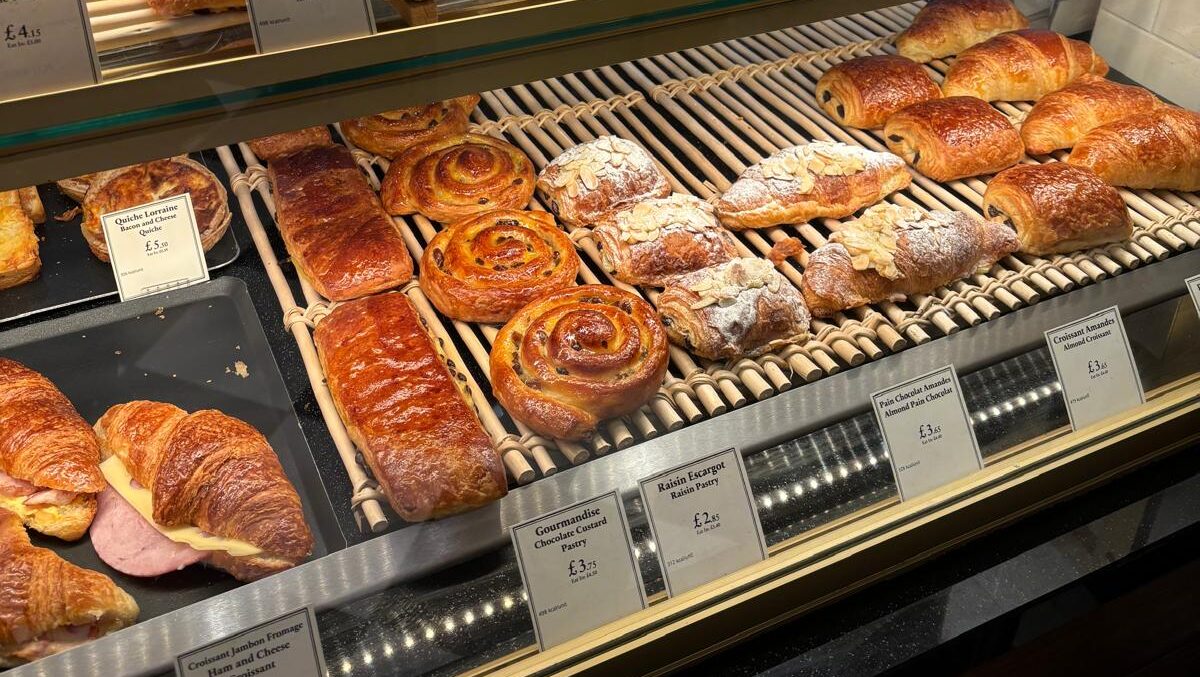
My next order came a few days later, at Paul on High Street. Although at £7, it was a bit pricier, I still got my fair share of goods: a croissant, a chocolate croissant, an almond croissant (just all of the croissants), a cinnamon roll, a cheese twist, and two cheese and salami baguettes. Needless to say, my meals were covered for the next few days.
Before long, I got hooked on the app, replacing my late-night Instagram doomscroll with, of all things, yellow-sticker food. I refreshed the app a few times a day, looking for what might be called a ‘rare find’. For me, that was the M&S bakery bag – I mean, who wouldn’t want the latest drop of Kathryn Turner-recommended cornflake cookies?
After turning on my M&S notifications and searching up M&S’ drop times, I got my hands on a bakery bag after two weeks of trying (I’m locked in like that) – and it did not disappoint. At £3.80, I got a box of mince pies, two doughnuts, two ‘Yumnuts’, a cheese pretzel, a sausage roll, and an apple turnover. Although I might’ve missed out on the M&S cookie craze, I couldn’t have been happier.
In a way, the more I used the app, the more it became a game – racing other users to get the best bags (M&S or otherwise), followed by the adrenaline rush in seeing what I ‘won’ in my surprise bag. In an age of shrinking attention spans and AI slop, perhaps it makes sense that buying leftover food has also become a form of entertainment for me. The issue with ‘gamifying’ surplus food, however, is that it might defeat the very purpose of the app.
Founded in 2015, Too Good To Go was set up to fight food waste – which, in the UK, is upwards of 10.7 million tonnes per year. When the whole appeal of the app is the surprise, there’s a fair chance you won’t get what you want, and the food will go to waste regardless. In my case, I learnt this the hard way after picking up a ‘sweet and pastry bag’ at Starbucks where I got, of all things, three boxes of porridge; if my brother hadn’t been willing to take the porridges for himself, I likely wouldn’t have had them. Searching across social media, gripes similar to mine with Too Good To Go aren’t uncommon – people complain that “they really put the ‘surprise’ in surprise bag”, while others throw away goods they don’t like, whether an egg mayo sandwich or some other item. When a significant amount of the food ends up in the trash anyway, it’s hard to see what the point of the app really is.
There’s also evidence for Too Good To Go’s wider problem. A 2025 study using mathematical models found that surprise bags, much like ordinary end-of-day discounts, could actually increase food waste. According to the study, leftovers could not only tempt businesses to overproduce – knowing they can sell off surplus later – but buyers might end up throwing away food they never wanted in the first place.
This paradox puts Too Good To Go in a strange position. Their business model relies on there being surplus food to sell – the very thing it is also trying to get rid of. But then it doesn’t so much get rid of food waste as move it to our kitchens and homes, which, given households make up 60% of the UK’s food waste, isn’t exactly the most promising space for it to end up.
So, is Too Good To Go too good to be true? Not entirely. For us students, it is genuinely good value – a £3-4 surprise bag can cover meals for a day or two. But the dopamine hit that comes with refreshing the app and searching for the next best thing makes it all too easy to forget why the app exists. After all, a surprise bag only matters when someone actually eats what’s inside.
As for me, although I’ll keep trying for the next M&S surprise bag, I might think twice before reserving another one I might not like.