

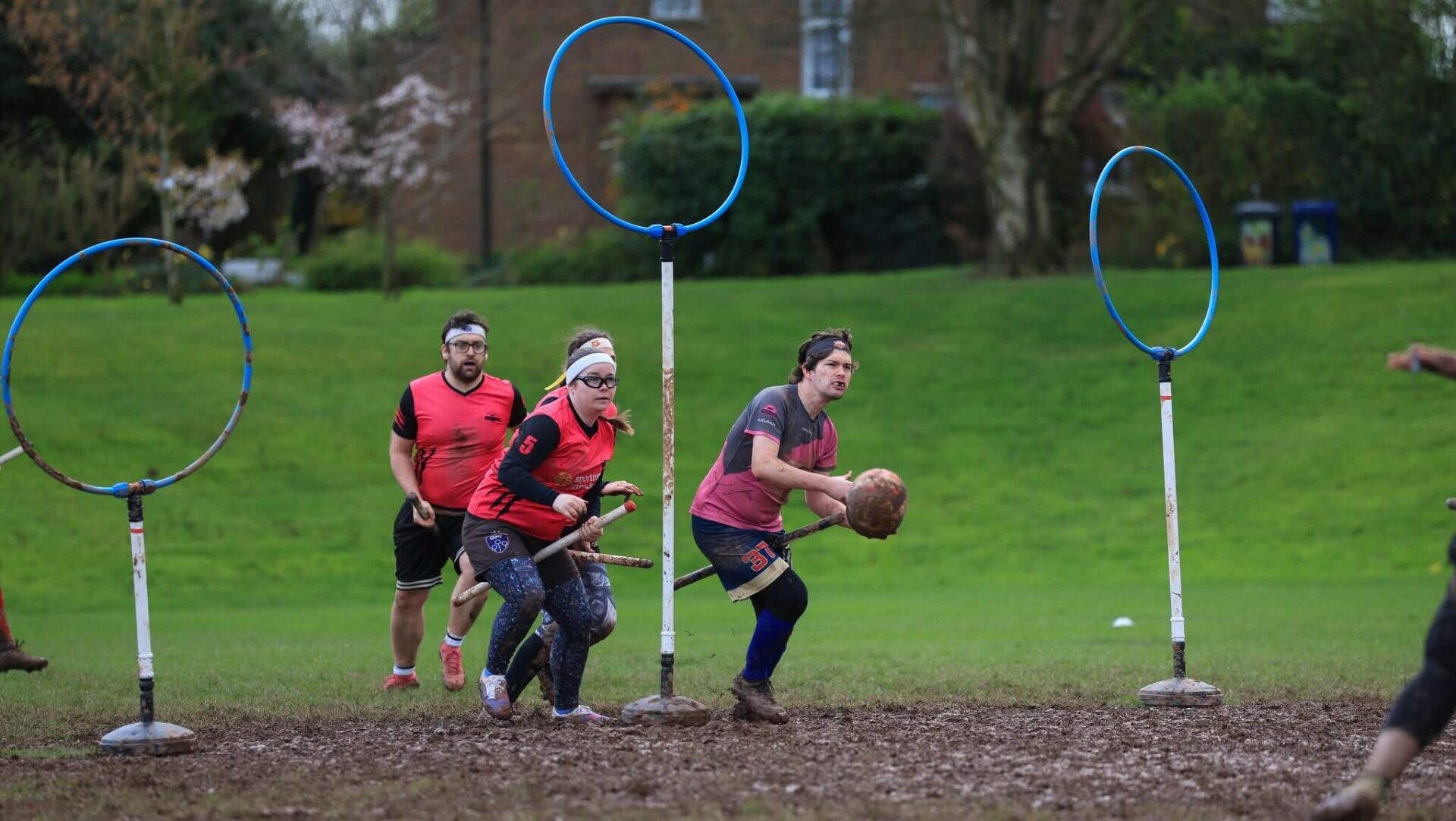
It isn’t often that fiction becomes reality. But that is exactly what has happened to Quidditch, now named Quadball.
The sport originated in the pages of the Harry Potter books in the late 1990s. A few years later, in 2005, two students at Middlebury College, Vermont, decided to transform an imaginary sport into a real one. Devoid of flying broomsticks and magical spells, the students nonetheless created a sport fit for muggles. Since then, it has grown rapidly and is now played in more than 40 countries worldwide, with over 20 teams currently competing in the UK.
Quidditch arrived at Oxford in 2011. The Oxford University Quidditch Club (OUQC), founded by student Angus Barry, was one of the first of its kind in the UK. One of its earliest competitions was a cuppers match between Worcester and St Edmund’s Hall. In time, the club’s membership grew large enough to accommodate two teams: the Radcliffe Chimeras and the more relaxed second team, the Oxford Quidlings. The Radcliffe Chimeras quickly attained national dominance, winning the first and third British Quadball Cups in 2013 and 2016. Currently the OUQC competes as a single team, the Chimeras, winning the 2025 British Quadball Cup to become the first team to win the tournament three times.
The first Quadball World Cup was held at Oxford in 2012, with just five teams. The tournament has since grown: the most recent World Cup, held in Belgium last summer, featured 31 teams. The 2027 World Cup is due to be held in London in July.
The rules of Quadball might appear complex but are, in reality, surprisingly simple. There are seven players per team, each of whom plays with a broomstick (or PVC pipe) between their legs as a handicap. The keeper guards their team’s three hoops; three chasers try to throw a volleyball (or quaffle) through the hoops to score; and two beaters throw bludgers (or dodgeballs) at opponents to immobilise them. Twenty minutes into the game, a referee acting as the snitch, wearing a yellow flag, enters the field, and each team’s seeker must catch it.
Watching Quadball for the first time, I was taken aback by the chaos of the sport: with four balls in play simultaneously, it is akin to watching three different sports at once. To seasoned Quadball players, like current OUQC Captain James Kramer, the chaos is what makes the sport so enthralling. “Once you’ve played for a while, you get a better reading of a game, and the chaos becomes a tactical opportunity,” Kramer tells me. “There’s so much opportunity for tactical depth, exciting plays and innovation.”
Recently, the sport has distanced itself from Harry Potter. In 2022, the sport’s international governing bodies announced it would change its name from Quidditch to Quadball, citing Rowling’s “anti-trans positions”. This came in response to JK Rowling’s controversial comments about transgender people, but also as part of an effort to establish an identity for the sport independent of its fictional origins.
“We clearly were Quidditch when the sport was founded, but I do think the sport has moved as far away as it can from that,” Kramer tells me. Whereas a decade ago, 90% of players were Harry Potter fans, now “in the two years I’ve been at the club, I don’t think we’ve had a single person join who is a Harry Potter fan,” Kramer adds. “We have built an identity as Quadball, and we have a very LGBTQ+ inclusive community,” he says. “We’re not going to shy away from our origins, and there’s plenty of people still in the community who were massive Harry Potter fans, but it’s also not who we are today.”
Kramer tells me that he was initially uneasy about trying out Quadball as a fresher because of its connections to Harry Potter. Its Quidditch origins were a “barrier to entry” rather than what drew him to it in the first place. “It was only when I did see it for what it is as an actual sport with its own community and own identity that I joined,” he says.
At a recent Quadball training session, I spoke to star performer Thomas Yates, who began playing the sport only last year. As he began his second year at Oxford, he chose to play Quadball because everyone starts at university as a beginner, with the same level of experience. Since then, his rise in Quadball has been dizzyingly fast. At the British Universities Quadball World Cup, he played well in a match defined by muddy, wet conditions, and he was scouted by Team England. He subsequently attended England training sessions and played his first international match over the summer. “It’s quite weird to get a message from a coach saying, ‘Hey, do you want to go and play a sport internationally?’” Yates tells me. “I felt like I can’t really turn that down, can you?”

The OUQC has enjoyed a surfeit of incredible moments, but one match in particular elicits excitement at its mere mention at Quadball training. It was the final of the British University Quadball Cup in 2026, pitting arch-nemeses Oxford against Cambridge. The latter entered the final in imperious form, having bludgeoned past their previous opponents, whereas Oxford had faltered along the way. This was a match defined by delicate skill, fierce tenacity, and tactical nous. After a hesitant start, Cambridge rediscovered their form, inching ahead of Oxford in goals. They had control of the dodgeballs, and momentum was in their favour. There was one snag: Cambridge did not have the yellow flag (or snitch).
At twenty minutes, the flag runner entered play, confounding seekers on both teams with his unyielding athleticism and nimble speed. As he avoided capture, Cambridge surged ahead on the scoreboard, leaving Oxford staring down defeat. After 23 minutes of fruitless pursuit, Oxford had just three minutes before the game’s time cap would automatically hand Cambridge victory. Yet, in those final precious moments, Oxford’s seeker caught the flag. Two more goals in the last 90 seconds sealed Oxford’s victory. It is no overstatement to call it a nail-biting finish.
“It is one of the highlights of my playing career,” Kramer says. “I would say that’s probably the most intense, exciting game I’ve played.” He stresses that this was a very abnormal game – the time cap is typically applicable in just one per cent of games.
A more representative Quadball game was the semi-final against Edinburgh at the same tournament. It was played in terrible conditions – the ground was a mudbath. Oxford was three or four goals behind throughout, and was desperately trying to wrestle its way back into contention. Despair quickly became delight when the Oxford seeker caught the yellow flag, propelling the team to victory. “It was just so dramatically perfect,” Kramer says.
With a formidable Quadball team and a close-knit community of players, OUQC looks set for another dramatic, exciting, and successful year. In March, the club will host an international development tournament, bringing in teams from Norway, Belgium, Switzerland, and Scotland.
As I left the Quadball training session on an incredibly cold October afternoon, I felt that there is a magic to the game that owes less to its Harry Potter allusions than to the bonds of community it creates.