

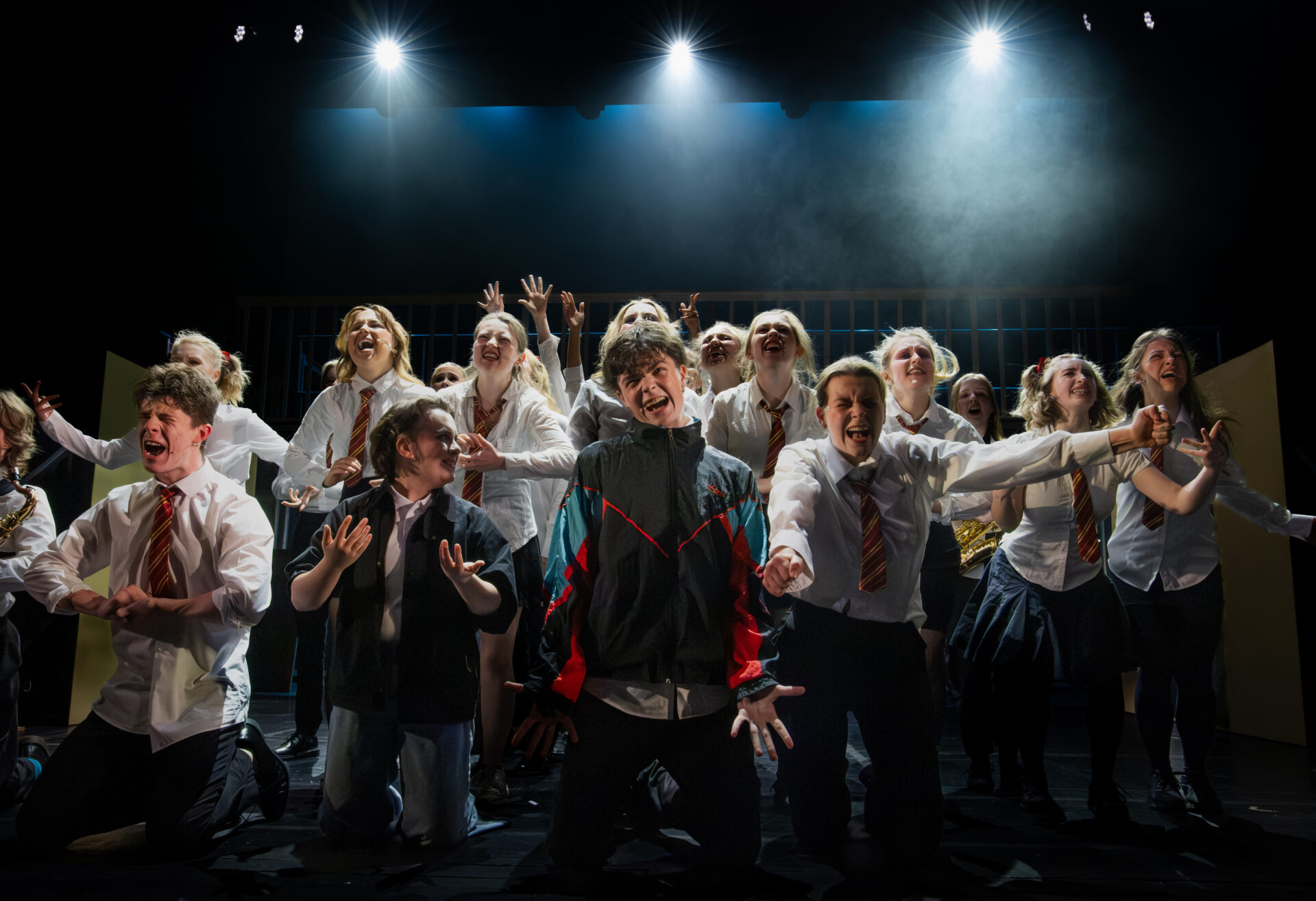
Cross Keys’ production of Our House at the Oxford Playhouse is an ambitious one. With a 30-strong cast, no shortage of intricately choreographed musical numbers, and the challenge of sustaining a dual timeline narrative, it attempts a great deal. It largely succeeds. Whimsical, high-octane, and joyfully irreverent, the performance brims with heart. Uniquely, Our House, a musical first written by Tim Firth in 2002, manages to effortlessly combine wit with tragedy, the heights of joy with the depths of grief.
Set in Camden in the 1980s, the musical, directed by Madison Bouchta, follows Joe Casey (Alex Innes), who makes a split-second decision which changes the course of his life. The play opens on Joe’s 16th birthday. His father, once imprisoned for his criminal exploits before dying young, looms large over Joe’s life – “a loser and a scumbag”, Joe bitterly calls him. Trying to impress his new girlfriend, Sarah (Maya Flint), he breaks into a flat to show Sarah a viewpoint overlooking his home on Casey Street. As the police arrive, Joe’s life fractures into two parallel paths. In one, he stays and accepts responsibility for the break-in, ultimately being sent to a correctional facility. In the other, he flees the scene. “I thought I was a good judge of character”, Sarah tells him afterwards in this second storyline, disillusioned by his cowardice, and the two break up.
From there, the musical follows the divergent trajectories of Joe’s life. We watch as the two versions of Joe move increasingly further apart: one remains fundamentally honest and true to himself, but suffers for it; the other evades accountability and descends deeper into moral compromise. “I’m a reformed young offender”, Joe insists in the former timeline. “This isn’t crime, it’s enterprise culture”, Joe claims in the latter, having fully embraced a corrupt corporate world.
Yet even as the moral distinctions between the two versions of Joe become increasingly pronounced, the production avoids reducing the story to a simplistic lesson. Instead, it presents both paths as responses to the same underlying insecurities, allowing the audience to understand even Joe’s most questionable decisions. The dual narrative, therefore, becomes more than a straightforward morality tale: it is a sharp exploration of class, loyalty, and the dangerous allure of wealth and social ascent.
As a jukebox musical, Our House is a nostalgia-filled celebration of 1980s ska-pop band Madness, reviving classics including ‘Baggy Trousers’, ‘Embarrassment’, ‘Night Boat to Cairo’, and, of course, ‘Our House’. The musical also includes one song, ‘It Must Be Love’, written especially for it.
Alex Innes delivers a standout performance as Joe Casey. Though at first I struggled to differentiate between the different courses of Joe’s life, Innes’ subtle acting, aided by costume changes, soon made it clear. He projected an affected confidence as the Joe who has ingratiated himself with the corporate elite, before pivoting effortlessly to the anxious vulnerability of the struggling offender. Innes portrays Joe with impressive complexity, displaying his endearingly exuberant charisma and confidence bordering on brashness, but also his insecurity.
Maya Flint’s Sarah is similarly nuanced. There is the ambitious Sarah, determined to attend university and become a lawyer, increasingly at ease within a more educated social milieu. Yet there is also the Sarah who cannot fully let go of Joe Casey, who returns immediately upon hearing of his arrest and remains, despite everything, compassionate and loyal. Flint captures both aspects beautifully.
Beyond the central couple, the supporting cast is consistently strong. Joe’s friends Emmo (Peter Hardisty) and Lewis (Luke Carroll), alongside Sarah’s friends Billie (Lottie Hutchison) and Angie (Imogen Bowden), exude a camaraderie that genuinely feels real. Harriet Wilson, as Kath Casey, vividly conveys the anguish of a mother forced to watch her son repeat the mistakes of his father. Meanwhile, Becca Harper’s Reecey is all swaggering aggression and brash, in-your-face confrontationality.
The second half of the play introduces hard-nosed upmarket property developer Mr Pressman, played to perfection by Beth Hunt. The slick superiority of Pressman, coupled with his callous heartlessness, brings a chilling effect to every scene he’s in.
Even fleeting performances leave an impression. Mr Pressman’s receptionist, for instance, subtly differentiates between the two timelines in the contrasting ways she treats suited businessman Joe and offender Joe – a small but highly effective detail.
One of the production’s most emotionally compelling devices is the frequent presence of Joe’s father (Tristan Hood), who silently observes events unfolding onstage. His presence becomes a powerful reminder that Joe’s choices are inseparable from the shame and insecurity inherited from his father’s failures. Running through the musical is a compelling paradox: Joe is driven to escape the humiliation associated with his father, yet in trying so desperately not to become him, he gradually follows the same path.
The production reaches its emotional peak in the final stages of the narrative. Standing silently at his mother’s funeral, Innes reveals a young man overwhelmed by guilt and regret. His carefully constructed corporate confidence drains away; his shoulders sag, and what remains is not a successful businessman but a frightened young man who has lost sight of himself. It is one of the production’s most devastating scenes.
The musical is full of extravagant, exuberantly choreographed set pieces – Joe’s last day of school and Joe and Sarah’s paradise wedding – during which one can only marvel at the complex dance sequences performed by the ensemble. Yet my one reservation is that these dazzling sequences occasionally threaten to overshadow the play’s deeper emotional core: its exploration of grief, love, family, coming-of-age, and difficult decisions.As the play drew to a close, the most powerful element of the play for me was its exploration of a young man’s crippling insecurity. Beneath Joe’s veneer of confidence is simply a terrified 16-year-old boy trying desperately to do the right thing without the guidance of a father. Our House ultimately becomes not just a story about crime or morality, but about the vulnerability of growing up and the frightening uncertainty of trying to decide who you are.