

Medieval mystery plays are something of a lost art today. Born of an era of limited literacy – and when ‘literacy’ meant a basic understanding of the scriptures, calculus, and how to write your own name – they were part of a broad arsenal of tools to instil belief in the laity. Such biblical stagings were part of the rich visual culture of medieval and early modern Christianity, a staple of religious holidays and festivals and a clear, succinct way to communicate the core meanings of faith to a population preoccupied with survival. Mystery plays have not had an easy ride – whilst they are still performed in parts, it is almost in homage, a respectful acknowledgement that, yes, in ye olden times, before the advent of such wonders as the Kindle and the megachurch, the best way to speak to the unordained masses was through the stage. It is for that reason – the sheer scale of attempting to transmute an English mystery play into a modern black box theatre – that I respect the director, Meryl Vourch, for adapting this medieval theme, The Harrowing of Hell.26, for the stage. It is running at the Burton Taylor studio from the 2nd until the 6th of June, with curtains drawing at 9:30pm, and then in Week 7 at the crypt of St-Peters-In-the-East, from the 9th till the 11th of June, beginning at 8pm.
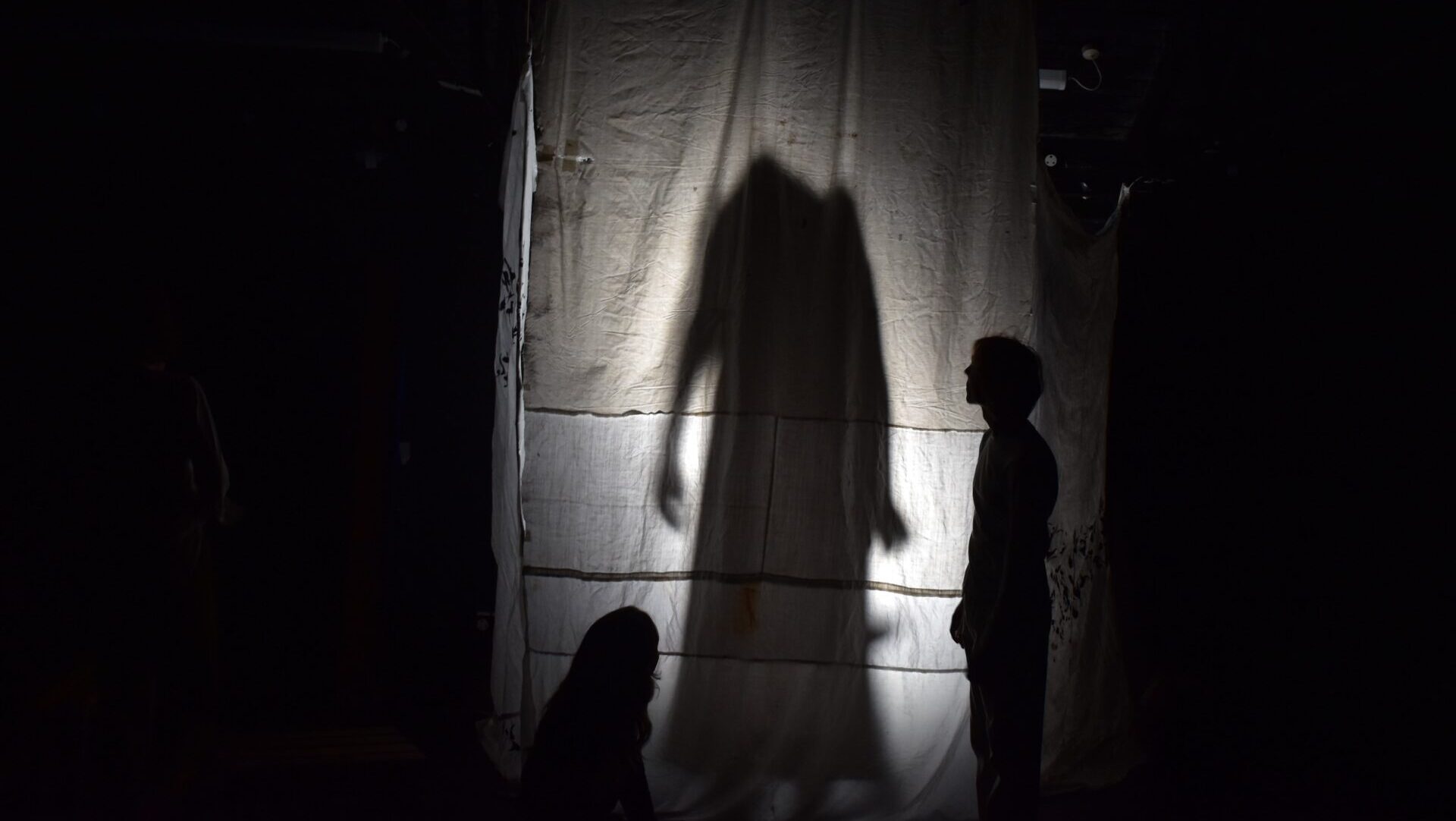
The atmosphere upon entry into the BT is heavy, the air is still. In an unfortunately sparsely populated audience, several literally ashen-faced cast members sat amongst us, before the play burst to life. Its opening section, with Satan, played by Thomas Arensen, contorting and struggling before a harsh cry pierces the air, is the most gripping section of the entire play. Its wordless appeal, Arensen’s impressive physicality, and the sudden shock of the shriek all meld perfectly to entrap the audience. The sound design and lighting were dynamic, lending themselves fittingly to a haunting depiction of hell, with the whispering of lost souls and the particularly striking sight of Christ’s silhouette behind a thin pall. Simplicity was the motto of the costume department, as The Harrowing of Hell.26 deliberately eschews ornate decoration to maintain focus on the performance.
The basics of the story, of Adam and Eve suffering in Hell at the hands of Satan and his devils before Christ rescues them from it, are performed well. The two devils, played by Elizabeth Henderson Miller and Sonny Fox are, again, incredibly well portrayed, with both giving everything to the role, including some manoeuvres that looked rather painful. Caleb Silverglied and Anastasija Vidjajeva both deliver strong performances as Adam and Eve, respectively, two wretches imprisoned in hell for so long that, despite their desire for salvation, they cannot bring themselves to take the steps towards it once proffered. Equally impressive is Patrizia Hinz, an authoritative narrator who holds the play aptly in her hands and maintains faithfulness to the nature of a mystery play. The bare space of the Burton Taylor, sparsely staged for the production, further lent to the unappealing afterlife depicted on the stage – save for an impressive demonstration from Arensen when he splits an apple in two.
However, despite the fine acting and good production quality, the play has a deep thematic flaw: it can never seem to decide on whether it is a modern take on a mystery play, or a faithful recreation of one. The former can be seen most clearly in its Paradise Lost-like Satan – who is not a total entity of evil but rather an individual with their own mores and desires – and keenly in its depiction of Christ. Whilst Jesus did cry out on the cross and doubted before his arrest, by the time of his earthly passing in the scriptures, he appeared to accept his sacrifice as necessary for the salvation of man. Yet the play’s Christ, played by Ian Machalek, lacks this acceptance. Instead, he wails and protests as if he has not already gone through his Passion. Once Machalek steps beyond the pall and confronts Satan, his Christ appears a curious blend of Son of God and Jared Leto’s Joker. The play resolves with a clear indication that Satan has lost, but is equivocal in its conclusion on the emancipation of man from eternal damnation. This issue is particularly heightened because of those elements of the play, the torturous nature of hell, the pestering demons and the clear indication from the narrator that Satan’s loss is a victory for good, which stick to the traditional mystery play framework.
It is not a bad play – it does not arouse any real upset or moral objection. As stated, The Harrowing of Hell.26 has many strong points, and the work of its cast and crew can’t be doubted. But after the enthralling first ten minutes, the play simply bored me. To bore an audience is worse than to offend or to shock – at least there lies engagement. Spending the remainder of the performance counting the minutes made it hard to enjoy.
Fundamentally, The Harrowing of Hell.26 is a finely acted, well-produced play which was enjoyable enough to watch, but its conclusion is unsatisfying. The play ends with an abrupt jolt – so abrupt that it cuts itself off before it can actually decide what it is saying.