

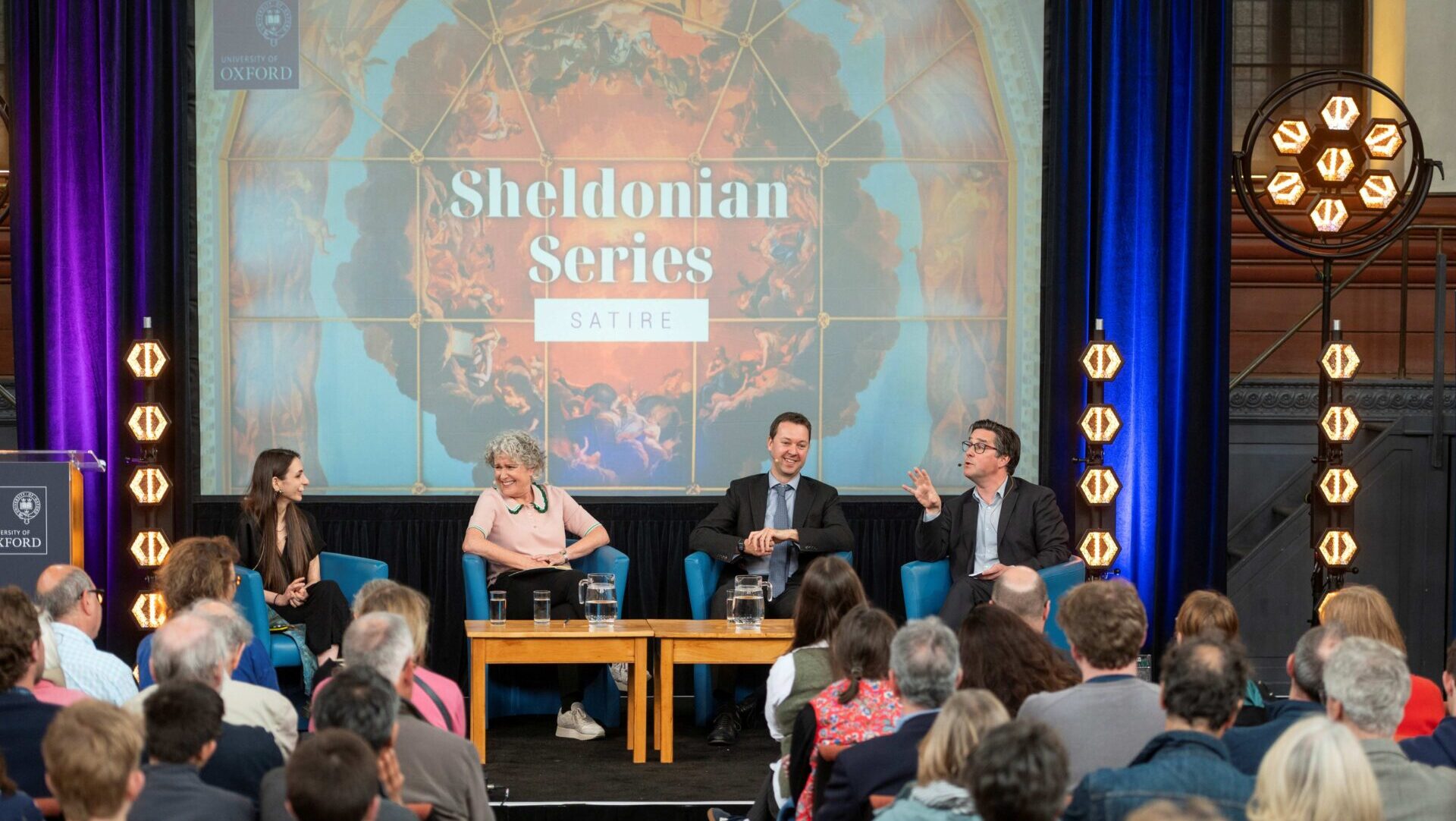
The 2025-2026 Sheldonian Series ended on Wednesday 20th May with a panel discussion on the power, use, and limits of political satire. Held in the Sheldonian Theatre, the event brought together leading figures from British comedy and public commentary to reflect on satire’s role in the current political moment.
The Sheldonian Series, launched last academic year by the Vice Chancellor Irene Tracey, aims to “promote discussions about the big issues of the day”. This year’s theme focused on different dimensions of power. In Michaelmas term, the series examined the power of speech through debates around “cancel culture”, while Hilary Term’s discussion focused on activism and protest movements.
Opening the evening in a pre-recorded video message, Tracey described the series as a “powerful reminder of what we stand for as a university community” and “what inclusive inquiry and freedom of speech should look like”. Professor William Whyte, the panel moderator, noted that the Sheldonian itself was “an ideal place” to discuss satire because it had effectively been “built for that very purpose”. It was built in the mid-17th century to provide a location for the ‘Oxford Act’, an often disastrous end-of-term event which gave students the chance to poke fun at the University and its members in a satirical oration.
The panel featured three prominent figures in the world of British political satire. It included Jan Ravens, an impressionist known for her work on Spitting Image and Dead Ringers, who performed multiple impressions throughout the course of the evening. Alongside her sat Andrew Hunter Murray, a Keble College alumnus turned Private Eye journalist and star of Radio 4’s The Naked Week. Completing the line-up was Ella Baron, cartoonist for the Guardian, who started her career drawing for Cherwell as an undergraduate at Merton College.
Three broad themes dominated the discussion. The first was satire’s ability to reshape how audiences see political events. Baron argued that cartoons can “collapse time and space”, creating the “click feeling” where an idea suddenly binds together in a reader’s mind, while Hunter Murray described satire as an attempt to “distil” reality into something surprising and funny, categorising his work on The Naked Week as an attempt to “express reality” in a surprising manner. Baron also argued that cartoons often work because viewers “see a cartoon before you even get to read the argument”, giving satire a unique immediacy within the modern news cycle.
A second theme was the question of whom satire should target. Baron argued that satire should involve “punching up but in all directions”, though she also warned that “if we think about punching up as redistribution of power, we can also think about those being crushed by it”. Hunter Murray similarly described “groupthink” as “the big enemy”.
He also expressed awareness of the often intensely personal character of the work they produce, admitting that he has had sleepless nights after The Naked Week airs, worrying they had taken it too far. Ravens reflected on this process of deciding “how far can I go?” when creating satirical impressions, particularly when dealing with recognisable public figures. Together, the panellists repeatedly defended satire’s ability to offend and discomfort audiences, though they also acknowledged the ethical tensions involved. Baron reflected on receiving death threats for some of her work, while Ravens stressed the importance of being “intensely considerate” and not producing satire “thoughtlessly”. She also stressed, however, that satirists “need to be able to offend” and “can’t be too soft”.
The final major theme concerned whether satire remains effective in an era shaped by social media, political extremity, and artificial intelligence. Asked by the audience whether modern politics has become “beyond satire”, Hunter Murray argues that satire simply adapts to the culture around it, while Baron suggested that figures such as Donald Trump may be difficult to caricature, as there’s “not a lot of headroom”, but remain open to satire. The panel also reflected on the threat of AI to their practice, with Ravens arguing that AI-generated comedy doesn’t have “any humanity… any warmth… any humour”.
The event culminated with a satirical performance by student comedian Foo, a DPhil student in Management. Foo delivered a presentation on “AI and your satire workflow” delivered in the character of “pre-McKinsey” Brasenose graduate “Jonty”.