

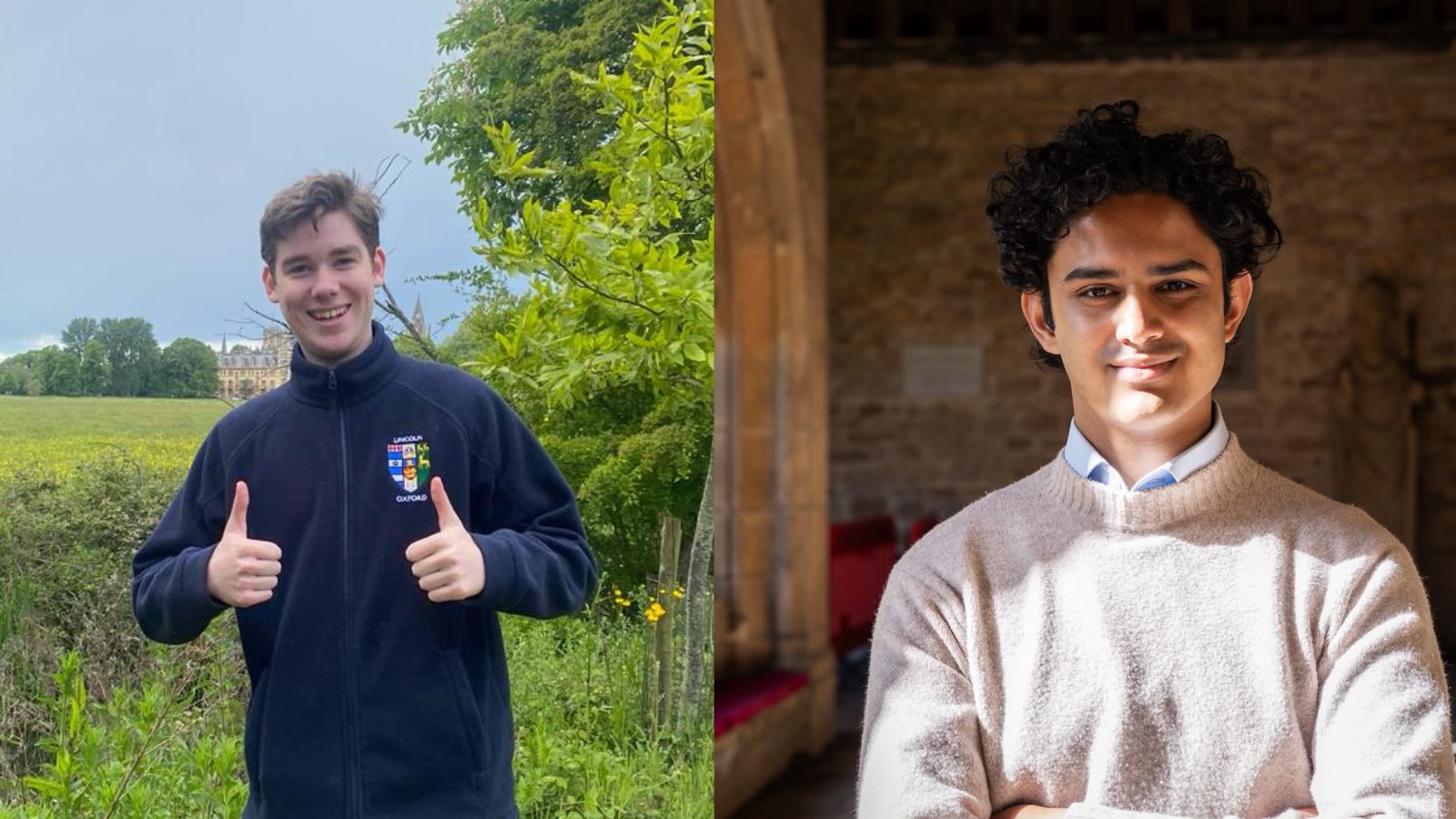
With polls set to open for Oxford Union elections tomorrow, Friday 12th June, Cherwell spoke to the candidates running to be President in Hilary Term 2027. Milo Donovan and Prajwal Pandey discussed their vision for the society, the challenges facing the Union, and how they would respond to recent controversies surrounding speaker invitations and free speech.
Introduce yourself briefly. Why are you running to be President?
Milo: Hello! I’m Milo, a second-year at Lincoln and the Society’s current Treasurer.
I’m running for President because I love the Union. I realise this is something relatively rare – most members don’t love the Union. They merely tolerate it. And I understand why. Between the hack messages, the headlines, and the sense that the best perks are reserved for people with the right friends, it’s a pretty hard place to love. I want to change that.
And I think it can be done by reversing a particular change: somewhere along the way, it stopped feeling like a debating society and started feeling like an elections society. It’s really no surprise people are alienated. The debates, the speakers, the socials, which are the things members actually joined for, became the backdrop, while the politics became the show.
I’ve spent four terms on committee, but my best memories of this place have nothing to do with Union politics: they’re the times I danced with my friends at a ball, grilled speakers at the despatch box, or stayed far too late in the bar arguing about a debate that had finished hours earlier. That’s a Union that’s easy to love, and that’s the Union I’m running to bring back.
Prajwal: Hey! I’m Prajwal, Librarian of the Oxford Union and a third year PPEist at New College.
Before Oxford, I had no extensive background in debating or public speaking. English was my second language growing up, and for a long time I felt shy and uncertain about speaking in public. The Union changed that for me. By speaking in the Chamber week after week, often in front of hundreds of people, I found a place that helped me confront those fears and develop a confidence I had not previously had the opportunity to build.
I am running for President because I want every member, whatever their background or experience, to feel that same possibility of transformation. The Union should be a place where people leave not only having heard great speakers and debates, but having gained new skills, perspectives, and experiences they could not have found anywhere else.
Which manifesto commitment are you most passionate about?
Milo: Banning hack messages.
Under the current rules, every candidate faces the same choice: spam, or lose to someone who will. I’ve sent three elections’ worth. I’m not proud of it. That’s part of why I want to change those rules.
This pledge also isn’t really one reform. It’s the thread that, when pulled, unravels most of what’s wrong here.
Right now, you don’t become President by being good at the job; you become President by assembling the largest slate, each member of which messages every friend, coursemate, and person they once met at a bar. Most people who vote for a winning candidate have never met them and couldn’t name one of their policies, they’re repaying a favour to someone further down the ballot.
But the deepest reason is what hack culture costs us with the members themselves. Ask yourself what you’ll say when your college children (or grandchildren) ask if the Union’s worth joining. For too many members, the answer is no, because their main contact with this place isn’t a great debate or a famous speaker, it’s the termly flood of messages they receive.
And underneath all of it is the simplest reason: hack culture teaches people here to treat each other as votes.
And to be clear about what the ban would actually cover: candidates could still post publicly that they’re running, publish their manifesto, and campaign in the open as loudly as you like. What goes is the private spam.
Prajwal: I am most passionate about my commitment to create an access membership fund, to allow sponsors to purchase memberships for underprivileged students. Though not a formal manifesto pledge, this is something I am already working on: I have presented the Union’s governing body with a clear plan of action and regular updates, with a view to implement this proposal by Michaelmas.
What do you like least about the Oxford Union in its current form?
Milo: The Union’s best opportunities rarely reach the members who pay for them. This place has some incredible things to offer: dinners with world-famous speakers, intimate meet-and-greets with people you grew up watching on television. Across my time on committee I’ve watched too many of them handed out as political currency instead, with dinner seats and meet and greet spots filled with the President’s allies, and members’ money spent on so-called “Presidential drinks,” a tradition whose chief beneficiaries are, by remarkable coincidence, Presidents.
When the perks are the President’s gift, the perks become politics. So take them out of the President’s hands, with random ballots for debate dinners and meet-and-greets, paper speeches for competitive debaters, and Presidential drinks abolished.
Prajwal: What I like least about the Union in its current form is how easily it gets pulled away from its purpose: too often, its energy is absorbed by internal politics, personal ambition, and public drama, rather than by debate, speakers, and the formative experiences it can offer ordinary members.
That is frustrating because I know how valuable the Union can be at its best: a place where students find their voice, test ideas, and feel that what they have to say matters. I want us to become that Union again.
What do you admire most about your opponent?
Milo: His tenacity. This Society is excellent at exhausting people, and he has conspicuously failed to be exhausted. Years of genuine work, much of it the kind nobody thanks you for. We disagree on plenty, but his commitment isn’t in question, and I’m happy to say so.
Prajwal: I admire Milo’s composure; he has always been nice to me and conducted himself with dignity.
Give an example of one debate and one speaker event you’d most like to hold in your term.
Milo: For a debate, I’d suggest: “This House Believes Our Children Will Live Worse Lives Than Our Parents’.” I like this motion because it doesn’t split left/right, it splits optimist/pessimist, which is a far rarer clash.
As for a speaker event, it has to be Zohran Mamdani. He’d fill the chamber on name alone, but that’s not the reason. His politics, agree with them or not, are about the things people actually live with: rent, transport, the cost of living. I’d like a speaker members could argue with about their own lives.
Prajwal: “This House Would Decriminalise Sex Work”.
I would also love to host Nazanin Zaghari-Ratcliffe for an individual event; her story is powerful and especially timely given current events in Iran.
The Union has recently faced significant national media scrutiny over issues ranging from allegations of antisemitism to debates over free speech and speaker invitations. What practical steps would you take as President to rebuild trust among members who feel alienated by these controversies?
Milo: Members of this Society have felt unwelcome in their own chamber, and they were not imagining it. There is no version of the Union that should have room for antisemitism, Islamophobia, or any other form of hatred. No buts, no howevers. Some things are just wrong, and a President should be able to say so.
I see no reason at all to invite speakers whose purpose is to cause harm to our members or the Oxford community more broadly. I also see no reason to pose debate motions that question people’s faith or identity.
But words from a candidate are just words. Members have read plenty of them. Trust isn’t rebuilt by what the Union says about itself. It’s rebuilt when members can watch the place being run transparently and compassionately.
To that end, I’d want to make sure that no invitation blindsides this Society again. Much of this year’s damage came from a booking made behind closed doors that the committee discovered when it leaked. I’d want any high-profile invitations to go to a committee poll before any emails are sent. If an invitation can’t get past our own committee, it was never going to serve the members. And beyond invitations, the fairness measures elsewhere in my manifesto are trust measures too.
None of this undoes what members have already experienced. But it’s the difference between asking for their trust and earning it back.
Prajwal: Rebuilding trust means changing the incentives that created these controversies, not just reacting better when they happen.
At the moment, there is often more leverage in making disputes public than resolving them properly in private. I would implement the many internal reviews into our rules and disciplinary procedures so that complaints are handled fairly and confidentially.
On speakers, I would improve the speaker approval process, consult the Access Committee before invitations are sent, and deliver on my pledge for greater transparency around invitations, so that members are properly informed before controversies arise
The invitation of speakers such as Tommy Robinson and Laurence Fox has sparked controversy across Oxford and beyond. Where do you believe the line should be drawn, if at all, between the Union’s commitment to free speech and concerns about legitimising extremist views?
Milo: The line is harm. No speakers invited to harm our members. That’s not a difficult call.
The Robinson event crossed that line, and I oppose it: a motion putting a faith up for debate, argued by a man best known for inciting hatred against the very members expected to sit through it.
And let’s be clear, the Union has heard from Tommy Robinson before. Nobody could claim his views were going unexamined or that we were discovering a suppressed perspective. Inviting him back added literally nothing to the sum of debate.
Also, free speech is not only about who stands at the despatch box. It’s about whether our members can walk into the chamber and feel welcome to speak up. An invitation that silences the room to platform the guest hasn’t expanded speech. It’s shrunk it.
Prajwal: The Union has endured because of its commitment to free speech; our platform has shaped discussions both in Oxford and beyond because of this principle. However, if we are to maintain the integrity of that tradition, we must not allow it to be reduced to provocation for its own sake. So long as our members are safe, respected, and able to challenge speakers properly, we should be willing to platform controversial figures – but only where they are rigorously held to account and where there is a productive purpose to their visit.
The Union hosts debates and events for their educational and intellectual value, not for spectacle or pure entertainment. Each debate has a limited number of guest speaker slots, so inviting someone means we are implicitly saying that their voice is worth hearing over the many others who could have spoken in their place. We must therefore platform those who can substantively contribute to debate, not simply those who generate outrage or headlines.
Any other comment you wish to share.
Milo: You’ve tolerated this place long enough. Vote for a Union you can #LOVE instead.
Prajwal: The most important consideration for every President is how they use their platform. The key question voters should be asking candidates is which speakers and issues they wish to give a platform to. I hope I have shown that I would use our platform with a clear purpose: to defend free speech, broaden who is heard in the Chamber, and ensure the Union is a force for good.
Find the candidates’ manifestos here:
Long Manifestos: https://oxford-union.org/resources/rules-regulations-and-policies/123/trinity-term-2026-manifestos-long
Short Manifestos: https://oxford-union.org/resources/rules-regulations-and-policies/122/trinity-term-2026-manifestos-short