

CW: Gun violence.
“What’s the worst thing you’ve ever done?” is the driving question of Kristoffer Borgli’s The Drama. The film centres around a couple whose otherwise perfect relationship is abruptly destabilised by the revelation of a shocking piece of information, mere days before their wedding. Simultaneously thoroughly thought-provoking, highly tense, and remarkably funny, it deals with issues of judgment and redemption, and has consequently fostered substantial debate and discussion.
It makes sense, then, that when I first heard about The Drama a few months ago, it was because my social media feed was suddenly flooded with discussion of the film’s ‘twist’, with people calling it shocking, controversial, and even problematic, although nowhere could I find exactly what this twist was. This mystery, aided by an innovative marketing campaign – most notably a wedding announcement in a real-life Boston newspaper – and the appeal of its A-list leads, had me curious and more than a little excited when I sat down to watch this film in my local cinema.
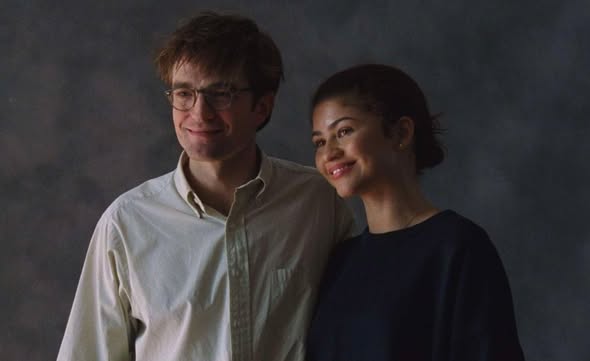
With the film labelled a romantic comedy, the opening scene certainly lives up to that. An awkward yet endearing meet-cute at a coffee shop sees Charlie (Robert Pattinson) approach Emma (Zendaya), pretending to have read the book she is engrossed in. He becomes increasingly more embarrassed as she appears to resolutely ignore him, but as it happens, she simply can’t hear him, being deaf in one ear and listening to music in the other. Once he succeeds in getting her attention, sparks begin to fly, and we’re presented with a short montage detailing the next stages of their love story. In these first few scenes, the film does an excellent job of getting you to connect with these characters in such a short space of time. You know you want to root for Charlie and Emma; yet at only the 15-minute mark, you do wonder where the story is taking them next. Where does the titular ‘drama’ come into this picture of expected marital happiness?
This is where the promised ‘twist’ comes in. Charlie and Emma are taste-testing wines while deciding on a wedding menu with their best man and maid of honour, when the four of them take it in turns to confess the worst thing they’ve ever done. The first three answers are a little disquieting, but none prompt any real moral outrage from the other characters. Finally, Emma confesses that, as a teenager, she planned and intended to carry out a school shooting. What’s more, her partial deafness stems not from birth, as she had previously claimed, but from holding a rifle too close to her ear when practising with it. The bulk of the film deals with the fallout, and indeed the drama, of this confession, finally exploding in a chaotic and messy wedding that perfectly demonstrates the aptness of the title.
For a film that grapples with morally complex ideas and centres around a particularly contentious topic, it may seem odd to point to comedy as one of its strengths. Nonetheless, what stood out most to me about The Drama was precisely its funny moments. The humour is most successful at its bleakest, one highlight being the exquisite dark comedy of an ebullient wedding photographer telling the couple – both clearly still reeling from the revelation – about the schedule for “shooting” photos. The line “shooting grandparents TBD” is hilarious in its absurdity. Likewise, the repeated anticlimax of a younger Emma trying to film a video manifesto with complete seriousness – not to mention decked out in all-black clothing and posing with her rifle – being persistently interrupted by mundane computer alerts makes for particularly comical, if also distinctly uncomfortable, viewing.
This is not to say that The Drama makes light of gun violence. Instead, it deals with relevant questions about morality in an intriguing and insightful way. It is a strikingly nuanced take on a familiar question: can people who have done bad things change? The decision to use a planned school shooting to interrogate this idea is interesting, since it is one of those acts that is often viewed in black-and-white terms. It is difficult to conceive of someone who has gone as far as to plan one out as a ‘good person’, no matter how much personal growth they have undergone since.
The film acknowledges the complexity of this issue, with Emma’s confession receiving much worse reactions than the others, despite the fact that she is the only one who has not actually carried out her ‘worst action’. Rachel (Alana Haim), for one, admits to locking a child with learning difficulties in a closet for at least a day. Regardless of which is actually morally worse, Emma’s planned act is viewed as inherently more appalling due to the greater significance school shootings have assumed, particularly in recent decades, within our moral landscape. Borgli further complicates the moral question by having Emma back out from her plan, not due to any virtuous change of heart, but simply because another shooting occurs before she can carry out her own. Her road-to-Damascus moment soon follows, yet we are given the impression that, if not for circumstances outside of her control, she would have done it, and we are forced to consider whether this is as bad as actually going through with it.
Above all, with Norwegian Borgli as director, The Drama offers a European perspective on what has come to be seen as a distinctly American problem. It is fundamental to the narrative that Charlie is English – having grown up in a country with strict gun laws, he struggles to understand Emma’s reasoning, attempting to rationalise her actions by blaming American society’s attitudes to guns, a perspective that I found myself readily able to sympathise with. At one point, Rachel scornfully asks him whether he thinks America is to blame for Emma’s planned shooting, and although he denies it, the answer the narrative gives is, at least in part, yes. This is hinted at later on in the film in a brief but unsettling moment, where Charlie off-handedly points out that there was a mass shooting the other day, simply to reassure Emma when she overhears two guests discussing shootings at the wedding. In just a few lines, Borgli is able to touch on a wider truth about American society – gun violence does occur nearly every day, to the point that it can be mentioned in such a casual manner. There is no overt pro-gun control argument in the film, and yet it makes a point of illustrating how gun violence is a problem that is not just individual but societal.
The Drama is a film defined by second chances. It opens with Emma giving Charlie the chance to re-introduce himself after a clumsy first attempt, and ends with both of them giving each other a second chance in a poignant scene reminiscent of the opening: they re-introduce themselves, signalling a fresh start, leaving both of their mistakes and wrongdoings firmly in the past. The questions raised about whether redemption is possible are answered staunchly in the affirmative by such an ending.
By no means a perfect film, The Drama is nonetheless a captivating watch that more than delivers on the promised drama, chaos, and mayhem throughout. It doesn’t always get the balance right – there are moments where the school shooting seems more a plot device than anything else – and yet its happy resolution makes a thought-provoking contribution to discussions around personal growth and morality.