

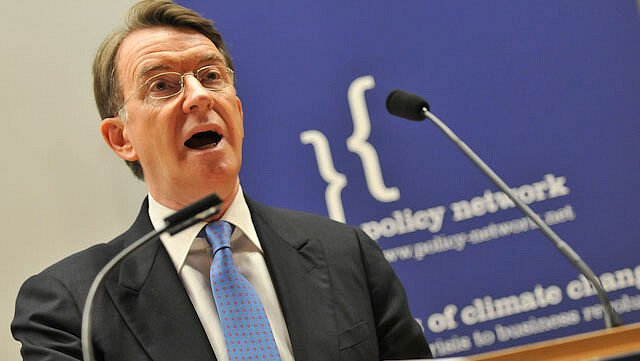
In October 2024, during the Oxford Chancellor election, one of my responsibilities as Deputy Editor of Profiles at Cherwell was to interview Peter (then Lord) Mandelson, who was among the five frontrunners contesting the election. I was due to meet him at St Catherine’s College at 2.30pm. While I was on the coach from London to Oxford, my phone rang – an unknown number – and on the other end was Mandelson. “I’m at St Catz”, he said, audibly annoyed: “Where are you?” I pointed out that he was an hour early. “No, I’m not. 1.30pm was the time I was given.” I explained that the Cherwell editors must have given me the wrong time, that I was very sorry, that it wouldn’t happen again, etc. He replied that he would try to fit in the interview at a later time.
When, eventually, I arrived at St Catherine’s College, it was an hour’s wait in the Porters’ Lodge before the great man presented himself. Even the manner of his entry was worthy of the Mandelson lore. A slick black car pulled up outside the college. It took me a moment to notice – though it might have been a trick of the light – that the peer was making the end of his nose very blunt against the car window, in an angular attempt to discover whether or not that journo from Cherwell had arrived on time. Seeing that I had, he sprang out, and we shook hands. I spent the next two hours intermittently interviewing him as he hopped between the several ceremonies and meetings which his position as an honourary fellow demanded of him. He seemed already to know what he wanted to say, which is fair enough for a politician. One tic stands out in my mind. Every time he mentioned some praiseworthy feature of his record in office, I, out of polite interest, said, “Really?”, and his tetchy response each time was to exclaim, “Yes!”, as if scandalised that anyone might be unaware of his achievements. By the end of the interview, his irritation had subsided, giving way to the famous “prince of darkness” charm which for years had sent him ricocheting back and forth between Cabinet and disgrace. He enquired whether I wanted a drink or snack. I politely refused. Then, with a suggestion that if I had any further questions, I could put them to him by phone, I left.
A week later, when the interview was published, I and the other Cherwell editors realised that it contained a serious omission. I hadn’t asked Mandelson about his connection to Jeffrey Epstein, of which I had not been aware, but which turned out, on investigation, to be well-documented. We did some research, scanned whatever was publicly available, and wrote an article on it. If the Prime Minister had read it before deciding on a new Ambassador to Washington, he would have found ample evidence on which to block Mandelson’s appointment. Among other things, it contains the smoking gun that in June 2009 Mandelson stayed at Epstein’s Manhattan townhouse, while Epstein was in prison for soliciting prostitution from a minor. That alone should have disqualified him from the Ambassadorship, from the Chancellorship, and from public life.
Given the anti-Mandelson frenzies which have erupted since the Epstein Files releases of September 2025 and February 2026, it is worth pointing out that these concerns about him went largely unraised when he was first appointed Ambassador, even though enough was already publicly known for a group of 19-year-olds to be able to compile a dossier on him. Keir Starmer and his government, like anybody else with access to Google, must have known that Mandelson had been an associate of Epstein. It did not trouble them. They celebrated the appointment of a great statesman, the genius behind New Labour and the grandson of Herbert Morrison. The apologies which have since been made are probably the result of the public outcry, not of any real remorse at having appointed him.
Very likely, members of the government or commentators in the media saw nothing wrong with making an Ambassador of the close friend of a disgusting paedophile. The President of the United States, after all, had been an even closer friend of the same man. It was taken for granted that friends of paedophiles, like war criminals, must be accepted as legitimate political players. Indeed, if the Mandelson principle were expanded, and friendship with war criminals became punishable by exclusion from public life, there would be hardly any Cabinet left. “No one can rule guiltlessly.” That must have been the rationale which led the government and the media to disregard Mandelson’s past; it must have been the rationale which led Mandelson himself to disregard his friend’s crimes while Epstein was still at large.
Mandelson, whose disgrace is now so complete that he has nothing more to do than to urinate publicly in Notting Hill, deserved shunning from public life and grilling in every interview long before the release of the latest files. The stink was already there, but not enough people noticed it.


 Mandelson.)