Thursday 11th June 2026
Blog Page 2

Circadian Renaissance

Outside, the sky is almond.

A conciseness to the air 

is brisk to touch the skin

and glaze the windowsill with morning condensation.

The honeyed sun insists,

makes the bedsheets lace

where last night’s tea glimmers like pennies in standing-water pools,

like wishing fountains

this morning’s balanced cups on white ruckled sheets.

On the desk capsized books like little roofs,

Paris on a tabletop,

and postcards pinned by the breeze to the wall.

Shirtsleeves on the chair,

sweetly billowed pirate sails,

fastened by a cool suspended poppy teardrop paperweight.

Two battered pairs of shoes

softened, baby-leather toes

and clacking soles

lined up like tin soldiers side by side

amid the padding of bare feet on tiles in yesterday’s bright evening,

body caught against the sun,

eyes made deep with light.

Sleep, strewn out like this

below the wire-frame arches and white-curtain columns

between the dust, the glass, and greenness

until the sun is orange,

for it is only summer once.

YA Thrills: Escapism and disguise

An issue that has been encountered by authors since the dawn of time, perhaps one that feels too obvious to even state, is that some readers will not enjoy their books. This can result from many issues: maybe some don’t like an author’s style of writing, or the genre they tend to write in. In these cases, readers tend to avoid those texts whilst easily acknowledging that others may enjoy them (with exceptions, of course). However, the point at which readers will not simply ignore the existence of a text they don’t like seems to be when it displays a political or social opinion that they disagree with.

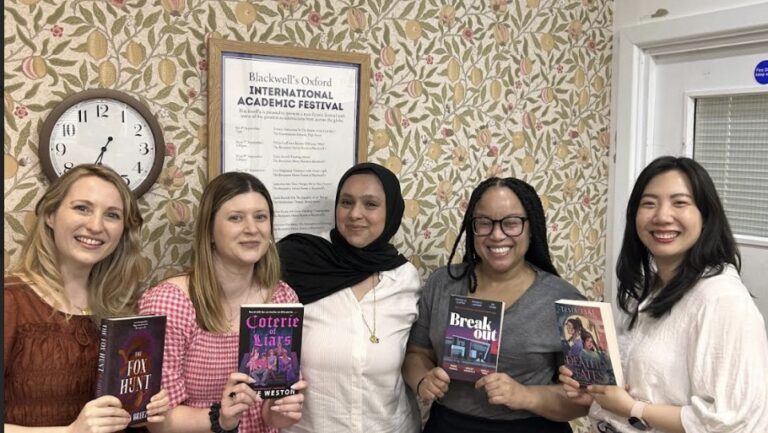
At Blackwell’s, a group of four YA authors, Tesia Tsai, Dhonielle Clayton, Caitlin Breeze, and Kate Weston, came together in a panel to discuss their novels. They talked about their inspirations, writing processes, and character development. The aspects of their discussion that most gripped me were twofold. The first was the extent to which each felt they had placed themselves into their texts, and how emotionally baring this must feel. The second is the need they felt to provide some level of removal within their books in order to avoid criticism for any commentary their books may provide on society.

The former idea is one that each writer experienced on a very individual level, as would be expected. Yet, in a way, the explanations of each made it clear that the writing process involved an inevitable soul baring. Tesia’s experience of the pandemic inspired her to write her novel Deathly Fates. When discussing her novel-writing process, she explained, “a lot of my frustrations end up being poured into my writing”. Her experience during the pandemic greatly influenced her writing process for Deathly Fates, increasing her awareness about the fragility of human life and opening up a fear of her own father passing away. This theme is clear throughout Deathly Fates, in which the main character must undertake a journey in order to save her father.

Rather than a fear of a possible and ever-nearing future, Caitlin instead discussed how her experience of the past is what inspired her to write her novel The Fox Hunt. She reflected on her time at university, noting especially the experience of women within age-old institutions like Oxford and Cambridge. Despite increasing attempts to move into the present, she discussed how entrenched in the past such ancient institutions tend to be, and the consequences for their students. As with Tesia’s fears for the future, Caitlin’s experiences of the past make themselves clearly present within her work.

Kate also talked about the extent to which emotional vulnerability went into writing her novel. She discussed her struggles with mental health, which were especially difficult during the writing process of her novel Coterie of Liars. Her struggles went into her characters, a process which is incredibly soul-baring. In a more comedic turn, she also admitted that many of her characters (those who meet less favourable ends) have been ex-boyfriends of hers. At its core, though, does this not share key elements with putting her experience with mental health into her novels? The writing process seems to be one for her which offers a kind of catharsis.

Dhonielle’s writing process was unique among these authors since she collaborated with five other people in order to write this book. Each person had one character from their novel, Breakout, which they wrote. Dhonielle describes the extent to which this writing process required incredibly careful organisation among the six of them. This careful collaboration was balanced, however, with its own soul-baring moments. Dhonielle explained how, in a strategy similar to Kate, she went through her old high school journals and picked out those she felt had most done her wrong during her childhood, and turned them into characters. As with Kate, at its surface, this appears comedic, but underneath it reveals the depth of personal experience each of these authors put into their writing.

Ultimately, the main message I took from this panel was the extent to which authors place their personal experiences, and themselves, into their work. Yet, another element of their discussion is the simultaneous removal from reality that each inserted into their texts. Tesia and Caitlin began this discussion, given that they have a more obvious removal from reality in the supernatural elements of their books. They discussed the protection this provided them in offering social or political criticism within their texts.

The fact that the society they offer within their texts is not one that exists in real life means that any complaint they receive about the comments on the state of the world their novels provide can be easily waylaid by the fact that they are not real worlds. I enquired further, with Kate and Dhonielle, whether they felt they had any parallel situation in their novels despite the fact that their novels do not contain supernatural elements. I received an answer in the affirmative, that the placement of their characters physically away from society, either on an island or in an elite party away from regular society, provides a parallel experience. Each group becomes an exaggerated microcosm of society, which cannot necessarily be seen (if the authors wish to avoid criticism) as a true reflection of society because of their intensely exaggerated nature.

These authors, then, showed me the delicate balance required within novel writing: a simultaneous baring of the soul and an attempt to hide away, to pre-provide an excuse for themselves in the case that they may receive criticism. Although this process may seem emotionally exhausting, it was clear from the words of each author that novel writing provides an escape and a catharsis which they would struggle to find in any other activity.

‘Cecil Rhodes would probably turn in his grave’: Kumi Naidoo on fossil fuels, Amnesty International, and fighting Apartheid

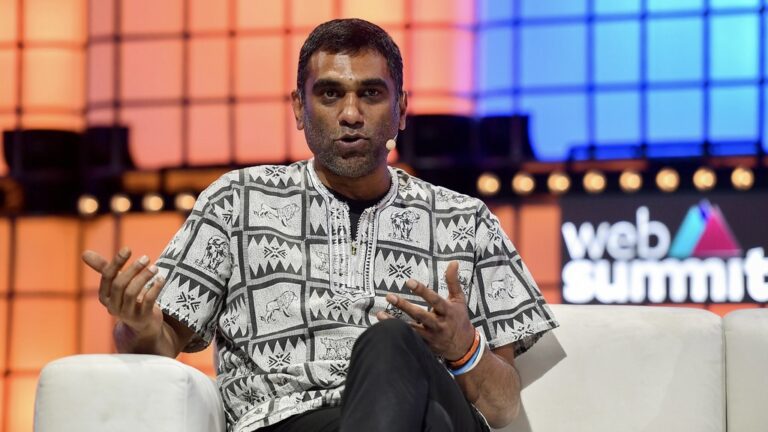
When former Rhodes scholar Kumi Naidoo reflects on his years fighting the Apartheid regime in South Africa, the first thing that comes to mind is not the peril he faced or the discrimination he suffered, but the friendships he made in the process. 

“The relationships you build up in that moment of major repression and trauma… sustain you”, he tells me. “Those of us who struggled gave up so much. But I always say to people: what we gain in terms of friendship, solidarity, a life of purpose, a life of meaning, all of these things are invaluable.” It’s a remarkable thing to say about a period of his life when he was wanted by the government.

Born in Durban in 1965, Naidoo was 15 years old when he first became a threat to the South African state after he began organising boycotts against the Apartheid system. A national student uprising had swept through the townships, driven by something simple and infuriating: the inequality in education. “One of the first slogans I heard as a 15-year-old was: ‘You pay our teachers peanuts, no wonder they give us monkey education.’”

The South African government, controlled by the white supremacist National Party during the Apartheid era, allocated vastly more to the education of white children than Black children. Teachers in the townships were underpaid and under-resourced. When students at his school in Durban stood up to say so, the state’s response was immediate and predictable. “Those of us who led the protests were expelled from school. In some funny way, that turned out to be a good thing because we were mainly being fed rote learning, memorising things. When we got expelled, we had to teach ourselves. Some progressive teachers came and helped us stay on top of our coursework.”

His mother had died by suicide that same year, as recounted in raw detail in his memoir Letters to My Mother: The Making of a Troublemaker. He had become politically aware before she died, he says, but her absence changed everything. Most of his friends who had been involved in the uprising were pulled back by their parents once things calmed down. He wasn’t. “In my case, I didn’t have the same family constraints. My mom was not there anymore to exercise caution. My relationship with my dad became strained after my mom passed. So I was able to do whatever I wanted to do. I didn’t have any restrictions on my time, on my movement, which, of course, all my friends had.”

He is quick to add that both parents had laid the groundwork for Naidoo’s activism, even if neither of them was explicitly political. His father was the informal auditor of half the community organisations in Durban, including Hindu associations, Muslim associations, and Christian churches. The headquarters for the local football and cricket associations was their home. Whenever young Kumi asked why Black children couldn’t use the same beaches or fairground rides as white children, the answer was always the same.

“Our parents would always say: ‘Oh no, no, you mustn’t ask questions like that. If you ask questions like that, you’ll end up in prison with Nelson Mandela.’” He laughs. “But I believe very strongly that my brother and I would not have contributed anything substantial to the liberation struggle were it not for the values our parents taught us.”

His mother, in particular, had given him something that transcended politics. “She said, the only religion you need is to see God in the eyes of every human being that you meet… Look for the weaknesses in yourself and the strengths in others, because maybe you can do something about the weakness in yourself, but you might not be able to do something about others.” He has carried that his entire life: “Now, as a holder of that wisdom, I take it and translate it to: ‘See God in every living thing, whether it be human beings or nature.’”

A few weeks after his mother’s death, a family friend sat him down. “My boy, I don’t know how you ever recover from something like this. But one thing I do know: however bad you’re feeling, however traumatised you’re feeling, there are people in our country, in our continent, and around the world who are in a much worse situation than you are. I would urge you not to feel sorry for yourself. Think about all that you have, and try to live your life with purpose, and work for the dignity of everybody.” The advice was transformative: “That’s basically how I’ve tried to live my life”, Naidoo says simply.

From the age of 15 to 18, while keeping on top of his coursework, Naidoo was on the run. He  co-founded Helping Hands Youth Association, his local residents’ association, and then he joined Nelson Mandela’s underground movement. He recalls how all-consuming this work became: “Your life became almost full-time activism. And then you did what little you could to just make sure you passed your exams and got into the next year.”

In December 1986, the army came to his home, looking for Naidoo. He happened to be away in Cape Town at the time – being interviewed, of all things, for a Rhodes Scholarship at Oxford University. He called home after learning he had made the shortlist. What his family told him stopped him cold. “They said: ‘Don’t come back home. The army was here last night.’” Despite being a wanted man, Naidoo was determined to continue his education. He recalls that there were police on every entrance to campus, so he disguised himself as a businessman and was driven onto campus by a white professor at whose house he had been hiding. “And so, I wrote my four exams at a sort of quote-unquote secret venue on campus.”

The Rhodes scholarship was Naidoo’s ticket out of the peril he now found himself in. At the interview, he was the only Black candidate among twelve finalists. When the only Black woman on the panel asked why so few applied, he had a direct answer: the application process itself was built for privilege. You needed a car. You needed money for petrol. You needed to travel to individual meetings with each of the nine panel members. “If you came from a working-class background, that was not something you could take for granted.”

Naidoo questioned whether it was right to take money from the endowment of Cecil John Rhodes, one of the architects of the very system that had forced him to leave South Africa. “I discussed it with my friends and comrades, and we landed on the point that, if I were to get the scholarship, Cecil John Rhodes would probably turn in his grave. And we were not going to lose any sleep from creating him discomfort.” He encourages Black students from poor backgrounds to apply to this day. “We should feel no embarrassment to access a scholarship that was the result of the exploitation of the people of southern Africa, especially if you’re going to use those skills for advancing the interests of the people, rather than just for the advancement of your self-interest.”

Arriving at Oxford to undertake a PhD in Political Sociology was a complete culture shock.  The level of political consciousness was not what Naidoo had hoped it would be: “What I found difficult was the level of privilege at Oxford, and the kinds of assumptions that came with it.” But the hardest thing was the separation from his home. “My body was in Oxford. But my heart and soul were still in South Africa because my friends were being thrown in prison, being murdered. All the time while I was in Oxford.”

There is one story he tells that captures the dissonance perfectly. In South Africa, International Workers’ Day on 1st May is a significant, serious occasion: a day to remember the struggle of the working class. When he arrived at Oxford and heard students talking excitedly about May Day, he thought he had found his people.“I thought: ‘Oh, there’s hope, everybody’s concerned about the workers.’” A grin. “Only to discover that May Day was a unique Oxford festival. A pagan festival.”

Naidoo left Oxford before finishing his PhD in 1990, when the African National Congress (ANC) was unbanned, and negotiations about the end of Apartheid began. “Coming back was very easy. I was desperate to be back home to help. Especially after Mandela was released and all the liberation movements were legalised. There was a big kind of excitement: ‘Hey, let’s go home and contribute.’”

In 1994, when the first universal suffrage elections were held, Naidoo found himself thrust into the role of Director of Training for the Independent Electoral Commission, responsible for preparing thousands of electoral staff nationwide. “I’d never run a massive national election before. Neither had I even voted in an election. And suddenly I end up as director for training.”

The challenges were immense. Ballot papers didn’t reach remote rural areas on time. Results were delayed. There was public contestation about the count. At points, Naidoo was the person on television explaining the delays. But it was also joyous: “It was special being part of a very important historic process. To see the long lines, the patience that people had to go and vote. After almost two decades of struggle, to see democracy finally be born in South Africa, that was quite a special experience.”

He returned to Oxford in 1995 to finish the DPhil he had started in 1987. He is cheerfully unashamed about the timeline: “My biggest academic achievement: I took the longest to ever complete a PhD at Oxford. I started in 1987 and graduated in 2000.” He pauses, laughing. “Most people, if it takes that long, they give up.”

After Apartheid came to an end with the victory of the ANC in the 1994 elections, Naidoo would eventually find himself engaged in a new struggle: climate justice. He had spent a decade leading CIVICUS, a global alliance of civil society organisations, when Greenpeace came calling. His first instinct was to redirect them. “I basically said to them: ‘Hey, I know some good environmentalists.’” 

When they persisted and asked him to meet, he agreed reluctantly. Then his daughter found out. “She said: ‘Dad, I won’t talk to you if you don’t seriously consider this Greenpeace position. Because Greenpeace is fighting for my future, and you need to do much more on climate change.’” He smiles. “I always attribute my embracing of environmental justice to the encouragement I got from my daughter.”

He brought to Greenpeace a critique that has come to define the rest of his career: “One of the biggest mistakes we made was that Western environmentalism framed climate change as an environmental issue, whereas climate change is a result of our economic system, our energy system, our food system, our transport system. To treat any of these issues in three different silos is exactly wrong.

“If you are a person of colour in the global North, most likely you’re living near a polluting facility. If you are white, you’re probably not facing the same challenges to air quality. Not only does linking these issues not dilute the environmental message, it actually makes climate justice much more real, pertinent, and brings it home to ordinary people. If you talk about climate only in degrees and parts per million, and you don’t connect it to air quality, to jobs, to local community, you will never move the large numbers of people you need to move.”

In June 2011, he spent four days in a Greenlandic prison after occupying a Gazprom oil platform in the Arctic. The drilling resumed soon after. He does not pretend otherwise. “Social change rarely happens in a straight line. Most actions do not achieve their immediate objective overnight. The anti-Apartheid struggle certainly did not.” What matters, he says, is cumulative pressure. “Sometimes the impact of an action is not measured in days or weeks but in whether it helps move society closer to a tipping point for change.”

The road has been bumpy. In 2015, he resigned from Greenpeace, a year after it emerged that a staffer had lost £3 million in donor funds on the foreign exchange market. His tenure as Secretary-General of Amnesty International was short-lived: he resigned, citing ill-health in 2019, not long after allegations of a toxic workplace culture, highlighted by a researcher’s suicide, led staff to petition for his removal. He speaks about both with the same equanimity he brings to everything. “When I was headhunted for both the Amnesty International and Greenpeace leadership roles, one of the key reasons I was approached was the recognition that both institutions were structurally racist and did not reflect the realities of the world as it actually is. A key part of my mandate was therefore to help rebalance power within these organisations.”

Transformation, he notes, creates losers as well as winners. “When institutions begin to shift power from Global North to Global South, some people inevitably lose privileged positions, influence, and status.” He does not say this unkindly. “But it becomes deeply problematic when organisations like Greenpeace and Amnesty call on the world to act urgently and justly, while failing to look anything like the 88% of the world’s population that lives in the Global South.”

So, is there a difference between being a great activist and being a great organisational leader? “They are definitely not the same thing. Activism often rewards disruption, urgency, moral clarity, challenging institutions from the outside. Organisational leadership requires patience, coalition-building, administration, compromise, sustaining complex systems over time. Some people are exceptional activists but not effective institutional leaders. Others are strong managers but struggle to inspire movements. I tried throughout my life to bridge those worlds, sometimes successfully and sometimes imperfectly. Ultimately, others will judge how well I did.”

He has also engaged with the World Economic Forum in Davos while publicly criticising it, a contradiction some find hard to swallow. He doesn’t. “I believe we must be able to engage critically without becoming captured. My criticism of Davos has always been that too many powerful actors speak about justice and sustainability while continuing to benefit from systems that produce inequality and ecological destruction. But refusing to enter those spaces at all can also become a form of self-isolation. If we only speak to people who already agree with us, we limit our ability to influence outcomes.”

His current focus is the Fossil Fuel Non-Proliferation Treaty, which he now leads as President of the initiative. The logic, he says, is simple: “Imagine one day you’re rushing off to school, and when you come back, you notice there’s water seeping out of the bathroom. You open the door and realise you left the tap on. What do you do first? Do you turn off the tap, or do you start mopping the floor?” He lets that sit. “For 30 years, we’ve been mopping the floor. 86% of what drives climate change is our dependency on oil, coal, and gas. Unless we address the root cause, which is fossil fuels, we’re not actually addressing the climate struggle at all.”

The model is the 1997 landmine ban treaty: a coalition of ambitious countries negotiates outside the UN system, brings it to the General Assembly, and forces a vote. “By the time that happens, there will be very few countries putting up their hands saying: ‘Oh yes, we want fossil fuels, just as nobody put up their hands saying we want landmines.’”

He is not naive about the opposition. “The lobbying capability of the fossil fuel industry is not to be underestimated at all. They’ve got marketing and communications resources on a scale that you can only dream about.” But the public understanding has shifted, and that, he believes, is harder to reverse than a lobbying victory. “I don’t think it’s going to be as easy for them as they might be thinking because more and more people understand that the root cause of climate change is our dependence on oil and gas.”

Naidoo is 61 now. A member of the University of Oxford’s Equality and Diversity Unit and an honorary fellow of Magdalen College, he remains very much a part of the city that provided him sanctuary from the repression of Apartheid. The boy who dressed as a businessman to sit his university exams while the police searched for him has lived, by any measure, several full lives. The professor who drove him through those campus gates is part of a long chain of people who took a risk for him, and for whom he has, in turn, taken risks. “It’s much better to try and fail”, he says, repeating one of his mother’s wisdoms, “than to fail to try”.


A new kid on the matcha block: NEPA Coffee and Food review

0

Any international student (or performative male) will know that it can be surprisingly hard to source a good matcha latte in Oxford. In January 2025, Cherwell provided some guidance on this issue by offering the student body a definitive ranking of Oxford matcha. Since then, however, there have been some new developments. NEPA café opened its doors on St Clement’s Street last year, and recently opened a new location on Cowley Road too. Having heard reports that their matcha gave all other cafés a run for their money, I decided to venture to both locations to find out. 

My outlook when seeking out new matcha is often pessimistic. Too many times I have spent upwards of £6 only to be given a large cup of green milk. So, when I walked through the doors of NEPA on St Clement’s Street, I tried not to get my hopes up. Still, my friend’s raving made it hard not to. To start, my fears were abated by the bright, clean atmosphere, and the hospitality of the staff. However, the tables were slightly too small, and the size of the café was limited. My friend and I were welcomed by low-volume pop music, which provided a nice atmosphere without being intrusive to those working. After we seated ourselves, it was time for the moment of truth – the matcha tasting. 

As a starting point, I ordered an iced matcha latte with soy milk (my preferred milk alternative for matcha). As I saw the barista hand-whisking the bright green powder, even my most cynical thoughts quieted down. I was certain that I was in for a good beverage – and I was right. The tea was pleasantly strong, with a very prominent matcha flavour from the first sip. It provided the perfect balance of earthiness, bitterness, and astringency for my taste, and it was nicely mellowed out by the milk. And since I appreciate that the drink comes unsweetened, my focus was on the flavour of the tea. Crucially, it was bright green and did not taste watered down at any point. Although the prices are far from cheap (£4.50 for a normal matcha latte, £5.10 with soy milk), the size and flavour of the drink did make up for it. 

I was pleasantly surprised to find that NEPA not only had a standard matcha latte on offer, but a fairly extensive summer menu, which includes strawberry, lychee, and mango matcha lattes. I must admit that, since my first trip, my friends and I have managed to cover all of the flavours on offer. NEPA’s summer matcha menu steals the show in my opinion and offers some of the best fruit-based matchas I have ever tried. Previously, I hadn’t ever tried a lychee matcha, and I was pleased to find that the syrup in NEPA’s version was not too sweet, as some lychee-based drinks tend to be. I thought that the slightly floral flavour of the fruit provided a nice contrast with the earthy matcha, and formed a unique flavour that I had never experienced before. The mango matcha, which included a mango purée rather than a syrup, tasted sweet and fresh, with the richness of the mango flavour pairing well with the notes of the matcha. However, my favourite always has and always will be the strawberry matcha latte. The perfect pink swirl paired with bright green makes for a beautiful beverage, with a purée that makes the latte taste like fresh strawberries rather than jam. For me, this was a near-perfect execution of a strawberry matcha latte. 

A few days after my first visit, I ventured to the NEPA on Cowley Road to see if there were any significant differences between locations. There, I found a much larger space with a few outdoor tables. While the size of the St Clement’s location occasionally risks feeling cramped, in the Cowley location, I had ample room to find seating and to set up my work. I perched on one of the stools facing Cowley Road, which offered me the perfect opportunity to people-watch in between readings. I was disappointed to find that the summer menu was unavailable on the day that I went, but the plain matcha latte I got was characteristically delicious. Where the St Clement’s location was perfect for a quick stop before a walk, or for a chat with a friend, the Cowley location was the ideal afternoon study spot. Combining a lovely setting with delicious tea, NEPA truly was the perfect cure to my previous matcha blues. 

A class of their own

0

There’s no denying that life at Oxford is filled with moments which would not exactly be considered normal to those outside of the Oxford bubble. Matriculation, sub fusc, bops – life here is permeated with language which, to those who are not familiar with the intricacies of this world, is slightly alien at best, and completely undecipherable at worst. I can completely understand how this exclusionary rhetoric feeds into the ideas of ‘poshness’ held by onlookers, but is this conception merely a myth, or does it still hold some weight?

I distinctly remember arriving at St Catherine’s College for the first time, anxious with anticipation about whether the people I would spend the next four years with would fulfil what I considered to be the Oxford stereotype: posh, introverted, and far more familiar with the library than the college bar. I also cannot help but remember the words “what school did you go to?” making their way into the very first conversation I had. Coming from a school where getting into Oxford was about as normal or attainable as going to Hogwarts, I was all too aware that my input to this conversation would hold absolutely no relevance to those coming from the network of private education. 

Fortunately, I’m now three years down the line, and my time at Oxford has proven to me that my initial conceptions and experiences could not be further from my reality. I consider myself very lucky to be surrounded by people who are all from completely different backgrounds, and I feel as though each one of the people I hold closest to me has added something uniquely valuable to my university experience. Of course, there are the occasional moments of eye-rolling amongst us when an out-of-touch comment is made, and there are invariably topics of discussion that we cannot all relate to, but it is important to remember that this is not a phenomenon which is exclusive to Oxford. 

I am also acutely aware, and eternally grateful, that Catz, renowned for its more laid-back and friendly atmosphere, is perhaps one of the least susceptible colleges to distinctions of ‘poshness’ which have the potential to create divides between groups of students. Having said this, part of me cannot help but wonder if this has less to do with the atmosphere of inclusivity that the college is proud of having fostered, or whether it rather plays into the desire of Oxford students to sometimes pretend as though there is not a class divide within the University. When such divides are not acknowledged, I feel as though this feigned ignorance has the power to become something more threatening to relationships. The desire (or even pressure) to blend in with peers is not something inherently strange, yet the quiet deceptions which underscore this desire to fit into a set mould have the potential to create much bigger problems than those which could arise from acknowledging our respective privileges and differences. A more diverse student body is something that many of us still chase, so why do we persist in trying to fulfil conventions of a set Oxford type? 

Although the people at Oxford may not inherently be any further from ‘normal’ than those at any other university (after all, normality is subjective), some of the institutional practices here are markedly more bizarre. After all, what other university precedes dinner with Latin chants? Or not only allows, but celebrates, three-way college relationships which result in having kids just a year later? Trying to explain Oxford’s traditions to people who exist outside our bubble does draw attention to the bizarreness of life here, and I, for one, can certainly see how all the University’s little quirks can be interpreted as ‘posh’ to onlookers. Even our sports socials – a decidedly common university affair – comprise games that get some looks when shared with friends from other universities. We can, of course, dismiss these as silly little differences of language or culture, but to those who aren’t privy to life at Oxford, these traditions can make the University seem worlds away from real life.  

However, it is perhaps in the subtleties of Oxford life where class differences become most apparent. The distinction of ‘poshness’ is one which, to me, exists not just between Oxford and the rest of the world, but also within the University itself. Existing at Oxford can be expensive, and class divides can manifest themselves in ways which may not be apparently obvious. Onlookers understandably perceive Oxford’s balls and events as a ‘posh’ affair, but it’s important to remember that this is a feeling which doesn’t cease to ring true on a university level. Differences in class manifest themselves in the very fact that some students are able to attend several balls a year, whilst others never experience one due to financial constraints. An Oxford Union membership was framed to me in freshers’ week as integral to the true Oxford experience, and now I know that this could not be further from the truth. 

It’s no surprise that a world in which the significance of certain costs is overlooked, one with prevalent sentiments of “you’ll only be here once” or “it’s the experience of a lifetime”, can give rise to the impression that its students are by default ‘posh’ and part of a privileged elite. However, the longer I spend in Oxford, the more I both notice the tendency of this sentiment being used to justify many of Oxford’s traditions, and yet understand that it cannot be generalised to the entire University population. It’s easy to forget that Oxford is full of people who live a very average life outside of the University when most of what is published online draws attention to the intricacies that differentiate it from the outside world.

In truth, after spending a year away from Oxford on my year abroad, I have grown to miss its quirks – quirks which may translate as ‘poshness’ to onlookers, but do undoubtedly form part of what makes life at Oxford so special. After all, where else can you wake up at 5am to hear choral singing from Magdalen tower, get your work brutally scrutinised by some of the world’s leading academics, punt down a river, and dance the night away in a black-tie ball, all within the same 24 hours?

The cocktail that will take you into your overdraft: The Alchemist reviewed

0


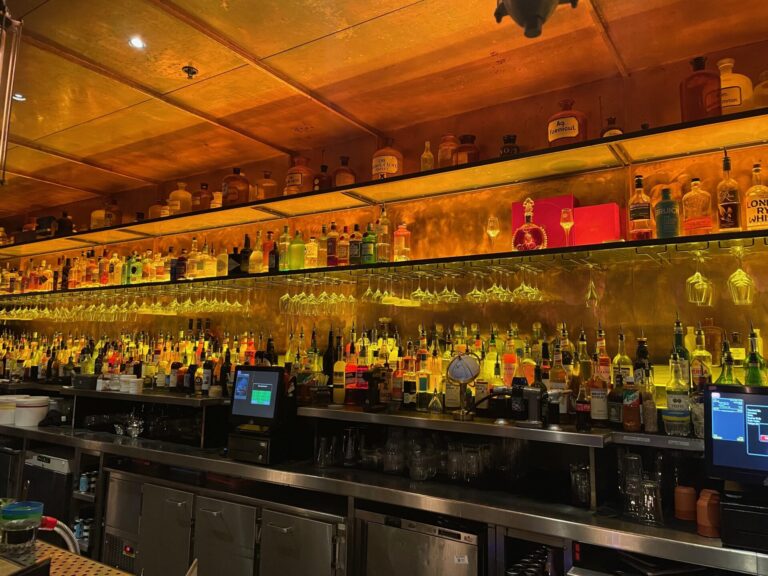
Venturing to the third floor of Westgate does slightly feel like you’ve left the real world behind. But making eye contact with the card machine as you pay for your cocktail at The Alchemist will bring you right back down to earth. Is it a fun night out with friends? Or has the price of cocktails made this kind of evening completely untenable, for students at least? 

Part of the fun of The Alchemist is the presentation of the drinks: there is an eye symbol on the menu informing you which drinks are presented with dry ice. Whether you feel like the drinks are worth the money, then, depends entirely on where you fall on the spectrum between whimsy and cynicism. Maybe I was caught on a bad night, but I found myself firmly in the latter camp. The irony is, if I were more drunk, then I would have been much more amenable to the spectacle of the drink presentation, but at £13.50 a pop, I was too sober to forget how much each bedazzled sip was costing me. 

Some of the highlights of the menu include drinks served in hip flasks, test tubes, tea cups, lightbulbs, and tobacco pipes. There’s also a section for shareable drinks, including something called the ‘Infinity Vortex’, which resembles a Rob Roy or Manhattan, and which will set you back £22. There’s also ‘The Globe’, which dares you to “share a pour that orbits the moon. Romance in perfect balance”, and offers a twist on a Cosmopolitan. Is the twist simply that it comes in a globe? Mostly, yes.  

I tried two cocktails and a ‘spice bag’. The first was a French Kiss, which was presented in a traditional cocktail glass, and contained vodka, berry liqueur, raspberry, pineapple, cranberry, and citrus juices, as well as popping candy, and a meringue topping. The flavours were simultaneously fruity and fresh, yet violently sweet. But its pink colour and meringue dome did provide it with a touch of whimsy, and it made the perfect accompaniment to a girly night out. 

Next, I tried the J2Woah. The picture next to it on the menu appeared to depict a beer bottle with a shooting star inside, but I didn’t quite get the theatricality that the menu promised. The bartender called out for a J2Woah, and I was fairly disappointed that the alchemy in question involved pulling out a bottle of pre-made cocktail from the fridge and plonking some cubes of dry ice into the top. It tasted good, but if the menu promises Ketel One citroen vodka, Cointreau, passionfruit, orange, wine, citrus, and golden shimmer, then I’d guess that you could approximate the experience by necking one third of a J2O and filling the bottle up with vodka. 

Now it’s time to be cynical about their chips. There’s just something about the words ‘spice bag’ and the number 10.50 following a pound sign that doesn’t sit right with me. The spice bag originated in Dublin twenty years ago as a late-night favourite at a Chinese takeaway. At an upscale bar, paying approximately 50p per chip (spice sachet would be more accurate), it just feels a little bit like you’re cosplaying a night out, but for twice the price – Hunger Games Capitol style. Admittedly, we were complicit in this gentrification since we ordered the truffle fries with halloumi, and I’ll confess they were very good. But I think I’d prefer to pay fine-dining prices for finer things. 

Overall, I’ve definitely had worse and less financially sensible nights out. £30 is about as much as I would pay in a restaurant, so if you’re looking for something slightly different to do with your friends or partner, then I wouldn’t necessarily rule it out. It’s definitely a good place to suggest if you’re confident that you’re not going to be footing the bill. 

If you can forget for a minute how easy it would be to replicate the experience at home by consuming a VK out of some kind of random object and then going to get a box of chips, then the experience is admittedly quite fun. The Alchemist’s menu reads like the colourful horoscope section of a tween magazine, and definitely makes for a more enjoyable deliberation experience than usual. The atmosphere was undeniable, though loud, and the view over Oxford in the summer sunset is quietly breathtaking. I wouldn’t even rule out going back myself, since my friend regrets not trying the drink that comes in a bong, and I concede that I would quite like to take a shot out of a conch shell. 

The death of the male novelist or the birth of the feminist?

A trend has emerged in recent years which centres on a worry that male authors are being decreasingly published and read, whilst women have begun to dominate the industry. This trend links closely with the controversial intention of Jude Cook to launch Conduit Books, which would aim, at least initially, to publish solely books written by men. This trend, in calling itself “the death of the male novelist”, perhaps exaggerates the situation at hand by implying the total loss of male authors. How much truth is there to this trend?

In reality, the situation is not so dire as that. When looking closer, it turns out that almost every article written on this topic refers to a single study completed by Joel Waldfogel, an economist, in 2025. Whilst a comprehensive, 42-page study, it does not take a genius to know that, for a reliable conclusion to be drawn, ideally, more than one source of proof should be drawn on. In addition, the World Economic Forum reports that “Waldfogel determined female and male authorship by first name, which risked misclassifying some authors”. It is notable, too, that while many articles cite Waldfogel’s study as proof that women so harshly outnumber men in the publishing industry, they never appear to give actual statistics, and this is telling when looking at the results yielded from his study.

He breaks book sales down by sector, and compares the percentage of books authored by women in that sector to the number of sales of the same books. In only two sectors do women outperform men in terms of authorship: romance, where women produce 78.3% of the work, and “Cookbooks, Food & Wine”, where women produce 51.4%. The latter is close enough to half that the split is essentially even, meaning that there is only one sector in which women author a significantly increased number of books compared to men. 

The belief that women take up more space in society than they actually do is an idea that has risen in recent decades, perhaps due to the increasingly visible presence of the feminist movement. Some may see this as a threat to the current state of society and lash out against women’s representation in every sector. Despite this, women’s texts produce over half of the sales in ten of the 41 total categories. Perhaps, then, the answer lies not in the authors themselves but in the publishers and purchasers of books.

Although there is a more equal weighting between male and female authors than is often assumed, many statistics make it clear that women comprise the majority of both publishing staff and readers. In 2019, women made up 78% of publishing staff (although this number drops in more senior roles) and, in 2024, 65% of women read fiction compared to 35% of men. Perhaps it makes sense that more published texts are by women, given that it is a female-dominated industry in the sense of both the workers and the consumers. 

However, it is easy to pick holes in this argument. For one, it has been shown that, whilst women read books equally by men and women, men tend to read books written by men. If the majority of readers are women, and women tend to read books by men and women equally, then the fact that there is an approximately equal number is a good reflection of the population’s reading habits. 

There is also something to be said for the importance of men’s representation within texts. Perhaps the sales of texts by women are elevated despite not making up a ridiculous proportion of the total because men are lacking in healthy representation within texts. Although diversity is important within reading, it is also important for everyone to read texts which represent their own situation, to feel seen. Men are able to find far more representation in past texts than women are, but this cannot be used as a blanket statement. Identity is intersectional, and men who are part of marginalised groups would be hard-pressed to find literature that represents them. Even people who would find their demographic in the old-fashioned canon would likely not feel represented by it: a man living in the 21st century would likely not relate to the experiences of men in a Dickens novel, for example.

Men’s representation in modern novels is important, but there is some doubt as to whether this representation is waning. Although it is taken as such, Waldfogel’s study does not seem to imply the death of the male novelist, and neither does some research into winners of major literary prizes over the last half-century. The Booker Prize and the Pulitzer Prize for Fiction, for example, both list their historical winners going back decades. These lists reveal that perhaps it is not so new a concept that women and men be on equal grounds regarding publishing and literary prizes. 

In 1970, three men and three women were on the shortlist for the Booker Prize, and Bernice Rubens, a woman, won the prize. There are plenty of other examples of women being nominated with more equal weighting to men than is often assumed throughout the histories of these prizes, in similar ratios to those seen today. Whilst men have often dominated nominations, perhaps the extent to which they have done so is less than is often assumed. 

Perhaps changes to the publishing industry are not borne of genuinely overwhelming shifts in gender splits, but instead in the eye of the beholder. In recent years, feminism as a movement has become increasingly vocal and proud in the Western world. Women have been present in the publishing industry and in literary prize lists for decades, yet it is only now that feminism – in particular, the visibility of women in the arts sector – is making its voice increasingly heard that society has begun to worry that the male novelist is a dying species. 

This is not an isolated situation, and is mirrored in other areas of society. People are afraid of the increasing gender quotas which aim to make gender divides within companies narrower. The FTSE Women Leaders Review shows that women are still underrepresented within companies at 43%, yet fears abound about whether gender quotas are damaging the quality of the workplace. The anxiety that women are gaining power within the world is not specific to books, and has risen along with the visibility of feminism in the last few decades.

Perhaps people have an issue not with women’s fiction being published in large quantities, but more with the way it cyclically supports and is supported by the vocality and power of the feminist movement. This backlash against progressive movements has always existed, and often involves strong responses to a fear of forward movement within society. The idea that male novelists are a dying breed is not founded in truth, but in anxiety over women gaining equal voices to men. The death of the male novelist as a concept exaggerated by the dramaticisms of its name, which fails to stand up under investigation.

I will not be misquoted into silence 

0

This is not the first time I have been through this. Nor, I suspect, will it be the last.

It is something that so many others have been through, and so many more will go through. 

Over the past two years, I have watched a familiar cycle unfold around almost anyone who is outspoken on Palestine. First comes political disagreement. Then comes insinuation. Then comes the attempt to transform lawful political expression into evidence of extremism. I have experienced each stage personally. The details change; the pattern does not. 

What has always struck me is how little scrutiny these claims themselves receive. Basic journalistic standards that would ordinarily apply to almost any other subject seem strangely absent when the subject is Palestine. At one stage, I was asked to respond to allegations concerning a Hamas militant I had never met and to whom I am not related, apparently because we share a common surname.

The most recent chapter follows the same script. It concerns private messages I sent in a student politics group chat more than nine months ago, before I even ran for the Presidency.

The headline that attracted the most attention claims that I said Hamas would be “lauded as heroes.” I did not. The statement referenced was part of a broader discussion about how armed movements have been treated throughout history. My observation was that organisations designated as terrorist groups are sometimes later accepted as political actors following negotiations, peace agreements, or independence movements. Nelson Mandela appeared on the United States terror watch lists until 2008. Yasser Arafat was designated a terrorist and subsequently received the Nobel Peace Prize. One may agree or disagree with that observation, and yet the historical context was conveniently ignored for the sake of stoking controversy.

The same applies to comments I made regarding October 7th. It has been reported that I described the attacks as “proportional.” What is far less frequently reported is that I explicitly stated that “proportional” does not mean “right”. I was not making a legal argument. I was not endorsing violence. I was making a sociological observation: that the severity of resistance is often linked to the severity of the conditions that produce it. To argue that decades of occupation, blockade, dispossession, and military violence form part of the explanation for an event is not the same as arguing that the event was justified. 

The blatant misrepresentation of my words by those in the national press who are responsible for reporting truthfully shows a clear lack of journalistic integrity. 

Explanation and endorsement are not synonyms. Yet when Palestinians speak publicly, they are often treated as though they are. 

The result is a standard under which Palestinians are permitted to speak only if they preemptively defend themselves against interpretations they never intended. I have no interest in doing that.

If there are criticisms to be made of my record as President, make them. If there are disagreements about decisions I have taken, events I have hosted, or positions I have advanced, let us debate them openly. But let us debate what was actually said, not a version reconstructed for outrage and for anger.

What I have learned throughout this process is that these campaigns rarely come from a position of confidence. If there were compelling arguments against what I actually believe, there would be little need for distortion, selective quotation, or guilt by association.

The irony is that the very existence of these attacks reflects something positive. Palestinian voices are increasingly present in spaces from which they were historically absent. Conversations that were once considered impossible are now taking place openly. That does not mean everyone agrees. Nor should they. But it does mean that representation matters.

This was never really about one article, one headline, or one election. It is about whether Palestinians can participate in public life as political actors in our own right, rather than as subjects of endless suspicion.

We can. 

And I have no intention of being misquoted into silence.

Oxford City Council announces new cabinet for 2026/27

0

Oxford City Council leader Susan Brown has announced her new cabinet for the 2026/2027 year. Brown, who also leads the Labour group on the Council, has appointed seven Labour councillors to the cabinet following local elections on 7th May in which Labour lost its overall majority but remained the largest party on the Council. The 7th May elections saw Labour win 20 seats, whilst the Green Party made significant gains to secure 13 seats.

The councillor roles cover a range of issues, ranging from housing and environmental health, to anti-social behaviour and leisure. The cabinet has announced that it will focus on local neighbourhood measures as well as building new affordable housing in the city. 

Councillor Linda Smith, Cabinet Member for Housing, told Cherwell that the Council will “support the development of purpose-built student accommodation” and that “growth in student numbers should be matched by growth in university-provided accommodation”. The Councillor referred to the Council’s recent approval of Mansfield College’s proposal for a new 174-student accommodation building as an example of such action. Councillor 

Smith also told Cherwell that the Council will be “protecting student renters and driving up standards in the private rented sector … Through inspections, enforcement action, civil penalties, and prosecutions”.

The cabinet has also pledged to explore extending Oxford’s Living Wage, currently set at £14.06 an hour. The wage represents 95% of London’s, yet the rising cost of living has forced a reevaluation by the Council to ensure residents of Oxford can continue to afford living in central parts of the city. The policy may affect students who stay in the city for work during vacations. 

The new cabinet takes office amid growing debate over the relationship between the council and the University of Oxford’s expansion plans. In April, the Council rejected an application by Regent’s Park College to convert the Oxfam Bookshop on St Giles’ Street into its Middle Common Room. However, plans for a new Oxford graduate college in Headington have also recently been approved.

Councillor Susan Brown told Cherwell: “Our Local Plan aims to balance [Oxford’s history and sustainable development] and makes it clear that all new developments must respect Oxford’s heritage … and contribute positively to the city’s character and identity.”

The 2026/27 cabinet also has the challenge of managing the changing organisation of the Oxford City Council. Oxfordshire’s existing Council will be replaced with a unitary structure in 2028, with the six existing councils expected to be abolished on 1st April 2028. In 2027, Oxford will begin preparing for this transition by establishing a shadow unitary council. In spite of these changes, the Council insisted to Cherwell upon the importance of continuing to fulfil its goals as the last Council to exist in the current form. 

Prime Minister of Sri Lanka delivers annual lecture at Oxford School of Global and Area Studies

0

Prime Minister of Sri Lanka, Dr Harini Amarasuriya, delivered the Oxford School of Global and Area Studies (OGSA) Annual Lecture at St. Antony’s College on 19th May.

The lecture, titled “The politics of development: Sri Lanka and beyond”, covered topics ranging from gender equality and women’s participation in politics, the Sri Lankan garment industry, and political reform. Amarasuriya, who was appointed Prime Minister on 24th September 2024, is the third woman in Sri Lanka to hold the title. She received her PhD in Social Anthropology from the University of Edinburgh and previously worked as a social anthropologist studying political dissent movements in Sri Lanka in the 20th century.

An OGSA spokesperson told Cherwell: “[Dr Amarasuriya] is an academic who entered into politics and could offer an interesting reflection on that transition … her government constituted a break with the past in Sri Lanka and had to contend with the difficulties of promoting social and political change.” 

Professor Diego Sanchez-Ancochea, Head of Department at OGSA, said in the press release that Dr Amasuriya’s lecture “offered an important and timely reflection on the relationship between politics and development, drawing on both scholarly insight and direct political experience”.

Last February, the Oxford Union cancelled a talk by Sri Lankan MP Namal Rajapaksa, the eldest son of the former President and former Prime Minister Mahinda Rajapaksa. The move followed dissent from Tamil student activists, referencing the Sri Lankan civil war, which ended in 2009. Mahinda Rajapaksa faced accusations of war crimes and crimes against humanity from human rights organisations and the United Nations.

Popular demonstrations (the ‘Aragalaya’)  in 2022 “denounced the corruption and the incompetence … of the Rajapaksa clan which had dominated since 2006.” Amasuriya, a member of Sri Lanka’s popular socialist National People’s Power (NPP) party, is considered a more progressive successor to Rajapaksa.

However, Amarasuriya’s government has continued a longstanding Sri Lankan policy of rejecting international investigations into war crimes committed against Tamils. An October 2025 article from the Tamil Guardian noted that her administration would instead pursue, what she described as, a “homegrown process” to address human rights concerns.

Amasuriya’s lecture was part of a wider visit to the United Kingdom, during which she held policy discussions with UK Foreign Secretary Yvette Cooper on the Sri Lankan government’s “commitment to human rights, reconciliation, and the country’s positive growth trajectory”. She also met with the Secretary of State for Education, Bridget Phillipson, and the Secretary General of the Commonwealth of Nations, Shirley Ayorkor Botchwey.