

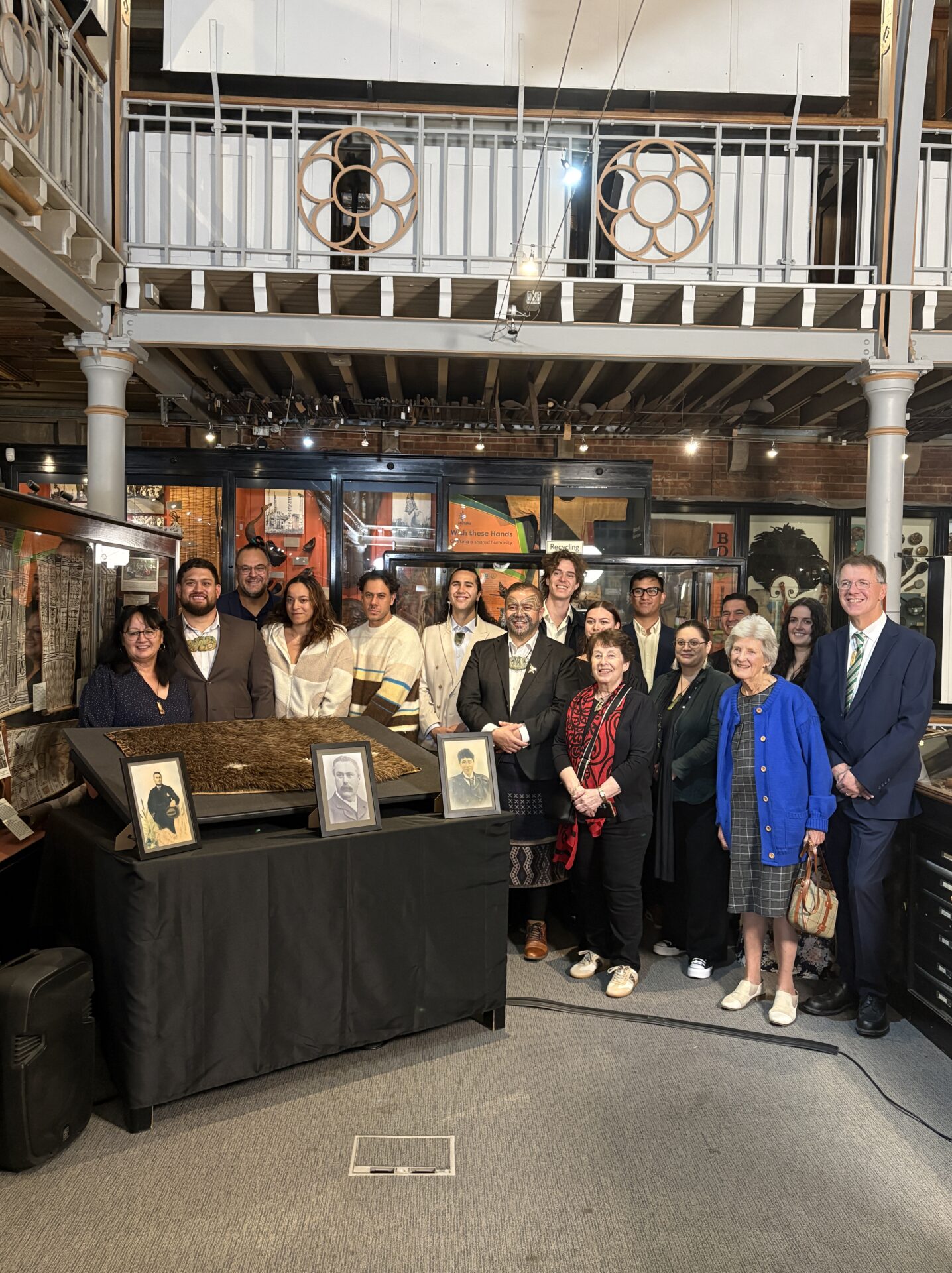
The Pitt Rivers Museum, with assistance from The Homebound Project, has returned a kahu kiwi to its Māori community in Aotearoa New Zealand after more than 100 years on loan to the museum.
A kahu kiwi is a traditional Māori cloak covered in the feathers of a kiwi bird. It is one of the most prestigious garments within the Māori community. On 10th October, a ceremony was held at the Pitt Rivers Museum to mark its departure.
The particular kahu kiwi was loaned to the Pitt Rivers Museum in 1913 by the widow of George Cleghorn, a 19th-century physician. Cleghorn was originally gifted the cloak by the local Māori population when working in the Wairau Pā region of the South Island. His initiatives to improve public health in the community included establishing a fever ward in the grounds of the local hospital.
The transportation of the kahu kiwi to Aotearoa was funded by The Homebound Project, a charity that works to repatriate items of cultural significance to indigenous communities worldwide. On its website, the Homebound Project highlights that the UK, unlike many other countries, has no law that requires repatriation of items belonging to other cultures. This means the cost of repatriation often falls on the indigenous community involved.
Dr Berklee Baum, founder of the Homebound Project, told Cherwell: “Across the United Kingdom, hundreds of thousands of Indigenous ancestors and cultural belongings remain in museum and university collections. Securing their return can involve long and complex negotiations. Even when a return is agreed, many UK institutions will not cover the costs and Indigenous communities are left to bear the financial burden themselves…
“The University of Oxford has refused to pay for the physical return of these belongings and ancestors. I think this is a very important fact to point out, so that we are not too quick to praise the University for their generosity. I created The Homebound Project to fill the financial gap left by UK institutions like the University of Oxford, relieving Indigenous communities of carrying the burden alone.”
Baum’s Homebound Project was founded on a one-off donation of $2,000,000.00, which was then invested. The interest generated from this investment funds projects like the return of the kahu kiwi to Aotearoa. It has also funded the repatriation of Naga ancestral remains from the Pitt Rivers Museum, with a return expected later this year.
When asked about the decision not to fund the kahu kiwi’s journey home, the Pitt Rivers Museum told Cherwell: “Where a claim for return is approved, the claimant will be responsible for the costs of returning the object(s), including the costs of any conservation processing that may be required for safe transport, packaging, transport and travel. An exception to this may be made in cases of financial hardship, where the University may consider a contribution towards the costs on a case-by-case basis.”
In a press release, Professor Laura Van Broekhoven, Director of Pitt Rivers Museum, said: “We are very pleased that the day has come for the kahu kiwi to return home… It has been our privilege to have cared for it on loan here in Oxford, and we know how deeply it will be cherished at Wairau Pā.”
Lorraine Eade, Chair of Ngāti Rārua o Te Wairau Society, a society representing the Māori community from which the kahu kiwi came, said that the return of the kahu kiwi was “beyond measure”, adding that it marked an “opportunity to extend [their] knowledge in terms of traditional weaving techniques”.
Before returning to the community in Wairau Pā, the cloak will be temporarily housed in the Museum of New Zealand Te Papa Tongarewa until construction of a new Wharenui (Meeting House) is completed at Hahunga Marae (a meeting ground in the Wairau region of New Zealand).