

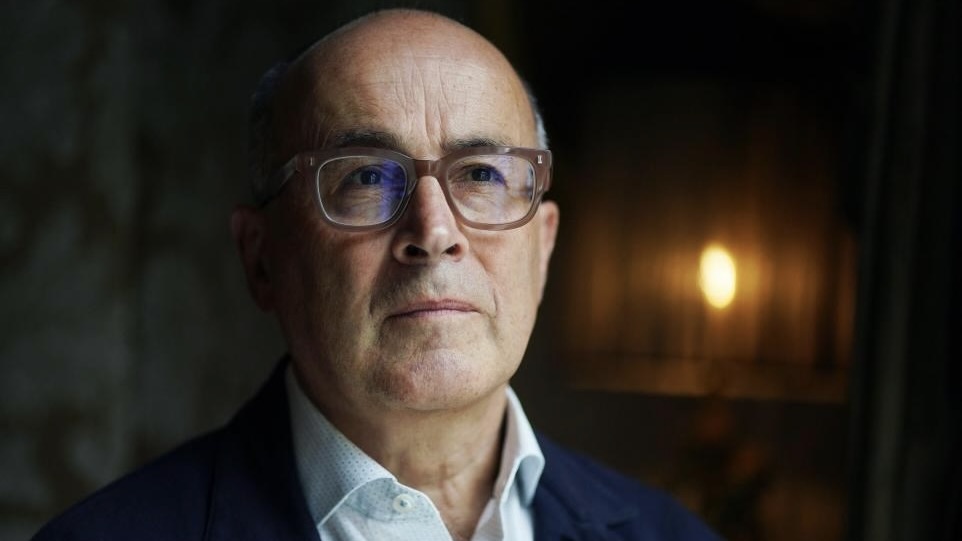
Professor Nick Maynard is the kind of surgeon that everyone hopes to see before an operation. Talking with me on video call, he shows a warming enthusiasm and friendliness that would reassure any patient, or student interviewer. This gentle humility makes the horror of the stories he has to tell, those from working in hospitals in Gaza, all the more jarring, and impossible to forget.
Professor Maynard studied Medicine at Exeter College, Oxford, and works now as a consultant gastrointestinal surgeon at Oxford University Hospitals alongside private practice. As a leading specialist in his field, Dr Maynard can expect to get attention from his peers in medical practice and research. It’s his work in Gaza that has given him global reach.
Palestine and Oxford have featured together in Maynard’s life for decades. He first visited the West Bank in 2006, knowing, of his own admission, very little about the history of Palestine, only “what I’d learned in school”. Visiting the streets of Old Jerusalem, Maynard described being “inspired by the people I met, by the beauty of the land”.
Originally visiting Palestine yearly to teach medical students, he first went to Gaza in 2010, and “never looked back”, taking teams of doctors from Oxford. His trips focused on developing his specialism in oesophageal and stomach surgery, and he began to get involved with Medical Action for Palestinians (MAP), a UK charity of which Maynard is now the chairman.
Even before the Hamas attacks on Israel on 7th October 2023 and the resulting Israeli military action, Maynard says those living in Gaza were “effectively in prison”, with bombings a “way of life” for Gazans. “Even prior to October 7th, Gaza has been a very challenging place to visit, to live in, to provide healthcare. Its economy has been almost completely destroyed for years. I’ve never, ever been to Gaza in all those years without witnessing, every single trip, aerial attacks from the Israeli military.”
Nonetheless, Maynard says that “nothing could have prepared us for the horrors we saw” when returning to the territory on Boxing Day 2023. His gaze strays from the camera slightly as he described his approach to Gaza from Egypt: “We’d stayed a few miles short of Rafah the night before, and it was a beautiful, sunny day, not a cloud in the sky. And as we approached Gaza, you could see this low-lying cloud over the whole of southern Gaza, smoke from the incessant bombing. And you could smell it from about a mile or two away. You could smell Gaza.”
Graphic videos on social media and messages from Palestinian friends on the ground could do nothing to prepare him for “the sheer devastation of the bombing, the thousands upon thousands upon thousands of displaced refugees…for the volume of injuries”. The hospitals were “completely packed”, not just with the injured, but also with their families and others displaced from across Gaza, with their homes completely destroyed in Israeli bombardments.
Professor Maynard has been to Gaza on three occasions since 7th October 2023. He has been very successful at getting media attention to raise awareness of the plight of the Palestinians – appearing on the BBC, Channel 4, CNN, and contributing to respected newspapers from across the political spectrum, from the Guardian to the Daily Telegraph. Discussing one of the most divisive issues of our time, it’s the precision of a surgeon’s instruction that makes his advocacy particularly effective. His careful analysis of evidence reaches conclusions that cannot be dismissed easily by the Israeli government as misinformation or pro-Hamas propaganda. His diagnosis is clear: Israel’s actions in Gaza constitute a genocide – “and I want you to use that word in this article”, he insists.
Still, his channelled anger is palpable when I ask him about the accusations of war crimes levelled at the Israeli Defense Forces (IDF) by organisations such as Amnesty International, Médecins Sans Frontières, and a United Nations Commission on Inquiry. He provides copious testimony, as he is accustomed to doing in interviews across mainstream media outlets: “Friends of mine have been abducted, detained, tortured to death,” he says, emphasising every word. Others who survived torture met him after their release, and gave “very detailed audio and video testimonies of how they’ve been tortured, all of which I’ve submitted to the international courts”.
I ask Maynard explicitly about accusations made by him and countless others, that Israel is deliberately targeting hospitals and medical workers in Gaza. He explains how, when working at Al-Aqsa Hospital in July 2024, his team would communicate every day with the Israeli authorities through COGAT, the liaison service of the IDF, to confirm that it was safe to work in the hospital. Maynard says they were told: “You will be protected. There will be no military activity.”
“They lied to us, because clearly they did attack the hospitals. They attacked the house we were in. I’ve witnessed with my own eyes the hospitals being targeted. I’ve witnessed friends being killed. I’ve seen the clearest evidence of the deliberate targeting of hospitals and healthcare workers. These are all war crimes.”
Maynard has been asked the same thing by journalists on dozens of occasions now. His frustration is most clearly directed at the “utterly ludicrous” defences given by spokespeople for, and supporters of, the Israeli government, who he says are “given substantial airtime by the BBC and other awful media outlets”. The Israeli Government, Maynard claims, has never given any “verifiable or remotely credible evidence” to support their defences to charges of war crimes, or to justify attacks on medical infrastructure. “If it wasn’t so depressing,” Maynard continues, “it’d be laughable”.
Israeli authorities have repeatedly justified attacks on medical infrastructure by claiming such buildings have been used by Hamas as command centres, or to store weaponry. “Hamas may be in the tunnels. I’ve no idea, I’ve never been in them. I don’t know what’s going on in the peripheral outbuildings, 100 metres away from the main clinical buildings, they may be based there”, he acknowledges. However, Maynard is unequivocal that there was “not one shred of evidence” that Hamas were operating in clinical areas of the hospital grounds. “They’re not bombing the outbuildings, they’re bombing the clinical areas, and that is where there are patients, that is where there are healthcare workers, that is where there are medical students. These are the people who are being killed by their bombs.”
Maynard says that the medical students whose workplaces are being targeted are “utterly remarkable”. Working in Al-Nasser hospital in southern Gaza, he was surrounded by students “in the middle of a war zone, desperate to learn and succeeding in learning”. With the medical schools destroyed by bombing, lectures and exams have been held in makeshift tents amid a backdrop of bombing. Maynard recounts invigilating one clinical exam for fourth-year medical students, all living in tents with no running water or electricity: “I think there must be about 20 or 30 students, they all turned up… all of them in freshly pressed, beautifully clean white coats. I was just gobsmacked.”
It’s a far cry from the modern medical training facilities of the Oxford Clinical School, which Maynard is keen to pay tribute to for facilitating the rescue of two Gazan medical students to continue their education. These two students, however, are from a total of only four Gazan medical students who made it to the UK following 7th October 2023, a number which Maynard describes as “shameful”.
Maynard came back from Gaza most recently in July 2025, after a trip where he sustained injuries to his head whilst working in Al-Nasser Hospital. After giving interviews from the hospital in Gaza, including to the BBC with a bandage still wrapped around his head, he has since devoted his free time back in the UK to activism and advocacy. At the same time, he has returned to his full-time job as a consultant surgeon at Oxford University Hospitals. Returning to normality and the “day job” in Oxford, he says it was impossible to know what to expect after “the profound impact … [of] dealing with atrocities”.
“I had children, patients of mine die under my hands because we couldn’t stop the bleeding from the gunshot wounds”, Maynard recounts. He tells the story of eleven-year-old Habiba, who was left with a severe oesophageal injury, after a bomb explosion. “I spent the whole night operating on her, reconstructing her oesophagus, but we couldn’t feed her. We had no nutrition to come in, and she died predominantly of malnutrition a few weeks later, despite the fact the surgery had itself been very successful”. Moments like those, he says, “you never forget…they’re imprinted on your memory”.
The return home came with profound relief and “enormous guilt”, as Maynard’s Palestinian friends and fellow surgeons remained trapped in Gaza. However, for Maynard, it’s after “saying goodbye to friends who you know you may not see again…to patients who may not survive, you feel the most profound anger” towards the West’s politicians and mainstream media outlets. Guilt and anger have left him with an “unbelievable, powerful urge…to tell everyone what I’ve seen, because they’re not hearing it from the media…the clear genocide…the war crimes, the ethnic cleansing”.
And so Maynard continues to give interviews like this one. It’s a “double-edged sword”, he tells me, because “when you recount all these stories, it brings back all the horrible memories. But the overall benefit is this compulsion to share”.
When you leave Gaza, he says, “you feel inadequate again. You want to be back out there”. Despite the “emotional turmoil” he feels after visiting the territory, he is clear that the experience has been “life-changing and life-enhancing”. Spending time in Gaza has been “a wonderful privilege, and the last two years have in many ways changed my life”. As he speaks, I look towards the colourful woven map of Palestine hanging on the door behind him.
He says he’s “desperate” to return, but the chance to volunteer in Gaza again looks highly unlikely with his raised public profile of pro-Palestinian advocacy: “People like me, who have spoken out a lot, are not being allowed in” by the IDF, who continue to control all access to Gaza by medical staff, as well as aid workers, aid delivery drivers and journalists. A law introduced in January now forces all aid organisations to register with the Israeli government and submit the personal details of all their staff to the Israeli authorities, leaving 37 non-compliant aid organisations facing bans from accessing the territory, including Médecins Sans Frontières (MSF).
With it looking unlikely that Professor Maynard will be able to work on the ground in Gaza any time soon, his activism in the UK takes on a heightened importance. He laments how global pro-Palestinian activism has “diminished” in recent months. “The marching has reduced, the vigils have stopped…the media isn’t reporting anything about Gaza.” He blames the reduced coverage on public understanding of the official ceasefire in Gaza, dismissed as “propaganda” by Maynard. “There’s not a ceasefire. There’s been a reduction in the violence, but there are still Gazans being killed by the Israelis every single day. The need for advocacy and activism is as great as ever”.
Making small talk before and after the interview, Maynard appears immensely calm, composed, affable. It makes his anger towards the UK Government and the University of Oxford all the more profound: “Oxford University is doing nothing like enough… the University authorities, by and large, have been silent, and that’s unacceptable.”
For Maynard, the “woeful silence” of our political institutions amounts to complicity, whilst the UK Government has been outright dishonest. “Don’t believe the government when they say there’s an arms embargo. There’s not.” He accuses the RAF of “providing military intelligence” for Israel through reconnaissance flights over Gaza, condemns continued UK trade with Israel, and highlights recent cooperation between the UK Government and Palantir, the US data analytics company, which was given a £330 million contract with the NHS in 2023, whom Maynard accuses of having “strong links to the Israeli military”.
Maynard’s testimony can appear extreme, even desperate, to a sceptical observer. The scale of the horror, the strength of the anger around Gaza, makes every attempt to describe what is happening there immensely polarising. Yet hearing him speak, Maynard’s anger does not come across as that of a partisan, but rather the quiet fury of an expert in their field, giving evidence on one of the greatest atrocities of our time, and feeling ignored by those he sees as complicit.
So, what students at Oxford University could do to make a difference? For Maynard, the answer is obvious. Students should do “what students have been the best at doing for decades: standing up for those who need support, standing up for the underprivileged, standing up for the victims of genocide.”