

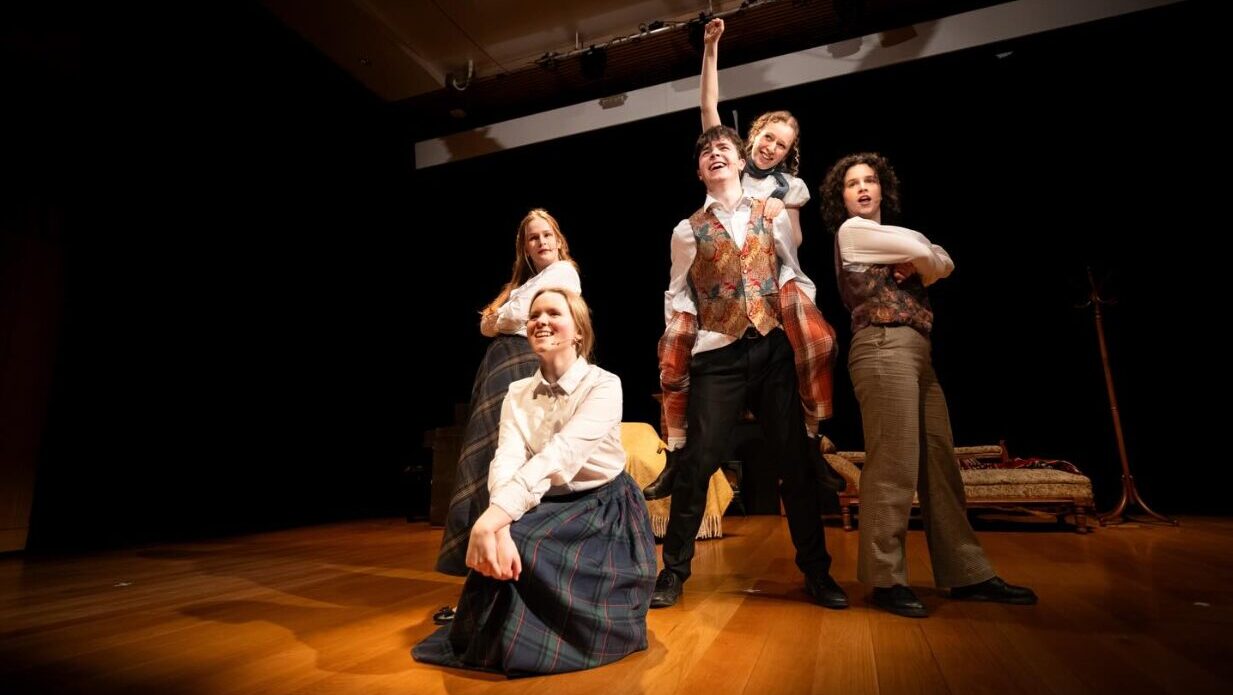
“We don’t live for society. We live for what we have inside of us. We live to expand our minds.” proclaims Jo March (Emma Hamilton) in Little Women the Musical, Pembroke College’s annual musical directed this year by Dawuud Abdool-Ghany. It would have been easy for this line to land as hollow and crass. However, Hamilton delivers it with a conviction and fervour that comes across as earnest and inspiring.
The musical is largely faithful to the book, though Jo’s storyline is prioritised over the other March sisters. The effect of this narrative choice results in a sharper focus on the question of whether Jo’s narrative should be read as feminist triumph or capitulation to the constraints of being a woman in the 19th century. For those who haven’t read the book (spoiler alert) Jo spends most of Little Women refusing to marry so that she can pursue her career as a writer. Under pressure from readers and publishers, in 1868 Louisa May Alcott wrote Jo a romantic ending, and as a result the story ends with Jo’s marriage to her older tutor Professor Bhaer. In 2026, in an Oxford University student drama context, this ending leaves an unpleasant aftertaste.
In spite of this, Abdool-Ghany’s take on Little Women is riotous fun and made for an entertaining evening. This was in no small part down to the lead, Emma Hamilton, a spectacular talent. In a cast with no shortage of vocal ability, her control, musicality, and expressive range is singularly incredible. The sparky impassioned energy of Jo is brought to life by Hamilton through rapid, sudden movement around every part of the stage. Hamilton manages to capture Jo’s magnetic storytelling, drawing both audience and cast with her into the fictional worlds she creates. She is ably assisted by Jo’s eventual fiancée Professor Bhaer (Nikhil Mark) whose mopish self-effacing movement and deadpan, terse dialogue combine with his excellent comic timing to provide an excellent foil to Hamilton. “Christopher Columbus!” Hamilton regularly exclaims as Mark despairs and shuffles around the stage in a manner that I am sure he has modelled off some unsuspecting tutor. I had not expected Little Women to be so well suited to musical form nor so hilarious.
This hilarity is often generated by Alex Innes’s Laurie. Innes is playful and endearing and he skilfully strikes the difficult balance between Laurie’s comedic moments with the immense tension and pathos of Laurie’s unrequited love for Jo. When Innes confessed his love to Jo, he had the audience rapt. Had a pin dropping had the impertinence to break the silence, it would most definitely have been heard.
Director Abdool-Ghany has done a masterful job in his use of proximity and movement to create contrast between the different romantic relationships in the musical. Jo and Laurie bounce around one another at a distance and when they do touch quickly jump back apart. Meg (Grace Greaves) and Mr. Brooke (Seb Fitzgerald) capture a contrastingly tender partnership, through gentle, slow movements and close blocking.
Another of the challenges for the director in the script is acting out the plays-within-a-play that Jo writes and enlists the other characters to perform. It is in these sections that the fantastic tongue-in-cheek tone of this production works best. The biggest laughs from the audience came from the tale of Clarissa (Paloma Diaz), the damsel in distress being rescued by Rodrigo (Alex Innes in his second role) from the decidedly dastardly Braxton (Seb Fitzgerald in his second role). The two men fought over Clarissa using rubber swords, and their wonderfully hammed-up confrontation was hysterical.
However, the light-hearted emotional tone that director Abdool-Ghany sustains throughout the musical at times feels at odds with the narrative. For instance, following Amy (Maisie Thorn) and Laurie’s return from Europe as a couple, Amy acknowledges the romantic history between Laurie and Jo, admitting, “I never meant for it to happen like this. I had always thought of Laurie as yours.” At the same moment, Laurie is struggling offstage with the luggage from Europe, and the audience laugh. Similarly, in the scenes covering the death of Jo’s sister Beth (Anna Gillespie) the fast pacing reduces the implicit pathos of the storyline. This playing down of tension flattens the emotional shifts within the musical.
The antique furniture making up Jessica Rodrigues’s set dovetails nicely with Elizabeth Bourn’s costume design to create a general sense that the musical is set in the original 19th-century context. Bourn chooses to dress Laurie and Jo in a waistcoat and trousers, whilst Meg, Amy, and Beth are in white shirts and ankle-length tartan skirts. The costume choice emphasises Jo’s individuality and autonomy, in contrast to the traditional models of femininity that her sisters represent. The similarity to Laurie works well with the direction of Jo and Laurie’s characters as vibrant and vivacious.
In all, Abdool-Ghany’s Little Women the Musical is undoubtedly brilliant. From the suitably dour Mr. Laurence (Adam Paterson) to the amusing Aunt March (Sophia Valmalette-Wright), who has something of the dry archness of Maggie Smith’s Violet Crawley, the actors are well-cast and extremely skilled. Abdool-Ghany has created a musical absolutely brimming with vibrant energy. A triumph.