

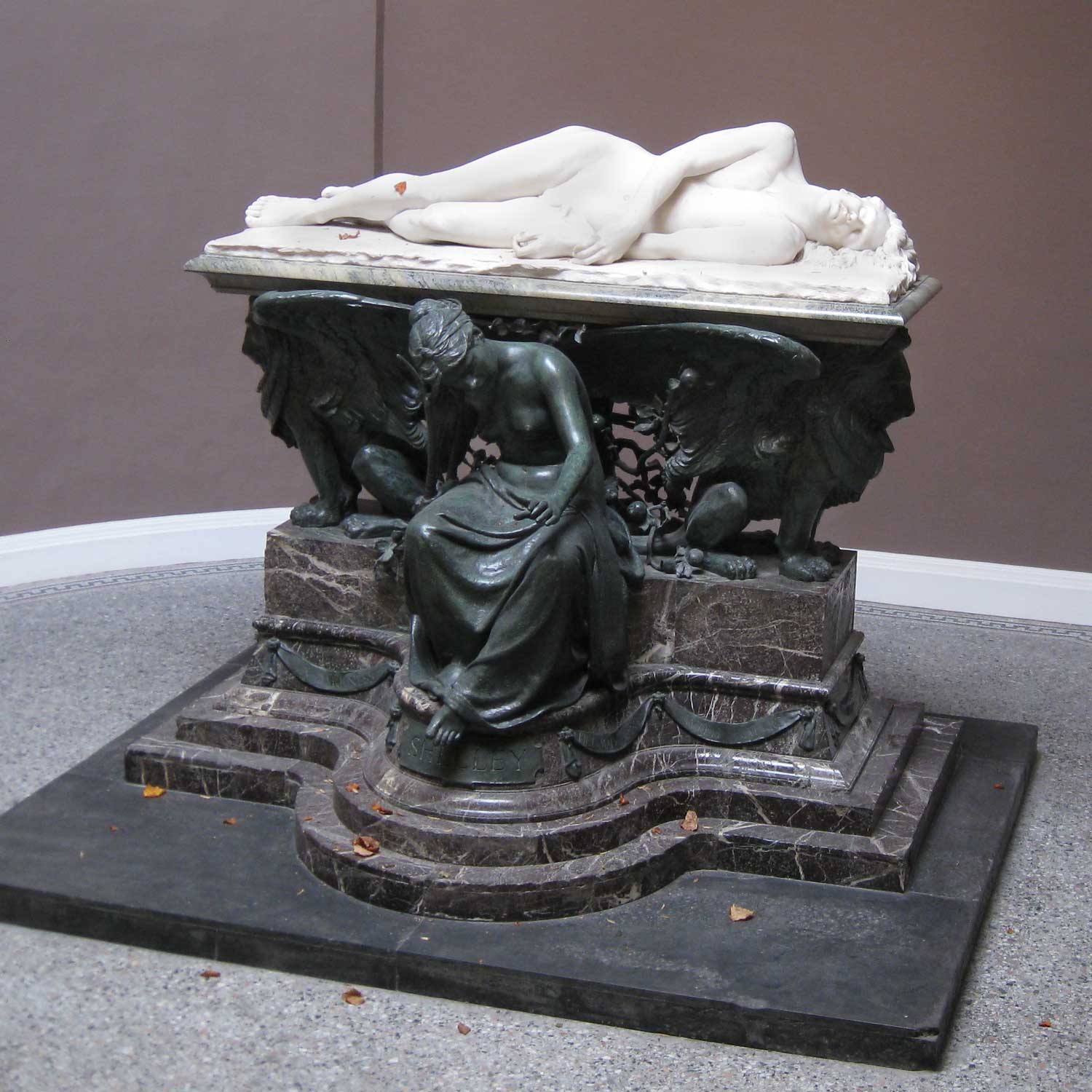
In 1811, a student at University College published a pamphlet including an essay titled ‘The Necessity of Atheism’ that he later distributed to the Heads of Oxford Colleges. The student, after disputes with the Master of University College at the time, was “sent down” on the grounds of “contumacy” (disobeying authority). This student was Percy Shelley.
Famous more for his poetry than political views (and for his wife Mary Shelley, author of Frankenstein), Shelley’s time at Oxford was short, defined by his anti-religious stance. The pamphlet argues that belief in God rests neither on direct experience, sound reason, nor reliable testimony, and so there is no rational basis for belief at all. It is no surprise then, that the exclusively protestant Oxford University took issue with this particular use of free speech.
It is not the content of Shelley’s essay that we must draw lessons from, but the structure. The essay is an essential element of university teaching and, for those of us studying humanities and social sciences at Oxford, it seems to be the foundation of our learning. The average student in these subjects at Oxford will write one to two essays a week, 2000 words long. But the essays we write, and the process of reasoning we follow, are arguably far-removed from the process of the essay produced by Shelley. They are more technically perfect, but also more sterile. Essays here are fixed; we all follow the same structures, word counts, and department-mandated reading lists. Great for displaying understanding of a subject, in theory.
But consider the average writing process of the Oxford student: First, an attempt to plough through a seemingly unending reading list. You will begin each week with a desperate desire to get through it, that slowly diminishes as the week goes on. Following this, developing a thesis to defend, struggling to find the balance between subject jargon and the literary standard of writing you try to maintain. Next, begin to write, and aim for a perfection that is entirely unreachable. It is because of this that you desperately may turn to A.I. (made oh-so-much easier with the university’s rollout of free ChatGPT), or essays handed down from college parents and friends. Finally, hand in and brace yourself for critique in an imminent tutorial.
And so, it is the perfectionism that brought us to this place that becomes our downfall, as you scramble to produce something that looks coherent, rejecting the idea that the essay should be a personal form of learning.
If students aren’t learning from the essays they spend 40+ hours on weekly, often the only form of assignment in one’s degree here, it is worth assessing whether the Oxford essay truly has any merit.
The word essay comes from the french verb essayer. Michel de Montaigne is said to have coined the term, and in his seminal work Essais demonstrates this unique writing practice. Montaigne writes essays on numerous topics, not as authoritative explanations, but in an ‘attempt’ to deconstruct and understand the topics. Covering ground from government andpolitics to religion and nature, all the essays have a sense of self fashioning and self discovery. The manuscripts are filled with the barely legible annotations of Montaigne, crossed out over and over. Montaigne himself said that he wanted a medium to assess the contents of his mind, leading to the outcome that the essay was to be a living, breathing document – collation of the human mind, with its tenacious facets. The essays have a distinct lack of structure, and Montaigne’s stream of consciousness means they read more like diary entries. They are refreshingly personal.
Contrast this with my weekly essay, which is structured purely around my understanding of others’ understanding of the topic. No merit is given to students whose ‘attempts’ feature themselves so clearly. Rather it is knowledge of the literature (and control of those never ending reading lists) that is most rewarded. It is also clear how contrary the perfectionism of the Oxford student writer is to the original form. Montaigne’s whole point of writing was to lay himself out in all his fallible glory, as he proclaimed in his writings: “My defects will here be read to life.”
The essay has never been so impersonal. It is this impersonality that means we cannot use these pieces of writing to achieve the aims once set out with them. Shelley’s essay is made strong through the combination of a deeply personal viewpoint and the critical analysis that this entails. ‘The Necessity of Atheism’ (and essays in their truest form) are clear ‘attempts’ to explore an idea or notion from his head onto the page. It is the product of the laborious activity of self-analysis, questioning, and critiquing, and an attempt to convey this final, highly personal product to readers.
If one is to consider that Shelley was writing some 200 years ago in this same institution that we are in, what may he think of the essay now? More perfect, yes, in knowledge of the topic, but always following some guide. The structure of the essay seems set in stone, but also, the ideas that we draw on too have become set in stone. A response to the rigid system of essay-writing in Oxford, no doubt.
I can’t help but wonder if it is the nature of academia that ‘voice’, and therefore ‘self’ is only something awarded to those senior enough. You must earn your right to speak here, in this place of inquiry and knowledge-seeking. This idea shouldn’t be further from the truth when you consider the political impact of the essay – something so revolutionary.
It was the lack of rules and boundaries of the essay that gave it such power to become something so great. With an accessibility that grew exponentially with literacy rates, the essay became a medium of immortalising any and all forms of discourse that recorded and reflected human and societal development. Literary discourses, philosophical discourses, scientific, personal, and religious discourses. The essay allows you to trace the origins of one’s thought and the development of their ideas. The essay retained this ability for most of its existence. Provocative, introspective, more akin to diary entries on random topics than anything that we would credit as essay worthy now. This is exactly what made them revolutionary. The essay allows you to delve into the furthest corners of your mind, and to come up against the limits of your critical capacities until you are forced to evaluate, and re-evaluate. In the process of writing an essay, a writer is forced to take a position, and to assess this position constantly, until they reach a level of surety that makes ideas worth conveying to the masses.
It was in the 20th century that essayists showed this the best. Against the backdrop of international societal uprooting – decolonisation, women’s rights movements, and civil rights movements – the essay gave an intellectual voice to those from whom the West had never listened to before. And it is here, in the 20th century, amidst all of these struggles, that the essay as a tool of dissent becomes most apparent. Edward Said coupled political discourse on occupation and the Palestinian cause with his personal feeling of alienation, and gave the basis of contemporary immigration discourse. bell hooks’ deeply personal essays on her life gave scholarly birth to intersectionality. Baldwin’s Notes on a Native Son is blistering when he says “I had discovered the weight of white people in the world”. The plainly descriptive sentences he uses not only affirm his lived experience, but are able to solidify them while staying far away from the structures we use today. Entire branches of Western progression of society towards this space of plurality of thought that we occupy can be traced by the remnants of people’s innermost reflections, and the essay was the best medium for them to do that.
I suppose we have become disenfranchised. The prescribed nature of the Oxford essay shows little aside from the stagnation of Oxford as a birthplace for ideas. The weekly essay should be a place for exploration, and tutorials a chance to think aloud and arrive at new conclusions. In practice, both function as a performance. You will learn quickly that it is better to sound confident even when you are unsure, to speak fluently rather than tentatively, to cite rather than to speculate. Over time, the aim is no longer to discover what one thinks, but to demonstrate that one has mastered what has already been thought.
Hierarchy plays a crucial role here. Voice, in Oxford, is something to be earned. Students are encouraged to efface the first person, to speak through the language of others, to defer to the canon before daring to intervene. There is a logic to this: scholarship demands rigour, humility, precision. But the effect is the loss of selfhood, the fingerprint of authorship, the very thing that once gave the essay its force. Oxford it is not bestowed upon you, but rather postponed. Does it come when you get your scholar’s gown? When you get the first class honours? The right to say I arrives later, if at all. Until then, you must speak cautiously, or not speak at all.
This is a far cry from the conditions under which the essay first gained its political power. Shelley did not write ‘The Necessity of Atheism’ as a rehearsal for authority. Montaigne wrote primarily to uncover his own fallibility. Baldwin, Orwell, Said, and hooks all wrote to give name to a novel experience that deserved recognition. In each case, the essay was a tool for a greater purpose.
Today, at Oxford, the essay is stagnant. The structure remains, the guiding principles unchanged. What has been lost is the sense that writing might still be capable of unsettling the place in which it is produced. Perhaps that is the final irony. At an institution that asks its students to write essays every week, we are closer than ever to a form that once celebrated personality, and groundbreaking ideas – and further than ever from imagining that our own writing might do the same.