

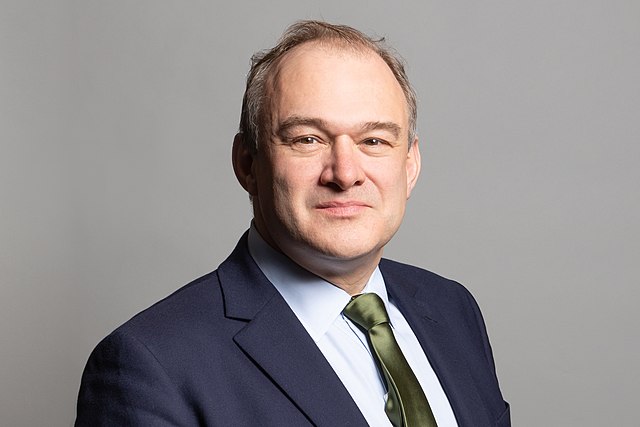
Multiple times throughout the interview Sir Ed Davey accidentally turned his Zoom camera off. He’d hastily apologise and search to turn it back on. His daughter, and later her cat, entered the room mid-interview, but only the cat was allowed to join us, resting her head on Davey’s shoulder. By the end of our conversation, it’s very clear that Davey is not a polished politician, nor does he wish to be.
Leader of the Liberal Democrats, the third largest Parliamentary party in the UK, Davey markets himself as a “centrist dad” of “middle England”. Spending his undergraduate years at the University of Oxford, studying Politics, Philosophy and Economics at Jesus College, Davey speaks of Oxford with the faint glint in his eye so common amongst Oxford alumni. He admits with a chuckle that he came to Oxford completely unprepared after his gap year, having done no pre-reading: “I had one sleepless night thinking I’d gone to the wrong university.” Having never studied the subject before, he felt “totally at sea” with the economics papers of his course. Despite this, he threw himself headfirst into the myriad of activities Oxford has to offer: serving as JCR president, taking part in amateur dramatics (at which he was “absolutely hopeless”), and getting involved with the Oxford Ecology Movement. But as many of us will likely later reflect, he says “I wish I’d done even more”.
Oxford was also the site of his “first major political engagement”. As Jesus JCR president during the 1987 General Election, Davey joined the ‘Tactical Voting ‘87’ campaign, which aimed to keep the Tories out of power in Oxford. Yet, despite his early political activism, and his PPE degree, a career in politics was never on the cards for Davey. His initial desire was to work in development in the global South, having had relatives involved with the World Health Organisation, the European Commission, and even Tiger Conservation. Ultimately, he applied for the role of Parliamentary Economics Researcher at what was then the Social and Liberal Democrat Party, driven by his interest in economics. This decision has undeniably shaped his life in a way he might never have imagined. At the time the party was polling at just 4% under leader Paddy Ashdown, and Davey confesses that “they only really employed me because they couldn’t afford anyone else”.
Within a month, he had joined the party as a member. Davey describes being “totally inspired by Paddy, and his espousal liberalism” and he continued to work with the party through the 1992 General Election. Despite a momentary dalliance in management consultancy (about which his only comment was distaste for his boss), his “bug” for politics dragged him back. Standing in the 1997 General Election as the Lib Dem candidate for Kingston and Surbiton, in South West London, “more as a have-a-go than anything else”, he was elected with a 56 vote majority. Davey reflects on his entrance into politics as a move of coincidence, and seems to believe fate was on his side at that moment: “I sort of fell into politics…it wasn’t a plan, it was a whole set of circumstances, and I ended up happily in a party that I feel is a classic liberal party, and liberalism is who I am.”
Our conversation moves to an emotive issue for Davey, one which has played a significant role throughout his life: care. Davey cared for his terminally ill mother in his early teenage years, then his grandmother, and today his severely disabled son. He admits that it’s a very personal issue and one that has only entered the public sphere of his life recently: “Only when you become leader do you become more open to questions about who you are.” He reflects that he’s “gone on a journey since becoming leader in 2020”, not only speaking about it more publicly, but also engaging with it more deeply on a personal level. His book, Why I Care: And why care matters (published in May 2025) is part manifesto, part introspection – his way of reflecting on his experiences. I ask Davey how care has played a role in who he is today, and he points to the work of Saul Becker, a renowned social scientist. Becker identifies three characteristics common in young carers: resilience, empathy, and time management skills – all of which Davey relates to from his time as a young carer. “You have to really get things done, smartly. You can’t mess about.”
Being a carer has, unsurprisingly, also informed his politics. He refers to the millions of family carers in the UK, and how “governments, councils, and public policy just don’t factor these people in”. He argues it would be “transformative…if we did care properly”; benefiting the economy, the health service, and general national happiness.
It’s a frustration he knows well from his years on the backbenches – watching policy fall short whilst being powerless to change it. That changed in 2010, when the Liberal Democrats found themselves with an unexpected opportunity to govern.
The movement from opposition to government was life-altering for a backbench MP like Davey. For the Liberal Democrats, it proved to be a once in a lifetime opportunity. After the 2010 General Election gave no overall parliamentary majority to a single party, an infamous five days of negotiations ensued, culminating with the Lib Dems entering into a formal coalition with the Tories. “I was actually arguing for a coalition with Labour…but we ended up extracting a lot more from the Conservatives in the coalition deal than I had possibly expected.”
He describes his appointment to the role of Junior Minister at the Department of Business, Innovation, and Skills as “exciting…if very unexpected”, and reflects proudly on his work to deliver shared parental leave that “ensured the labour market was fairer to women”. It was his promotion to Secretary of State for Energy and Climate Change, however, that excited him most, and he visibly lights up as we begin to talk about it. “It was just brilliant…we essentially created the offshore wind industry as a result of what we did.” Holding the role for three and a half years, Davey became the longest serving Energy Minister since the early 1980s. “At the time, I was convinced I wouldn’t be a minister again, and I thought ‘I just have to work as hard as I possibly can, score as many goals as I can’.” He attributes all of his successes to “a fantastic civil service”, and makes clear his outright distaste for the right-wing’s undermining of the organisation’s credibility, a clear reference to Dominic Cummings’ “blob” label for the service.
When I ask him to reflect on these coalition years over a decade on, he’s remarkably more positive than I, perhaps naively, expected. “We achieved an awful lot – taking the lowest paid out of tax [brackets], getting investment in mental health services, keeping us in the NHS.” He admits, “politically, it didn’t go very well for us”, with the party losing nearly 40 seats, Davey’s included, but “we showed a) what Liberal Democrats can do in power, and b) that coalitions can work, and be stable”. If anything, Davey thinks the coalition acts as “a great argument for electoral reform”. “I know lots of people don’t like it…but for the country, I think it was the most stable government we’ve had in a long time”, pointing to the five Prime Ministers the UK has had in the span of less than ten years. “They’ve had big majorities, and they’ve been completely unstable, divided, frankly hopeless.”
Despite his distaste for the First Past the Post electoral system, it’s undeniable that Davey has benefited from it. His pride in his party is undeniable, and when I ask what he brings to it, I get a single word answer: “Winning.” He admits he is bragging, but “winning is rather important in politics”. The three elections before 2024 gave the Lib Dems a respective eight, twelve, and eleven seats. With Ed Davey as leader, the 2024 General Election saw them win 72 – their best result since 1923. When I mention the recent polling, that has seen his party at just 12%, he quickly dismisses their value. “People often think about politics like we have proportional representation (PR).” In reality, it’s about vote concentration in a specific geographic area, not about the lateral spread of popularity across the country. “I look at whether we are winning.”
One thing that voters definitely know Davey for is his outrageous stunts, and when I mention them, I see a smile light up his face again: “It’s really challenging for us to get media coverage…partly because we are sensible – we don’t say crazy things, we don’t say extremist things.” It’s true that a lot of the nuanced points Davey tries to make about care and EU relations simply aren’t compatible with the clickbait media culture of today. But the reasoning for the stunts runs deeper than chasing journalists. He sees an emotional deficit at the heart of liberal politics: “People who have our liberal views…tend not to do emotion very well.” The data and analysis, he admits, are well-covered – but “if you don’t have the emotional element to what you are doing, you just don’t connect with people”. He posits this as the reason for the success of the Right, saying “Johnson, Farage, Trump, they are much better at emotions, but these emotions are often nasty emotions”. It’s a gap that’s only widened on social media where, he admits, “we have been too slow in getting our social media team together, making it a priority, and coming across well”.
It’s the question of emotion in politics that leads us, naturally, to Brexit. His time spent negotiating with the EU as a minister convinced him of the value of the supranational organisation. For Davey, “Brexit is just a total disaster…we have lost so much”, but trying to get the public to engage with it again is proving to be difficult. “It divided people, divided the country, friends, families, neighbours, work colleagues, in quite an emotional way.” As such, “even the most strongly ‘remain’ people…often don’t want to talk about it…they just have this memory of it all being a nightmare”.
Davey is unambiguous about the party’s mission: to stop “Trump’s America coming to Farage’s Britain”. It is here where Davey’s passion is most clear to me. His smile and composure leaves him, and I see the anger beneath at the growing popularity of the Reform Party, a party he fiercely condemns as “a danger, an absolute danger”. Davey draws parallels between Trump’s protectionist tariffs and Farage’s pioneering of Brexit: “Like Trump, Farage doesn’t really believe in free trade. He wants to stop us from trading with our European neighbours.” Davey argues that, under Farage, Britain’s foreign policy would be centred on courting the favour of Trump and Putin, rather than the UK’s national interests. “The authoritarianism, anti-democratic behaviour of America goes against British values”, and, as such, he explains, Farage is “a real threat to our future”.
It’s clear this is a man who still has plenty to fight for. But I turn our conversation away from the future, and towards the past – and the regrets that inevitably come from such a long career in politics. When I ask Davey how he handles his regrets, he has a simple philosophy, but arguably one that would not stand up to scrutiny from the public. “You learn from it, don’t you?… Inevitably you make mistakes…often it is better to go with your instincts.” Particularly when he first started as a minister, Davey felt there was “so much to learn”, so many processes to comprehend and utilise for his own agenda.
Any life after politics will likely be defined by his family and “what I like doing – going for walks, good food, travelling”. But, for now, he certainly has ambitions that will drive him for decades to come, and is genuinely reluctant to imagine taking a step back from politics: “It’s too exciting at the moment…. When I talk to colleagues and party members, I often say we have a moral responsibility to stop reform, and an historic opportunity to win many more seats.” For a man who fell into politics by accident, he seems in no hurry to find his way back out.