

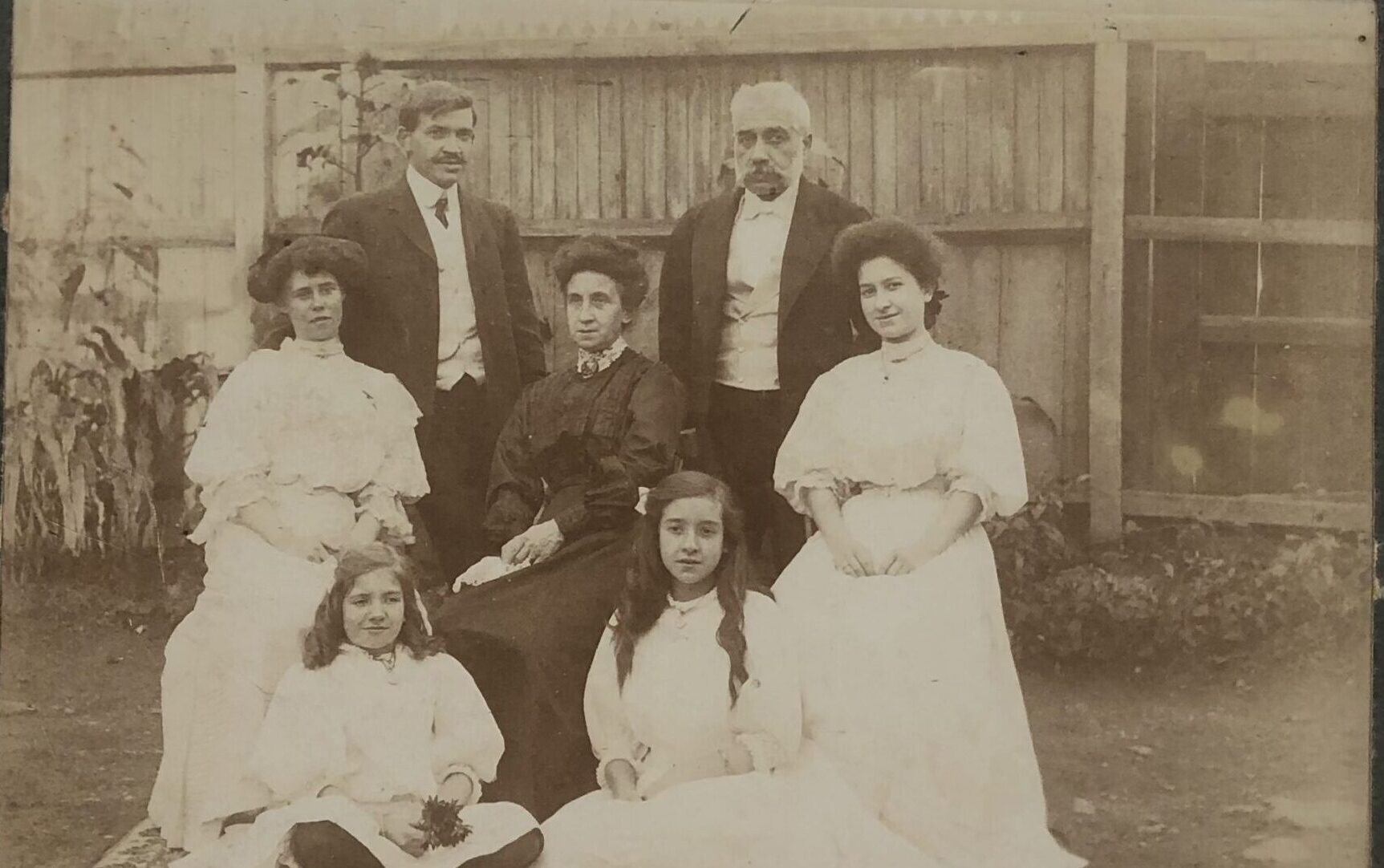
Like many people, I used to zone out a bit when my parents started talking about family history. Being the youngest child – by quite a large gap, since there are eight years between me and my older brother – a lot of the memories which seemed to belong to the “family” as a collective happened before I was born. I would sit through conversations about “great grannies” and stare at grainy photographs of unknown people in unknown gardens, trying to piece together a sense of the past, a past which wasn’t actually that distant – we’re only talking three generations back – but one which felt like a foreign land all the same. As we delved further into the past, these figures became even more hazy.
My parents would consult the grandparents, oracular-style, on whether certain cousins were once or twice removed, on what so-and-so did during the war, and so the puzzle became increasingly difficult to muddle through. All the while, I wondered about the true relevance of any of it. None of my ancestors were noble, or appeared all that interesting. It was highly unlikely that, like Josh Widdecombe on Who Do You Think You Are, we’d accidentally discover we were connected to a figure of royalty, making the seemingly endless sifting through old parish records and censuses worth it.
Unsurprisingly, this was quite short-sighted of me,especially since I’ve always been interested in history. Admittedly, it was the kind that happened thousands of years ago, often involving gripping tales of aristocratic betrayal, missing tombs, and undeciphered languages – I wasn’t the only one to be taken in by that big shiny golden book about ancient Egypt in primary school. For such a long time, I was excited by the history that seemed to rewrite the rules of the world I was familiar with, one where ritual practice and superstition often dominated, of generals leading battle charges with plumed helmets and naval battles staged in amphitheatres. All those unsolved areas of history also seemed to beckon to me, promising a treasure trove of untold secrets and scandals around every corner.
I haven’t stopped being interested in these things in the least. But something changed when I started thinking about what I wanted to study at university, and which areas of Classics appealed to me in particular. Studying ancient Epic poetry at A-Level – specifically the Iliad and the Aeneid – had awoken me to a world, not only of mythological cities and their destruction, of sea-monsters, witches and oracles, but one in which the stories of regular people were just as poignant.
I’ll always distinctly remember coming across a particular passage in the Iliad: in a scene which comes about as close as the ancients can get to a high-speed car chase, Achilles chases Hector around the city walls of Troy, intent on single-hand combat to the death, in revenge for killing his beloved Patroclus. It’s an extremely tense episode, with everything seemingly hanging in the balance. Yet, suddenly the narrator stops. He describes the two springs that feed the Scamander river, and the stone washing-troughs which the Trojan women used to clean their clothes in times of peace.
My teacher was keen for us to focus on this particular vignette, and I came to understand that it was the heart-wrenching sense of the microcosm within the macro that was so powerful. The idea that, beyond a war which had ravaged a city and its communities for ten years, there was still the memory of people as they are everyday. Although fictional, I imagined those women talking amongst themselves, exchanging niceties whilst they scrubbed their robes. I’m sure there are plenty of Greek students who could make much more of this passage, and what is being done with the language, but for seventeen-year-old me, this changed everything.
The thing is, the stories that have the power to fascinate us the most are often the ones hiding in plain sight. I soon realised that, actually, it was the human aspect of literae humaniores (the fancy Latin name for ‘Classics’) which drew me in and, in a much more wholesome, sustaining way than battles or mythological creatures, kept me entertained. The humanity in history is one of the main (and many) reasons why I love my subject.
Incidentally, it was around this time that my grandma’s memory started to decline, in a fairly rapid and alarming way. She had always been so diligent in researching the family history on my dad’s side, compiling complex maps of family trees and storing away letters and photographs of people she had never met. I didn’t appreciate it fully when I was younger, how this is a task which requires an incredible amount of patience and willpower (particularly when you have an eight-year-old screeching, for the umpteenth time, “but who was Grandpa Norman?” in the background). Now, when I’m sifting through reading after reading – most recently, trying to make sense of the web of mythological characters in the Metamorphoses, and how they relate to one another – I sometimes think of her, and her eagerness to pursue the past.
On a recent visit to their house, I was shown a photograph I’d never seen before. Extremely faded, it showed a group of seven people in a garden: two men, three women, and two younger girls seated at their feet. On the back, written in an elegant, watermark-flecked script, were their names, all with the last name “Gascoyne”. Descendants of French Huguenots who had come to England fleeing persecution – specifically, to places like Spitalfields and Soho – the group, although somewhat uppity-seeming in their Edwardian clothing, were rather unassuming. Without the context of the lives they led – the two men were silk-weavers, I’m told, and had inherited their trade from their forefathers – it would be just another old photograph, just another list of unfamiliar names. But the stories which my grandma so carefully collated – even if she can’t remember them herself now, or even who we are – make these remnants of family history so special, even if, to the outsider, the photo is just another artefact.