

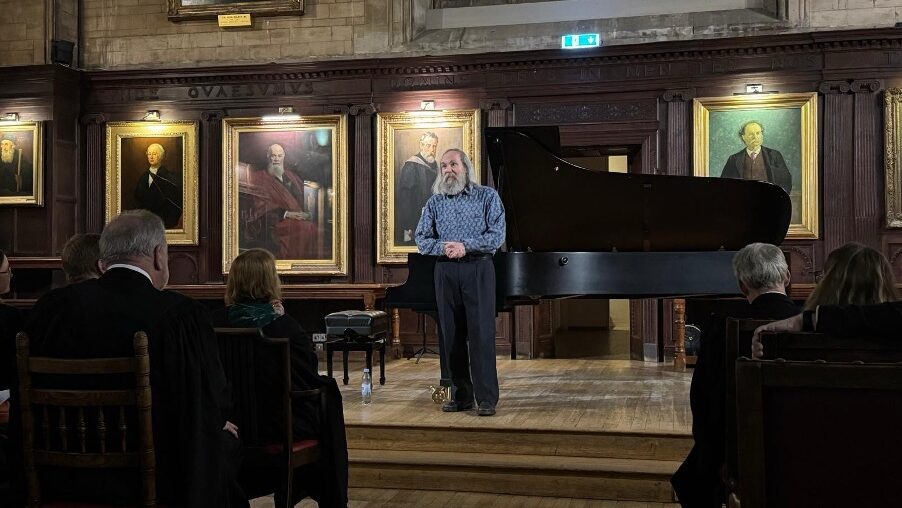
On the 23rd and 24th February, the Ukrainian composer and pianist, Lubomyr Melnyk, returns to Oxford for a performance at New College’s New Space, hosted by Balliol College Music Society. When Melnyk last performed in Oxford, in November 2025, audiences were left questioning what precisely they had just heard. A piano recital, certainly, but one that seemed to exceed the physical and sonic limits of the instrument itself. For Nathan Adlam, a Balliol mathematician and pianist who co-runs the society alongside Towa Matsuda, the concert marks the continuation of something far more personal than a visiting recital.
Melnyk’s performance carries a deep significance. It marks the four-year anniversary of Russia’s invasion of Ukraine – a date etched into the memories of countless people. For Melnyk, the stage becomes more than a place of artistry; it becomes a space of remembrance, resilience, and reflection. The weight of the invasion’s anniversary makes the performance important, not only for Melnyk, but also for the millions of Ukrainians he is representing. The event is also widely supported by the Oxford University Ukrainian society, who were fundamental in advertising the last concert series in Michaelmas term.
Those who attended Melnyk’s Oxford recital last year will have struggled to describe the performance, feeling less like a conventional piano concert and more like a complete immersion. The rapid unbroken streams of sound makes it hard to locate a central melody, with the music instead surrounding the listener. In an intimate venue such as the New Space, that effect is likely to be intensified with the piano’s resonance filling the room and collapsing the distance between performer and listener. Raphael Darley, a maths student studying at Balliol who attended last November’s performance, described hearing “four voice lines, each having five textures.”
Adlam told Cherwell: “I found him by accident during the lockdown and was instantly hooked.” What began as private fascination developed into formal study; Melnyk has described Adlam as “the sole student to have taken him truly seriously”. Adlam single-handedly organised Melnyk’s Oxford debut last November, drawing on community support across the University to hear Melnyk’s signature ‘continuous music’.
Melnyk is often described as an ‘experimental’ composer, but the term misleads as much as it clarifies. His ‘continuous music’ style is built on rapid, sustained streams of notes that create the impression of layered textures unfolding simultaneously. Yet, as Nathan is keen to stress, it is deeply rooted in Western classical harmony. “He absolutely adores Bach and Beethoven,” Adlam explains. Rather than rupture with tradition, Melnyk’s work extends it, as a kind of operatic classicism.
Much of the astonishment centres on the physical technique itself. Melnyk is recorded to be the fastest pianist in the world, with the ability to play an astonishing 19 notes per second. His style demands extraordinary stamina and speed, sustaining patterns at velocities that seem mechanically impossible. Even Adlam, who performs the repertoire as an amateur, is struck with disbelief. After Menlyk’s last recital at Magdalen College, he recalls a midwife remaining half an hour afterwards, “so terribly worried” for his hands; she could not believe he did not suffer from repetitive strain injury.
There is also a larger story unfolding behind the scenes. A documentary, led by filmmaker Rupert Clague, explores Melnyk’s music and life. The project, The Peace Piano, has reportedly secured Werner Herzog as executive producer. The performances this February also sit alongside a study from a research team from the University of Cambridge and Goldsmiths, University of London, which focuses on flow state. Attendees of the event are encouraged to complete the questionnaire which will investigate how live music leads to altered states of consciousness, framing Melnyk’s performance as more than just music, but as a psychological experience.
Melnyk’s return to Oxford represents more than just a repeat performance. His performance is significant to the memory of Ukraine on the anniversary of the Russian invasion, and it signals the growth of a small but intensely committed community around his work – one rooted, unexpectedly, in a Balliol maths student’s lockdown discovery.