

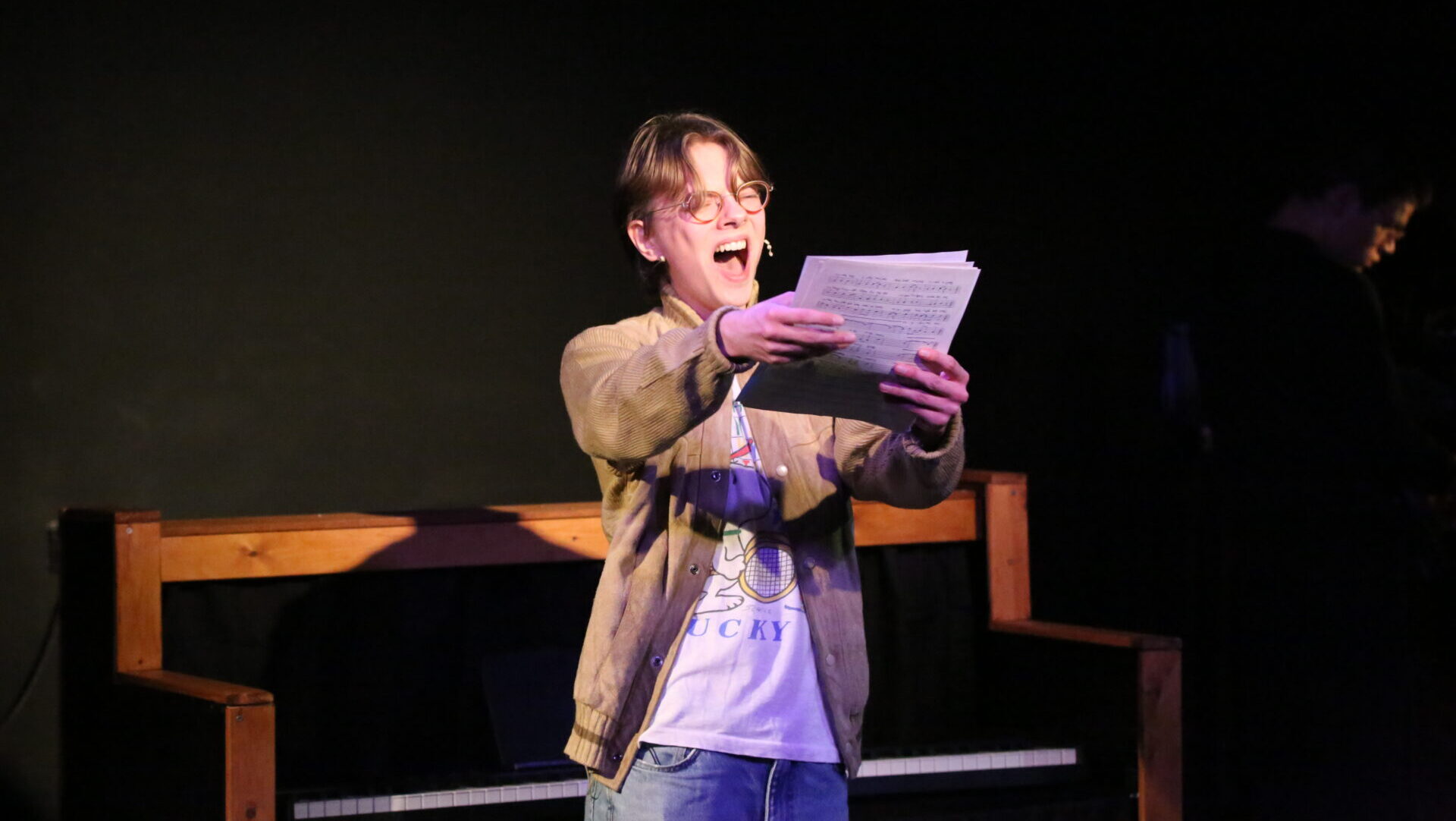
Piezoelectric Productions’ Tick, Tick…Boom! was an ambitious attempt at a classic which ran into slight difficulties with the intimacy of the Pilch performing space. The show deals with the struggling composer Jon (Laurentien Jungkamp) – semi-autobiographically based on writer Jonathan Larson – as he labours to write the next great American musical while dealing with the conflicting hopes of his girlfriend Susan (Katie Gill) and best friend Michael (Noah Rudder). This version, directed by Alexandra Russell, featured a stripped-back set themed with musical notes, and a great deal of attempted comedy via multi-rolling.
I suspect the fact that Tick,Tick…Boom! shares a lot of the same themes as the recent Playhouse show Company (also about a lost-in-life male lead, released 20 years prior) contributed to its inability to pack a punch. The opening scene in which Jon laments being almost 30 lacked the humour needed to reel the audience in, and didn’t feel like it added much to the script. The quick-fire introductions of characters Susan and Michael needed more energy to catapult the show forwards. This was a show that improved as it developed, rather than delivering instant impact.
This was partially due to the limitations of performing such a quintessentially American script to a tired British audience: a lot of the jokes towards the beginning, for example the ‘Sunday’ number which dramatises brunch at a restaurant, simply weren’t landing. There is famously nowhere to hide in the Pilch. Its small stage space, combined with having the audience sat around three sides, meant that each potentially funny moment that failed to deliver was unfortunately all the more noticeable. Some attempts were made to include audience members sitting on the sides (for example, during an argument, Jungkamp and Gill stand back to back rather than facing forwards), but in general, the show’s forward orientation meant those not sat at the back of the space lost out.
Having said this, the cast should be commended for their perseverance in this difficult space. Musicals are best suited for larger performance spaces where less convincing moments can be brushed over behind grand lighting and sound arrangements. The intimacy of the Pilch meant that each time a scene ended the audience felt like they were taking the same nervous intake of breath as the actors in preparation for the next scene, rather than being transported into the musical’s imaginary world. For such a light-hearted show, the unforgiving nature of the Pilch forced the actors to be subjected to a high level of audience scrutiny.
The most powerful performance came from Katie Gill as Susan. Her commitment to comedic moments was exemplary, eliciting laughs in the sexually charged ‘Green Green Dress’ number, as well as in her several smaller multi-rolling parts. Her vocals were strong, delivering a beautiful rendition of ‘Come to Your Senses’ when playing Karessa.
As the show progressed the actors settled into their stride. Occasional moments brought laughs from the audience, such as when Jon buys a ridiculous number of Twinkies. Ironically for a musical, I felt the actors’ talent shone through most when they weren’t singing. I believed in the care between Jon and Michael as they confided in each other while ‘driving’ in a car. Tension was effectively created in the moment when Michael tells Jon he is sick, although it suffered from a lack of contextualisation.
Jon and Susan’s conversations also felt more authentic as the show progressed. The chemistry in their relationship felt most real when emotions became sombre – especially at the point where Susan catches Jon kissing his colleague Karessa. The actors’ strengths lay more in naturalistic acting than they do in the over-the-top theatricality that Tick, Tick…Boom! demands.
The show relies on multi-rolling, and Piezoelectric Productions chose to denote each new character with a small costume change. Costume designer Ben Adams used simplistic identity markers to this effect: for example, a cloak representing the character of Jon’s agent was worn by both Rudder and Gill, amusing the audience when Rudder took on a feminine role. The choice to keep these costumes on a box onstage made these transitional moments slightly clunky.
The best part about this show for me was the underlying musical score. This can be credited to Caitlin Hawthorn, Meg Gu, and live musicians Ally Sheridan, Tom Murphy, and Tommy Watt. The live musicians’ presence onstage was a nice touch, and their talent undeniable. One choice I did question was to place a piano onstage for Jungkamp’s character which he barely played: at points this meant he was left standing near a piano with piano music playing in the background, which felt slightly misguided. Ella Wilson’s set design, adorning the stage with sheet music stuck on pillars and hanging from the ceiling, effectively conveyed Jon’s obsession with perfecting his compositions.
Overall, Piezoelectric Productions’ Tick Tick….Boom! retained the underlying warmth the musical is known for, but failed to execute its nuances.